Karen Barad (2007: 19-20), through a discussion of Michael Frayn’s play Copenhagen, analyses the disagreement between Werner Heisenberg and Niels Bohr concerning the former’s uncertainty principle. She summarises the difference between their views in the following way.
For Bohr, what is at stake is that particles do not have determinate values of position and momentum simultaneously. The issue for Bohr is not that we cannot know both the position and momentum simultaneously. Heisenberg’s point is that in measuring any of the characteristics of a particle, we necessarily disturb its pre-measurement values, so that the more we know about a particle’s position, the less we will know about its momentum, and vice versa.
Bohr is making a point about the nature of reality, not simply our knowledge of it. He is calling into question the belief that the world is made up of individual things with their independent sets of determinate properties. The lesson that Bohr derives from quantum physics is that the world is not constituted by things drifting aimlessly in the void that possess the complete set of properties that Newtonian physics assumes, such as, for example, position and momentum.
Rather, it is in the nature of measurement interactions that, given a particular measurement apparatus, certain properties become determinate, while others are excluded. Which properties become determinate is not governed by the desires or will of the experimenter, but by the specificity of the experimental apparatus. Different quantities become determinate using different apparatuses.
It is not possible to have a situation in which all quantities will have definite values at once, because some are always excluded in any one case. Two complementary sets of variables emerge from this. For any given experimental apparatus, those variables that are determinate are said to be complementary to those that are indeterminate, and vice versa. Complementary variables require different and mutually exclusive apparatuses. Heisenberg eventually accepted Bohr’s interpretation that it is complementarity that is at issue, not uncertainty.
“Some observations can never be made simultaneously. For example, one cannot see an electron as a particle and a wave at the same time. Two different experimental situations are necessary, and they cannot be realized simultaneously. The principle was first formulated by Niels Bohr. (Lefebvre, 1983, p. xxv) “
References
Barad, K. (2007). Meeting the universe half way: quantum physics and the entanglement of matter and meaning. Durham, NC: Duke University Press.
Originally posted on the Actors/Networks blog on 14 May 2010 by Allan Parsons
As Victor Margolin (2006: 107) comments, design is the conception and planning of the artificial. The scope and boundaries of design are intimately entwined with our understanding of the limits of the artificial. As design continues to make incursions into realms that were once considered as belonging to nature, so does its conceptual scope widen, leading to situations that Jacques Derrida (1994) characterises as artifactual and actuvirtual, that is, situations where previously accepted boundaries between the (f)actual and the artificial and between the actual and the virtual, seem to blur and cease to guide thought reliably.
It is in an interview entitled ‘The Deconstruction of Actuality’, that Jacques Derrida (1994: 28) introduces these two portmanteau terms: artifactuality and actuvirtuality.
By artifactuality, he means to point out that,
“actuality is indeed made: it is important to know what it is made of, but it is even more necessary to recognise that it is made. It is not given, but actively produced; it is sorted, invested and performatively interpreted by a range of hierarchising and selective procedures – factitious or artificial procedures which are always subservient to various powers and interests of which their ‘subjects’ and agents (producers and consumers of actuality, always interpreters, and in some cases ‘philosophers’ too), are never sufficiently aware. The ‘reality’ of ‘actuality’ – however individual, irreducible, stubborn, painful or tragic it may be – only reaches us through fictional devices. The only way to analyse it is through a work of resistance, of vigilant counter-interpretation, etc.”
Stiegler uses the notion of artifactuality in the context of his discussion of the transformation of libidinal energy through the processes of sublimation and de-sublimation. For Freud, Lemmens (2019) explains, drives differ from animal instincts in that they have no particular goal. Through sublimation, drives are bound and oriented toward social and cultural investments. In the process, they transformed into desires. Understood in this way, sublimation is a process of accumulating and orienting libidinal energy. Freud defined libidinal energy as the energy of the individual and collective psyche, expressed through affective and cognitive or noetic dispositions, such as love, passion, dedication, wonder, curiosity and the will to know. Marcuse later argued that de-sublimation causes desires to regress back into drives (Lemmens, 2019).
For Stiegler, in contrast to Freud, sublimation and de-sublimation are fundamentally modulated or mediated by technologies, that is, by a technical system or milieu of mnemotechnologies. For Stiegler, this ecology of spirit must thus be understood in terms of an ecology of desire or a ‘libidinal ecology’.
It is this intimate relation between desire or affectivity, on the one hand, and technology, on the other hand, that Stiegler describes as ‘the artifactuality of desire’ in The Lost Spirit of Capitalism: “desire is constituted through its artefactuality” (Stiegler, 2014: 46). From Stiegler’s perspective, the problem is not biopower or capitalism but lack of attention, leading to failure to remember and failure to learn, and lack of desire caused by desublimation (Lindberg, 2020) .
The relevance of this debate for design practice is that the Stieglerian notions of mnemotechnologies, media technologies and technical systems are being interpreted here as a web or an ecology of ‘designs’ of different kinds, intensities and complexities. Thus, to paraphrase Stiegler, the intimate relation between desire or affectivity, on the one hand, and designs, on the other hand, is what constitutes the artifactualisation of desire. From a Stieglerian perspective, the noetic is fundamentally enabled and conditioned by the technical: Stiegler thinks noesis essentially as technesis. Taking up this perspective, Peter Lemmens (2019) proposes to talk explicitly about the techno-noosphere. The argument presented here is that designs, woven together into a performing design ecology, ‘are’ the techno-noosphere; rather, they assist in the realisation of the techno-noosphere through their processes of artifactualisation.
Actuvirtuality
In addition to highlighting such artificial syntheses, including synthetic images, synthetic voices and all the prosthetic supplements which can be substituted for real actuality, Derrida (1994: 29) also points to a concept of virtuality, including virtual images and virtual spaces, but most importantly virtual outcomes or events. He notes that,
“Clearly it is no longer possible to contrast virtuality with actual reality, along the lines of the serene old philosophical distinction between power and act, dynamis and energeia, the potentiality of matter and the determining form of a telos, and hence of progress, etc. Virtuality now reaches right into the structure of the eventual event and imprints itself there; it affects both the time and the space of images, discourses, and ‘news’ or ‘information’ – in fact everything which connects us to actuality, to the unappeasable reality of its supposed present.”
(Derrida, 1994: 29)
In sum, designs are both artifactual and actuvirtual!
Derrida, J. (2002) Artifactualities, in Bajorek, J. (tran.) Echographies of television: filmed interviews [of Jacques Derrida and Bernard Stiegler]. Cambridge, UK: Polity Press, pp. 1–27.
Lemmens, P. (2019) Web 3.0 and The Web of Life. Attuning the Noosphere with (the Intelligences of) the Biosphere in the Context of the Anthropocene, Glimpse, 20, pp. 1–15. Available at: http://hdl.handle.net/2066/204691 (Accessed: 12 September 2021).
Lindberg, S. (2020) Politics of digital learning – thinking education with Bernard Stiegler, Educational Philosophy and Theory, 52(4), pp. 384–396. doi: 10.1080/00131857.2019.1586531.
Lucy, N. (2004) A Derrida Dictionary. Oxford, UK: Blackwell Publishing.
Margolin, V. (2002) The Politics of the artificial: essays on design and design studies. Chicago, IL: University of Chicago Press.
Simon, H. (1996) The Sciences of the artificial. 3rd edn. Cambridge, MA: MIT Press.
Stiegler, B. (2013) What makes life worth living: on pharmacology. Translated by D. Ross. Cambridge, UK: Polity.
Stiegler, B. (2014) The Lost spirit of capitalism. Disbelief and discredit Volume 3. Translated by D. Ross. Cambridge, UK: Polity Press.
“Friedrich Dürrenmatt’s [novel] The Pledge (1958) … is about the inability of an ‘expert system’ (the police) to solve the ‘problem’, that is, a mysterious crime. Dürrenmatt’s work is all about the demise of rationality and the triumph of chaos. Acknowledging this tragic fact, my book [What Design Can’t Do] proposes to get rid of the distinction between design (all about order), and bricolage, which has to do with dealing with the mess out there.” (Lorusso, 2023b)
“the designer is … a bricoleur – a person who makes do with what they find, in the conditions in which they find themselves.” (Lorusso, 2023a)
The issues at stake here concern the value of montage, collage, assemblage and bricolage: as methods of construction for design; and as methods of understanding how design acts in the world. What is also at stake is the status of design in the context of both the poietic aesthetics of the ‘work’ and the political praxis of the ‘act’:
in relation to the work of art;
in relation to the discussion of the differences between art as work and art as event;
the relation of design to modernism and avant-gardism; and
the relation of design to avant-gardism as anti-art.
Is there such a phenomenon as anti-design, analogous to anti-art? If so, what is its historical trajectory?
Bricolage
Christopher Johnson (2013: 44) argues that,
“If one were searching for an appropriate metadiscourse for the description of the processes of bio-neurological and technological evolution, it seems that the technical metaphor of bricolage would in fact provide a more effective means of conceptualising these processes than Stiegler’s more abstract notion of differentiation. As the molecular biologist Francois Jacob puts it, evolution as bricolage is the ‘constant re-use of the old in order to make the new’ (Levi-Strauss 2009: 50).”
The argument being developed here is that design practice is best understood through processes of bricolage. Designs seek to re-work or un-throw the already existing, as the found within the given, to articulate new projects, projections and trajectories. Designing begins from the ongoing projections of those trajectories into which we have been thrown and in which we remain entangled. The principles through which design operates in this schema are thrownness, entanglement, foundness and givenness, understood dynamically as trajectories with an ongoing momentum to which appropriate responses must be found. Over time, designs articulate spatio-temporal bricolages, whose eventful historicity is marked by momentary assemblages.
Montage and Collage
“The collage technique, that art of reassembling fragments of preexisting images in such a way as to form a new image, is the most important innovation in the art of this [the 20th] century. Found objects, chance creations, ready-mades (mass-produced items promoted into art objects) abolish the separation between art and life. The commonplace is miraculous if rightly seen, or recognized.”
(Simic, 1992: 18)
The following is a summary of the montage and collage section, pp.31-40, of David Graver’s book, The Aesthetics of disturbance, with some suggestions as to the relevance of these methods of construction for design practices.
Not all theorists agree on the subtle differences between montage and collage. However, Graver suggests that there is some agreement about their principles of construction.
In montage, disparate fragments of reality are held together and made part of the work of art by the work’s constructive principle. All elements are related rationally to the whole, despite the heterogeneity of their sources.
While Graver is discussing the ‘work of art’, it is argued here that what he says holds true for ‘works’ of design, whatever their material form, or indeed their degree of immateriality.
In collage, the fragments of reality are not fully integrated into the representational scheme of the work of art. Unsubjugated elements of their external life shine through and disrupt the internal organisation of the piece.
If this insight is extended to the work of design, the dynamic may be reversed: designs, while conventionally taken to be part of the quotidian world, can disrupt the flow of the everyday by incorporating some unsubjugated representational qualities borrowed from the work of art. In this way, a dialogue can be set up between the meaning-generating regimes of art-forms, as internal organisation evoking of aesthetic wholeness or closure, and everyday utility, as contextual responsiveness evoking open-endedness or unendingness. Such dialogue, as competing interpretive modalities, may be valuable for particular forms of design practices which seek to bring into relationship ‘higher’ purpose, for example, ethical social interaction, and ‘mundane’ operational purpose, for example, cooking a meal.
At a methodological level, this opens up the question of the relationship between perception and interpretation, of what one perceives as already interpreted and the co-existence of different modes of perception-interpretation. It also opens up the question of whether there exists a hierarchy of modes of perception, with the ‘visual’ at the top, allied to the insight that there can never just be visual perception on its own. It is always part of a recognised or unrecognised synaesthesia.
In montage, the principle of construction uses elements of the external world to undercut and to put question the principle of imitation (mimesis, representation). For design, again, this may be reversed. Elements of imitation (mimesis, representation) may be used to undercut and to put in question the commonplace understanding of the external world. By implication, this changes the status of any particular ‘design’. It is no longer simply grasped as part of the quotidian external world, in other words, fully understood through ‘use’.
In collage, the principle of imitation uses elements of the external world to undercut the principle of construction: the extreme of imitation is the presence of the object itself. The implications for the methodology of design practices is that designed ‘objects’, of whatever material or immaterial form, are at once: utilities, whose meaning is exhausted through its use; self-referentially mimetic, in as far as they stand for themselves as indexical or iconic signs, in Peirce’s terms; and symbolic, in as far as they are part of a cultural landscape or ecosystem of entities whose meanings are differential or relational. In this way, designs can be both central to the operation of the everyday and liminal to that mode of understanding the real by drawing upon different approaches to interpretation the world. Like collages, designs may emphasise the radical heterogeneity of their elements. The unprocessed or unsubjugated elements of the external world within a collage have been alienated from their original circumstances but have not settled within the frame of the artwork. From the perspective of design, the unprocessed or unsubjugated elements of the mimetic world within a design have been alienated from their original circumstances but have not settled within the frame of the design. In Derrida’s (1994) terms, designs are artifactual and actuvirtual.
While the artwork strips away the quotidian context of meaning and use from the heterogeneous objects, transforming them into aestheticised objets trouves [found objects], the foundness of the objects points persistently back to the world from which they came and endows them with a disruptive autonomy from the formational powers of the artwork. In reverse, the design redoubles, sets trembling or sets oscillating the quotidian context of meaning and use by incorporating aestheticised modes of mimesis, representation and reflection into that quotidian context itself. If there is a mode of transportation or transformation it is both towards and away from the quotidian.
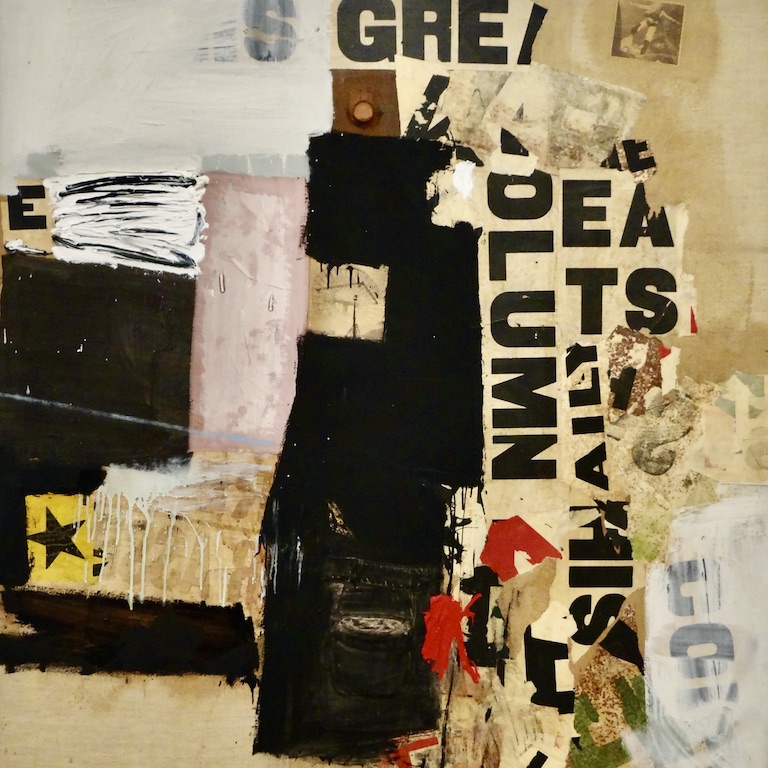
At an extreme, the process of collage seeks to subordinate direct reference to the world and the indirect references of artistic creation in order to highlight the unmediated presence of material objects, the singularity of the manifestation. Lindner and Schlichting define this form of collage as ‘material image’ (Materialbild) and take the work of Kurt Schwitters to exemplify it. The material it forms is no longer strictly aesthetic. External objects such as, for Schwitters, ticket stubs, buttons, spools and bits or wood or wire have been reduced to an unmediated materiality. The paint and gesso have also been transformed from their aesthetic materiality into a more immediately object-like existence. This ‘unmediated presence’, of course is paradoxical, as Lindner and Schlichting’s terms suggests: it mixes materiality with mimesis, ‘object’ with ‘representation’. The attempted subordination to singular presence is constantly in danger of unravelling into utilitarian object-hood, mimetic imagery or an oscillatory vibration between both, all of which are forms of ‘mediation’ or ‘relationality’.
Schwitters 1919, Aufruf
The creative process, the process of forming, while tied to the productive skills of the maker, has abandoned the historically mediated development of artistic expression to play at gluing together the detritus of daily existence. Thus, in collage, paint becomes another found object and the painter becomes a bricoleur. Both the surface of the artwork and the process of the creation are made more immediate and concrete than in the realm of conventional art or high modernist art.
In montage, the emphasis is on construction rather than on the concrete materiality of the objects. Collage construction allows the parts to shine forth in their heterogeneous individuality. Indeed, they are more themselves than they could be in daily life. In montage, the individual elements participate in a project that is greater than themselves. Nevertheless, this project differs from the expressive unity of conventional and high modernist art in that the heterogeneity of the elements is not suppressed. Rather, the disjunctions and inconsistent material juxtapositions of montage contribute to the unifying purpose of the work just as much as the homogeneous material in conventional art does.
The unity of montage is an artificial one. Montage flaunts the cohesive power of its constructive procedure through its intentional incompleteness. In its incompleteness, montage establishes irreverent connections in three dimensions:
Among the elements of which it consists;
With the sources from which these elements are drawn; and
In relation to the central purpose that holds the elements together.
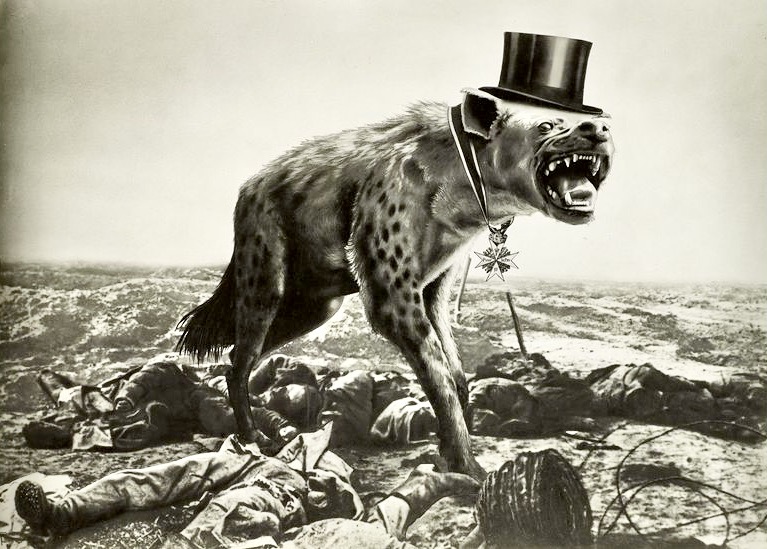
The common dynamics of montage can be seen in the very different uses made of their constructive principle by John Heartfield and Max Ernst. The central purpose of Heartfield’s work is political. Therefore the elements of each work always join in a pointed comment on a contemporary social issue. The example that Graver discusses is ‘War and Corpses – the last hope of the rich’. Both its disparate sources and the artificiality of its juxtapositions contribute to its political message.
Heartfield, War and Corpses
The resort to photo-montage for Heartfield is necessary because a single photo-graph could not simply document the relationship between the war dead and corporate profits, two distinct realms of material social reality. Such complex chains of interconnection require extensive explanations which the photo-montage succeeds in short-circuiting.
However, in Heartfield’s photo-montage, it is important that each element is a photo-graph because they affirm the reality of those distinct realms of material social existence, notably:
The forlorn battlefield corpses;
The self-satisfied grandeur of a ruling class bedecked with formal hats and jewel-encrusted medals; and
The existence of vicious animals that feed on the dead.
In transforming the hyena’s reality into allegory, Heartfelt entangles the reality of the battlefield and the reality of the capitalists while at the same time condemning that entanglement. Thus particular photo-montage documents visually the reality of the social situation by demonstrating it gruesome character. Through deixis, they rhetorically bring a complex, entangled field of social relationships to a singular moment of ‘presence’.
In this way, the formal entanglements of photo-montage stand as allegories of the entanglement of socio-cultural and socio-economic reality.
In the case of Max Ernst, unlike the collages of Schwitters or Pablo Picasso, the foreign elements within the image frame of Ernst’s picture books do not disrupt the integrity of the work with their persistent foreignness. Similarly to the work of Heartfield, the foreignness assists in creating the unique reality of the work. While Heartfield’s images appeal to the reality of a particular political discourse, Ernst’s images make more ambiguous references to various social, psychological and cultural forces.
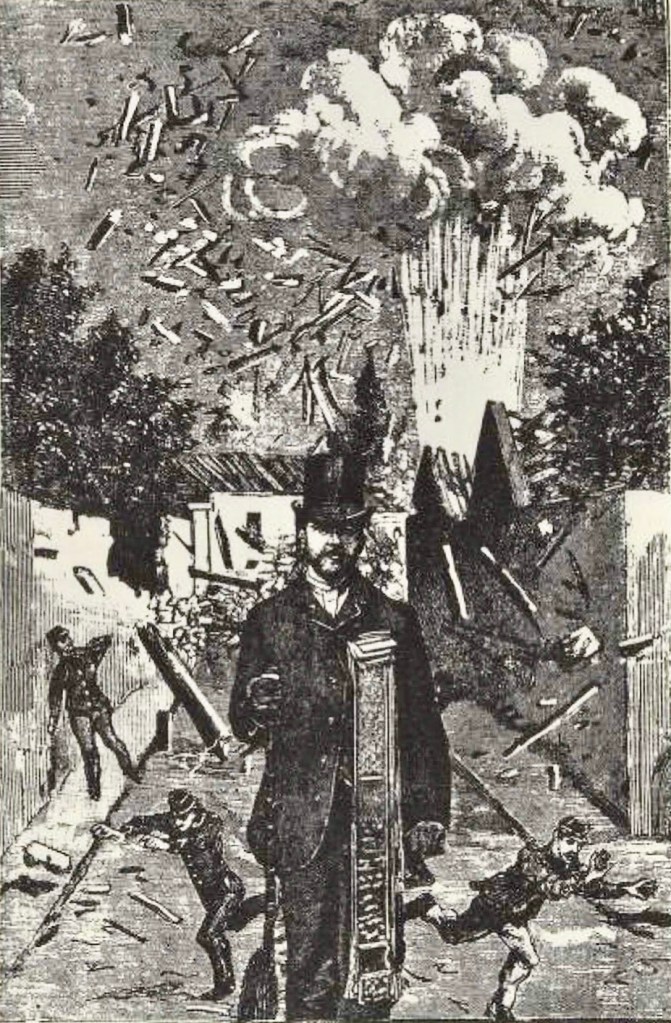
Ernst’s ‘Drum roll among the stones’, while made from 19th century engravings, is nevertheless similar in may respects to Heartfield’s ‘War and Corpses’. On a battlefield depicting an explosion and fleeing soldiers, Ernst has placed a sedate bourgeois gentleman in the lower centre of the scene, looking calmly at the viewer, unaffected by the explosion. The individual elements still make reference to their origins: the sensationalism and formality of 19th-century mass-produced art. Yet they seem to have joined together in a hallucinatory, spectral reunion of dead images.
Ernst, Drum-roll among the stones
Ernst’s construction of the logic of the scene suggest more contemporary references which exceed the simple montage of outdated engravings. It could be argued that Ernst has depicted, from a different perspective that is no less incisive, the same modern problem that concerns Heartfield. Rather than explain the causes of state terrorism, Ernst displays the tranquility of an assassin.
The differences between Heartfield’s and Ernst’s montages have less to do with the constructive method employed than with the extent to which the central purpose in which the assembled heterogeneities participate is predominantly figural or discursive. Heartfelt is intent on telling a particular story. His montages have messages. They are held together by a discursive line of reasoning. Ernst’s montages do not make heir intentions clear. The viewer can never be entirely confident of the validity of their reading in respect of a presumed authorial intent.
Ernst’s montages participate in the disturbing silence of the anti-art avant-garde, a ‘silence’ that one might equally describe as a cacophony of noise, an absence of meaning as a multiplicity or over-abundance of meanings, seemingly unanchored deictically or intentionality. In contrast, Heartfield’s messages exclaim loudly the explicit political ideals of the partisan avant-garde.
The partisan avant-garde
The partisan avant-garde stakes its right to exist on a particular reading of the world to which it adheres. The anti-art avant-garde stakes its right to exist on the sensuous discomforts and delights of ambiguous presences, the immediacy of the figure and multiple worlds to which the figure might call us or, in Althusser’s terms, interpellate us.
All art contains both figural and discursive elements. The visual impact of Heartfield’s “War and Corpses’, for example, cannot be reduced to its discursive condemnation of capitaism’s fondness for war and profiteering. The images of his photo-montages expand beyond their explicit discursive messages to assert a figural presence that arises from the immediate density of the visual field.
In Heartfield’s montage, the figural presence can be sensed in the compelling juxtaposition of:
The hyena’s voracious snarl;
The comic quality of the top hat and medal;
The poignant victimhood of the corpses;
The anger of the caption; and
The bold appearance of the image spread across two facing pages.
Although the figural element of the image spreads beyond the discursive element, it does not escape the discursive closure around a determinate statement or message. Word and image, or discourse and figure, in Heartfield’s case, are fused into a theatrical gesture, rather than simply a message. While the message takes precedence, the viewer understands it so clearly because of the figural density and the weight, or force, of the artistic gesture that hurls it at them.
The anti-art avant-garde
The anti-art avant-garde also fuses word (discourse) and image (figure) into a kind of gesture. However, because anti-art is more ambiguous or contradictory, or perhaps paradoxical and aporetic, in its deployment of discursive elements, the gesture is more disconcerting. The viewer does not know from whence it comes: who speaks? From whence? To whom? When? Where?
There is no clear message to which to respond: to agree, to disagree, to concur, to reject, to dismiss, to disavow, and so on. The viewer is confronted more noticeably with the discomforting presence of ‘mute’, or ‘white noise’, figural intensity. It becomes difficult to define the encounter in discursive terms, for example, when does it end? The encounter does not have a discrete beginning, middle or end, discursive closure or logical conclusion. The discursive elements are too fragmentary to cohere a formal discourse. Such anti-art photo-montages do not ‘speak’ discursively, yet neither are they ‘silent’. Rather, they are mute-ations of discourse (Graver, 1995: 38).
Collage and montage represent two extreme poles between which lies a continuous band of constructive possibilities.
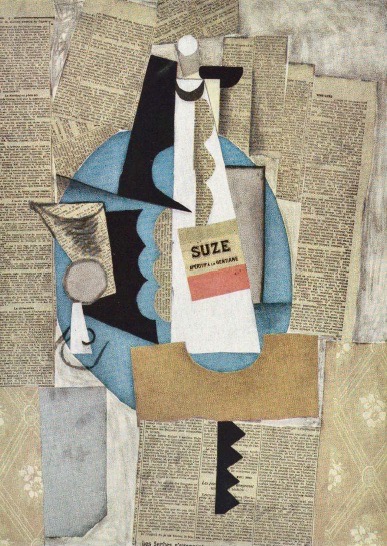
Schwitters’ work is a pure instance of collage. Picasso displays a collage sensibility in his emphasis on the material textures of objects and their references to their past lives. However, he sets the material immediacy of his collage elements off against the representational impulses of the picture plane. In Picasso’s ‘La Suze’ (1912), for example, the layering of paper strips, newsprint, wallpaper and a bottle label is similar to the celebration of quotidian detritus in Schwitters’ ‘Aufruf’ (1919).
Picasso, La Suze
However, in Picasso’s picture, the cut-out shapes figure forth a tabletop, bottle and glass, while the past life of the glued-down elements suggest the scene their shapes depict: the bottle-label, newspaper and wallpaper could be common objects from a Parisian cafe-bar. The collage elements of this work do not completely submit to the scene they depict, as in montage, but they do nevertheless flirt with the possibility of such a submission. Thus, Picasso’s collage constructions move provocatively towards the possibilities of montage.
Ernst’s montages are haunted by subdued suggestions of collage in that they celebrate the world of book engravings more persistently and disruptively than Heartfield’s montage elements draw attention to their origins.
If one takes as a requirement for ‘aesthetic’ work the notion of mastery over artistic themes and materials that are accepted as legitimate by conventional and high modernist art forms from 1919-1929, then the radical heterogeneity of collage during that period is inherently anti-aesthetic. Heartfield’s photo-montages, for example, violate the conventional social functions of art by placing art at the service of proletarian political causes. Montage, in contrast, can be either aesthetic or anti-aesthetic.
Dezeuze, A. (2008) Assemblage, bricolage, and the practice of everyday life, Art Journal, 67(1), pp. 31–37. Available at: http://www.jstor.org/stable/20068580 (Accessed: 24 April 2016).
Graver, D. (1995) The Aesthetics of disturbance: anti-art in avant-garde drama. Ann Arbor, MI: University of Michigan Press.
Johnson, C. (2013) The Prehistory of Technology: On the Contribution of Leroi-Gourhan. In Christina Howell and Gerald Moore (eds.) Stiegler and Technics. Edinburgh: Edinburgh University Press, pp. 34-52.
Kaprow, A. (1965) Assemblage, environments and happenings. New York, NY: Abrams.
Lorusso, S. (2023) What design can’t do: essays on design and disillusion. Eindhoven, NL: Set Margins.
An important reference point for the modern movement was the idea of the Gesamtkunstwerk, the ‘total work of art’. This concept, though it plays a key role in the theory and practice of modernist avant-gardes, is notoriously difficult to define. In broad outline, it suggests both the blurring of boundaries between art and life and the synthesis of different arts into a unified style or collective project.
The dream of the Gesamtkunstwerk … figured as a decisive switchboard of various modernist agendas and self-definitions. It illuminates how modernism, by negotiating the dialectics of art and technology, of the aesthetic and the political, of high art and modern mass culture, aspired to couple artistic experimentation to social reform and to reshape the present in the name of a different future. (Koepnick, 2016, p.274)
The idea of the Gesamtkunstwerk conveys an enthusiasm for cultural renewal that emerged along with Romanticism in the early nineteenth century (Roberts, 2011). The term was first used by the German writer and philosopher K. F. E. Trahndorff in in his work Aesthetics or Doctrine of Worldview and Art of 1827. However, the synthesis of the arts fusion has long appeared in history. The German opera composer Richard Wagner used the term in two 1849 essays “Art and Revolution” and “The Artwork of the Future” and the word has become particularly associated with his aesthetic ideals. (HiSoUR)
Synthesis of arts (German: Gesamtkunstwerk) is a work of art that makes use of all or many art forms or strives to do so. A Gesamtkunstwerk is a work that combines various arts such as music, poetry, dance / pantomime, architecture and painting. The compilation is not arbitrary and illustrative: the components complement each other necessarily. (HiSoUR)
Gesamtkunstwerk … also means “total work of art”, “ideal work of art”, “universal artwork”, “synthesis of the arts”, “comprehensive artwork”, “all-embracing art form” or “total artwork”, (HiSoUR)
It refers to a type of autonomous artwork that integrates simultaneously and related to different media or artistic disciplines, the Gesamtkunstwerk has a “tendency to eradicate the boundary between aesthetic structure and reality” (Odo Marquard). (HiSoUR)
It is not a reference to the divine creation, as was customary in art between Gothic and Baroque, but it claims its own validity. (HiSoUR)
References
Charnley, K. (2020) ‘Art, design and modernity: the Bauhaus and beyond’, Open Arts Journal, (9), pp. 43–56. doi: 10.5456/issn.2050-3679/2020w04.
The Bauhaus, a revolutionary art and design school, opened in 1919 under the architect Walter Gropius (1883–1969). He remained director until 1928. In all, there were three directors of the Bauhaus, all of them architects. After Gropius, Hannes Meyer (1889–1954) held the directorship between 1928 and 1930 and Ludwig Mies van der Rohe (1886–1969) led the school for its last three years. Gunter Metken (1994) notes that Hannes Meyer radically changed the course set by his predecessor, Gropius. Due to his social commitment and keen awareness of the contemporaneous crisis, Meyer established the Bauhaus as a centre for social, industrial and housing design, rather than an institution for the aesthetic education of an elite.
Its predecessors were the institute to the Grand Ducal Saxon Art Academy and the Grand Ducal School of Arts and Crafts. The latter closed at the outbreak of the First World War (Forgacs, 1995).
The Bauhaus moved twice during its relatively short existence. Founded in Weimar, it relocated to Dessau in 1926 and then to Berlin in 1932. These changes of location evidence a prolonged struggle with sceptical and conservative authorities. After the start of World War 2, artists and instructors at the Bauhaus fled to the United States and brought the Bauhaus ideas to the universities of America. The influences of the Bauhaus guided American art and design education for many years and, in some respects, they still do. American art education has been steeped in the Bauhaus practices. Educators today are re-evaluating these ideas to see if they are still valid as teaching methods in the twenty-first century.
Gropius intended the school to unify and renew the arts, based on a concept of Gesamtkustwerk, the total work of art or total design, which would serve a new architecture and enable new forms of social life. His focus was on a marriage between art and industry. This Gesamtkunstwerk ideal shaped the structure of the institution and the trajectory of its development.
The Bauhaus legacy is twofold: as a laboratory for the artistic avant-garde; and as the birthplace of modernist design. Indeed, the name ‘Bauhaus’ has practically become a synonym for modernism (Siebenbrodt, Wall and Weber, 2009). The modern movement promoted the idea that the arts, design and architecture might catalyse progressive social change.
Although this ambition was shaped by diverse intellectual and political influences, one important reference point wasthe idea of the Gesamtkunstwerk, the ‘total work of art’.
This concept, though it plays a key role in the theory and practice of modernist avant-gardes, is notoriously difficult to define. In outline, it suggests both the blurring of boundaries between art and life and the synthesis of different arts into a unified style or collective project.
The precise term was first used by Richard Wagner in the middle of the nineteenth century, though it conveys an enthusiasm for cultural renewal that emerged along with Romanticism in the early nineteenth century (Roberts, 2011).
As Lutz Koepnick (2016, p.274) puts it:
The dream of the Gesamtkunstwerk … figured as a decisive switchboard of various modernist agendas and self-definitions. It illuminates how modernism, by negotiating the dialectics of art and technology, of the aesthetic and the political, of high art and modern mass culture, aspired to couple artistic experimentation to social reform and to reshape the present in the name of a different future.
The aspiration toward total design has been criticised for its elitism, its complicity with consumerism and … its megalomania and proximity to totalitarian ideology (Tafuri, 1976; Baudrillard, 1981; Foster, 2002; Roberts, 2011; Tonkinwise, 2014).
The Gesamtkunstwerk meant not only creating a new unity of the arts, but also breaking up the prevailing beliefs about art, and it was abstraction that made this possible.
References
Aicher, O. (2015) Analogous and digital. Berlin, DE: Ernst and Sohn.
Charnley, K. (2020) ‘Art, design and modernity: the Bauhaus and beyond’, Open Arts Journal, (9), pp. 43–56. doi: 10.5456/issn.2050-3679/2020w04.
Forgacs, E. (1995) The Bauhaus idea and Bauhaus politics. Translated by J. Bakti. Budapest: Central European University Press.
Metken, G. (1994) ‘We draw no strength from the people’: artists, solitude, community, in Keith Hartley et al. eds. The Romantic spirit in German art 1790-1990. London: South Bank Centre; Edinburgh: National Galleries of Scotland; and Munich: Octagon Verlag, pp.106-114.
Siebenbrodt, M., Wall, J. and Weber, K. (2009) Bauhaus: a conceptual model. Ostfildern, DE: Hatje Cantz.
The proper goal of sculpture and of all the visual arts, it might have been held at one time in the past, is the depiction of physical beauty. However, this universalistic horizon, as well as the horizon of critics and philosophers of the Enlightenment, are rendered problematic by the opacity of language and imagery, which have ceased to be understood as perfect, transparent media through which reality may be represented to the understanding. Thus, Mitchell (1984), comments,
“For modern criticism, language and imagery have become enigmas, problems to be explained, prison houses which lock the understanding away from the world.”
The term visual media, a colloquial expression used to designate technological apparatuses such as television, cinema, photography, painting, and so on, is highly inexact and misleading, W.J.T. Mitchell (2005) argues. All so-called visual media, it transpires on closer inspection, involve the other senses, especially touch and hearing. All media are mixed media from the standpoint of sensory modality. Rather, what the assumption that some media are exclusively visual marks is the predominance of the visual in our contemporary culture.
RELATED TERMS: Avant-garde movements; Modernism; Design practice and functionalism
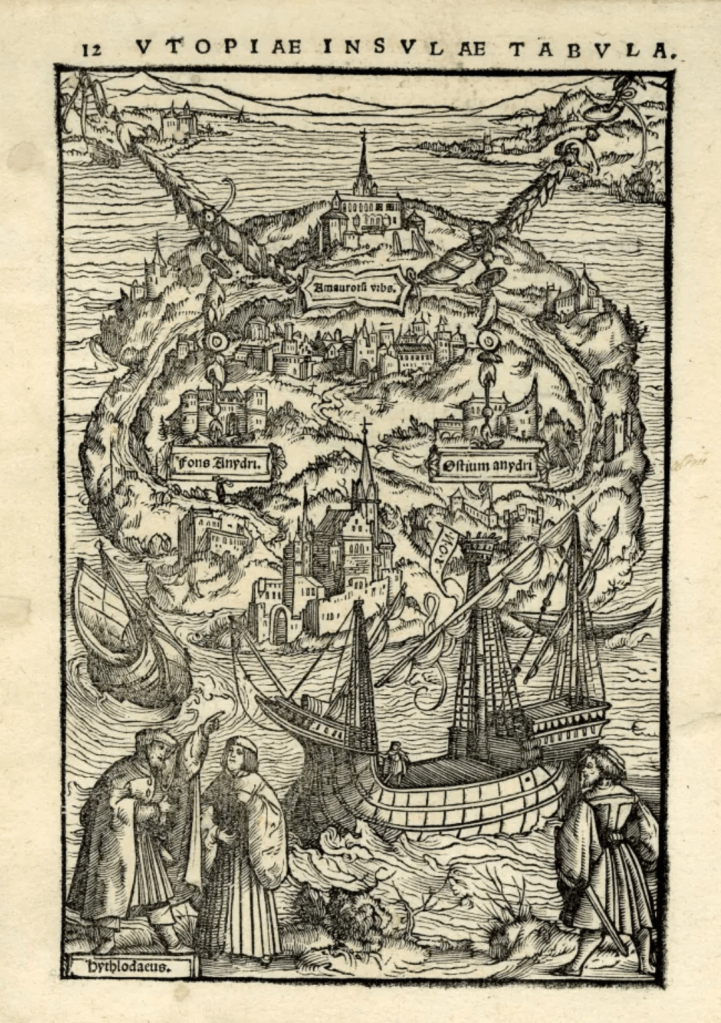
Woodcut map of Thomas More’s Utopia by Ambrosius Holbein
Sir Thomas More published his Utopia in 1516 . The word ‘utopia’ combines two Greek roots, ou- meaning ‘no’ and topos meaning ‘place’, hence literally utopia is a no-place, a non-existent place or nowhere. However, embedded within the word utopia is a pun. The near-identical Greek word eu-topos means a ‘good place’.
In creating such a concatenation, More was highlighting the question of whether and, if so, how a good place (eutopia), currently non-existent or nowhere to be found (outopia or utopia), can be created (brought into existence) and established (sustained).
Utopian thinking is an important element of modernism and of avant-garde practices. It is therefore of great important for design practices when considering what any specific design is seeking to accomplish as an intervention and how it is seeking to do so.
Closely related to urban planning, urban design is an aspect of urban or suburban planning that focuses on creating a desirable environment in which to live, work and play. Design analysis includes the relationship between buildings, streets, land use, open space, circulation, height, natural features and human activity. A well designed urban or suburban environment demonstrates the four generally accepted principles of urban design:
clearly identifiable function for the area;
easily understood order;
distinctive identity; and
visual appeal.
An interesting resource from the point of view of design practices is the exhibition, Grand Reductions: Ten diagrams that changed urban planning, a review of which can be found in Emily Badger (2012). The diagrams are Ebenezer Howard’s Garden City, Le Corbusier’s Radiant City, Frank Lloyd Wright’s Broadacre City, The Street Grid, The Mega-region, The Transect, The Setback Principle, The Nolli Map, Psychogeography and The Hockey Stick.
The relationship between urban design and narrative is explored by Mark Childs (2008).
Childs, M. C. (2008) Storytelling and urban design, Journal of Urbanism: International Research on Placemaking and Urban Sustainability, 1(2), pp. 173–186. doi: 10.1080/17549170802221526.
“We constantly re-write our own biographies and continually give matters new meanings. To rewrite history in this sense – indeed, in an Orwellian sense – is not at all inhuman. On the contrary, it is very human.”
Milan Kundera, cited in McEwan, I. (1984) An Interview with Milan Kundera. Granta, 11, 34-35.
Some narrators are seen as ‘unreliable’, that is, as someone (or something) whose rendering of the story the reader has reasons to suspect. We ordinarily accept what a narrator tells us as authoritative. The fallible or unreliable narrator is one whose perception, interpretation and evaluation of the matters he or she narrates do not coincide with the opinions and norms implied by the author, which the author expects the alert reader to share (Abrams, 1999, 235).
With the growth of social media and an increasing awareness of the deliberate misinformation campaigns that have been conducted during the mass media era through the advent of the newspaper, radio, cinema and television, for example by the tobacco industry around health issues and the fossil fuel industries around climate issues, the notion of the unreliable narrator can be seen to have a different sense in addition to that which prevailed in postmodernist literature. These media- and internet-based issues are often discussed under the headings of ‘fake news’ and ‘post-truth’ politics. Design practices, therefore, needs to be aware of both the more literary and the more political instances of unreliability in narration.
Seymour Chatman notes that imaginative participation in the point of view of fictional characters, for example, by donning the perceptual and conceptual clothing of objectionable fictional characters or unreliable narrators such as the Raskolnikovs or Verlocs or Jason Compsons or one of Celine’s ‘hero’ narrators, does not imply moral endorsement. It is simply the way we make sense, or rather the way implied authors enable us to become implied readers who make sense, out of unusual or even downright alien viewpoints. We do not compromise our right thinking by engaging in that kind of participation, nor do we condone the character’s outlook.
In the context of psychoanalysis, the analyst attends to signs that indicate that the analysand may be an unreliable narrator, for example, by highlighting the persecutory actions of others and minimizing the analysand’s seduction of the persecutor to persecute, slanting the story in order to block out significant periods in his/her life history or to elicit pity or admiration or glossing over, by silence and euphemism, what the analysand fears will cast him/her in an unfavorable light, or sometimes in too favourable a light. In short, the analyst takes the telling as performance as well as content. The analyst has only tellings and showings to interpret, that is, to retell along psychoanalytc lines (Schafer, 1980)
The device of the unreliable narrator, in other words, may be used to heighten the implied reader’s awareness of the ‘reality’ of the situation in question, to engage them in considering how the tale is told as well as with the ‘content’ of the tale. One ‘reads’ and ‘interprets’ as an analyst, rather than takes as given, that is, re-tells the ‘truth’ or the ‘reality’ of what is at stake.
A number of modernist and postmodern writers deliberately construct stories which are not coherent, where an unreliable narrator, an unclear division between reality and imagination or a breakdown of reality and perception leaves us with an inconsistent story. Examples include Coover’s “The Babysitter”, Cortazar’s “Hopscotch” or Borges’ “Garden of Forking Paths”. Such work interrogates our everyday notions of time, reality and order, in much the same way as Cubism did in painting and Dada in theatre (Bernstein, 2009, 7).
Schafer points out that the question of the unreliable narrator bears on the question of the validity of interpretation: to speak of the unreliable narrator, one must have some conception of a reliable narrator, that is, of the validity of the account. Yet there is no single definitive account to be achieved. Validity can only be achieved within a system that is viewed as such and that appears, after careful consideration, to have the virtues of coherence, consistency, comprehensiveness and common sense.
References
Abrams, M. H. (1999) A Glossary of Literary Terms. 7th edn. Boston, MA: Heinle & Heinle.
Bernstein, M. (2009) On hypertext narrative, Proceedings of the 20th ACM conference on Hypertext and hypermedia – HT ’09. New York, NY: ACM Press, p. 5-14. doi: 10.1145/1557914.1557920
Booth, W. C. (1983) The Rhetoric of fiction. 2nd edn. Chicago, IL: University of Chicago Press.
Chatman, S. (2016) What novels can do that films can’t (and vice versa ), Critical Inquiry, 7(1), pp. 121–140.
Nunning, A. F. (2005) Reconceptualizing unreliable narration: synthesizing cognitive and rhetorical approaches, in Phelan, J. and Rabinowitz, P. J. (eds) A Companion to narrative theory. Oxford, UK: Blackwell Publishing, pp. 89–107.
Schafer, R. (1980) Narration in the psychoanalytic dialogue, Critical Inquiry, 99(5), pp. 383–389.
” … stories and their worlds are crucially shaped by the affordances and limitations of the media in which they are realized.” (Ryan and Thon, 2014: 2)
Design practices are often nowadays considered to be a transmedia practice, taking advantage of the affordances offered by different media, from architectural, to artefactual, pictorial and written, so that the visitor-participant has to work to piece the content together from each platform, but this does not mean that it may not on occasion also utilise cross-platform distribution or multimedia capabilities.
Henry Jenkins (2016) contends that it is important to distinguish among the terms transmedia, cross-platform and multimedia.
Transmedia, as an adjective, refers to some kind of structured relationship between different media platforms and practices.
Transmedia approaches are:
multimodal – they deploy the affordances of more than one medium;
intertextual – each platform offers unique content that contributes to our experience of the whole;
dispersed – the viewer constructs an understanding of the core ideas through encounters across multiple platforms; and
layered – each extension adds something we did not know before, deepening our our intellectual and emotional connection to the material.
Cross-Platform refers to the channel of delivery or means of distribution, such as cinema release, online streaming or sale of DVDs. The different channels are not related additively but are simply alternatives for each another. The reader-spectator need not visit all of these hubs; one will suffice. They will not learn anything new, content-wise, by viewing them all.
Multimedia refers to the case where a single app or website might include video, audio, text, and simulations. The example of a multimedia project cited by Jenkins is Snow Fall in the New York Times.
A transmedia project, on the other hand, would distribute these experiences across platforms so that the audience has actively to work to assemble the pieces, often through networked interpretation.
References
Jenkins, H (2006) Convergence Culture. New York: New York University Press.

 Incomplete ...