Design History and Racialisation [Footnote]

RELATED TERMS: Design History; Modernity; Modernity and Coloniality;

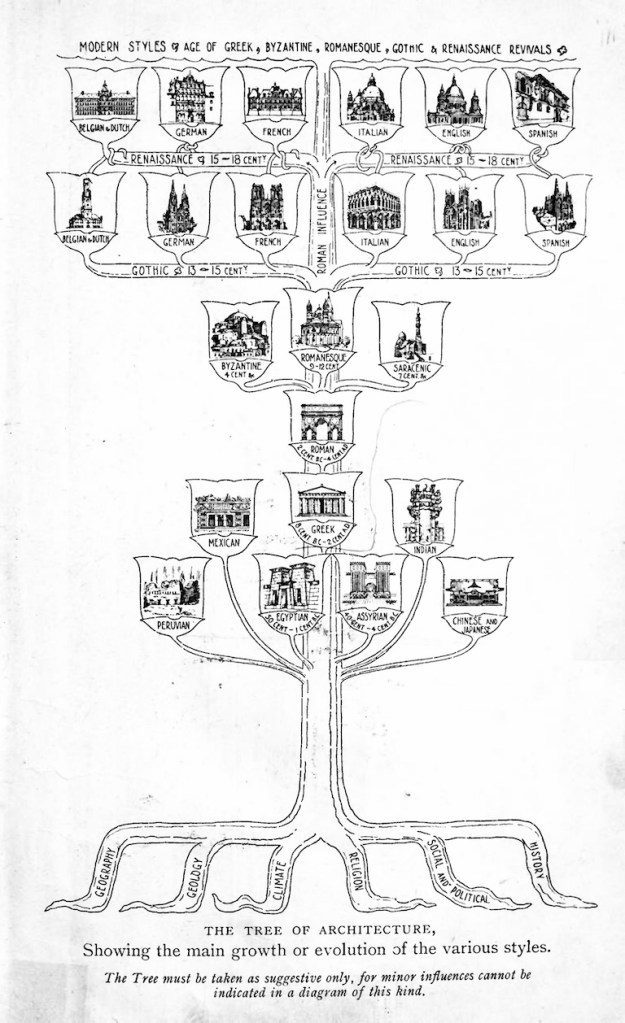
Banister Fletcher’s Tree of Architecture

As noted in the Design History post, Lauren Williams (2019) posits an integral relationship among neoliberalism, design and racism in arguing that, “Racism and design have always supported capitalism, but as neoliberalization drives innovations on both, post-raciality and Design Thinking emerge, respectively, as new formations.” How can we approach this nexus of concepts and beliefs around race in relation to design history, where race, racialism, racism and racialisation are somewhat invisible or, as Cheng conjectures in relation to architectural history, have been sublimated, because it is assumed we are living in a post-racial age? 

In order to engage this dimension of design history, we may have to shift to an acknowledgement of the influences of art history and architectural history on the understanding of design history. The ‘prehistory’, so to speak, of design history may be found in the existing Western histories of art, architecture and technology. Design history emerges in their shadow. In this way, we can acknowledge, similarly to recent scholarship in architectural history, that traditional narratives of design modernism, which emphasise industrialisation, urbanisation, technologisation, capitalism and avant-garde aesthetics, should also stress the historical contexts of imperialism, colonialism, slavery and international migration. 

Nevertheless, we may still have to engage with divergent opinions on how historical racial thinking relates to modern thought. As Alleyne (2006: 491) points out, while some argue that racism is deeply and inextricably interwoven within Enlightenment thought itself, for example, Paul Gilroy (1993) and David Theo Goldberg (1993), others see racism as a degenerate by-product of post-Enlightenment thinking, for example, Kenan Malik (1996) and Robert Miles (1993) and that Enlightenment universalistic ideals, the ideas of inclusive democratic citizenship without regard to ‘race’, class or gender, are still in the process of being struggled over.

Continue reading “Design History and Racialisation [Footnote]”

The Surface of Design – Ranciere [Footnotes] 


RELATED TERMS: Deutscher Werkbund; Distribution of the Sensible – Ranciere; Worldlessness #2: Worldlessness and Design

In the context of design practice, design theory and design history, the essay, ‘The Surface of Design’, by Jacques Ranciere is highly relevant. What interests Ranciere when he speaks of design is the way in which one sense of the word, that is, drawing lines, displaying words graphically or assembling surfaces, opens to another sense of design: the division and articulation of communal space.  

Ranciere is interested, that is to say, in the ways in which, by assembling words or forms, people define not merely various forms of art and design, such as drawings, poems and buildings, but also certain configurations of what can be seen, the visually perceptible, and what can be thought, the conceivable, two modes of the ‘sensible’, articulating forms of inhabiting the material world. This emphasis on the division and articulation of communal space, resonates, as previously noted in Distribution of the Sensible – Ranciere, with the design of narrative environments.

These configurations of the visible and the conceivable, as designs, are at once symbolic and material. They cross the boundaries among arts, genres and epochs and cut across the categories of autonomous histories of technique, art or politics. Ranciere broaches the question of how the practices of design and the idea of design, as they develop at the beginning of the 20th century, redefine the place of artistic activities in the set of practices that configure the shared material world. The examples he cites are the practices of:

creators of commodities, 

those who arrange them in shop windows or put their images in catalogues; 

constructors of buildings or posters, who construct ‘street furniture’, but also 

politicians who propose new forms of community around certain exemplary institutions, practices or facilities, for example, electricity or soviets. 

Continue reading “The Surface of Design – Ranciere [Footnotes] “

Worldlessness #3: Saving the world / at the end of / the world / is not enough

RELATED TERMS: World; World-Building; Worldlessness #1; Worldlessness #2: Worldlessness and Design

A Revisit at 2 Bis Rue Perrel (2022) by Cai Zebin.

METAPHYSICS No need to know what it is. Laugh at it: this creates an impression of great intelligence. (Flaubert, The Dictionary of Received Ideas)

“Folks cried and laughed and hugged each other and called out loud for the end of the world. No one poured cold water on this by asking, What does that mean — the end of the world? How can you say that? Where’s that going to leave us? Or, How will we make sense of the end of the world when we go back to speak with our “allies”?” (Wilderson, 2020: 205-206)

The ‘sub-human’ or ‘non-human’ are totally destructible. … They have to be wiped out almost before they exist as the non-human in our metaphysical imaginations. They are of course wiped out by their being what they are — which, of course, is what they are not.” (Cooper, 1968: 7-8)

In the Worldlessness #2 post, it was noted that Roland Vegso, in his book Worldlessness After Heidegger, could be interpreted as posing a challenge for designers, artists, activists and academics. This challenge is:

to imagine worldlessness without an apocalypse; 

in non-eschatological terms, (without an ‘end of the world’);

in non-salvational terms (without ‘saving the world’, without redemption or liberation);

And without a sense of loss (because you cannot lose what you have never had and cannot have). 

[We might add a further challenge here: to imagine worldlessness in non-utopian terms.]

Picking up initially on the threads of this secular eschatology and salvation[1], many media and academic discourses circle around the need to acknowledge the impending ‘end of the world’ or, more actively, to ‘end the world’ or to ‘end this world’; or, alternatively, the need to ‘save the world’. 

Continue reading “Worldlessness #3: Saving the world / at the end of / the world / is not enough”

Theory [Snippets 11]

RELATED TERMS: Posthuman; Postmodernism; Poststructuralism; Structuralism; Theoretical Practice

Two designed products, the drinks can and the apartment block, intersect, reflected and represented in a third designed entity, a ‘socio-natural’ medium, the canalised water body, form an impossible assemblage that ‘is’ only ‘there’ for the camera and is now gone. The phenomenon, the momentary event, no longer exists, except ‘here’. Is it only the can that exists materially in this scenario, above the surface-medium in the digital-photographic medium? Overcoding suggests the signifying of consumerism, consumption and waste, waste being a variant of Mary Douglas’ dirt: ‘matter out of place’. The consumer, signified as an presence through absence and indexicality, inhabits another ‘world’.

What is the state and status of theory in the 2020s? For example, could it be argued that one can speak of a cycle, a story cycle, a twisted tale from which there is no escape, one that traces the turns and returns within an intergenerational inheritance that cannot be declined, the gift given to us, that speaks of, “untimely specters that one must not chase away but sort out, critique, keep close by, and allow to come back” (Derrida, 1994: 87).

Thus, do we inherit (American) cybernetics (of the 1940s-1960s) through (French) structuralism (of the 1950s-1960s), itself becoming (French) post-structuralism (of the 1960s-1970s), critically articulated to the work of the postwar Freudo-Marxist philosophes engagés, that returns as (American) postmodernism (of the 1980s-1990s), that proliferates into … ‘globalised-localised’, ‘internationalised’, ‘deterritorialised’ theory[-activism] or activism[-theory], in an ontological, practice and performative turn, but not a pragmatic turn. Theoretical moments become social movements, theoretical-activist-movements that articulate distinctive axio-epistemo-ontologies – modes of existence in which ‘we’ are constituted and partake, but not necessarily together or in a spirit of togetherness. To paraphrase Hayles (1999), while some of us became posthuman, others became nonhuman.

Continue reading “Theory [Snippets 11]”

Worldlessness #2: Worldlessness and Design 

RELATED TERMS: World; World-as-Milieu; World-Building; Worldlessness #1; Worldlessness #3: Saving the world / at the end of / the world / is not enough

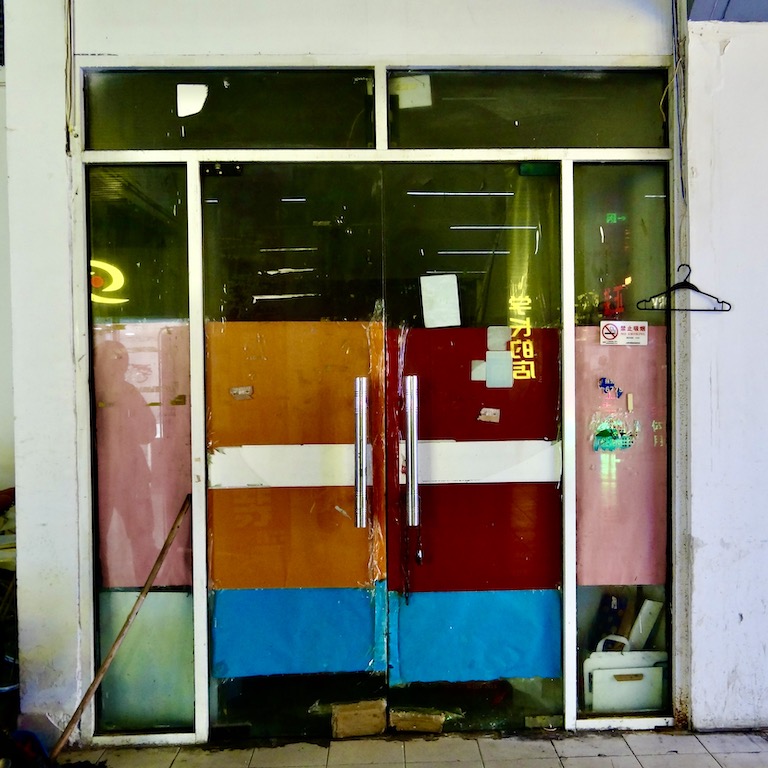
Abandoned shop, Songjiang

How are we to understand whether contemporary and past design practices are vitally important or utterly trivial, or a mixture of both. In other words, are they matters of concern: do they matter and, if so, how do they matter, to whom and in what ways?

From this perspective, it is notable that contemporary design practices, although considered to be flawed, are often described as world-building or world-making[1]. For example, Arturo Escobar (2021: 25) comments that, “Design, in short, is being acknowledged as a decisive world-making practice, even if often found wanting in this regard.” This orientation can be found even in the more critical or speculative forms of designing, such as that of Tony Dunne and Fiona Raby. For example, in Speculative Everything, they argues that, 

“Although design usually references sculpture and painting for material, formal and graphic inspiration, and more recently the social sciences for protocols on working with and studying people — if we are interested in shifting design’s focus from designing for how the world is now to designing for how things could be — we will need to turn to speculative culture and what Lubomír Doležel has called an ‘experimental laboratory of the world-constructing enterprise’.” (Dunne and Raby, 2013: 69)

Dunne and Raby describe a design experiment in which they began with new ways of organising everyday life through alternative beliefs, values, priorities and ideologies, proceeding thereafter to develop scenarios and personas to bring it to life. In doing so, they sought to “tell worlds rather than stories”, as they put it, citing Bruce Sterling (Sterling and Bosch, 2012)[2]. The question they pose for this approach is whether the viewer, when presented with design proposals for objects, would imagine the world to which the designs belong, thereby moving from the specific to the general. They contend that,

“This is very different from other world-making activities such as cinema and game design in which the world itself is shown, and even architecture, which usually presents an overview from which the viewer has to imagine the specific.” (Dunne and Raby, 2013: 173) 

Continue reading “Worldlessness #2: Worldlessness and Design “

Worldlessness #1

RELATED TERMS: World; World-as-Milieu; World-Building; Worldlessness #2: Worldlessness and Design; Worldlessness #3: Saving the world / at the end of / the world / is not enough
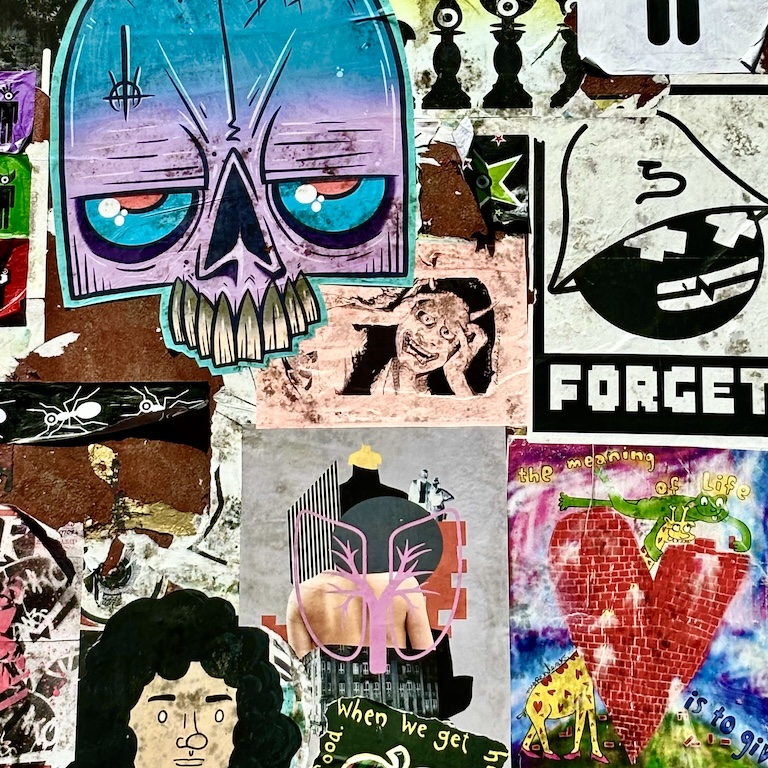
“Ridiculous sums of money are spent producing bronze sculptures. Honoring heroes and artists on Stockholm’s street corners. Akay’s concrete sculptures give tribute to the [anonymous, AP] invisible citizens, they offer a reminder of more affordable solutions to a problem. People approach the sculptures with caution, so life like. Is it real? It’s not real. Some gather around to kick a man when he’s down. This is real.– Kid Pele. January, 2006″ cited in the book, The Art of Rebellion 2 by C100

A Possible Phenomenology of the Anonymous, the Invisible, the Im-material and the Im-mediate

It was noted in The Paradox of the Anonymous that Dan Hancox (2025) projectively and retrojectively ascribes to Walter Benjamin a wish or a command for us, “to sift through the rubble, bring up the dead, to reassemble history from below.” 

The question that this potential (re-)writing of history from below raises is that of methodology: what are the methods of remembering, recovering or, indeed, ‘creating’ the evidence from which such a history can be assembled or re-assembled? It is a question of figuring, configuring and re-configuring. What the notions of the anonymous, those without name, and the invisible, those without image or (phenomenal) appearance, brings to attention, it might be argued, is the (nominalist) logocentrism and the (anthropic) ocularcentrism of world-making and therefore of world-history making. World history consists of (named, located, traceable) events in which the actions of named (individuals and peoples) become visible phenomena (appearances) and the consequences of those actions tracked temporally through a narrative of these worldly events.

Continue reading “Worldlessness #1”

Econarratology

RELATED TERMS: Narratology

What does this image ‘say’?; and how does it ‘say’ it: What does this image ‘show’?

“as Arendt puts it, ‘real stories, in distinction from those we invent, have no author.’ ” (Batuman, 2008)

The question underlying this post is the issue of what an adequate narratology would be for the practice of the design of narrative environments, an approach to designing that emphasises the (necessary) inter-relationships among people, narratives and environments.

In this context, the potential value of econarratology can be seen in three respects.

Firstly, it is an example of postclassical, contextualist narratology, which relates the formal, material and media elements of a narrative discourse to environmental, cultural and social systems to generate situated, meaning-creating interactions and interpretations; in short, people, narrative and environment are all brought into play in econarratology. 

Secondly, it takes account of the cognitive dimensions of the narrative-environment interaction. This allows for the possibility of bringing into play the 4E cognition paradigm that the design of narrative environments acknowledges, in which cognition, learning, intelligence and interaction are seen to be embodied, extended, embedded and enactive. 

Continue reading “Econarratology”

Burnout Society

RELATED TERMS: Disciplinary Societies and Societies of Control

The question underlying this post is whether design practices are carried along by the shift proposed by Byung-Chul Han (2015), the impetus coming from elsewhere, or are they highly active proponents and drivers of the change, providing the materials for depressive evaluations of oneself, compulsive inattentiveness or hyper-attention as a scattered mode of awareness, and creative and productive burnout. Aside from this, there remains the question of how well this depicts societal processes in the period since the 1990s and whether the occurrence of Covid 19 might alter the characterisation of societal organisation so that it accommodates, perhaps in contradictory ways, the articulation of immunological and hyperpositive responses to disease and unease, a movement reinforced by the confused interaction of globalisation (hybridisation) and nationalist protectionism (immunological defence) evident in the mid-2020s.

From Immunological Organisation and Defence to the Violence of Positive Sameness

Byung-Chul Han (2015), the Korean-German philosopher, argues that the 20th century was an immunological age, an epoch in which distinctions between inside and outside, friend and foe and self and other were of paramount importance. However, in his view, a little-acknowledged paradigm shift has been underway for some time, beginning around the time of the ending of the Cold War in 1989-1991. In this emerging paradigm, contemporary society increasingly escapes the immunological scheme of organisation and defence and instead is marked by the lessening in importance of the categories of otherness and foreignness.

Continue reading “Burnout Society”

Technology, Process Knowledge, Temporality and Design

RELATED TERMS: Hypomnesis, Hypermnesis and Anamnesis; Methodology and Method; Practice

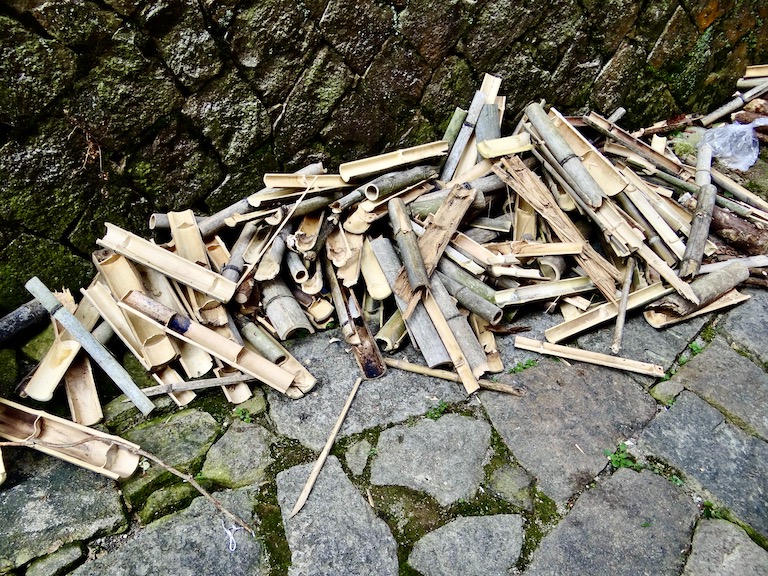
The process of piling, in expectation of … re-using? … discarding? … re-processing? …

Dan Wang (2025: 71) distinguishes among three meanings of technology. The first is technologies as tools, for example, the pots, pans, knives, ovens and so on required to prepare a meal. Second, technologies can operate as explicit means of instruction, for example, the recipes, blueprints or patents that can be written down, followed and passed on. Third, and for Wang the most important, is technologies as process knowledge, that is, the proficiency gained from practical experience. This last is often discussed in terms of know-how, institutional memory and tacit knowledge, as Wang (2025: 74) notes.

To explore the value of his position, Wang brings to attention the specificity of Chinese process knowledges in the context of the history of architecture. He notes that builders across the world, from the Ancient Egyptians to medieval Europeans and more recently, have sought to arrest the erosion that affects buildings through time by using durable materials, such as stone, which endow the building with a degree of longevity and endurance, if not permanence. However, as discussed by Simon Leys in his 2009 book The Hall of Uselessness, In China builders have embraced the passage of time by using exceedingly perishable, often fragile, materials. By building temples out of wood, with panelling sometimes made of paper, Chinese architecture had a built-in obsolescence. This means that the buildings, if they are to be preserved, demand frequent renewal. Rather than employing the strongest, most durable materials, making the building last, Chinese builders instead embraced transient materials as a means towards the prolongation of designs whose goals are spiritual, by making the process of (re-)building the persistent element.

Continue reading “Technology, Process Knowledge, Temporality and Design”

Governance, Politics and Design

RELATED TERMS: Politics and the Political

That forms of governance are ‘designed’ is often acknowledged only in passing. For example, the trend towards authoritarianism in the politics of the USA is recognised by some to have accelerated under Trump rather than to have begun with him. To argue that US authoritarianism began with Trump, Abdelrahman ElGendy (cited in Roth, 2025) comments, is to assume that the USA was a healthy, functioning democracy that faltered, which ElGendy thinks is not the case. He continues,

“When a democracy is designed with this capacity for authoritarianism you’re never more than one election away from its reappearance. That’s not an accident, that’s a design flaw.” (ElGendy, cited in Roth, 2025)

Continue reading “Governance, Politics and Design”