RELATED TERMS: Design History; Modernity; Modernity and Coloniality;
As noted in the Design History post, Lauren Williams (2019) posits an integral relationship among neoliberalism, design and racism in arguing that, “Racism and design have always supported capitalism, but as neoliberalization drives innovations on both, post-raciality and Design Thinking emerge, respectively, as new formations.” How can we approach this nexus of concepts and beliefs around race in relation to design history, where race, racialism, racism and racialisation are somewhat invisible or, as Cheng conjectures in relation to architectural history, have been sublimated, because it is assumed we are living in a post-racial age?
In order to engage this dimension of design history, we may have to shift to an acknowledgement of the influences of art history and architectural history on the understanding of design history. The ‘prehistory’, so to speak, of design history may be found in the existing Western histories of art, architecture and technology. Design history emerges in their shadow. In this way, we can acknowledge, similarly to recent scholarship in architectural history, that traditional narratives of design modernism, which emphasise industrialisation, urbanisation, technologisation, capitalism and avant-garde aesthetics, should also stress the historical contexts of imperialism, colonialism, slavery and international migration.
Nevertheless, we may still have to engage with divergent opinions on how historical racial thinking relates to modern thought. As Alleyne (2006: 491) points out, while some argue that racism is deeply and inextricably interwoven within Enlightenment thought itself, for example, Paul Gilroy (1993) and David Theo Goldberg (1993), others see racism as a degenerate by-product of post-Enlightenment thinking, for example, Kenan Malik (1996) and Robert Miles (1993) and that Enlightenment universalistic ideals, the ideas of inclusive democratic citizenship without regard to ‘race’, class or gender, are still in the process of being struggled over.
Before embarking on further reflections on design history as design theory through considering a part of its prehistory in architectural history, it may be worth making a brief digression, firstly, through the terms race, racism, racialism and racialisation and, secondly, the notion of neoliberalism and its suspected demise.
Race
Brian Alleyne (2006), for example, explains that ‘race’ denotes the belief that humans can be grouped according to visible characteristics such as, for example, skin colour, hair type, personality, cultural traits or all of these. Following upon this perceptual practice, ‘racialism’ is a view that human beings are fundamentally grouped into races; while ‘racism’, starting from the same notion that human beings are grouped into races, adds further that these races are of differential intrinsic worth.
Racial thinking peaked in Western thought in the nineteenth century, when scientific racism, founded in the belief that ‘race’ is rooted in biological difference and that racial characteristics were therefore inherited, sought to infer essential, inner characteristics from external, phenotypical differences. The death knell for scientific racism was sounded by the defeat of Nazism in the 1940s and by subsequent developments in genetics. Nevertheless, ‘race’ is still often discussed as if it were a fixed biological category akin to species (Alleyne, 2006)
The move away from biologically based notions of difference between human populations to one grounded in a concept of culture was pioneered by Franz Boas (1948). For Boas, what mattered in differentiating human groups was not what they looked like, not some notion of ‘race’ understood through phenotype, but ‘culture’: a determining symbolic, belief, communication and reasoning system which shaped the individual. In recent times, ‘racialisation’ is seen as one of a number of processes of affiliating and othering whereby social groups enact and distinguish themselves from one another.
(Post-)Neoliberalism
Davies and Gane (2021) argue that research in the period since the 2008 financial crisis, while tracing the roots of neoliberalism back beyond the origins of Thatcherism or the crisis of Keynesianism to its intellectual kernel in the 1920s and 1930s, also considers whether neoliberalism has survived intact or mutated into something that is more authoritarian, illiberal or anti-democratic. As neoliberalism is being corroded and displaced by logics and rationalities that share some of its formal qualities, for example, suspicion of the state, emphasis on decentralisation and re-forming of individual subjectivity, this is leading to the declining autonomy of ‘the market’ and of ‘competition’ as organising principles of social and global organisation through popular and intellectual discrediting of neoliberal policy elites, instruments and institutions combined with attempts to repurpose them towards ends beyond the market.
In one characterisation of this post-neo-liberalism, Albena Azmanova, for example, argues that neoliberal capitalism, having survived the economic recession of the second decade of the 21st century, has since transformed into an even more noxious form that she calls ‘precarity capitalism’. Design practices, in seeking to address this widespread societal precarity, are themselves trapped within this noxious system, as Bianca Elzenbaumer (2021: 317) explains:
“We know that the desire to use design as a tool for critical inquiry – to undo the roots behind issues such as rampant racism and earth systems breakdown – is shared by many, but precarious conditions of work and life – which for designers manifest in ways such as overwork and underpayment, hyper-flexibility and lack of predictability, inability to access sick pay, paid vacations, or parental leave – make such a critical and transformative use of design materially difficult. When confronted with the pressure and anxieties produced by precarity, doing work that challenges the status quo often seems utopian as a basis on which to secure one’s immediate livelihood. We also agree, however, that to be a realist in our times of social and ecological breakdown fuelled by neoliberal politics that try to commodify everything, one needs to be utopian and to work with full force towards just and sustainable futures.”
Race and Architectural History and Architectural Theory
From the perspective of architecture history, as one of the precursor of design history, Cheng (2020) discusses aspects of the inheritance from the processes of ‘modernisation’ as follows. Like Alleyne, she emphasises the 19th century as the key period in which views of race, raciality, racialisation and racism flourished. Numerous reasons have been cited for the rise of virulent race thinking during this period, chief among which were slavery and imperialism. Cheng argues that concepts regarding different population groups’ distinct mental and cultural aptitudes and pasts helped construct concepts of historicity and architectural progress that were crucial for the very idea of what it means to be ‘modern’ and consequentially for architectural modernism.
For epistemic legitimacy and to derive a rational, historically-conscious theory of design, architects began to draw on race science, one of several emerging ‘human sciences’. In consequence, most 19th-century European architects and theorists consciously or unconsciously shared several racial beliefs. They included the notions that:
humanity could be divided into distinct biological groups marked by inherited physical and intellectual traits;
different races and cultures produced characteristic forms of building, identifiable as ‘styles’;
processes of racial evolution, diffusion, and hybridisation could help explain transformations in architectural style and, correspondingly, that architecture could be read as evidence of racial history.
the variety of architectural forms, and the peoples that produced them, could be hierarchically arrayed along a time scale of progress from the primitive to the modern.
The dominant 18th-century explanations for differences among groups of people pointed to climate and environment, while leaving room for the possibility of adaptation and progress. However, these older ideas of cultural and population groups being distributed across geo-environmental space gave way to chronological schema: different races were arrayed along a hierarchical and developmental timescale. The classificatory table acknowledging diversity was replaced by the historical timeline instilling a progressive hierarchy.
These figures of racial theory were borrowed by architectural thought. By the mid-19th century, architects were debating whether to continue to imitate the immutable model of divine nature, articulated in the classical position, or, following the model of the biological and geological sciences, seek to uncover the objective laws of historical change which were held to govern how societies and their cultural products evolve over time. An ironic consequence of these debates was that it was often the more ‘progressive’ advocates of architectural change, in support of their challenge to entrenched academic classicists, who turned to anthropology and race science to bolster their ideas about modernity, historicity and cultural production. Racial themes evolved over time, moving from a nationalist emphasis on finding an appropriate architecture for a particular place to finding what was considered to be the best expression for the present, increasingly understood as the modern period.
Cheng argues that one way to witness how architectural history became more explicitly racialised over the course of the 19th century is to compare Antoine-Chrysostome Quatremère de Quincy’s typology to that proposed by Edward Freeman in A History of Architecture (1849). While repeating the schema of the Chinese tent, Egyptian cave, and Greek hut as original architectural types, Freeman added a fourth: the Gothic cathedral. Quatremère de Quincy had cited geography and habit as the conditioning forces for these primitive typologies. Freeman, however, posited a deeper force: race. Freeman understood race in idealist sense as “a kind of national genius, traceable to an ancient bloodline” (Cheng, 2021: 138).
In Cheng’s account, the most systematic racial typology of architecture in the 19th century can be found in the writing of Eugène-Emmanuel Viollet-le-Duc. He was deeply influenced by contemporary race theorists but especially by Joseph-Arthur, comte de Gobineau, author of Essai sur l’inégalité des races humaines (1853–1855). Viollet-le-Duc’s reiterated the racial stereotypes of the day, asserting that Blacks were an “abject race,” the Semites were simple, contemplative, and calculating; and the “Arya” were “of great stature and brave, as cited by Cheng. Following Quatremère de Quincy’s scheme, Viollet-le-Duc associated each racial group with a distinct dwelling type, material and constructional method. In this way, Cheng argues, the idea that a white race, Viollet-le-Duc’s ‘Gallo-Romans’ or ‘Aryans’ or the ‘Anglo-Saxons’ in England and the USA, had a special proclivity for independence, rationality, practicality and innovation, reflected in its architectural materials and forms, became a crucial element in modernism’s ability to incorporate racialised ideas, while shedding the more explicit expression of racist discourse, in the early 20th century.
During the 19th century, the idea became prevalent that history was shaped by racial conflicts, migrations and admixtures, influencing art and architectural historians. Variations of an Aryan myth permeated European and American architectural histories, contributing to architects’ self-understanding of their own special roles and capacity for creating a new modern architecture. Many of these racialised architectural histories depicted white Aryans as agents of historical change, their architecture uniquely capable of progress and development. Other groups, depicted as weaker, were implicitly or explicitly portrayed as prone to stagnation or conquest.
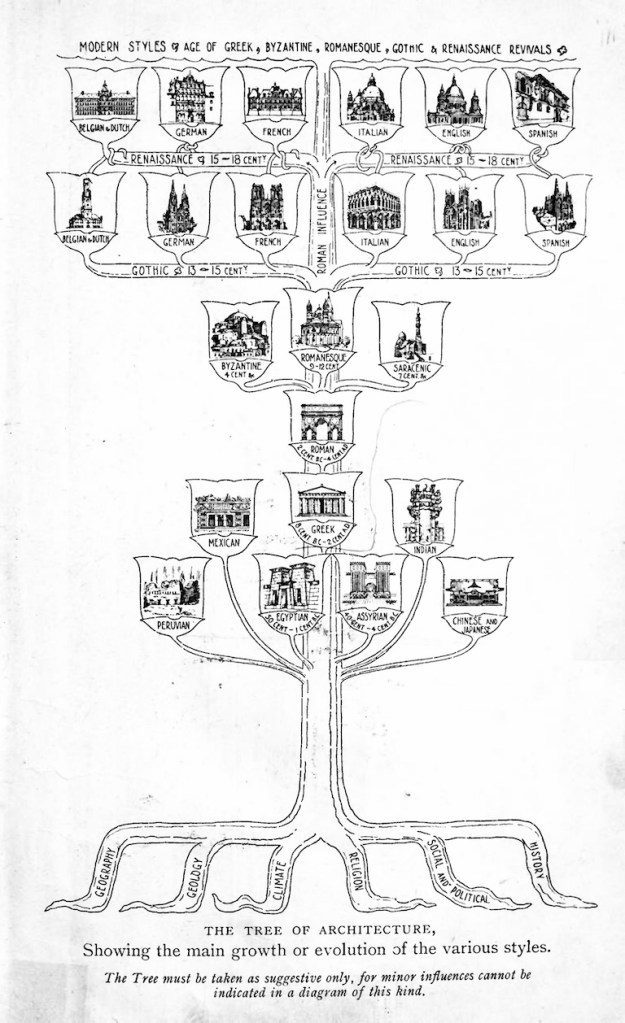
Cheng cites as a prime example of the developmental timeline manifested in architecture the exhibit of human habitation at the 1889 Paris Exposition in whose accompanying book, L’Habitation Humaine (1892), Garnier and Ammann placed Chinese, Japanese, Eskimo, Aztec, Incan, African, and Australian dwellings in a section entitled “Peoples Isolated from the General Movement of Humanity.” This kind of racial timeline of architecture was given iconic form in Banister Fletcher’s Tree of Architecture diagram. [See figure]
Racial theories of architecture did not disappear in the 20th century. Rather, they underwent a process of sublation. As described by David Theo Goldberg (2002), a shift occurred between two kinds of racialism in the mid-to-late 19th century, passing from an older ideology of racial naturalism, which positioned non-Europeans as inherently inferior, to a racial historicism that deemed these same groups as immature and less developed. It is such racial historicism that underpinned movements like abolition and assimilationist colonial regimes. More recently, however, it is used to underpin the ideal of colour-blind ‘racelessness’ as the political teleology of the processes of modernisation.
Nationalism gave way to a cosmopolitanism among elite European cultural practitioners. In parallel, question of what style a particular nation should adopt increasingly gave way to the problem of ‘what is modern architecture?’ The notion of a temporal progression from primitive to modern was retained. However, the attendant concept of inherent racial fixity was sublimated, with race first becoming a subtext of modernism and then a spectre haunting architectural discourse and practice.
Cheng highlights that the process of the sublation of race can be witnessed in the writing of Adolf Loos. By simply understanding Loos as prophet of un-ornamented modernism, the way in which his definition of the modern is deeply steeped in the racial logics of the previous century is lost. Loos equated the universalisation of Germanic culture with the modern society of the future, even though he did not consider that Germanic culture was the sole preserve of Germanic people.
In the 1920s, motivated in different ways by an anti-nationalist ethos following World War I, socialist internationalism and a belief in technology and global trade’s connective, levelling capacities, most avant-garde architects began to speak a language of internationalism, proclaiming their desire to supersede national differences and to construct a common, universal modernism.
These internationalist impulses within European avant-garde architecture were formalised and co-opted by Henry-Russell Hitchcock and Philip Johnson in their International Style show at the Museum of Modern Art in 1932. In the process, Cheng (2020: 152) argues, “they not only divested modernism of its political charge, an oft-cited criticism, but also stripped away the vestiges of racial-national particularity in favor of a putatively universal aesthetic suited to the present and future.”
Modernism was to be raceless and the new internationalist architectural style, which they claimed existed exists throughout the world, was to be unified and inclusive. The pretence of universalism, however, was belied by the fact that, of 62 projects in the published catalogue, only one was by a non-European or non-American architect, Mamoru Yamada of Japan. Thus, a style whose characteristic features were initially asserted to be lack of ornamentation and utilitarianism associated with the superiority of a particular race was now fifty years later linked with the transcendence of national and racial divisions.
Yet, like the ideology of colour blindness that it reflected, modernism continues to be haunted by the spectre of its racialist genealogy, a genealogy that has yet to be fully exhumed.
By retracing the steps by means of which racial thought is sublimated in architectural history, it becomes possible to recognise that design, as a quintessentially modern phenomenon, was shaped as much by ‘internal’ and ‘national’ historical forces as by the kinds of transnational encounters enabled by empire and globalisation. As is the case for architecture, so for design practices more generally, that racialism, the idea that humankind can be divided into indelible and unequally endowed biological groupings, in the entanglements of modernity, history, empire and design has not been sufficiently recognised (Cheng, 2020: 134). In short, the history of design is contextualised by an international political economy in which national material cultures are shaped and in which changes seemingly internal to design practices in the forms of ’styles’ become comprehensible as part of a history of ‘modernisation’ that incorporates a history of racialisation.
Those design histories which begin with the replacement of craft production with the design and manufacture of artefacts and progress through the emergence of product design, the development of graphic and communication design, through service design to the emergence of social design of various degrees of participation, to the situation where everyone is, in a loose sense, a designer, overlain by the digitisation of social practices and design practices of all kinds, can themselves be framed by the longer-term histories of architecture and art, infused by historical anthropological, archaeological and other human sciences’ assumptions concerning ‘race’.
Racial thought, then, may be seen to be inherent in design history and theory, sublimated as in architectural history, even while it is not explicitly expressed there. It is by way of inheritance through assumptions about universality, about ‘styles’ and by way of historical framing that the ‘spectral presence’ of ‘racialisation’ may be seen to emerge in thinking about the ‘human’ dimension of design and designing.
References
Alleyne, B. (2006) Race and racism, in Harrington, A., Marshall, B. L., and Muller, H.-P. (eds) Encyclopedia of social theory. Abingdon, UK: Routledge, pp. 490–492.
Azmanova, A. (2020) Capitalism on edge: how fighting precarity can achieve radical change without crisis or utopia. New York, NY: Columbia University Press.
Boas, F. (1948) Race, language and culture. New York, NY: Free Press.
Cheng, I. (2020) Structural racialism in modern architectural theory, in Cheng, I., Davis, C. L., and Wilson, M. O. (eds) Race and modern architecture: A Critical history from the Enlightenment to the present. Pittsburgh, PA: University of Pittsburgh Press, pp. 134–152.
Davies, W. and Gane, N. (2021) Post-neoliberalism? An Introduction, Theory, Culture and Society, 38(6), pp. 3–28. doi: 10.1177/02632764211036722.
Elzenbaumer, B. (2021) Designers beyond precarity: Proposals for everyday action, in Mareis, C. and Paim, N. (eds) Design struggles: Intersecting histories, pedagogies, and perspectives. Amsterdam, NL: Veliz, pp. 317–330.
Gilroy, P. (1993) The Black Atlantic: modernity and double consciousness. London, UK: Verso.
Goldberg, D. T. (1993) Racist culture: Philosophy and the politics of meaning. Oxford, UK: Blackwell.
Goldberg, D. T. (2002) The Racial state. Oxford, UK: Blackwell Publishers.
Malik, K. (1996) The Meaning of race: Race, history and culture in Western society. Houndmills, Basingstoke, UK: Macmillan Press.
Miles, R. (1993) Racism after race relations. London, UK: Routledge.
Williams, L. (2019) The Co-constitutive nature of neoliberalism, design, and racism, Design and Culture, 11(3), pp. 301–321. doi: 10.1080/17547075.2019.1656901.


One thought on “Design History and Racialisation [Footnote]”