RELATED TERMS: Actantial Model – Greimas; Actantiality; Actor; Actor-network theory; Agency; Avatar; Human actantiality; Performance and Performativity

Why actant?
In order to develop a consistent approach in which the narrative, the environmental and the people dimensions of narrative environments are all understood to act, it is necessary to adopt a theory of action that is post-humanist in the sense that it does not put human agency first and foremost, but contextualises it within a field of more complex systemic, networked or rhizomic performance and performativity, while also acknowledging the possibility that such fields of action can generate new contexts.
One such theory is that which has developed around the term ‘actant’, as ‘material-semiotic’ entity or an operational or performative collective. As Lynnette Khong (2003: 698) explains,
“Instead of thinking of the world as made up of human subjects reflecting and acting upon passive objects, we should consider it as being made up entirely of actants. Latour portrays actants as teleological beings that come into existence only through their engagement with other actants (Sturdy, 1991, p. 164). In Pandora’s Hope, for example, Latour describes how, within the realm of scientific practice, actants interact with one another in order to become recognised entities, and to achieve a relatively stable position in a whole network of interactions.”
An actant is capable of exerting influence in a narrative setting (epistemologically, culturally, self-consciously), of effecting change in an environmental setting (ontological, ecological), and of altering perceptions, thoughts and emotions in a human intercorporeal and intersubjective, social setting (experience, consciousness, affiliation, empathy). In a narrative environment setting, an actant moves across these analytically-distinct fields, bringing them into relationship and effecting transformations across them, creating new ‘realities’.
In the words of Donna Haraway (1992),
“Non-humans are not necessarily “actors” in the human sense, but they are part of the functional collective that makes up an actant. Action is not so much an ontological as a semiotic problem. This is perhaps as true for humans as non-humans, a way of looking at things that may provide exits from the methodological individualism inherent in concentrating constantly on who the agents and actors are in the sense of liberal theories of agency.”
In the design of narrative environments, actantiality is an ontological, semiotic, epistemological and experiential issue at one and the same time.
A history of the term
The structuralist semiotician A.J. Greimas was the first to invoke the term actant in connection with narrative. However, he did not invent the word. In developing his actantial typology Greimas drew on the syntactic theories of Lucien Tesnière who, in Elements de syntaxe structurale (1959), translated as Elements of Structural Semantics (2015), likened a sentence to a little drama. Greimas drew on the syntactic theories of Tesnière in order to re-characterise Propp’s ‘spheres of action’ as actants (Herman, 2000).
For Tesnière, a sentence is like a drama. As a drama, it implies a process and, most often, actors and circumstances. The verb expresses the process. Actants are beings or things that participate in the process or that come into being through the process. Circumstants express the circumstances of the action (Melcuk, 2004). Tesnière acknowledged just three actantial grammatical functions: first actants (subjects), second actants (first objects), and third actants (second objects). Tesnière classified circumstants in the standard way, that is, according to the semantic content that they contribute to the clauses in which they appear, such as, temporal, locative, causal, final circumstances and those of manner, and so on.
When transposed from the plane of dramatic reality to that of structural syntax, the action, actors and circumstances become, respectively, the verb, the actants and the circumstants. The verb expresses the action. The actants are beings or things that participate in the action, in whatever capacity and whatever style this might entail, even if it is as mere walk-ons and in the most passive way imaginable. Actants are always nouns or the equivalents of nouns. Inversely, in a given phrase nouns always assume, at least in principle, the function of actants.
Tesnière’s actant vs. circumstant distinction is, for the most part, synonymous with the more modern terminology of argument versus adjunct . Actants (arguments) are necessary to complete the meaning of a given full verb, whereas circumstants (adjuncts) represent additional optional information, that is, information that is not essential to completing the meaning of the verb (Kahane, S. and Osborne, 2015).
Actant and narrative
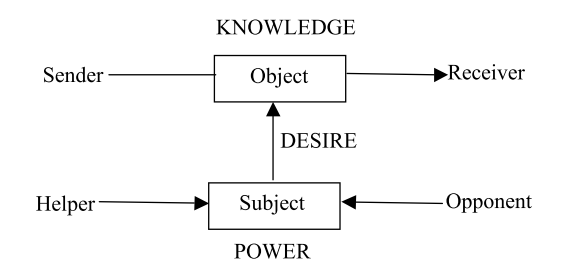
As Timothy Lenoir (1994) explains, Greimas set out to produce a generative grammar of narrative in which a finite number of functional themes in binary oppositions juxtaposed with possible roles, such as subject-object, sender-receiver, helper-opponent, would generate the structures we call stories.
Greimas distinguishes between actants, which belong to narrative syntax, and actors, which are recognisable in the particular discourse in which they are manifested (Greimas 1987: 106). In simple terms, actors are the things in a narrative that have names, such as the King, Tom, Excalibur, while actants are the narrative units-functions they manifest. One actant can be manifested by several actors; and the converse is equally possible, just one actor being able to constitute a syncretism of several actants.
Beetz (2013) provides two examples of the use of these Greimasian actants:
“In a classical folklore tale, for example, the king (Sender) calls on his bravest knight (Subject) with his magical sword (Helper) to bring freedom (Object) to his daughter (Receiver), who is held captive by the evil sorcerer (Opponent); every actant is manifested by one actor. But in the comic series Batman, Subject and Sender are the same person in the narrative. Bruce Wayne (Sender), who gives himself the mission to bring justice to Gotham City (Object) is Batman (Subject), who fights The Joker, Poison Ivy and others (all Opponent) to secure the lives of the citizens of Gotham City (Receiver).”
These examples show that actants can be manifested by several actors and that one actor can manifest several actants. They also show that actants do not have to be manifested by human characters, as is the case in the freedom of the daughter, justice for Gotham City. Objects and abstract concepts can be actants just as much as humans, as long as they can be identified as ‘that which accomplishes or undergoes an act’. Furthermore, in a dynamic interpretation of Greimas’s semiotic square, one actor, over the course of a narrative unfolding, can pass through all modalities of actantiality (sender receiver, subject, object, helper, opponent)
Greimas’s actants, like Bruno Latour’s in his actor-network theory, therefore, are not solely human actors. Actants can also be non-human for Greimas as well as Latour. Actants are syntactically defined, and, for Greimas as for Latour, the performance of the actor presupposes competence. Subjects are defined not only as subjects but also by the position occupied in a narrative journey, a journey characterised by the acquisition of competences. Actors are constructed as the conjunction of actantial and thematic roles on this two-by-two grid (Lenoir, 1994).
An actant is a class of ‘characters’, in the broadest sense of this term, which have the same function in their different manifestations in a narrative. Actants appear as certain forces, powers or capabilities in a given text, situation or field. They are by no means equivalent to ‘actors, i.e. the concrete characters of a story or the dramatis personae of a play. (Rulewicz, 1997)
The reasons for requiring the concept of actant are as follows, as explained by Rulewicz:
Firstly, an actant may be abstraction, such as God, Freedom or Equality; a collective character, such as the chorus in ancient tragedy, a group of characters fulfilling the same tasks, like soldiers in an army; or an actant may be represented by different characters that all act in a definite way. It should be added that an actant may be an animal, organism, inanimate object or, indeed, an environment, so long as one understands the term ‘environment’ actively, as an ongoing process of contextualisation and environing.
Secondly, one character may simultaneously or successively assume different actantial functions.
Thirdly, an actant may or may not appear as a presence in the narrative, nor does it have to appear in the utterances of the characters. An actant may be the general abstract notion which is presented on the ideological level of the narrative.
Actant, actor-network theory [actant-rhizome ontologies] and new materialism
In the context of actor-network theory, Akrich and Latour (1992: 259) define the term actant as:
“Whatever acts or shifts actions, action itself being defined by a list of performances through trials; from these performances are deduced a set of competences with which the actant is endowed; the fusion point of a metal is a trial through which the strength of an alloy is defined; the bankruptcy of a company is a trial through which the faithfulness of an ally may be defined; an actor is an actant endowed with a character (usually anthropomorphic).”
Haraway (1992: 313) poses the question of actant and actantiality as one of ontology rather than representation:
“I have stressed actants as collective entities doing things in a structured and structuring field of action; I have framed the issue in terms of articulation rather than representation.”
Haraway (1992: 332) suggests that perhaps her approach comes down to,
“re-inventing an old option within a non-Eurocentric Western tradition indebted to Egyptian Hermeticism that insists on the active quality of the world and on “animate” matter.”
Latour emphasises the way that humans, as actants, both act and are acted upon by other entities (Khong, 2003: 698). While borrowing from Latour, Jane Bennett (2010: 21), similarly to Haraway, evokes the vitality or vibrancy of matter,
“While the smallest or simplest body or bit may indeed express a vital impetus, conatus* or clinamen**, an actant never really acts alone. Its efficacy or agency always depends on the collaboration, cooperation, or interactive interference of many bodies and forces. A lot happens to the concept of agency once nonhuman things are figured less as social constructions and more as actors, and once humans themselves are assessed not as autonoms but as vital materialities.”
* Conatus: In a general sense, conatus is an effort or an attempt. More specifically, it is a tendency simulating an effort on the part of a plant or an animal to supply a want. Conatus is a central theme in the philosophy of Benedict de Spinoza (1632–1677). It is derived from principles that developed by Hobbes and Descartes. In Spinoza’s philosophy, conatus is an innate inclination of a thing to continue to exist and enhance itself. The Spinozistic conception of conatus has been related to modern theories of autopoiesis in biological systems.
** Clinamen: Is defined variously as an inclination or tendency to turn aside; a bias; or an event without any cause, this last in reference to the Epicurean theory of the causeless swerving of atoms.
References
Akrich, M. and Latour, B. (1992). A Summary of a convenient vocabulary for the semiotics of human and nonhuman assemblies. In: Bijker, W.E., and Law, J., eds. Shaping technology/building society: studies in sociotechical change. Cambridge, MA: MIT Press, 259–264.
Beetz, J. (2013). Latour with Greimas Actor-Network Theory and Semiotics. Academia.edu. Available from https://www.academia.edu/11233971/Latour_with_Greimas_-_Actor-Network_Theory_and_Semiotics [Accessed 7 August 2015].
Bennett, J. (2010). Vibrant matter: a political ecology of things. Durham, NC: Duke University Press.
Greimas, A. J. (1987). On Meaning. Minneapolis: University of Minnesota Press.
Haraway, D.J. (1992). The Promises of monsters: a regenerative politics for inappropriate/d others. In: Grossberg, L., Nelson, C., and Treicher, P.A., eds. Cultural studies. New York, NY: Routledge, 295–337
Herman, D. (2000). Existentialist Roots of Narrative Actants. Studies in Twentieth Century Literature, 24 (2), 257–270. Available from https://newprairiepress.org/sttcl/vol24/iss2/5/ [Accessed 17 November 2018].
Kahane, S. and Osborne, T. (2015). Translators’ Introduction. In: Elements of structural syntax. Philadelphia, PA: John Benjamins.
Khong, L. (2003) Actants and enframing: Heidegger and Latour on technology, Studies in History and Philosophy of Science Part A, 34(4), pp. 693–704. doi: 10.1016/j.shpsa.2003.09.003.
Lenoir, T. (1994). Was that last turn a right turn? The semiotic turn and A.J. Greimas. Configurations, 2, pp.119–136. Available at:http://web.stanford.edu/dept/HPS/TimLenoir/SemioticTurn.html
Melcuk, I. (2004). Actants in semantics and syntax. Linguistics, 42 (1–2), 1–66, 247–291. Available from http://olst.ling.umontreal.ca/pdf/MelcukActants.pdf [Accessed 9 March 2018].
Rulewicz, W. (1997). A Grammar of narrativity: Algirdas Julien Greimas. The Glasgow Review, (3). Available at:http://www.arts.gla.ac.uk/STELLA/COMET/glasgrev/issue3/rudz.htm [Accessed September 21, 2014].
Tesniere, L. (2015). Elements of structural syntax. Translated by T. Osborne and S. Kahane. Amsterdam, NL: John Benjamins.
For a practical guide to using the actantial model in the design of narrative environments, see:
Hebert, L. and Eveaert-Desmedt, N. (2011). The Actantial model, In Tools for text and image analysis: an introduction to applied semiotics. Rimouski, Quebec: Universite du Quebec a Rimouski. Available at http://www.signosemio.com/documents/Louis-Hebert-Tools-for-Texts-and-Images.pdf