Urban Design

RELATED TERMS: Architecture;

Closely related to urban planning, urban design is an aspect of urban or suburban planning that focuses on creating a desirable environment in which to live, work and play. Design analysis includes the relationship between buildings, streets, land use, open space, circulation, height, natural features and human activity. A well designed urban or suburban environment demonstrates the four generally accepted principles of urban design:

  • clearly identifiable function for the area;
  • easily understood order;
  • distinctive identity; and
  • visual appeal.

An interesting resource from the point of view of design practices is the exhibition, Grand Reductions: Ten diagrams that changed urban planning, a review of which can be found in Emily Badger (2012). The diagrams are Ebenezer Howard’s Garden City, Le Corbusier’s Radiant City, Frank Lloyd Wright’s Broadacre City, The Street Grid, The Mega-region, The Transect, The Setback Principle, The Nolli Map, Psychogeography and The Hockey Stick.

The relationship between urban design and narrative is explored by Mark Childs (2008).

References

Badger, E. (2012) The Evolution of urban planning in 10 diagrams, Citylab. Available at: https://www.citylab.com/design/2012/11/evolution-urban-planning-10-diagrams/3851/ (Accessed: 3 November 2018).

Childs, M. C. (2008) Storytelling and urban design, Journal of Urbanism: International Research on Placemaking and Urban Sustainability, 1(2), pp. 173–186. doi: 10.1080/17549170802221526.

http://www.fairfaxcounty.gov/dpz/comprehensiveplan/glossary/uz.htm

Unreliable Narrator

RELATED TERMS:

“We constantly re-write our own biographies and continually give matters new meanings. To rewrite history in this sense – indeed, in an Orwellian sense – is not at all inhuman. On the contrary, it is very human.” 


Milan Kundera, cited in McEwan, I. (1984) An Interview with Milan Kundera. Granta, 11, 34-35.

Some narrators are seen as ‘unreliable’, that is, as someone (or something) whose rendering of the story the reader has reasons to suspect. We ordinarily accept what a narrator tells us as authoritative. The fallible or unreliable narrator is one whose perception, interpretation and evaluation of the matters he or she narrates do not coincide with the opinions and norms implied by the author, which the author expects the alert reader to share (Abrams, 1999, 235).

With the growth of social media and an increasing awareness of the deliberate misinformation campaigns that have been conducted during the mass media era through the advent of the newspaper, radio, cinema and television, for example by the tobacco industry around health issues and the fossil fuel industries around climate issues, the notion of the unreliable narrator can be seen to have a different sense in addition to that which prevailed in postmodernist literature. These media- and internet-based issues are often discussed under the headings of ‘fake news’ and ‘post-truth’ politics. Design practices, therefore, needs to be aware of both the more literary and the more political instances of unreliability in narration.

Seymour Chatman notes that imaginative participation in the point of view of fictional characters, for example, by donning the perceptual and conceptual clothing of objectionable fictional characters or unreliable narrators such as the Raskolnikovs or Verlocs or Jason Compsons or one of Celine’s ‘hero’ narrators, does not imply moral endorsement. It is simply the way we make sense, or rather the way implied authors enable us to become implied readers who make sense, out of unusual or even downright alien viewpoints. We do not compromise our right thinking by engaging in that kind of participation, nor do we condone the character’s outlook.

In the context of psychoanalysis, the analyst attends to signs that indicate that the analysand may be an unreliable narrator, for example, by highlighting the persecutory actions of others and minimizing the analysand’s seduction of the persecutor to persecute, slanting the story in order to block out significant periods in his/her life history or to elicit pity or admiration or glossing over, by silence and euphemism, what the analysand fears will cast him/her in an unfavorable light, or sometimes in too favourable a light. In short, the analyst takes the telling as performance as well as content. The analyst has only tellings and showings to interpret, that is, to retell along psychoanalytc lines (Schafer, 1980)

The device of the unreliable narrator, in other words, may be used to heighten the implied reader’s awareness of the ‘reality’ of the situation in question, to engage them in considering how the tale is told as well as with the ‘content’ of the tale. One ‘reads’ and ‘interprets’ as an analyst, rather than takes as given, that is, re-tells the ‘truth’ or the ‘reality’ of what is at stake.

A number of modernist and postmodern writers deliberately construct stories which are not coherent, where an unreliable narrator, an unclear division between reality and imagination or a breakdown of reality and perception leaves us with an inconsistent story. Examples include Coover’s “The Babysitter”, Cortazar’s “Hopscotch” or Borges’ “Garden of Forking Paths”. Such work interrogates our everyday notions of time, reality and order, in much the same way as Cubism did in painting and Dada in theatre (Bernstein, 2009, 7).

Schafer points out that the question of the unreliable narrator bears on the question of the validity of interpretation: to speak of the unreliable narrator, one must have some conception of a reliable narrator, that is, of the validity of the account. Yet there is no single definitive account to be achieved. Validity can only be achieved within a system that is viewed as such and that appears, after careful consideration, to have the virtues of coherence, consistency, comprehensiveness and common sense.

References

Abrams, M. H. (1999) A Glossary of Literary Terms. 7th edn. Boston, MA: Heinle & Heinle.

Bernstein, M. (2009) On hypertext narrative, Proceedings of the 20th ACM conference on Hypertext and hypermedia – HT ’09. New York, NY: ACM Press, p. 5-14. doi: 10.1145/1557914.1557920

Booth, W. C. (1983) The Rhetoric of fiction. 2nd edn. Chicago, IL: University of Chicago Press.

Chatman, S. (2016) What novels can do that films can’t (and vice versa ), Critical Inquiry, 7(1), pp. 121–140.

Kurtzleben, (2017). President Trump, unreliable narrator. NPR. Available at https://www.npr.org/2017/06/19/532601222/president-donald-trump-unreliable-narrator?t=1622561971951 [Accessed 1 June 2021]

Nunning, A. F. (2005) Reconceptualizing unreliable narration: synthesizing cognitive and rhetorical approaches, in Phelan, J. and Rabinowitz, P. J. (eds) A Companion to narrative theory. Oxford, UK: Blackwell Publishing, pp. 89–107.

Schafer, R. (1980) Narration in the psychoanalytic dialogue, Critical Inquiry, 99(5), pp. 383–389.

Other Resources

Lee, S. (2021) Unreliable narrator. BBC Sounds. Available at https://www.bbc.co.uk/sounds/play/m000wynk [Accessed 17 June 2021]

Sweet, M. (2020) The Unreliable narrator. BBC Sounds. Available at https://www.bbc.co.uk/sounds/play/m000gmv5 [Accessed 17 June 2021]

Transmedia, Cross-Platform and Multimedia

RELATED TERMS: Affordances; Mode and Medium

” … stories and their worlds are crucially shaped by the affordances and limitations of the media in which they are realized.” (Ryan and Thon, 2014: 2)

Design practices are often nowadays considered to be a transmedia practice, taking advantage of the affordances offered by different media, from architectural, to artefactual, pictorial and written, so that the visitor-participant has to work to piece the content together from each platform, but this does not mean that it may not on occasion also utilise cross-platform distribution or multimedia capabilities.

Henry Jenkins (2016) contends that it is important to distinguish among the terms transmedia, cross-platform and multimedia.

Transmedia, as an adjective, refers to some kind of structured relationship between different media platforms and practices.

Transmedia approaches are:

  • multimodal – they deploy the affordances of more than one medium;
  • intertextual – each platform offers unique content that contributes to our experience of the whole;
  • dispersed – the viewer constructs an understanding of the core ideas through encounters across multiple platforms; and
  • layered – each extension adds something we did not know before, deepening our our intellectual and emotional connection to the material.

Cross-Platform refers to the channel of delivery or means of distribution, such as cinema release, online streaming or sale of DVDs. The different channels are not related additively but are simply alternatives for each another. The reader-spectator need not visit all of these hubs; one will suffice. They will not learn anything new, content-wise, by viewing them all.

Multimedia refers to the case where a single app or website might include video, audio, text, and simulations. The example of a multimedia project cited by Jenkins is Snow Fall in the New York Times.

A transmedia project, on the other hand, would distribute these experiences across platforms so that the audience has actively to work to assemble the pieces, often through networked interpretation.

References

Jenkins, H (2006) Convergence Culture. New York: New York University Press.

Jenkins, H. (2016) Transmedia what?, Immerse. Available at: https://immerse.news/transmedia-what-15edf6b61daa (Accessed: 8 April 2021).

Ryan, M.-L. and Thon, J.-N. (eds) (2014) Storyworlds across media: toward a media- conscious narratology. Lincoln, NE: University of Nebraska Press.

Time

RELATED TERMS: Place, Space, Placiality and Spatiality

From the perspective of design practices which incorporate thinking about the temporality of the design, the discussion of the relationships among the notions of narrative, time and the human by Paul Ricoeur (1984) may be useful. Ricoeur argues that,

‘time becomes human time to the extent that it is organized after the manner of a narrative; narrative, in turn, is meaningful to the extent that it portrays the features of temporal experience.’

(Ricoeur, 1984: 3)

The ancient Greeks had two words for time: chronos and kairosChronos means absolute time: linear, chronological and quantifiable. Kairos, on the other hand, means qualitative time: the time of opportunity, chance and mischance. For example, if you wake up because the alarm says it is 7.30am, you are adhering to a chronological time system (clock time). If you wake up because have had sufficient sleep, you are following kairological or event time (perhaps also circadian time).

The concept of rhythm become relevant here, especially in relation to generating and understanding possible worlds. This may concern rhythmic times within linear, unfolding times; reversible and irreversible time; recurrent and unrepeatable times; circular and linear directionality of time; time-asymmetry and time-symmetry.

In addition to conforming to clock time, we each have a sense of event time, which is at once subjective and culturally objective. With clock time, objectified time is outside the activity and regulating it; with the latter, the time of an activity is integral to the activity itself (Loy, 2001: 275). In this context, the thought of the Japanese Zen master Dogen, may be instructive for design practice. As Loy (2001: 275) explains, Dogen demonstrates that objects are time: objects have no self-existence because they are necessarily temporal. They are not objects as usually understood. Conversely, Dogen demonstrates that time is objects. Time manifests itself not in but as the ephemera we call objects, in which case time is different than usually understood. “The time we call spring blossoms directly as an existence called flowers. The flowers, in turn, express the time called spring. This is not existence within time; existence itself is time.” (Dogen, cited in Loy, 2001: 275)

Hans Ramo (1999) discusses these two ancient Greek concepts of time along with their corresponding concepts of space, chora (or khora) and topos, in conjunction with the Aristoelian notions of action and the kind of knowledge with which those modes of action are associated: theoria (contemplation of universals) and episteme (knowledge of universals, ‘scientific’ knowledge); poiesis (making, producing) and techne (skill, know-how, proficiency); and praxis (action, inter-action) and phronesis (practical wisdom, judgement). He develops four possible time-spaces: chronochora (abstract time-abstract space), chronotopos (abstract time-meaningful space), kairochora (meaningful time-abstract space) and kairotopos (meaningful time-meaningful space).

The last term, kairotopos, might be taken as a definition of a sense of ‘place’ and ‘placiality’, where both the spatiality (my space, our space) and the temporality (my memory, our memory, my history, our history) are significant for a situated human being.

This bears on the discussion of the notion of ‘home’ (our space, our history) and whether one should presume that the fundamental human experience is that of ‘homeliness’ (being-at-home) or of displacement (being-at-odds), in relation, for example, to Heidegger’s notion of ‘being-thrown’, the ‘thrownness’ of being human. Perhaps it is the case that we are at once thrown into the known (tradition, what has unfolded and continues to unfold) and the unknown (futurity, what will unfold henceforth).

Carlo Rovelli: “If by ‘time’ we mean nothing more than happening, then everything is time. There is only that which exists in time.”

References

Loy, D.R. (2001). Saving time: a Buddhist perspective on the end. In Timespace: geographies of temporality, edited by Jon May and Nigel Thrift. London, UK: Routledge, pp.262-280

Ramo, H. (1999) ‘An Aristotelian human time-space manifold: from chronochora to kairotopos’, Time & Society, 8(2–3), pp. 309–328. doi: 10.1177/0961463X99008002006.time-meaningful place)

Ricoeur, P. (1984) Time and narrative. Volume 1. Translated by K. McLaughlin and D. Pellauer. Chicago, IL: University of Chicago Press.

Rovelli, C. (2018) The Order of time. Translated by E. Segre and S. Carnell. New York, NY: Riverhead Books.

Thackara, J. (2005) In the bubble: designing in a complex world. Cambridge, MA: MIT Press.

Wolf, W. (2003) ‘Narrative and narrativity: a narratological reconceptualization and its applicability to the visual arts’, Word & Image, 19(3), pp. 180–197. doi: 10.1080/02666286.2003.10406232.

Threshold

RELATED TERMS: Liminality; Reception Theory and Reader Response Criticism

A threshold is the entrance to a building, or sometimes a transition from one space to another.

The threshold is the point at which we move from one space, state, set of ideas or view to another. Before we cross the threshold, we are outside. After we cross, we are inside. That is, we have entered a different world. Usually, but not always, when we stand at the threshold we can see what we are entering.

Thresholds are important in design practices, often asking the audience or participant to move from one world to another when moving from one space to another.

Thresholds and threshold moments have to be carefully designed as they are so important to the succeeding experience.

Flora Samuel (2010) discusses the use of thresholds, and their role in dis-orientating and re-orientating, by Le Corbusier.

References

Samuel, F. (2010) Le Corbusier and the architectural promenade. Basel, CH: Birkhauser.

Theoretical Practice

RELATED TERMS: Actor Network Theory; Avant-Garde Movements; Cinema and Film Theory; Creative Thinking; Critical Theory; Critical Thinking; Design and Theory: Total Design; Design History; Design Practice and Functionalism; Heidegger; Interaction Design; Methodology and Method; Open Systems Theory; Postmodernism; Poststructuralism; Practice; Sculpture; Sloterdijk; World-Building

It could be argued that a design, in bringing theory together with practice, forms a complex ‘whole’, a ‘totality’ or a ‘system’ of some kind, one that involves human, non-human and environmental value systems, for which suitable conceptual frameworks that encompass all these dimensions satisfactorily are difficult to find, as is discussed by Frederiksen et al. (2014). One way of expressing this ‘wholeness’, that is not a unity but a heterogeneous ensemble or assembly, is that it constitutes a ‘world’

Although an output of design thinking and design practice, in other words an intentional output, a design is not solely a ‘whole’ in the form of a ‘product’, ‘commodity’ or ‘artefact’; nor is it a ‘whole’ in the form of a ‘media product’ or a ‘service’ in any simple sense. When placed in domestic or public space, any design becomes part of, and takes part in, an un-preconceived assemblage. This is to think of design in the modality of material public discourse.

The general argument articulated here is that designs ‘act’ and affect people in the world. While they are ‘practical’, they are not simply functional or instrumental in their mode of action; nor, indeed are they simply ‘aesthetic’. This requires a subtle understanding of social ‘practices’ and the part designs play in such practices, such as, for example, is provided by a theory of actantiality which incorporates notions of agency, potentiality, actuality and virtuality and notions of action and re-action, of response and responsibility.

In seeking to find methods and concepts for thinking about designs as parts of ‘wholes’, other than those which resort to a distinction between form (as ‘aesthetics’) and function (both as purpose and as mode of action), it may be valuable to think of designs as elements in ‘open systems’. Other metaphors which may prove useful in the initial stages of thinking about the openness of designs to environments are dynamic systems, networks, spheres, worlds, societies, communities or situations. In this context, while a designed ‘whole’ may contain structures, they are part of more dynamic processes which, in some way, operate together to form a more or less temporary ‘whole’.

From a methodological perspective, in the early stages, it is important not to think of modes of action of this ‘whole’ in empiricist terms, e.g. not to think of a design as a building, a museum, a school, a factory, an office, a home, or indeed, a city or a country. To do so is potentially to foreclose design thinking and design practice around existing functionalist aesthetics from which it would be difficult to break free, without an extensive critical practice, for example, ‘deconstructing’ (Derrida) the existing ‘distribution of the sensible’ (Ranciere) to enact a re-distribution of the sensible (as in some forms of avant-garde art practice). It is also important not to think of this design ‘whole’ in universalist terms, which assumes an abstract universality of time and space, a singular humanity and a common experience, all of which would be misleading. A finer-grained approach, incorporating plurality and diversity, is needed.

In other words, an approach to design practices is needed which can, on the one hand, question the taken for granted assumptions of existing categories and practices; and, on the other hand, allow for the plurality of human experiences. It is also important that such design thinking and practice admits that the outputs are open to ‘chance’ or ‘happenstance’, that its mode of action and effectuality cannot be fully foreseen or foreclosed.

Thinking about such matters as how ‘wholes’ are constituted has been underway at least since the end of World War Two. One of the initial problematics being tackled in that post-1945 period was the issue of ‘totalitarianism’, i.e. of the constitution of a ‘whole’ which was so deterministic that it left no room for freedom of action and interaction, no matter whether this took the form of ‘communistic’ regime or of a ‘fascistic’ regime, such as is raised by the work of Hannah Arendt.

Since that time, a whole range of theories have emerged that seek to address this issue of a ‘whole’ that not a totalitarian unity (e.g. post-Marxist thinking and new materialist thinking) nor a universal uniformity (e.g. post-Humanist and post-structuralist thinking). In more recent times, since the early to mid-1970s, several new problematiques have arisen around the notions of ‘globalisation’, ‘neoliberalism’ and ‘neoconservatism’, with their concerns to define a single, unified ‘world’ governed by the principles of a presumed (and presumptuous) capitalistic ‘free market’.

For example, designs could valuably be thought through in terms of their possibly being active parts of:

distributions of the sensible (Ranciere)

apparatuses or dispositifs (Foucault, Deleuze, Agamben, Barad)

biopolitical regimes (Foucault, Agamben)

actor-networks (Latour, Callon, Law)

actant-rhizome ontologies (Latour)

rhizomes (Deleuze and Guattari)

machinic assemblages (Deleuze and Guattari)

socio-techical assemblages (Schatzki)

agencements (Deleuze and Guattari)

story worlds (world-making #1) (Jenkins; Tsing)

autopoietic systems (Luhmann, Maturana and Varela)

spheres, bubbles and foam (Sloterdijk)

assemblages (De Landa, Braidotti)

fields of actantiality (Greimas, Latour)

fields of spatial (social) practice (Lefebvre)

fields of habitus (Bourdieu)

learning environments (Tovey)

nature-cultures (Haraway)

onto-epistemologies (Haraway), ethico-onto-epistemologies (Barad)

cybernetic organisms (Haraway)

open systems (e.g. Ludwig von Bertanlanffy)

world systems (e.g. Wallerstein)

world, Liebenswelt, Umwelt (world-making #2) (e.g. Husserl, Heidegger, Merleau-Ponty)

complex adative systems (John Holland)

dynamic systems (Forrester)

strange loops or tangled hierarchies (Hofstadter)

As may now be obvious, the assumption behind employing the above kinds of theorisation is that they become necessary when one recognises that designs are never neutral. Attention must be paid to the ways in which they invite, welcome, include and promise some people and are uninviting, unwelcoming, exclusive and unpromising to others, a situation which may be part of a larger scale processes of ‘othering’ more generally. Furthermore, one cannot assume a neutral ‘outside’ or ‘common ground’: as one exits one designed environment, one enters another, even if this is new domain is defined as ‘public space’.

A design, as an outcome of design thinking and design practice, is a response to a situation, and in the form of its responsiveness it evinces a ‘philosophy’, both in the sense of a ‘methodology’, i.e. a characteristic way of using it, realised through a set of practical interactions, but not simply reducible to them; and in the sense of an ‘atmosphere’, a characteristic way of feeling or experiencing it.

In thinking about design practices in this way, as part of open systems that require some kind of theorisation to understand the nature of their openness and connectedness, you will be able to articulate them within appropriate theoretical horizons, albeit possibly shifting horizons, thereby incorporating insights from such domains as feminist theories, post-Humanist theories, New Materialist theories, speech act theory, complexity theory, chaos theory and post-Marxist theory and possibly even insights from Buddhist thinking.

In short, you will be able to approach design practices with an array of suitable critical and creative thinking methodologies in the form of ‘philosophies’ and/or ‘tools’ for thinking through what is happening and may happen.

References

Fredriksen, A. et al. (2014). A conceptual map for the study of value. An initial mapping of concepts for the project ‘Human, non-human and environmental value systems: an impossible frontier?’ LCSV Working Paper Series. Manchester, UK: School of Environment, Education and Development, University of Manchester. Available from http://thestudyofvalue.org/wp-content/uploads/2013/11/WP2-A-conceptual-map.pdf [Accessed 28 May 2015].
Theatre of Cruelty – Artaud

RELATED TERMS: Alienation Effect – Verfremdungseffekt; Avant-Garde Movements; Epic Theatre – Brecht; Performance and Performativity; Theatre; Tragic Theatre – Aristotle;

Antonin Artaud, 1896-1948, wrote the extraordinary theoretical book, Le Théâtre et son double (The Theatre and Its Double) in 1938. Influenced by Balinese dancers he saw in Paris in the early 1930s, Artaud imagined a Western theatre that would neglect realism and narrative for kinetic images, rituals and even magic. The sheer physicality of Artaud’s theatre is exceptional. The mise-en-scene is not mere staging. It becomes an attack on the spectator’s senses: language is for screaming rather than for dialogue; traditional musical instruments are replaced by new alloys of metals to produce intolerable, ear-shattering sounds or noises. Such theatre surrounds the audience, enticing it to participate. It was a theatre not of estrangement but of derangement. His theatre of cruelty aims not to stage cultural masterpieces but to make the audience experience its flesh in the form of fear, delirium, and extremes of sensation.

The influence of Georges Bataille can be seen in Artaud when he writes in one of his manifestos:

“The theater cannot become itself again . . . until it provides the spectator with the truthful precipitates of dreams, in which his taste for crime, his erotic obsessions, his savagery, his fantasies, his Utopian sense of life and of things, even his cannibalism, pour out on a level that is not counterfeit and illusory but internal”

(Artaud, 1958: 92)

The theatre of cruelty anticipates in some ways the more radical performances of Peter Brook, the Living Theater, Happenings and performance art. Although Artaud aspired to create consequential avant-garde art, he was never able to put his theory of the theatre into practice and it is as a theorist that he is mostly remembered.

References

Artaud, A. (1958). The Theatre and Its Double, translated by M.C. Richards. NY: Grove.

Kostelanetz, R. (1993). A Dictionary of the avant-gardes. Pennington, NJ: a capella books.

Bruns, G.L. (2007). Becoming-animal (some simple ways). New Literary History, 38 (4), 703–720. Available from http://www.jstor.org/stable/20058035 [Accessed 18 July 2019].

Theatre and Drama Theory

RELATED TERMS: Epic theatre – Brecht; Deixis and Deictic Acts; Performance and Performativity; Theatre of Cruelty – Artaud; Tragic Theatre – Aristotle 

“What is the real thing? The question is an ideal subject for the stage, where the actual and the illusory constantly shadowbox.” (Clapp, 2024)

The ‘as if’ and the ‘what if’ at the heart of theatre, drama and narrative are all important notions for design practices and the reception of designs as elements of everyday practices and material public discourse.

Keir Elam (1980) makes a distinction between ‘theatre’ and ‘drama’. He takes ‘theatre’ to refer here to the complex of phenomena associated with the performer-audience transaction, with the production and communication of meaning in the performance itself and with the systems underlying it. By ‘drama’, on the other hand, he means that mode of fiction designed for stage representation and constructed according to particular ‘dramatic’ conventions. The epithet ‘theatrical’, then, is limited to what takes place between and among performers and spectators, while the epithet ‘dramatic’ indicates the network of factors relating to the represented fiction.

Both ‘theatre’, in the context of environment-people interactions, and ‘drama’, in the context of narrative-people interactions, are relevant for design practices. The distinction between ‘theatre’ and ‘drama’ highlights the difference in levels of deictic act involved in theatre, and thus the different levels of deixis in the designed entity, Brandt (2016) frames the distinction between theatre and drama in terms of cascades of deixis.

Continue reading “Theatre and Drama Theory”

Terraforming

RELATED TERMS: World-building

Jaune Quick-to-See Smith

The name of the architectural practice, Terreform, was derived from the combination of “terre”, meaning earth or soil, and “reform”, meaning to rebuild, reconstruct or recreate. The founders sought to differentiate their practice from that of “terraforming”. In planetary engineering, terraforming is a process of transforming an alien atmosphere to create a habitable living environment for humans. Instead of contriving to copy of the Earth’s atmosphere elsewhere, as the notion of “terraform” commonly implies, Terreform seeks to reform the planet Earth in place. Their intention is, “to repair the atmosphere of our world by fostering designs that reform the current pollution causing global trends.”

As their website explains, Terreform ONE [Open Network Ecology] is a nonprofit art, architecture and urban design research group who seek to combat the extinction of all planetary species through pioneering acts of design: design against extinction. It was co-founded in May 2006 by Mitchell Joachim, Maria Aiolova and others. Their projects aim to explore the environmental possibilities of habitats, cities and landscapes across the globe.

Similarly, Benjamin Bratton (2019) in The Terraforming, a short polemical book that serves as the basis for an urban design research programme at the Strelka Institute in Moscow, also notes that “terraforming” is usually taken to refer to the re-shaping of the ecosystems of other planets or moons in order to make them capable of supporting Earth-like life. However, he suggests, the ecological consequences of the Anthropocene mean that, in the coming decades, we will need to terraform the planet Earth itself, that is, if it is to remain a viable host for its own life.

Discussion

The planetary, the global and the world, particularly the concern for ‘our world’, may need to be distinguished from one another as terms that refer to some sort of autopoietic ‘whole’, one in which the governance of ‘our world’ is part and parcel. These distinctions, in turn, may need to be considered in relation to the discussion about the differences between (neoliberal) globalisation and alternative forms of ‘mondialisation’, to cite a term used by Jean-Luc Nancy and Jacques Derrida among others, or ‘new world order’, to cite a term from the early 1990s that has been reborn.

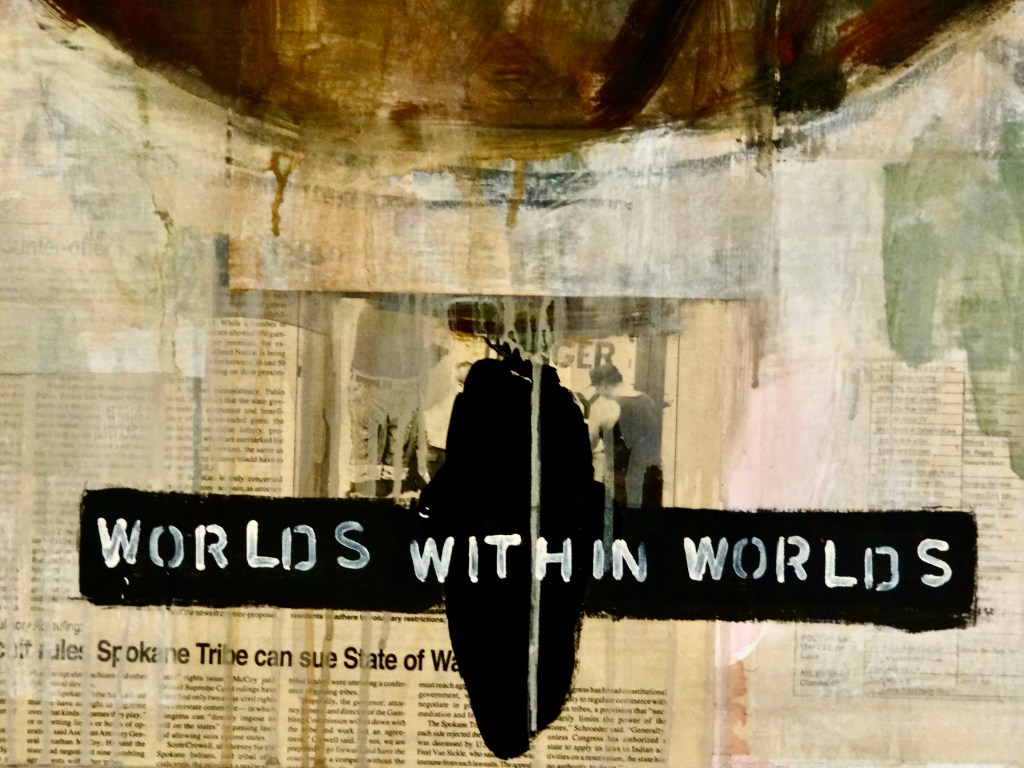
The ‘project’, if such it can be called, is ecological and political at once. This brings into play a consideration of what differences there are between an ‘order’, a ‘natural’ order or an ‘order of things’, both inadequate phrases, and a ‘mode of governance’, particularly whether an ‘order’ can be maintained or sustained through ‘governance’. Governance itself brings into play such notions as hierarchy, heterarchy, anarchy and hegemony; and especially the difficulty of understanding how all four exist at once in the contemporary ‘world’, or rather the contemporary worlds: world of worlds and worlds within worlds as pluriverse. The question of actual and possible worlds appears as a supplement.

References

Bratton, B. (2019) The Terraforming. Moscow, RU: Strelka Institute

Website

Terreform website: https://terreform.org

Structuralism

RELATED TERMS: Actantial model – Greimas; Narratology; Poststructuralism; Semiotics; Sculpture;

“In short, the very manifesto of structuralism must be sought in the famous formula, eminently poetic and theatrical: to think is to cast a throw of the dice [penser, c’est e’mettre un coup de des].”

Deleuze, G. (2004) ‘How do we recognise structuralism?’, in McMahon, M. and Stivale, C. (trans.) Desert Islands and Other Texts 1953–74. Los Angeles, CA: Semiotexte, pp. 170–192.

It is important to grasp the importance of structuralism for design practices, not so much for what it is itself but for its relation to narratology and to other cultural practices, as well as for the thinking that developed, more or less simultaneously, under the heading of poststructuralism.

French structuralism was inaugurated in the 1950s by the cultural anthropologist Claude Lévi-Strauss, who analysed, using Saussure’s linguistic model, such cultural phenomena as mythology, kinship relations, and food preparation. In its early form, in the 1950s and 1960s, structuralism cut across the traditional disciplinary boundaries of the humanities and social sciences by claiming to provide an objective account of all social and cultural practices. It views cultural practices as combinations of signs that have a set significance, perhaps, more clearly, a dominant interpretation, for the members of a particular culture. It undertakes to make explicit the rules and procedures by which the practices have achieved their cultural significance. In addition, it seeks to specify what that significance is, by reference to an underlying system of the relationships among signifying elements and their rules of combination (Abrams, 1999: 300).

The structuralist impulse was little understood in Anglo-Saxon and Anglo-American academic cultures, where structure was considered as the complement to function within a structural-functionalist paradigm. Hence structure was seen as an element in the functionalism that dominated and continues to dominate those cultures. This is particularly the case in design practices because, as Burkhardt (1988: 146) notes, “The birth of design is bound up with the birth of functionalism.”

The importance of structuralism, however, is not as a form of reductionism, i.e. the notion that all appearances or surface structures can be reduced to a few structural elements, but rather as a form of relational thinking. As such, structuralism serves, on the one hand, as a critique of positivism i.e. a critique of the view that the world consists of fully-formed entities with predefined properties. On the other hand, it serves as a critique of functionalism, i.e. a critique of the view that an act is originary and is a simple cause which gives rise to a simple effect.

Structuralism opens up thought to the potential of network ontologies, that is, non-positivistic modes of existence, and network ‘causalities’, that is, forms of non-originary, co-implicated inter-action.

Structuralism, the Death of God and Post-Humanism

Deleuze (2004: 175) notes that one consequence of the structuralist emphasis on symbolic elements that primarily do not have extrinsic designation nor intrinsic signification but rather a positional, relational sense,

“is that structuralism is inseparable from a new materialism, a new atheism, a new anti-humanism. For if the place is primary in relation to whatever occupies it, it certainly will not do to replace God with man in order to change the structure. And if this place is the dummy-hand [la place du mort, i.e. the dead man’s place], the death of God surely means the death of man as well, in favor, we hope, of something yet to come, but which could only come within the structure and through its mutation.”

(Deleuze, 2004: 175)

Three types of relation can be distinguished, Deleuze (2004: 176) explains, real, imaginary and symbolic, of which it is the third which is of key significance for structuralism. The first type is established between elements which enjoy independence or autonomy. He gives the examples of 3 + 2 or 2/3. The elements are real and such relations must themselves be said to be real. The second type of relationship is established between terms for which the value is not specified but which, in each case, must have a determined value. He gives the example of x2 + y2 – R2 = 0. Such relations can be called imaginary. The third type is established between elements which have no determined value themselves, and which nevertheless determine each other reciprocally in the relation. His example is ydy + xdx = 0, or dy-/ dx = – x/y. Such relationships are symbolic, and the corresponding elements are held in a differential relationship: dy is totally undetermined in relation to y, and dx is totally undetermined in relation to x. Each one has neither existence, value, nor signification. Yet the relation dy/dx is totally determined. The two elements determine each other reciprocally in the relation. This process of a reciprocal determination is at the heart of a relationship that allows one to define the symbolic nature.

Deleuze (2004: 177) continues: Corresponding to the determination of differential relations are singularities. These are distributions of singular points which characterise curves or figures. For example, a triangle has three singular points. Thus, Deleuze argues, the notion of singularity becomes crucial. Taken literally, it seems to belong to all domains in which there is structure. The general formula which serves as a manifesto for structuralism, i.e. that “to think is to cast a throw of the dice,” itself refers to the singularities represented by the sharply outlined points on the dice. Every structure, then presents two aspects: a system of differential relations according to which the symbolic elements determine themselves reciprocally; and a system of singularities corresponding to these relations and tracing the space of the structure. Every structure, Deleuze concludes, is a multiplicity.

Significant for the understanding of the role of designed objects, artefacts and other design interventions, Deleuze explains that, “Symbolic elements are incarnated in the real beings and objects of the domain considered; the differential relations are actualized in real relations between these beings; the singularities are so many places in the structure, which distributes the imaginary attitudes or roles of the beings or objects that come to occupy them.”

In a certain sense, then, structures are not actual. What is actual is that in which the structure is incarnated or rather what the structure constitutes when it is incarnated. However, in itself, a structure is neither actual nor fictional, neither real nor possible (Deleuze, 2004: 178). Deleuze suggests that the word virtuality might designate the mode of the structure or the object of theory. However, he cautions that this would have to be on the condition that we eliminate any vagueness about virtuality. The virtual has a reality which is proper to it, but which does not merge with any actual reality, any present or past actuality. It could be said of structure that it is real without being actual, ideal without being abstract, a sort of ideal reservoir or repertoire, in which everything coexists virtually, but where the actualisation is necessarily carried out according to exclusive rules, always implicating partial combinations and unconscious choices.

Structuralism and narratology

The word ‘narratology’ was first used by the Franco-Bulgarian philosopher Tzvetan Todorov and has since made remarkable progress due to the works of such narratologists as Claude Bremond, A. J. Greimas, Roland Barthes, and Gerard Genette. It derived from Vladimir Propp’s study of Russian forktales and the structuralism of Claude Lévi-Strauss, who had re-evaluated the Russian formalism of the 1910s to the 1930s.

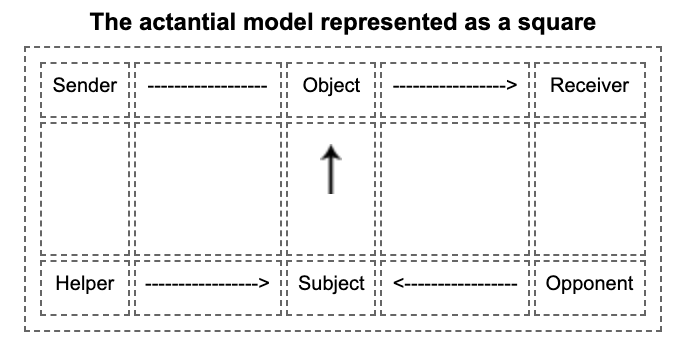
A. J. Greimas, a linguist and semiotician, considered Propp’s morphology in connection with Lévi-Strauss’s structural analysis of myth. Through a consideration of Propp’s thirty-one functions, Greimas defined an actant as a fundamental role at the level of narrative deep structure. Greimas’ actantial model schematically shows the functions and roles that characters perform in a narrative. Greimas replaced Propp’s syntagmatic structure of narrative with a paradigmatic one: the establishment of the actors by the description of the functions and the reduction of the classification of actors to actants of the genre (Susumu, 2010).

Greimas also employed Souriau’s catalogue of dramatic function. In so doing, Greimas found that the actantial interpretation could be applied to different kinds of narrative, not just folktale, and that Souriau’s results could be compared with those of Propp.

In this way, Greimas arrived at his first actantial model:

Source: The Actantial Model by Louis Hébert, http://www.signosemio.com/greimas/actantial-model.asp

Structuralism outside narratology

A good example of how structuralist thought, as relational thinking or the thinking of difference, is valuable outside of the domain of narratology can be found in Rosalind Krauss’ (1979) discussion of sculpture in what she calls the expanded field.

References

Abrams, M.H. (1999). A Glossary of Literary Terms, 7th ed. Boston, MA: Heinle & Heinle.

Burkhardt, F. (1988). Design and ‘avant-postmodernism’. In: Design after modernism, edited by J. Thakara. London, UK: Thames and Hudson, 145–151.

Deleuze, G. (2004) How do we recognise structuralism?, in McMahon, M. and Stivale, C. (trans.) Desert Islands and Other Texts 1953–74. Los Angeles, CA: Semiotexte, pp. 170–192.

Krauss, R. E. (1979) ‘Sculpture in the expanded field’, October, 8, pp. 30–44. Available at: http://www.jstor.org/stable/778224 (Accessed: 10 February 2016).

Susumu, O. (2010). Greimas’s actantial model and the Cinderella Story: the simplest way for the structural analysis of narratives [Thesis]. Hirosaki, Japan: Hirosaki University. Available from http://repository.ul.hirosaki-u.ac.jp/dspace/bitstream/10129/3788/1/JinbunShakaiRonso_J24_L13.pdf [Accessed 2 February 2016]