Jan Golembiewski is an architect and neuroscientist working at Psychological Design, an architecture practice based in Sydney, Australia. His research investigates the psychodynamic significance of environmental action. He suggests that design, at all scales, from cities to buildings to interiors, down to the objects in them, prompt, motivate and ground human behaviour. In other words, design provides ‘affordances’ for human behaviour, human interaction and human community. Design, in this sense, is not the sole remit of ‘the designer’. We all practice design decision making in our homes whenever we make aesthetic choices.
Human-environmental interaction has been explored by cognitive science and environmental psychology. The work of John Bargh and James Gibson, for example, explores the insight that perception and action are completely intertwined. Perception is not a passive or reactive reception of data. Rather, it is an active, projective scanning of, and engagement with objects, people and environments. We attend to our surroundings selectively, acting on some aspects while ignoring others. We also adapt to our environments and use conditionally what is on offer. Design, by changing the features and arrangements of the environment, is capable of altering that attention and use.
What is at stake in this post is whether it is valuable to explore a re-articulation of user-centred design and the notion of affordance through certain concepts borrowed from psychoanalysis. This may enable a conception of how designs intervene in the psycho-drama of the subject in its social operation and the formation or individuation of the self as person and persona. Through these means, the notions of ‘use’, ‘the user’ and utility can be transformed through a re-contextualisation in terms of actantiality.
One way of expressing this is to say that the ‘I-the-user’, the assumed identity of the pragmatic-utilitarian subject, has to be seen alongside other aspects of the contemporary 20th and 21st century Western subject which, according to Ragland-Sullivan (1987: 10), continues to be, “a mixture of the medieval ‘I’ believe; the Cartesian ‘I’ think; the Romantic ‘I’ feel; as well as the existential ‘I’ choose; the Freudian ‘I’ dream and so forth.” To these aspects, Luepnitz (2009) suggests we might add the Winnicottian ‘I’ relate and the Lacanian ‘I’/it speak(s).
It is especially the differences between the Winnicottian and the Lacanian approaches understanding the subject that are taken here to be most important for this re-articulation of the utilitarian ‘I’ use. Let us begin with Deborah Luepnitz’s portrayal of a major difference between the thought of Donald Winnicott and Jacques Lacan. Luepnitz (2009: 964) states that,
“For Winnicott, the central drama will turn around the infant’s loss or feared loss of maternal connection. For Lacan, while loss is obviously important, something even more profound is at stake – the lack built into subjectivity by the mere existence of the unconscious.”
The unconscious for Lacan is ‘the discourse of the Other’, the radical otherness through which the subject comes into existence.
One way of understanding the difference between lack and loss may be to conjecture that the Winnicottian approach emphasises the constitution of the subject through the formation of the body, the gradual assumption of a separate and distinct body that is one’s own, while Lacan’s focus is on the constitution of the subject in language, the gradual assumption of an ‘I’ who speaks.
Both the body and language, however, as Agamben (2016: 80-94) argues, are ‘inappropriable’: that which one assumes to be one’s own, ‘my body’ and ‘my speech’, is only accessed through the externality and commonality of ‘the (m)other’s body’ and the ‘(m)other tongue’. The relation to one’s body, for example in the case of need, as discussed by Levinas, cited by Agamben (2016: 85), reveals that the body,
“is a field of polar tensions whose extremes are defined by a ‘being consigned to’ and a ‘not being able to assume.’ My body is given to me originarily as the most proper thing, only to the extent to which it reveals itself to be absolutely inappropriable.”
(Agamben, 2016: 85)
Loss and lack, then, are important concepts for conceiving what it is that designs, whether as artefacts, services or systems, do for the subject and the self in being ‘used’. Through that interaction, they may, for example, be said to replace the ‘lost object’ of the self and/or to ‘fill’ the ‘hole’ at the centre of the subject. That may define the character of their ‘promise’, what they seek to provide as ‘gift’, that is, a supposedly restored but in fact inaugural and imaginary, ‘wholeness’. Designs, in being appropriated, seem to offer a way to resolve the inappropriability of the self-subject.
Both loss and lack, in different ways, highlight the self and subject, firstly, as processes and, secondly, as processes of exosomatisation: the bodily dependence of the self and the subject on the world with its other bodies, that into which the self and the subject have been thrown, from which they emerge, in which they seek to attain a degree of self-suffiency and agency. However, to be an agent, to have self-motivation and self-control, is, simultaneously, to be a subject in a symbolic-political order, to be subjected to that order, to be limited by the laws of that culture (Luepnitz, 2009: 963). This is to highlight both the impossibility of total self-sufficency and yet its persistence as an object of desire. This tension is one aspect of what marks and articulates actantiality as conditioned and conditional agency.
References
Luepnitz, D.A. (2009). Thinking in the space between Winnicott and Lacan. The International Journal of Psychoanalysis, 90 (5), 957–981. DOI: 10.1111/j.1745-8315.2009.00156.x.
Ragland-Sullivan, E. (1987) Jacques Lacan and the philosophy of psychoanalysis. Urbana, IL: University of Illinois Press.
In the understanding of design action and interaction being developed here, the term ‘user’ is situated in the context of the theory of actantiality. Actantiality is a theory of the situated and situational condition of any action. Actions are provisional: conditioned and conditional. The utilitarian ‘I’, the ‘I-as-user’, is therefore considered as part of the dynamic processes whereby the personal formation of the self and the socio-cultural operation of the subject take place and then take their place, that is, become part of ongoing situated conditional interaction.
In this way, while utilitarian actions may be seen as responses to affordances, they may also become part of the creation of opportunities, an inaugurative or inventive action. In this context, utilitarian actions may be part of a transcendence of their place or part of a transgression of their place in a complex dance of placing, displacing, orienting and disorienting.
The term ‘user’ may be valuable for acknowledging, perhaps unintentionally, the repetitive and/or ‘addictive’ qualities of some forms of interactivity within the consumer economy and the more recent attention economy.
One question that arises in the context of online environments is: What is the status of the ‘multi-user realm’? Is it a realm in which individual users come together as an aggregate, remaining separate; or do they come together to form a community? Or, does this distinction depend on the design of the environment itself? This discussion mirrors and extends that within the realm of the public and the creation of publics.
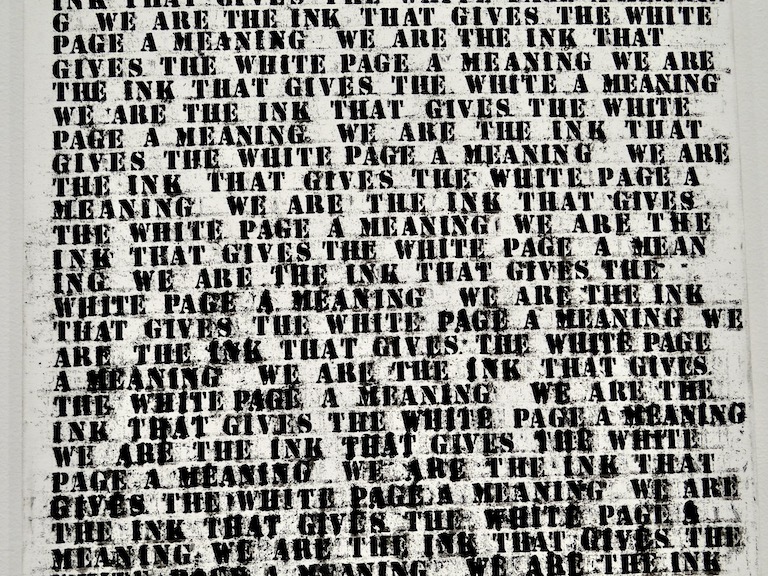
Glenn Ligon, Prisoner of Love #1 (Second Version), 1992. In his 1986 memoir, Prisoner of Love, Jean Genet writes, “In white America, the Blacks are the characters in which history is written. They are the ink that gives the white page a meaning.”
David Marriott (2021: viii) proposes that the work of Afro-pessimism has an extreme, audacious place in the history of Black Studies. The value for Marriott is that Afro-pessimism allowed him to rediscover what is for him the most exacting question: what is blackness? Furthermore, Annie Olaloku-Teriba (2018) suggests that it is crucial to engage with Afro-pessimist literature because it has both shaped and been shaped by the organisational impulses of Afro-American and Black British activists in particular.
What accounts, then, for the particular critical purchase and affective resonance of what Jarod Sexton (2016) at one time called, “a highly technical dispute in a small corner of the American academy”?
Rather than a fixed ideology, Afro-pessimism may be better thought of as a theoretical lens for situating relations of power at the level both of the political economy and the libidinal economy (Wilderson et al 2017: 7, n.1). Libidinal economy is defined as the distribution and arrangement, the condensation and displacement of desire and identification, of energies, concerns, foci of attention, anxieties, pleasures, appetites, revulsions, and phobias. In short, the libidinal economy affects the whole structure of psychic and emotional life, including the complex relationship between sexuality and the unconscious. Although unconscious and invisible, such processes have a palpable effect on the world, including the monetary, political economy.
Afro-Pessimism, Critical Race Theory and Racial Realism
Afro-pessimism, in many ways, picks up the critiques started by Black revolutionaries in the 1960s and 1970s. In this sense, it may be seen to have a relationship to critical race theory and the legacy of the civil rights movement of the 1950s and 1960s. For example, Derrick Bell, whose ideas proved foundational to critical race theory, came to recognise over time that decisions in landmark civil-rights cases were of limited practical impact in the longer term. He drew the unsettling conclusion that racism is so deeply rooted in the makeup of American society that it has been able to reassert itself after each successive wave of reform aimed at eliminating it.
This developed and strengthened a theme in Bell’s earlier work, that black rights have been held hostage to white self-interest. He began to argue that racism is permanent. Blacks can no longer afford to educate themselves and live their lives on the proleptic delusion of an integrated and non-racist white America, when they know that their reality is fundamentally determined by white racism (Cobb, 2021). Hopes of the gradual elimination of racism can no longer serve as the base from which Blacks are taught to interact with the world.
However, this position has its critics. Stanley Crouch (1995), for example, wrote that Bell’s theory of interest convergence undermined the importance of Black achievements in transforming American society. Crouch regarded Bell’s view as pessimism. To Bell, it was hard-won realism (Cobb, 2021). By overstating the case, Crouch argued, “the issue is smudged beyond recognition”. Crouch perceived Bell as fundamentally defeatist, someone who accepted high positions of success then told others below him that they don’t have a chance. Crouch (1995: 76), in addition, suggests that it is possible for black females, for example, to identify with achievements across colour lines. They do not necessarily need to see someone who looks like them to believe it is possible to succeed in the world. If that were the case, Crouch argues, no black achievement of any kind would have taken place unless it was based on replicating some practice held over from Africa.
In as far as Afro-pessimism holds that Black Americans are still viewed as they were viewed in days of the slavery, that is, as different, inferior, and as outsiders, as does Orlando Patterson (1982), there are clear parallels between the thought of Bell and Afro-pessimism. Patterson theorises slavery as a relational dynamic between “social death”, the slave, and “social life”, the human.
A central argument of Afro-pessimists is that Black people are constitutively excluded from the category of the self-possessing, rights-bearing human being of modernity. Afro-pessimism is marked by its ontological nihilism and its attempt to think blackness in terms other than property, alienation, and re-appropriation (Marriott, 2021). Violence, as structure or paradigm, and sexual violence, as an ensemble of practices within that paradigm, is at the heart of Afro-pessimist meditations (Wilderson, 2020: 167).
Jared Sexton (2016) suggests that, “if Afro-Pessimism is defined by anything … then it may be the motive force of a singular wish inherited in no small part from black women’s traditions of analysis, interpretation, invention, and survival”. That ‘wish factor’ is born of a confrontational style that assumes a general antagonism. This style contrasts sharply with what might be called the ‘hope creed’ that characterises those engaging in the politics of everyday life through the assumption of a general consensus disrupted by conflict.
Afro-pessimism and Identity Politics
Afro-pessimism is often misunderstood as a discourse about identity politics. When Afro-pessimists talk about blackness, Wilderson insists, they are talking about a kind of vector of violence and rituals. They are talking about blackness as a position. When others talk about blackness and identity, they are talking about it as a culture. The first step for those trying to understand Afro-pessimism is that one has to think about blackness as a kind of site (Wilderson and Park, 2020).
In an issue of the journal Historical Materialism whose theme is identity politics, Annie Olaloku-Teriba (2018) discusses the value and limitations of Afro-pessimism, focussing on the conceptual confusions around the notion of blackness and the implications this has for theories of anti-blackness.
Design and Afro-pessimism
In as far as design practices work across material, political, libidinal and symbolic economies, understanding their deployment is crucial for recognising how flows of energies are articulated through the materiality of design interventions, which partake in the societal processes of sexuation and racialisation and the constructs which emerge from them. In particular, design practices operate between the political economy and the libidinal economy: by shaping material practices, including processes of commodification they, in turn, shape desire. Design practices thus serve as part of the formation as well as deformation of desire, which is, as argued by Stiegler (2013: 123), technologically conditioned through and through. In short, a libidinal economy is crucially sustained by a mnemotechnical milieu, that is, a technical ‘milieu of the mind’ (Lemmens, 2017). This takes into account Stiegler’s (2013: 123) argument that, “what is generally ignored by the theory of the libidinal economy, including by Freudians, is the role of technics, which also means, in our epoch, the role of industry – which Valery was almost alone, in his time, in trying to think.”
In terms of the design of the theoretical discourse around blackness and anti-blackness, William Hart (2018) outlines what he calls a ‘genealogy’, but which might easily be characterised as a ‘montage’ or ‘bricolage’, of concepts derived from debates about slavery and capitalism with which both Afro-pessimists and black optimists might find some agreement. Hart cites:
Frantz Fanon’s (1988, 1952) phenomenology of blackness, particularly his concept of ‘negro phobogenesis’ or the “lived experience of the black person”;
Orlando Patterson’s (1982) notion of slavery as social death;
Cedric Robinson’s (2020, 1983) concept of ‘racial capitalism’;
Hortense Spillers’s (1987) ontological distinction between ‘body’ and ‘flesh’, rooted in the experience of the Middle Passage and slavery;
Saidiya Hartman’s (1997; 2007) meditations on ‘world’ destruction within the hold of the slave ship, the afterlife of slavery and naïve celebrations of agency; and
Nahum Chandler’s (2008) concept of blackness as a ‘double movement,’ both ontic and ontological, that is, blackness as ‘paraontological’.
Afro-Pessimism, African Americans, Afropessimism and Africa
William Hart (2018: 19) suggests that Frank Wilderson appropriated the term Afro-pessimism from development theory, while Aaron Robertson (Wilderson and Robertson, 2020) points out that a conversation in 2003 between Saidiya Hartman and Frank Wilderson (Hartman and Wilderson, 2003) is generally cited as the start of a second wave of Afro-pessimist thought.1
During the 1980s, the term Afropessimism expressed the view of many Africanists in economics, area studies and elsewhere concerning the prospects for the African continent. Black Africa was seen as politically corrupt and poorly equipped for economic development. This was because black Africa, in contrast to their more prosperous Asian counterparts, had failed to adopt the political reforms and follow the market-centric strategies promoted by the World Bank, the International Monetary Fund and other institutions of global capitalist management. Under Wilderson’s re-signification, Afro-pessimism becomes an ontological account of white supremacy and the tenacity, perdurance and radicality of anti-blackness.
Ochieng Okoth (2020) avers that, for decades, Afropessimism had referred to the unrelentingly negative coverage of Africa in Western news media. Such Afropessimist discourses imposed a Eurocentric developmental model on the continent, assessing its progress in relation to a set of arbitrary criteria that takes Western liberal democracies to be the final stage in the progress of world history. Greg Thomas (2018), Ochieng Okoth notes, has given the name Afro-pessimism 2.0 to Wilderson’s, Sexton’s and others’ appropriation of the term.
Afro-pessimism – added notes from Wilderson et al. 2017
In the ‘Introduction’ to Afro-Pessimism: an introduction, the editors point out that one of the central tenets of Afro-pessimism, developed from the work of Orlando Patterson, is a re-definition of slavery: rather than being a relation of forced labor, it is more accurately a relation of property. The slave is objectified and legally made a commodity to be used and exchanged. It is not just the slave’s labour-power that is commodified, as is the case with the worker, but their whole being. For this reason, they are precluded from the category of the ‘human’: inclusion in humanity is predicated on social recognition, volition, subjecthood and the valuation of life, but slaves are not recognised as social subjects.
Furthermore, Afro-pessimism argues that the slave, because a commodity, is socially dead. This means that slaves are open to gratuitous violence, as opposed to violence contingent upon some transgression or crime; natally alienated, their ties of birth not recognised and familial structures intentionally broken apart; and generally dishonoured, or disgraced prior to any thought or action is considered.
This social death means, according to Afro-pessimism, that slaves experience their ‘slaveness’ ontologically: being-a-slave means ‘being for the captor’. Slaves, therefore, are not oppressed subjects, who experience exploitation and alienation, but are objects of accumulation and fungibility or exchangeability.
This distinction problematises any positive affirmation of identity: non-Black categories are defined against the Blackness they are not, a relation of race that directly and indirectly sustains anti-Blackness by producing and sustaining racialised categories.
From this understanding Afro-pessimism defines what it sees as the limits and failures of the Civil Rights and Black Power movements, including their reformist ideologies of progress and their integration with bureaucratic machinery, which is seen as disastrous from an Afro-pessimistic perspective. Afro-pessimism argues that it is not possible to affirm Blackness itself without at the same time affirming anti-Black violence. As a result, attempts at recognition and inclusion in society will only ever result in further social and real death. Because Blackness is negated by the relations and structures of society, Afro-pessimism posits that the only way out is to negate that negation.
The challenges Afro-pessimism poses to the affirmation of Blackness extend to other identities, in the process problematising identity-based politics.
Afro-pessimism is critical of the rhetoric often used that takes an assumed, historically oppressed subject at its centre, for example, workers or women, arguing that this rhetoric conflates experience with existence while failing to acknowledge the incommensurate ontologies between, for example, white women and Black women.
To speak in generalities, of workers or women, for example, is to speak from a position of anti-Blackness. This is because the non-racialised subject is the white, or at least non-Black, subject.
This means that the movements against capitalism, patriarchy or gender mean little if, firstly, they do not elucidate ontological disparities within a given site of oppression; and, secondly, they do not seek to abolish the totality of race and anti-Blackness in an unqualified way. This is not to privilege anti-Black racism in a hierarchy of oppression, but to insist upon the un-livability of life for Blacks over centuries of social death and physical murder, perpetuated, at different times, by all non-Black subjects in society.
Notes
1. The phrase ‘Afro-pessimists’ appears in the conversation between Hartman and Wilderson (2003) in the context of a discussion of the supposed differences in dispositions between Africans and African-Americans. Hartman states,
“In In My Father’s House, Anthony Appiah says that African-Americans are angrier at white people than Africans because colonialism didn’t exact the same psychic damage. I don’t believe that, I think that’s an untrue statement. I think that there’s definitely a difference between we who are of the West and people elsewhere, but I really challenge that supposition because the psychic damage of apartheid is tremendous. When you look at certain African writers, say Achille Mbembe and the other so-called “Afro-Pessimists” who are diagnosticians of their society, you see the consequences of the colonial project. The trauma may not be as extreme or radical as in our case because we’re literally living inside this order, but I would still greatly qualify these positive assessments of African subjectivity.”
Chandler, N. D. (2008) Of exorbitance: the problem of the negro as a problem for thought, Criticism, 50(3), pp. 345–410. Available at: http://www.jstor.org/stable/23130886 (Accessed: 7 February 2023).
Crouch, S. (1995) ‘Dumb Bell blues’, in The All-American Skin Game or, The Decoy of Race. The Long and the Short of it, 1990-1994. New York, NY: Pantheon Books, pp. 75–76.
Fanon, F. (1988, 1952) Black skin, white masks. London, UK: Pluto Press.
Grant, C. A., Woodson, A. N. and Dumas, M. J. (eds) (2021) The Future is black: Afropessimism, fugitivity, and radical hope in education. New York, NY: Routledge.
Hart, W. D. (2018) Constellations: Capitalism, Antiblackness, Afro-Pessimism, and Black Optimism, American Journal of Theology and Philosophy, 39(1), pp. 5–33. Available at: https://www.jstor.org/stable/10.5406/amerjtheophil.39.1.0005 (Accessed: 2 September 2022).
Hartman, S. V (1997) Scenes of subjection: terror, slavery and self-making in nineteenth-century America. New York, NY: Oxford University Press.
Hartman, S. V (2007) Lose your mother: a journey along the Atlantic slave route. New York, NY: Farrar, Strauss and Giroux.
Hartman, S. V. and Wilderson, F. B. (2003) The Position of the unthought, Qui Parle, 13(2), pp. 183–201. Available at: https://www.jstor.org/stable/20686156 (Accessed: 1 December 2022).
Lemmens, P. (2017) The conditions of the common: a Stieglerian critique of Hardt and Negri’s thesis on cognitive capitalism as a prefiguration of communism, in Ruivenkamp, G. and Hilton, A. (eds) Perspectives on Commoning. London, UK: Zed, pp. 169–212.
Marriott, D. S. (2021) Lacan Noir: Lacan and Afro-Pessimism. Cham, CH: Palgrave Macmillan.
Patterson, O. (1982) Slavery and social death: a comparative study. Cambridge, MA: Harvard University Press.
Robinson, C. J. (2020, 1983) Black Marxism, 3rd edn. Chapel Hill, NC: University of North Carolina Press.
Sexton, J. (2016) ‘Afro-pessimism: the unclear world’, Rhizomes, 29. doi: 10.20415/rhiz/029.e02.
Spillers, H. J. (1987) Mama’s baby, Papa’s maybe: An American grammar book, Diacritics, 17(2), pp. 64–81.
Stiegler, B. (2013). Uncontrollable Societies of Disaffected Individuals: Disbelief and Discredit. Volume 2. London-New York: Polity.
Thomas, G. (2018) Afro-Blue Notes: the death of Afro-pessimism (2 . 0)?, Theory and Event, 21(1), pp. 282–317. Available at: https://muse.jhu.edu/article/685979 (Accessed: 12 November 2022).
Wilderson, F. B. (2010) Red, White and Black: Cinema and the structure of U.S. antagonisms. Durham, NC: Duke University Press.
Wilderson, F. B. et al. (2017) Afro-Pessimism: an introduction. Minneapolis, MN: Racked & Dispatched.
Wilderson, F. B. (2020) Afropessimism. New York, NY: Liveright Publishing.
Wilderson, F. B. and Park, L. (2020) ‘Afropessimism and Futures of … : A Conversation with Frank Wilderson’, Black Scholar, 50(3), pp. 29–41. doi: 10.1080/00064246.2020.1780863.
Beginning in the 1970s and continuing through the 1980s, critical legal scholars, such as Richard Delgado, Patricia Williams, Mari Matsuda and Alan Freeman, began publishing work that developed the discourse around race, power and law. Together, they advanced the idea that the law, rather than being a neutral system based on objective principles, operated to reinforce established social hierarchies (Cobb, 2021).
In 1989, Kimberle Crenshaw contributed a concept that became one of the best-known elements of critical race theory. The idea was expressed in a 1989 article, ‘Demarginalizing the Intersection of Race and Sex: A Black Feminist Critique of Antidiscrimination Doctrine, Feminist Theory and Antiracist Politics.’ Her central argument concerned the notion of ‘intersectionality’. As Miriyam Aouargh (2019: 16) explains, when Crenshaw initially coined the term, it was in response to a court case against discrimination in which the judge had rejected a plea based on the plaintiff being black and female. He argued that she should make a choice: to pursue the case either against racism or against sexism. In his opinion, it could not be both. The notion of intersectionality was a way to accommodate the reality that any one (legal) person has multiple (social) identities that cause overlapping oppressions. In this sense, intersectionality, understood as an interface, brings to attention the ways in which people who belong to more than one marginalised community can be overlooked by anti-discrimination law. In many ways, this was a distillation of the kinds of problems that critical race theory addressed (Cobb, 2021).
Hill Collins and Bilge (2016) define the importance of intersectionality in the following terms:
“Intersectionality is a way of understanding and analyzing the complexity in the world, in people, and in human experiences. The events and conditions of social and political life and the self can seldom be understood as shaped by one factor. They are generally shaped by many factors in diverse and mutually influencing ways. When it comes to social inequality, people’s lives and the organization of power in a given society are better understood as being shaped not by a single axis of social division, be it race or gender or class, but by many axes that work together and influence each other. Intersectionality as an analytic tool gives people better access to the complexity of the world and of themselves.”
Intersectionality and Identity-Based Politics
The notion of intersectionality came to be associated with identity-based politics. The process of recognising that which was formerly perceived as isolated and individual as social and systemic is one that characterised the identity politics of African Americans, other people of colour, gays and lesbians and other marginalised groups. For these groups, Crenshaw (1991) argues, identity-based politics has been a source of strength, community and intellectual development.
Design and Intersectionality
The concern for design practices in relation to intersectionality and identity-based politics is the extent to which certain affordances are offered for particular identities or subject positions over others, perhaps through the design of avatars by means of which social subjects are addressed and drawn into particular design worlds, whether material or digital. Does the design hierarchise social identities, for example, in presenting intersections among homosexuality, race, cultural renewal and self-formation, or exclude particular social identities? How is the design implicated in, for example, the production of whiteness and masculinity? Does the design seek to generate or acknowledge new intersections?
References
Aouragh, M. (2019) “White privilege” and shortcuts to anti-racism, Race and Class, 61(2), pp. 3–26. doi: 10.1177/0306396819874629.
Crenshaw, K. (1989) ‘Demarginalizing the intersection of race and sex: A black feminist critique of antidiscrimination doctrine, feminist theory, and antiracist politics’, University of Chicago Legal Forum, 1, pp. 139–167. Available at: https://chicagounbound.uchicago.edu/uclf/vol1989/iss1/8 (Accessed: 10 August 2022).
Crenshaw, K. (1991). Mapping the margins: intersectionality, identity politics, and violence against women of color, Stanford Law Review, Vol. 43, No. 6 (Jul., 1991), pp. 1241-1299.
Hill Collins, P. and Bilge, S. (2016) Intersectionality. Malden, MA: Polity Press.
RELATED TERMS: Anthropology; Actor-Network Theory; Ethnomethodology; Avatar
A cyborg anthropologist looks at how humans and non human objects interact with each other, and how that changes culture.
Another aspect of cyborg anthropology concerns how the self can be extended, doubled or multiplied, online, through identification with an avatar. This, in turn, opens to the study of how people interact with each other through such techno-social interactions, in addition to the ways in which they interact in embodied social situations.
Actor Network Theory has been applied in cyborg anthropology in order to analyse the fluid exchange between technological actors and human actors. This is especially valuable since the technologies being studied actively dismantle our ontological pre-suppositions as to what constitutes a ‘human’ or a ‘technology’.
Cyborg anthropology is a subspecialty, launched in 1993, at the Annual Meetings of the American Anthropological Association (AAA). Within the AAA, cyborg anthropology is associated with the Committee for the Anthropology of Science, Technology and Computing (CASTAC).
The word avatar has a number of definitions, for example, it may mean the incarnation of a Hindu deity, especially Vishnu, in human or animal form; an incarnate divine teacher; an embodiment or manifestation, as of a quality or concept; a temporary manifestation or aspect of a continuing entity; or an icon, graphic or other image by which a person represents themselves on a communications network or in a virtual community, such as a chatroom or multiplayer game. In another sense, it may be taken to mean the various representations, identifications, and internalisations that make up a person’s intra-psychic world and which are the elements of their overall sense of self.
As Ralitza Petit (2011) points out, until the late 1980s, the word avatar was used solely in the context of Hindu myths, particularly in discussions of embodiment and incarnation. Derived from from the Sanscrit word for ‘descent’, avatar or avatara in this Hindu context refers to the manifestation or appearance of an alternate body by means of which a Hindu deity descends to earth, a body that frequently merges human and animal forms.
The idea has been transferred to literature, film and online gaming so that avatar is now taken to mean the counterpart to the human body within such media. This can be seen in the context of the processes of exosomatisation, extending the body towards extra-bodily, mediated experiences that are nevertheless still embodied. Thus, in digital online environments, the avatar becomes the human body’s visual counterpart. In this way, the avatar has become as essential to the state of ‘digital-virtual’ being (avatarial embodiment) as the ’embodied’ self is to being-in-the-‘flesh’ (corporeal embodiment).
As Klevjer (2006) expresses it, in the context of the computer game, the avatar,
“exploits the digital computer’s unique capacity for realistic simulation, and acts as a mediator of the player’s embodied interaction with the gameworld, The relationship between the player and the avatar is a prosthetic relationship; through a process of learning and habituation, the avatar becomes an extension of the player’s own body. Via the interface of screen, speakers and controllers, the player incorporates the computer game avatar as second nature, and the avatar disciplines the player’s body.”
(Klevjer, 2006: 10)
The avatar gives, “the player a subject-position within a simulated environment, a vicarious body through which the player can act as an agent in a fictional world” (Klevjer, 2006: 10).
Avatar or Fashion Design? Design Museum Copenhagen
Avatar, body, subjectivity and spatiality
As Petit (2011: 93) explains, the human body, understood instrumentally, has been taken as a privileged device for measuring space throughout the history of architecture. This conception can be found in antiquity, in the work of Vitruvius, the Renaissance, in the work of Leonardo da Vinci and Leon Battista Alberti and in modernity, in the work of Le Corbusier. The avatar, alternatively, presents a new paradigm of referencing. More than a physical or psychoanalytical measure of space, an avatar in an online environment becomes the originating code by means of which the body’s spatial context is not only evaluated but created.
Petit notes that in the Humanist tradition no two human subjects are identical. Nevertheless, by focusing upon the relative similarity in uprightness, height range and the predictability of human bodily movement, architectural practice has assumed that the human figure permits an anthropocentric understanding of space that is effectively universal. This presumed universality lends to architecture a certain stability, through anthropomorphic systems of measurement and legibility. The avatar reverses this humanist logic, Petit contends.
Thus, Petit (2011: 95) argues that the space of virtual worlds is specifically constructed by and around its constituent avatars. This is unlike the modernist conception of a universal space by which the subject is surrounded and received. The avatar, by contrast, is crucial to the definition of a virtual space in the process of representing that space to the player. Spatial representation is established through the supremacy of the avatar. Spatiality, thus conceived, does not exist independently of the avatar.
Picking up on this difference in the relationship between ‘body’ and ‘space’ in humanistic and digital environments, Bob Rehak (2003: 103) notes that the video game avatar, which is presented as a human player’s double, merges spectatorship and participation in ways that fundamentally transform both activities.
In discussions of virtual reality (VR) and online gaming, the relationship between player and avatar is assumed to be a transparent, one-to-one correspondence. However, Rehak insists that the heterogeneity of players and their avatars should not be elided. They exist in an unstable dialectic. Players experience games through the exclusive intermediary the avatar, an ‘other’ whose ‘eyes’, ‘ears’ and ‘body’ are components of a complex technological and psychological apparatus.
Just as one does not unproblematically equate a glove with the hand inside it, one should not presume that the subjectivity produced by video games or other implementations of VR transparently correspond to, and thus substitute for, the player’s own subjectivity. This remains the case even though it is precisely this presumption that appears necessary to secure and maintain a sense of ‘immersion’ in ‘cyberspace’.
To obscure the difference between players and their game-generated subjectivities is to elide questions of ideological mystification and positioning which are inherent to interactive technologies of the imaginary (Rehak, 2003: 104).
Moore, H. L. (2012) ‘Avatars and robots: The imaginary present and the socialities of the inorganic’, Cambridge Journal of Anthropology, 30(1), pp. 48–63. Available at: http://www.jstor.com/stable/43610889 (Accessed: 10 March 2021).
Rehak, B. (2003) ‘Playing at being: psychoanalysis and the avatar’, in Wolf, M. J. P. and Perron, B. (eds) The Video game theory reader. New York, NY: Routledge, pp. 103–127.
“The tension between the endless desire that is the source of human motivations and the hopeless demands that fail to appease it is the very heart of the human tragedy, according to Lacan.”
Mansfield, 2000: 46)
In as far as designs intervene in existing entanglements of socio-cultural situations embedded in techno-natural situations, and vice versa, design practices may engage with processes of dramatisation and narrativisation. This is in line with the conception that techno-genesis and socio-genesis are mutually entwined through the processes of exosomatisation. While narrative and drama are most often woven together in practice through plot – narratives involve dramatic incidents while dramas involve narrative sequences – they may be distinguished for analytical reasons.
The designer may therefore consider how the design enters into the drama of the situation, heightening, extending or resolving a dramatic tension, or takes part in the movement of events as part of a narrative progression. Designing, in other words, may be considered as part of dramatisation, as part of (story) telling; or as part of the dramatisation of story telling through the arrangement of plot. This may affect decisions as to which modes and media of communication are drawn upon in the design, impacting the balance between ‘telling’ and ‘showing’.
References
Mansfield, N. (2000) Subjectivity: theories of the self from Freud to Haraway. St Leonard’s, NSW: Allen & Unwin.
Resources
Sorkin, A. and Wilson, J. (2022) Aaron Sorkin. [Interview with John Wilson in This Cultural Life series on the BBC Sounds platform]. Available at https://www.bbc.co.uk/programmes/m00161mc [Accessed 13 July 2022]
Aaron Sorkin discusses the distinctions that exist under the umbrella term ‘writer’. He focuses on the differences between being a playwright and being a screenwriter, but implicitly he also distinguishes those two roles and that of the novelist. All three writerly roles deal with ‘dramatisation’ but in different ways. Although having worked on stage plays, television dramas and cinema films, Sorkin sees himself primarily as a writer of radio plays because, for him, it is the rhythm and flow of the verbal dialogue which holds his interest.
Afrofuturism has been defined as a cultural aesthetic that combines science-fiction, history and fantasy. It aims to connect those from the black diaspora with their forgotten African ancestry (Tate, No Date). ‘The Comet,’ a short story by W. E. B. DuBois that represents DuBois’ foray into fantasy in 1920, is said to have helped lay the foundation for the paradigm that came to be known as Afrofuturism (Ogbunu, 2020). While its beginnings may be said to lie in African-American science fiction, such as the writings of DuBois, Octavia Butler and Samuel R. Delany, it now refers to literature, music and visual art that explores the African-American experience. In particular, it draws attention to the role of slavery in that experience.
Mark Dery, while coining the term Afrofuturism, points to a potentially troubling paradox to which it gives rise. Thus, he writes,
“Speculative fiction that treats African-American themes and addresses African-American concerns in the context of twentieth century technoculture – and, more generally, African-American signification that appropriates images of technology and a prosthetically enhanced future – might, for want of a better term, be called ‘Afrofuturism.’ The notion of Afrofuturism gives rise to a troubling antinomy: Can a community whose past has been deliberately rubbed out, and whose energies have subsequently been consumed by the search for legible traces of its history, imagine possible futures? Furthermore, isn’t the unreal estate of the future already owned by the technocrats, futurologists, streamliners, and set designers – white to a man – who have engineered our collective fantasies? The “semiotic ghosts” of Fritz Lang’s Metropolis, Frank R. Paul’s illustrations for Hugo Gernsback’s Amazing Stories, the chromium-skinned, teardrop-shaped household appliances dreamed up by Raymond Loewy and Henry Dreyfuss, Norman Bel Geddes’s Futurama at the 1939 New York World’s Fair, and Disney’s Tomorrowland still haunt the public imagination, in one capitalist, consumerist guise or another.”
(Dery et al, 1994: 180)
In his interview with Dery, Samuel R. Delany, points out that science fiction (SF) was by no means initially a clear choice for African-American readers and writers because of its cultural significance in the United States:
“It was fairly easy to understand why, say, from the fifties through the seventies, the black readership of SF was fairly low – by no means nonexistent. But far lower than it is today. The flashing lights, the dials, and the rest of the imagistic paraphernalia of science fiction functioned as social signs – signs people learned to read very quickly. They signaled technology. And technology was like a placard on the door saying, ‘Boys Club! Girls, keep out. Blacks and Hispanics and the poor in general, go away!’ “
(Delany in Dery et al 1994: 188)
As Ogbunu (2020) points out, when most people think of Afrofuturism today, in the early decades of the 21st century, the Marvel Cinematic Universe’s Wakanda comes to mind, an African country that hides advanced technology from the world. Within Wakanda, Afrofuturism, in this case, manifests most explicitly in the award-winning fashion and set design, a hypnotic blend of African traditional art and dress, cyberpunk, and space opera, as discussed by Angela Watercutter (2018).
Afrofuturism’s importance might be seen to transcend the arts and may be described as a political identity or ideology. In that context, it bears some relationship to Afro-pessimism. While Afrofuturism uses science fiction themes to reimagine historic events through futurist frameworks, the focus of Afro-pessimism is on the continued appearance of, and resistance to, forms of racism and slavery in contemporary life (Gaylord, 2018)
References
Dery, M. et al. (1994) Black to the future: interviews with Samuel R Delany, Greg Tate and Tricia Rose, in Dery, M. (ed.) Flame wars: the discourse of cyberculture. Durham, NC: Duke University Press, pp. 179–222.
Undesigned design: Accumulated graffiti as graphic communication, London
First …
Design as a professional, social practice has historically been divided according to its material outputs, its concrete products, using categories that have become conventional. For example, jewellery design produces items of jewellery, fashion design produces items of clothing and architectural design produces buildings and cities, with each domain incorporating a value hierarchy: there is good design and there is bad design. However, professional design practices have moved far beyond the creation and styling of commodities. They now include such domains as software development, ethnographic research and management consulting (Stern and Siegelbaum, 2019: 268); and even extend to the design of organisational structures and entire societies (Engholm, 2023). This makes design increasingly elastic and difficult to define. Its scope continues to extend because, as Buchanan (2001: 9) notes, “design is an art of invention and disposition, whose scope is universal, in the sense that it may be applied for the creation of any human-made product.”
In seeking to explain the historical development of design practices, Engholm (2023) argues that one could speak of a discipline-specific understanding of design, on the one hand, and a general understanding of design, on the other hand. In the discipline-specific understanding, design is primarily linked to the modern industrial age, with craftsmen employed to create concept designs and product prototypes for industrial mass production. It centres on a materially or artistically based intention to create a given form and is tied to traditional design disciplines, such as industrial design and graphic communication.
In the general or anthropological understanding, designs emerge from human responses, engagements and entanglements with their situations and their surroundings. In this perspective, all forms of tool use as well as projective action, action aimed at bringing something that does not yet exist into concrete, material existence, can be considered design.



 Incomplete ...