RELATED TERMS: Avant-garde movements; Multimodal research; Method and methodology
Two major research philosophies or methodologies have been identified in the Western tradition of science: positivist or scientific, which is quantitative in character; and interpretivist or anti-positivist, which is qualitative in character. In the context of design practices, a third, performative, paradigm is relevant, which is active, generative and dialogic in character. In recent years, a fourth paradigm might be said to have emerged, post-qualitative research, in which the researcher cannot avoid discussing their implication in the ‘object’ of research, implying a necessary self analysis and relational analysis.
Positivist paradigm
Positivists believe that:
reality is stable and can be observed and described from an objective viewpoint, without interfering with the phenomena being studied;
phenomena should be isolated and that observations should be repeatable; and
predictions can be made on the basis of the previously observed and explained realities and their inter-relationships. (Davison, 1998)
Interpretivist paradigm
Interpretivists contend that only through the subjective interpretation of and intervention in reality can that reality be fully understood. The study of phenomena in their natural environment is key to the interpretivist philosophy, together with the acknowledgement that scientists cannot avoid affecting those phenomena they study. They admit that there may be many interpretations of reality, but maintain that these interpretations are in themselves a part of the scientific knowledge they are pursuing. (Davison, 1998).
Performative paradigm
Under the performative paradigm, perception takes place in the midst of social cognition. The performative paradigm assumes an enactive intersubjectivity. Social cognition emerges from embodied social interaction or, in Merleau-Ponty’s term, from intercorporeality (cf). (Fuchs, 2009).
While the representational idiom of the sciences of modernity is an epistemological enterprise geared towards the production of theory, the performative paradigm of cybernetics is instead a practice, including theory and other kinds of account, which looks at the diversity of its components and actors and constructs a view of the world capable of accounting for such motley assemblages. (Fazi, 2011)
The performative paradigm incorporates an enactive approach. From an enactive point of view, organisms do not passively receive information from their environment which they then translate into internal representations. Rather, they actively participate in the generation of meaning. Thus, a cognitive being’s world is not a pre-given external realm represented by the brain; it is the result of a ‘dialogue’ between the sense-making activity of an agent and the ‘responses’ from its environment (Fuchs, 2009) or ‘affordances’ in the environment, as discussed by J.J. Gibson.
Post-Qualitative paradigm
This might also be termed the ‘ontological turn’. It is not simply about the researcher knowing about something but about the researcher being embedded within the apparatus by means of which knowledge is generated and validated. Patti Lather (2016) suggests that this kind of research is about the nature of the real and how to recover footing in a mind-independent reality where things talk back (DeLanda, 2010: 47).
For examples of performative research in art and design, see:
Haseman, B. 2006. A Manifesto for performative research. Media International Australia, (118), pp.98–106. Available at: http://eprints.qut.edu.au/3999/1/3999_1.pdf. Accessed on 18 April 2013.
Markussen, T. 2005. Practising performativity: transformative moments in research. European Journal of Women’s Studies, 12 (3), pp.329–344. Available at: http://ejw.sagepub.com/cgi/doi/10.1177/1350506805054273. Accessed March 25 2013.
For a discussion of the performative methodology in practice, in this case an examination of a healthcare team, see:
Davison, R.M. (1998). Research methodology. In An Action Research Perspective of Group Support Systems: How to Improve Meetings in Hong Kong [PhD Thesis]. Hong Kong: City University of Hong Kong. Available at: http://www.is.cityu.edu.hk/staff/isrobert/phd/ch3.pdf
DeLanda, Manuel. (2010). Deleuze: History and science. New York, NY: Atropos Press
Fuchs, T. and Jaegher, H., (2009). Enactive intersubjectivity: participatory sense-making and mutual incorporation. Phenomenology and the Cognitive Sciences, 8(4), pp.465–486. Available at: http://www.springerlink.com/index/10.1007/s11097-009-9136-4
Lather, P. (2016). Top Ten+ List: (Re)Thinking Ontology in (Post)Qualitative Research. Cultural Studies ↔ Critical Methodologies, 16 (2), 125–131. Available from http://journals.sagepub.com/doi/10.1177/1532708616634734 [Accessed 18 July 2017].
To represent, or re-present, to bring to presence and/or to indicate prior presence or existence, is the activity from which representations arise. In that sense, representation is similar to the notion of ‘sign’, as that which stands for something for someone in some respect.
Representation names both a field of established and emerging relationships and the act of representing. It does not specify what kind of relationships, which may be mimetic, diegetic, reflexive or constitutive, for example; nor does it specify how that representing is, or should be, done.
The notion of representation, in as far as it seems to denote the existence of an ‘original presence’ of which the re-presentation is a ‘copy’ in some sense, has been the source of much philosophical debate since the 1960s. Nigel Thrift, for example, tries to create a style of thinking which he calls nonrepresentationalist. Such nonrepresentational theory, Thrift writes, “is an approach to understanding the world in terms of effectivity rather than representation; not the what but the how.”
As Thrift explains, non-representational thinking draws upon three lines of thought: recent developments in feminist theory, such as those of Bordo, Butler, Grosz, and Threadgold on a performative philosophy and Irigaray on space; distributed theories of practices, taking their cue from writers such as Wittgenstein and Heidegger, Bourdieu and de Certeau as well as from actor-network theory with its emphasis on spatial distribution; and a tradition which takes biology as its inspiration and illustration and which draws on the work of Von Uexkull, Bateson, and Canguilhem, as well as Heidegger’s later work.
References
Thrift, N. (2000) ‘Afterwords’, Environment and Planning D: Society and Space, 18(2), pp. 213–255. doi: 10.1068/d214t
A relational aesthetics views artworks as social interstices. For Bourriaud (2002), what is important is, “The possibility of a relational art (an art taking as its theoretical horizon the realm of human interactions and its social context, rather than the assertion of an independent and private symbolic space) …” Bourriaud points to, “a radical upheaval of the aesthetic, cultural and political goals introduced by modern art.”
The artwork creates a social environment in which people come together to participate in a shared activity.
In relational art, the audience is envisaged as a community. Rather than the artwork being an encounter between a viewer and an object, relational art produces intersubjective encounters. Through these encounters, meaning is elaborated collectively, rather than in the space of individual consumption.
References
Bourriaud. N (2002) Relational Aesthetics. Dijon: Les Presse du Reel.
In the context of developing an actantial or a performative approach to design practices, which emphasises process and dynamic relations over static fixity, as well as the dialogical constitution of the subject and the object neither of which is prior to the other, some Marxism-derived terms may be of value, One such term is reification.
The term reification derives from two Latin roots: res, meaning ’thing’, and facere, meaning ‘to make’. As a compound term, it is taken to mean ’to make into a thing’. It is used to describe the process by which a human subject or dynamic set of social relationships are regarded as objects, or are ‘objectified’, that is, rendered fixed and static and thus mis-perceived as ‘false consciousness’. This results in the experience of alienation.
In Marxist theory, reification is said to occur through the exploitation of the worker by capital and is therefore related to Marx’s concept of commodity fetishism, which names the process by which the goods produced by human labour become commodities with exchange or monetary value, and this value is substituted for social relations of exchange. Under reification people are regarded as things: workers’ value is identified with the objects they produce for consumption and so, in becoming thus commodified, they lose their full humanity.
Although reification is associated especially with the Marxist critique of capitalism, certain thinkers, for example, Theodor Adorno, see it as a more durable feature of the human condition.
References
Brooker, P. (2003). A Glossary of Cultural Theory, 2nd ed. London, UK: Arnold.
Design practices may be considered a form of reflexive practice, employing both reflexivity and reflection.
For Mary Holmes (2010), reflexivity refers to the practices of altering one’s life as a response to knowledge about one’s circumstances. In the context of education, Kaya Prpic (2005) defines reflexive practice as reflective inquiry that involves making connection between one’s personal life and professional career. For Siraj-Blatchford and Siraj-Blatchford (1997, p. 237), reflexivity is, “the self-conscious co-ordination of the observed with existing cognitive structures of meaning”, i.e. it is a process in which the observations that we make are dependent upon our prior understandings of the subject of our observations. On this basis, reflection may be defined as ‘thinking about’ something after the event. Reflexivity, by contrast, involves a more immediate, dynamic and continuing self-awareness, a reflection in the moment which is incorporated into the ongoing inter-action.
Prpic argues that It is important to distinguish between reflexivity as a position and reflectivity as a general process, by which she means that a position of reflexivity, an ability to locate ourselves in the situation, is complemented by a process of reflectivity. Reflectivity, as developed from the ideas of Argyris and Schön (1974), is the process in which we are able to reflect upon the ways our own assumptions and actions influence a situation, and thus change our practice as a direct result of this reflective process.
In the context of social theory, reflexive practice is situated within the concepts of reflexivity, modernity, globalisation and individualism, according to Giddens (1990). Giddens considers that reflexivity concerns the relationships between knowledge and social life, arguing that, as traditional frameworks of society dissolve, new patterns of identity are emerging, forcing people to live in a more open or ‘reflexive’ way. Giddens, therefore, thinks that we are all engaged in some level of reflexive practice every day, even if unconsciously, in that we make choices and react to the world in which we live, as we constantly respond and adjust to the changing environment around us. Even the small choices we make in our daily lives, such as what we wear, what we eat, how we spend our time, how we take care of our health and our bodies, are part of an ongoing process of creating and recreating our reflexive self-identities or, rather, positionalities.
Such definitions of reflexive and reflective practices are close to the concept of praxis, as discussed by bell hooks and Paulo Freire, for whom praxis involves critical reflection and contemplation on one’s actions and using the reflection to inform practice.
Boden (2016) argues that traditional theories of reflexivity, such as, for example that provided by Giddens, are overly rational and individualistic. Such approaches do not take into account the role that feelings play in reflexive processes, as is argued by Burkitt (2012) and Holmes (2010). Reflexivity is better understood as relational, embodied, and emotional, Burkitt contends. Dallos and Stedman (2009) further contend that reflexivity can be a creative, artistic and playful activity that utilises a person’s selfhood and agency beyond the narrower confines of their acquired academic knowledge.
For those advocating a more mindful approach to living, reflective practice is a step towards reflexive practice and a move from individuality to relationality. Thus, Tanaka, Nicholson and Farish (2013) argue that,
“Engaging in reflexivity requires critical thought and careful consideration followed by action rooted in understanding. Engaging in mindfulness and introspection with careful and open consideration to the complexity of situations and events that present themselves frequently generates reflexive practice. Where reflection is often individual, reflexivity is decidedly relational.”
As Dressman (1998) expresses it, reflexivity while including reflecting on the more mechanical aspects of practice, moves towards a deep attention to individual positioning within social contexts. In this way, reflexivity moves from awareness to connectedness. Reflexivity is a process that includes attention to beliefs about ontology, the study of what it means to exist, and epistemology, the study of what it means to know, thus providing an opportunity to explore other world views. Reflexivity requires attention to an object, while at the same time attending to one’s role in how that object is being constructed or constituted, as noted by Davies, et. al, 2004.
Being reflexive then is not simply a process of looking back and contemplating. It also involves considering one’s contributions to the construction of meanings and the reinterpretation of one’s actions in light of newly constructed meaning, as discussed by Willig (2001). Moreover, one is able to amend misinterpretations in what you believe and how you act.
In turn, Tanaka, Nicholson and Farish (2013) see reflexive practice as a step towards understanding the role of mindfulness and inter being, the capacity to be aware of what is going on and of what is there, which they see as as a more useful approach to engaging an ongoing consideration of self and other, as well as, it might be added, self and other in situation and in environment, to which narrative environment design could be attuned.
In the context of biology, Willis (2019) states that, “The concept of reflexivity, akin to the self-referential “strange loop” of Hofstadter (1979; 2007), refers to an aspect of systems comprised of objects with properties in distinguishable but interacting domains, variously construed to be related hierarchically.”
References
Argyris, C. and Schon, D.A. (1974). Theory in practice: increasing professional effectiveness. San Francisco, CA; London: Jossey-Bass.
Boden, Z.V.R. et al. (2016). Feelings and intersubjectivity in qualitative suicide research. Qualitative Health Research, 26 (8), 1078–1090. Available from http://qhr.sagepub.com/cgi/doi/10.1177/1049732315576709 [Accessed 5 September 2016].
Burkitt, I. (2012). Emotional reflexivity: Feeling, emotion and imagination in reflexive dialogues. Sociology, 46, 458–472.
Dallos, R. and Stedman, J. (2009). Flying over the swampy lowlands: reflective and reflexive practice. In: Reflective Practice in Psychotherapy and Counselling. Maidenhead, England: McGraw-Hill Education, 1–22.
Davies, B. et al. (2004). The ambivilant practice of reflexivity. Qualitative Inquiry, 10 (3), 360-389.
Dressman, M. (1998). Confessions of a methods fetishist: Or the cultural politics of Reflective nonengagement. In, Chavez, R. C. & O’Donnell (Eds.), Speaking the unpleasant: The politics of (non)engagement in the multicultural terrain, (pp. 108-126.). Albany: State University of New York Press.
Giddens, A. (1990). The consequences of modernity. Stanford, CA: Stanford University Press.
Holmes, M. (2010). The emotionalization of reflexivity. Sociology, 44, 139–154.
Prpic, K. (2005). Managing academic change through reflexive practice: a quest for new views. In: Higher education in a changing world, Proceedings of the 28th HERDSA Annual Conference, Sydney, 3-6 July 2005, Milpera, NSW: Higher Education Research and Development Society of Australasia. Available from http://www.herdsa.org.au/wp-content/uploads/conference/2005/papers/prpic.pdf [Accessed 10 October 2013].
Roebuck, J. (2007). Reflexive practice: To enhance student learning. Journal of Learning Design, 2 (1), 77–91.
The role of the reader is crucial for reception theory and reader-response criticism. Reception theory has had its greatest impact in Germany while reader-response criticism is associated mainly with American criticism. There is some continuity between the two. This is particularly the case with the work of Wolfgang Iser, who is frequently included in both camps (Newton, 1988).
As Akimoto and Ogata (2012) explains, reception theory is one standpoint in modern literary theories and narratology. This approach focuses on the reception or reading process of literary works and has been extended to the reception of works in other media, such as film, television and works of art. In this theory, readers, viewers or spectators contribute strongly to the production process of literary and other works as a whole.
One representative theorist of reception theory is Hans Robert Jauss (1921-1997), who does not fit well into a reader-response framework. Jauss characterises literary history using a concept of “horizon of expectation”, which means a kind of previous knowledge for positioning a new work on the context of readers’ experiences of reading. The artistic character of a new work is grasped through the disparity between the given horizon and the work. The appearance of a new work may result in the change of an old horizon. In this theory, literary works and other works are continuously changing through the interaction between authors and readers.
As Newton explains it, Jauss uses Gadamer’s concept of a fusion of horizons, a fusion that takes place between the past experiences that are embodied in the text and the interests of its present-day readers, to discuss the relation between the original reception of a literary text and how it is perceived at different stages in history up to a current moment.
Rather than Gadamer, Iser takes his lead from the phenomenology of Roman Ingarden. Iser differs from reader-response critics in his belief that the text has an objective structure, even if that structure must be completed by the reader. Iser argues that all texts have lacunae that the reader must fill by using their imagination. In this interaction between text and reader, the aesthetic response is created.
Theorists who analyse media through reception studies are concerned with the experience, for example, of reading a book or watching a cinema film or a television programme, and how meaning is created through that experience.
In reception theory, it is important to understand that the media text, that is, the individual movie or television programme, has no inherent meaning in and of itself. Rather, meaning is created in the interaction between reader/spectator and textual structures and media. In other words, meaning is created as the viewer watches and processes the film.
Reception theory argues that contextual factors, as much as textual ones, influence the way the spectator views the film or television program. Contextual factors include elements of the viewer’s identity as well as the circumstances of exhibition, the spectator’s preconceived notions concerning the film or television programme’s genre and production, and even broad social, historical, and political issues.
In short, reception theory places the viewer in context, taking into account all of the various factors that might influence how she or he will read and create meaning from the text.
References
Akimoto, T. and Ogata, T. (2012). A Narratological approach for narrative discourse: implementation and evaluation of the system based on Genette and Jauss. Proceedings of the Annual Meeting of the Cognitive Science Society, 34 1272–1277. Available from https://escholarship.org/uc/item/9xx344rq [Accessed 10 October 2015].
Newton, K.M. (1988). Reception theory and reader-response criticism. In: Newton, K.M., ed. Twentieth-Century Literary Theory: A Reader. London: Macmillan Education UK, 219–240.
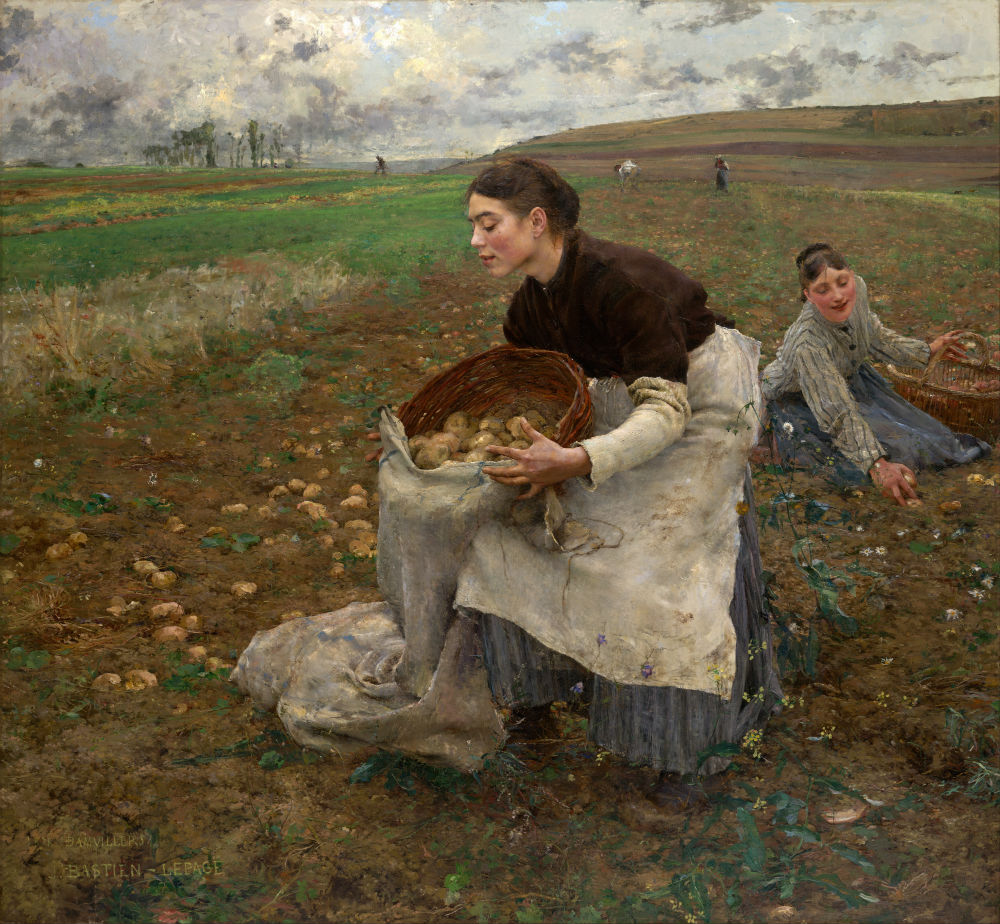
Jules Bastien-Lepage, October, 1878, National Gallery of Victoria
“The essence of realism … is the distance taken with regard to stories, to their temporal schemes and their sequences of causes and effects. Realism opposes situations that endure to stories that link together and pass from one to the next.” (Ranciere, 2013: 7)
“Stories demand that we retain, from each situation, the elements capable of being inserted into a schema of causes and effects. But realism, for its part, requires us to go ever deeper into the interior of the situation itself, to expand, ever farther back, the chain of sensations, perceptions, and emotions which make human animals into beings to whom stories happen, beings who make promises, believe in promises, or cease to believe in them.” (Ranciere, 2013: 9)
Rationale
How meaningful is the question of ‘realism’ for design practices? Is it an important question, or one that is more important for works of art, whether literary, visual or audiovisual?
While not directly relevant as an aesthetic, semiotic or representational judgment, it could be argued that the question of ‘realism’ is important for designers because it also implicitly raises a number of questions concerning: the character of of ’reality’; the character of that which is being represented; and, by implication, the question of the ‘subject’, as actant or interpretant, for whom the design establishes relationships among the ‘realistic’, the ‘real’, the ‘fictional’ and the ‘factual’. Understanding the complex relationships among these four terms, ‘realistic’, ‘real’, ‘fictional’ and ‘factual’, is vital for understanding how the ‘real’ is constituted, experienced and, indeed, performed.
One important reason for considering ‘realism’, then, especially in its ‘deformed’ or ‘neo-‘ forms, is the nature of the (human) ’subject’, or, more broadly, in a post-humanist and ‘augmented reality’ digital environment, the ‘persona’, ‘avatar’ or ’actant’, that is implicated. Of particular interest is how bodily capacities drawn upon by the design, which determines the nature of the participatory action required of the (human or other) interpretant-actant.
In terms of participation, the implied ’subject’ of a conventional work of ‘realism’ is a reader, viewer or spectator, that is, focused primarily on ‘the eye’ with responses that are primarily intellectual. The sensory range is curtailed, excluding the other sense-organs, and the interpretive range is restricted, to cognitive understanding, issues which Juhani Pallasmaaa (2005, 2009) discusses in the context of architectural design.
In short, ‘realism’ is not a primary issue for designers. However, the issue of ‘reality’ is a key concern. So is the relationship established to an implied/addressed ‘subject’, through whatever degree of participation is called upon between the design and the ‘reality’ that the designer is seeking to evoke, affirm or critique; or, indeed, affirm critically. This assumes that the primary aim of a design is not to describe, show or represent a reality but to take up an active, practical, critical relationship to a specific, definable social-material ’reality’.
While those artefacts deemed to be works of ‘realism’, for example, in the late 19th century, may have been ‘critical’ of the ‘reality’ they were representing, the implied subject received that critique as a reader of a literary text or as a viewer of a pictorial text, in short, as a spectator of that ‘reality’ not as an active participant in that ‘reality’. For the participant-actant in a design, particularly if it is an environmental design, while it may the world of an other that is being enacted (their world), it is presented in such a way that ‘you’, the participant-actant is implicated. In other words, ‘your world’ is put into relation with ‘their world’ in a practical dialogue.
It is, therefore, not so much the techniques of ‘realism’ that are of primary interest or value to the designer, but their purpose: to highlight in a critical manner, to establish a critical relationship to, an enacted ‘reality’. It has to be said, in case there are any misunderstandings at this point, that ‘reality’ itself is always in question, realised as emergence through a plurality (Arendt, 1990) of distinct standpoints and viewpoints inter-acting while seeking to establish the (symbolic, rational) ‘reality principles’ (Brown, 2015, 2018; Parsons, 2018) among themselves.
Because ‘designs’ are not ‘works of art’ in any straightforward sense, they are not simply works of representation, realistic or otherwise. They take place in ‘the real’, and (re-)enact the real. Nevertheless their ‘reality’ is a ‘mixed reality’: realistic and real; fictional and factual. They are, in the words of Jacques Derrida (1994), artifactual and actuvirtual.
Realism in Jakobson: Summary
Although one should bear in mind, as Nelson Goodman (1983: 272) cautions, that, “Realism, like reality, is multiple and evanescent, and no one account of it will do.” [1], nevertheless, in discussing ‘realism’, a good place to start is the work of Roman Jakobson (1987), who differentiates among five different meanings of the word ‘realism’:
1. Realism as the intention of the author/creator/maker, who conceives the text as realistic;
2. Realism as the reception of the text, i.e. the reader/spectator/auditor perceives the text as realistic;
3. Realism as literature and painting characteristic of the realistic movement(s) of the nineteenth century, literary realism and realism in painting [2];
4. Realism as any number of literary, painterly, theatrical, photographic or cinematographic techniques and devices which lend a sense of the real to a text, image, cinematic, televisual, videographic or theatrical production;
5. Realism as the consistent motivation and realisation of poetic devices, for example, in the poetic (‘more accurate’) rendering of a delirious experiential state (experiential realism)
For Jakobson (1987: 13), realism does not represent the extra-literary or extra-artistic world as it really is. Rather, it follows certain rules whose goal is to create a particular illusion or impression of reality, a reality-effect, so to speak.
Realism in Jakobson: Narration
Realism, as Roman Jakobson (1987) defines it, is “an artistic trend which aims at conveying reality as closely as possible and strives” for maximum verisimilitude. We call realistic those works which we feel accurately depict life by displaying verisimilitude.
Jakobson points out that this immediately faces us with a dilemma. Realism may be taken to refer to the aspiration and intent of the author, i.e. it is conceived by its author as a display of verisimilitude (meaning 1). It is conceived as intending to be true to life. Alternatively, a work may be called realistic if the person judging it perceives it as being true to life (meaning 2).
In the first case, we evaluate on an intrinsic basis, in terms of the literary or other artistic conventions used, the diegetic universe, in Souriau’s phrase, the structure and rhetoric of the work. In the second case, the reader’s individual impression is the decisive criterion, the imaginary world constructed by the reader or spectator ‘measured’ against, compared with or contrasted with the symbolic world the reader or spectator inhabits). The realism lies in the reception and interpretation of the work.
Jakobson considers that these two distinct meanings have been irredeemably confounded in the history art, such that the question of whether a given work is realistic or not is covertly reduced to the question of what attitude the reader or spectator takes toward it.
This has led, Jakobson argues, to the emergence of a third meaning. He points out that classicists, sentimentalists, the romanticists (to an extent), even the “realists” of the nineteenth century, the modernists to a large degree, and finally the futurists, expressionists, and their like, have all proclaimed faithfulness to reality, maximum verisimilitude, in other words, realism, as the guiding motto of their artistic programme.
In the 19th century, this motto gave rise to an artistic movement. It was primarily the late copiers of that trend, Jakobson argues, who outlined the history of art (as recognised at the time of Jakobson’s writing in 1921), in particular, the history of literature. Hence, he suggests, one specific case, one separate artistic movement, was identified as the ultimate manifestation of realism in art and was made the standard by which to measure the degree of realism in preceding and succeeding artistic movements.
Thus, a new covert identification has occurred, a third meaning of the word “realism” has crept in (meaning 3), one which comprehends the sum total of the features characteristic of one specific artistic current of the nineteenth century. For literary and art historians in the early 20th century, the realistic works of the 19th century represent the highest degree of verisimilitude, the maximum faithfulness to life.
As the conventions of a particular moment in art and literary history come to be equated with realism (meaning 3), the definition of realism as the artistic intent to render life as it is (meaning 1) becomes subject to ambiguity: realism can be taken as the tendency to deform the given artistic norms that are conceived as an approximation of reality (meaning 2.1); or as the tendency to conform to the conventions of a given artistic tradition, one conservatively conceived as faithfulness to reality (meaning 2.2).
Taking this ambiguity into account, and applying it in the context of meaning 2, which presupposes that my subjective evaluation will pronounce a given artistic fact faithful to reality, meaning 2.1 emerges when I rebel against a given artistic code and view its deformation as a more accurate rendition of reality; while meaning 2.2 emerges when I am conservative and view the deformation of the artistic code to which I subscribe as a distortion of reality.
The concrete content of 1.1, 1.2, 2.1 and 2.2 is extremely relative, Jakobson notes.
Thus, new realist artists (in the sense of 2.1) were compelled to call themselves neo-realists, realists in a higher sense of the word, or naturalists, and they drew a line between quasi- or pseudo-realism (meaning 3) and what they conceived to be genuine realism, that is, as borne out in their own work.
‘’I am a realist, but only in the higher sense of the word”, Dostoevski claimed, while almost identical declarations have been made in turn by the Symbolists, by Italian and Russian Futurists, by German Expressionists, and so on.” (Jakobson, 1987: 24)
Progressive realism can be characterised in terms of unessential details. One such device, Jakobson argues, is the condensation of the narrative by means of images based on contiguity, that is, avoidance of the normal designative term in favour of metonymy or synecdoche, a condensation which is realised either in spite of the plot or by eliminating the plot entirely. For example, when describing Anna’s suicide, Tolstoj primarily writes about her handbag. Such an unessential detail would have made no sense to Karamzin, although Karamzin’s own tale, in comparison with the 18th-century adventure novel, would likewise seem but a series of unessential details [3]. Since such a device is frequently thought to be realistic, i.e. lifelike in the sense that life does not follow a narrow narrative path but is full of irrelevant (from the perspective of story) personas and events, this gives rise to meaning 4, stressing that 4 is often found within 3.
This desire to conceal the answer, this deliberate effort to delay recognition, brings out a new feature, the newly improvised epithet or added quality. Thus, a strange term may be foisted on an object or asserted as a particular aspect of it. Negative parallelism explicitly rejects metaphorical substitution for its proper term: “I am not a tree, I am a woman,” says the girl in a poem by the Czech poet Sramek. This literary construction can be justified; from a special narrative feature, it can become a detail of plot development.
From time to time, the consistent motivation and justification of poetic constructions have also been called realism. Thus, the Czech novelist Capek-Chod in his tale, “The Westernmost Slav” somewhat disingenuously calls the first chapter, in which a ”romantic” fantasy is motivated by typhoid delirium, a “realistic” chapter. Jakobson calls such realism meaning 5. That is, it is a mode of ‘realism’ in which the requirement of consistent motivation and realisation of poetic devices is met. Meaning 5 is often confused with 3, 2 and so on.
Notes
[1] Similarly, Kirstin Sørensen comments that there are three perceptions of literary realism that predominate. All of them have been considered, and sometimes still are considered, to define literary realism, but all of which ultimately do a disservice to the genre and its appreciation. They are realism as a period phenomenon, that is, the realistic literature of the 19th century; realism as maximum accuracy in the representation of reality; and realism as maximum verisimilitude to the real (appearance of the real).
[2] In literature, this includes the work of Honoré de Balzac in France, George Eliot in England, and William Dean Howells in America. In painting, this includes the work of French artists Gustave Courbet, such as, for example, ‘The Stonebreakers’ of1850, Honoré Daumier, and Jean François Millet as well as such US artists as William Sidney Mount, Thomas Eakins and (although a little later in the early 20th century) the Ashcan school. According to literary history, realist literature is was produced in Europe and the USA from the1840s to the 1890s, when realism was superseded by naturalism.
[3] As Jakobson (1987: 25) explains, “If the hero of an eighteenth-century adventure novel encounters a passer-by, it may be taken for granted that the latter is of importance either to the hero or, at least, to the plot. But it is obligatory in Gogol or Tolstoj or Dostoevskij that the hero first meet an unimportant and (from the point of view of the story) superfluous passer-by, and that their resulting conversation should have no bearing on the story.”
References
Arendt, H. (1990). Philosophy and politics. Social Research, 57 (1), 73–103.
Brown, W. (2015). Undoing the Demos. Cambridge, MA: MIT Press
Ranciere, J. (2013) Bela Tarr: The Time after. Translated by E. Beranek. Minneapolis, MN: Univocal.
Shiff, R. (1988). Art history and the nineteenth century: realism and resistance. Art Bulletin, 70 (1), 25–48. Available from http://www.jstor.org/stable/3051152 [Accessed 6 September 2018].
According to Ekin Erkan (2019: 218), while biopower may sufficiently explain the kinds of neuroses troubling citizens in the mid-to-late 20th century, psychopower, in contrast, is globalized and diffracted. As a system, it encompasses the organization of the capture of attention made possible by the psycho-technologies developed gradually through radio in the early 20th century, television in the mid-20th century and digital technologies in the late 20th century.
Psychopower results in the massive destruction of attention, exacerbated by ‘24/7 capitalism’, “where generalized human life is inscribed into duration without breaks and defined by a principle of continuous functioning (and sleeplessness)” (Erkan, 2019: 218).
Design challenge or design paradox
In this context, a challenge for design practices might be expressed as follows:
How can you use what Rosen (2012) calls the ‘weapons of mass distraction’ (broadcast media plus internet-based media) to gain the attention of people in order for them to be able to focus on the problems (at various scales) in which they are entangled? This is conceived as problem setting rather than problem solving.
If you do not use those media, people will not see your design. If you do use those media, they will be unable to act on it, because they will not be attending to it and focusing on it (Rosen, 2012). A further difficulty is that, given the proliferation of information and misinformation, people will find it difficult to decide who or what to trust as a basis and an orientation for action (Quill, 2014).
In this context, Larry Rosen (2012) makes a distinction between addiction and obsession. He argues that people are obsessed by their devices and platforms, such as smartphones and Facebook. Simplifying greatly, he argues that addiction stems from a need to increase neurotransmitters, such as dopamine, endorphins and others, in our brain, while obsession stems from a need to decrease neurotransmitters that are related to anxiety. He adds the caveat that obsessions also increase other neurotransmitters that block positive, elevated moods and produce anxiety.
Of relevance for design practice is that anxiety spans addiction and obsession, both of which affect the ability of attend and to focus. Both, in other words, affect human actantiality as capability to act-in-situation, to be able to recognise, constitute and act upon affordances. What might be described as a perceptual and interactional impoverishment ensues.
References
Erkan, E. (2019) ‘Psychopower and ordinary madness: Reticulated dividuals in cognitive capitalism’, Cosmos and History, 15(1), pp. 214–241.
Quill, L. (2014) Secrets and Democracy. Houndmills, Basingstoke, UK: Palgrave Macmillan.
In the practice of the Situationist International, psychogeography is defined as the study of the specific effects of the geographical (and topographical) environment, whether consciously organised or not, on people’s emotions and behaviour.
Debord and his Situationist International colleagues proposed a set of cultural strategies to combat and subvert the commodification of everyday life under contemporary capitalism, of which psychogeography was part. Psychogeography draws attention to the emotional or psychic aspects of urban experience, and to the spontaneous encounter with and reflection on this experience.
Debord associates two key strategies with psychogeographical practice: ‘derive’ and ‘detournement’.
The figure of the psychogeographer has obvious affinities with the earlier idea of the urban flaneur and draws also on the ideas of the surrealists on the modern city, as explored, notably, in Louis Aragon’s Paris Peasant (1926) and Andre Breton’s Nadja (1928), both set in Paris. (Brooker, 2003: 2010)
The film below presents a portrait of Timothy ‘Speed’ Levitch, a tour guide whose embodiment of ‘cruising’ enacts the spirit of psychogeography.https://www.youtube.com/embed/IOeXcXUzyPU
References
Bonnett, A. (1992). Art, ideology, and everyday space: subversive tendencies from Dada to postmodernism. Environment and Planning D: Society and Space, 10 (1), pp.69–86.
Brooker, P. (2003). A Glossary of Cultural Theory, 2nd ed. London, UK: Arnold.
Coverley, M. (2006) Psychogeography. Harpenden, Herts, UK: Pocket Essentials.
Ellard, C. (2015) Places of the heart: the psychogeography of everyday life. New York, NY: Bellevue Literary Press.
Richardson, T. (ed.) (2015) Walking inside out: contemporary British psychogeography. London, UK: Rowman & Littlefield International.
The protagonist may sometimes be referred to as the main character, the focal character or the hero. In one sense, it is the actantiality around which the unfolding of the narrative unfolds: its movements and actions giving rise to counter-movements and counter-actions, creating a centre or point of return for the specific actantial dynamics and also, in many respects, the narrative’s deictic centre. For design practices, taking into account Greimas’ and Latour’s actantial theory, the actant by means of which the action centrally unfolds may not be a human ‘character’ but rather a place, an atmosphere, an institution, an organisation or a non-human life form which has agency in some respect.
For example, while Lear is clearly the protagonist in Shakespeare’s King Lear, it could also be said, taking into account the way agency is distributed by the plotting of the play, that the the force of nature, as embodiment of ‘the gods’ and their will, is the protagonist. In more contemporary examples, concerning ecological and environmental narratives and assuming a non-theological perspective, the protagonist might be the world’s oceans and their circulations, the atmosphere’s air and its flows or the earth’s oceanic and continental plates and their movements. These types of environments open up to the kind of thinking that takes place under the heading of ‘new materialism’, in which matter is not assumed to be passive and inert but active and ‘vital’, a problematic term which, in turn, opens up debates about what is meant by ‘material vitality’ (Bennett, 2010).
From another perspective, the protagonist is the character with whom the audience is intended to share the most empathy.
Empathy is a pivotal moment in engaging a reader, viewer or audience in the sequence of action in a narrative. The question of whether such emotional engagement is conjoined with an accompanying intellectual engagement or is treated as an end in itself, as part of an emotional catharsis, is key to the debate that Brecht, in establishing the ground for his ‘epic theatre’, develops with the Aristotelian view of tragic theatre.
The protagonist, while sometimes referred to as the “good guy”, in a pre-feminist or a pre-gender-neutral formulation, may be the clear villain or antihero of the piece.
Further discussion
In an interesting discussion of kinds of fictions, relevant for notions of the protagonist in design practices, Northrop Frye (2000: 33-34) argues that it is possible to classify fictions or narratives by the hero’s, heroine’s or protagonist’s power of action, which may be greater than, less than or roughly the same as that of the reader, viewer or audience.
Thus, in Frye’s scheme, if the protagonist is superior in kind both to other humans and to the environment of other humans, they are a divine being, and the story about this protagonist will be a myth in the common sense of a story about a god.
If the protagonist is superior in degree to other humans and to the environment, the hero/ine is that of romance, whose actions are marvellous but who is nonetheless a human being. The hero/ine of romance moves in a world in which the ordinary laws of nature are partly, but not wholly, suspended.
If the protagonist is superior in degree to other humans but not to the natural environment, the hero/ine is a leader. While this protagonist has authority, passions, and powers of expression far greater than the reader, viewer or audience, what they do is subject both to social criticism and to the order of nature. This is the hero/ine of the high mimetic mode, of most epic and tragedy, and is the kind of tragic hero/ine that Aristotle had in mind.
If the protagonist is superior neither to other humans nor to the environment, the hero/ine is one of us. The reader, viewer or audience responds to a sense of their common humanity, and the world conforms to our own experience. This is the hero/ine of the low mimetic mode, of most comedy and of realistic fiction. It may be difficult to retain the word ‘hero/ine’ for this type of protagonist, while such a character may not attain to the degree of becoming an anti-hero/ine.
If the protagonist is inferior in power or intelligence to the reader, viewer or audience, so that there is a sense of looking down on a scene of bondage, frustration or absurdity, the hero/ine belongs to the ironic mode. This remains the case when the reader, viewer or audience feels that s/he is or might be in the same situation, as the situation is being judged by the norms of a greater freedom.
References
Bennett, J. (2010) Vibrant matter: a political ecology of things. Durham, NC: Duke University Press.
Frye, N. (2000). Historical criticism: theory of modes. In: Anatomy of criticism: four essays. Princeton, NJ: Princeton University Press.
 Incomplete ...