Posthuman

RELATED TERMS:  Anthropo-Scenes; Anthropocene – Capitalocene – Chthulucene; Plantationocene; Humanism; Object-Oriented Ontology; PostanthropocentrismPosthumanism;

Ferrando (2013) states that the term ‘posthuman’ has become a key term in contemporary academic debate. It addresses an urgent need for an integral redefinition of the notion of the human, following the onto-epistemological as well as scientific and bio-technological developments of the twentieth and twenty-first centuries. Like posthumanism and postanthropocentrism, posthuman is a valuable term with which to engage when considering the design and interpretation of how the narrative, the environmental and the human aspects of designs interact. [1]

Ferrando warns that the terms posthuman, posthumanism and transhumanism are confusedly intertwined. She argues that the following distinction should be kept in mind:

“for some transhumanists, human beings may eventually transform themselves so radically as to become posthuman, a condition expected to follow the current transhuman era. Such a take on the posthuman should not be confused with the post-anthropocentric and post-dualistic approach of (philosophical, cultural, and critical) posthumanism.”

(Ferrando, 2013)

According to N. Katherine Hayles (2006: 160-161), whereas, since the Enlightenment, the ‘human’ has been associated with rationality, free will, autonomy and a celebration of consciousness as the seat of identity, the posthuman in its more mischievous forms is construed as “an informational pattern that happens to be instantiated in a biological substrate”.

There are, however, more benign forms of the posthuman that can serve as effective counterbalances to the liberal humanist subject, in which, rather than as untrammeled free will, agency is recognised to be always relational and distributed. This also enables a correction of an over-emphasis on consciousness, so that a more valuable view of cognition can be developed, in which cognition is recognised as being embodied, distributed throughout the human body, and extended into the social and technological environment (Hayles, 2006: 160-161). These insights are especially valuable for the ways in which agency can be understood in designed systems and entities which intertwine narrative, environmental and human actantiality or modes of performativity.

It is usually Donna Haraway’s (1991) ‘Cyborg Manifesto’ that is credited with critically embracing the ambiguous potential that ‘becoming posthuman’ might bring, both liberating and regressive, Stefan Herbrechter (2013: 3) suggests. However, this debate really takes off with N. Katherine Hayles’s How We Became Posthuman (1999), in which she attacks the transhumanist fantasies underpinned by cybernetics that want to digitalise the body by merely repressing the old Christian and Cartesian mind-body dualism problem.

In doing so, Hayles contends, they continue a humanist, idealist and universalist tradition that occludes material differences. Rosi Braidotti, and other materialist, posthuman feminists such as Karen Barad (2003, 2007) or Vicki Kirby, for example, instead focus on the material effects of changes to human embodiment. An early version of this emphasis can be found in Halberstam and Livingston’s Posthuman Bodies of 1995.

An account of medical and cultural approaches to the posthuman can be found in Andy Miah’s (2007) chapter “Posthumanism: A critical history”.

Posthuman and Transhumanism

Kevin LaGrandeur (2014) notes two significant differences between transhumanism and the posthuman. Firstly, the posthuman focuses on information and systems theories, i.e. cybernetics. Consequently, the posthuman has a primary relationship to digital technology. Secondly, the posthuman emphasises systems, such as humans, as distributed entities, in other words, as systems comprised of, and entangled with, other systems.

Transhumanism does not emphasize either of these things.

The transhuman as a project seeks to modify the human species via any kind of emerging science, including genetic engineering, digital technology and bioengineering. Prosthetics and other modifications are used to enhance, rather than compensate for, normal human functions (LaGrandeur, 2014).

Notes

[1] Adalaide Morris (2006: 4) suggests that: “Although the term “posthuman” has been defined in various ways, the common element in its use is a synergy between human beings and intelligent machines.”

Morris (2006: 35) further notes that the term “intelligent machine” first gained currency in Alan Turing’s landmark essay “Computing Machinery and Intelligence,” in which he proposed the imitation game as a test for machine intelligence. Katherine Hayles uses ‘intelligent machine’ to denote machines performing tasks that require cognition. The example she gives are neural nets performing sophisticated decisions, expert systems making judgments, information-filtering ecologies selecting data, genetic programs designing electrical circuits. Morris argues that any entity that can perform these tasks should prima facie be considered as thinking or intelligent and uses the term to mean any digital device capable of processing data and acting on the basis of that data.

What is of more interest for design practices is not machine intelligence per se, but how human, machine, intelligent machine and variously constituted environments, from built environments to soundscapes and atmospheres to ambiences, are enfolded and interact to form what might be called adaptive living systems with emergent (not simply embodied or programmed) intelligence.

References

Barad, K., (2003). Posthumanist performativity: toward an understanding of how matter comes to matter. Signs: Journal of Women in Culture and Society, 28 (3), pp.801–831. Available at: http://www.jstor.org/stable/10.1086/345321

Barad, K. (2007). Meeting the universe halfway: quantum physics and the entanglement of matter and meaning, Durham: Duke University Press.

Braidotti, R. (2013). The Posthuman. Cambridge, UK: Polity.

Braidotti, R. and Hlavajova, M. (eds) (2018) Posthuman glossary. London, UK: Bloomsbury Academic.

Ferrando, F. (2013). Posthumanism, transhumanism, antihumanism, metahumanism, and new materialisms: differences and relations. Existenz, 8 (2), 26–32.

Haraway, D.J. (1991). A Cyborg manifesto: science, technology, and socialist-feminism in the late twentieth century. Chapter 8 in Simians, cyborgs, and women: the reinvention of nature. New York, NY: Routledge, 149-181.

Halberstam, J. and Livingston, I. (1995). Introduction: Posthuman bodies. In: Posthuman Bodies, edited by J. Halberstam and I. Livingston. Bloomington, Indiana: Indiana University Press.

Hayles, N.K. (2006). Unfinished work: from cyborg to cognisphere. Theory, Culture & Society, 23 (7-8), pp.159–166. Available at:http://tcs.sagepub.com/cgi/doi/10.1177/0263276406069229

Hayles, K. (1999). How we became posthuman: virtual bodies in cybernetics, literature, and informatics. Chicago Ill.: University of Chicago Press.

Herbrechter, S. (2013). Rosi Braidotti (2013) The Posthuman. Cambridge: Polity Press. ISBN : 978-0-7456-4158-4 [Book review]. Culture Machine, (April). Available at: http://www.culturemachine.net/index.php/cm/article/viewFile/495/516

LaGrandeur, K. (2014) What is the difference between posthumanism and transhumanism. Institute for Ethics and Emerging Technologies https://archive.ieet.org/articles/lagrandeur20140729.html [Accessed 17 June 2021]

Miah, A. (2007). Posthumanism: A critical history. In: Medical Enhancements and Posthumanity. New York, NY: Routledge, 1–29.

Morris, A. (2006). New media poetics: as we may think/how to write. In: New media poetics: contexts, technotexts, and theories. edited by A. Morris, and T. Swiss. Cambridge, MA: MIT Press, 1-46.

Wolfe, C. (2010) What is posthumanism? Minneapolis, MN: University of Minnesota Press.

Postanthropocentrism

RELATED TERMS: Anthropo-Scenes; Anthropocene – Capitalocene – Chthulucene; Plantationocene; Humanism; Object-Oriented Ontology; Posthuman; PosthumanismSpeculative Realism

The idea of ‘postanthropocentrism’, which questions the human exceptionalism and methodological individualism of certain strands of humanist traditions, is a key focus of posthumanist thinking. It is a rethinking the human in its necessary relations to the nonhuman others, such as animals, machines, objects, systems, environments, for example, that form a necessary, but generally unrecognised, part of ‘being human’. (Herbrechter, 2013: 3)

The value of the concept of postanthropocentrism for design practices is that it invites a reconsideration of the relationships among the discursive, the narrative, the environmental and the human dimensions of the overall design, conceived as a field of actantiality. The narrative and the environmental are not supplements or additions to human being but are integral parts of an extended life/support system, in Sloterdijk’s terms, of which the human is part.

References

Braidotti, R. (2013) The Posthuman. Cambridge, UK: Polity.

Herbrechter, S. (2013). Rosi Braidotti (2013) The Posthuman. [Book review]. Culture Machine, (April). Available at: http://www.culturemachine.net/index.php/cm/article/viewFile/495/516

Politics and the Political

RELATED TERMS: Agonistic politics – Mouffe; Dissensus – Ranciere; Distribution of the sensible; Biopolitics and Biopower; Arendt; Heidegger; Lefebvre

Specific narrative environments, whether explicitly designed or not, may be said to be ‘political’ or to have political effects in some sense. In order to define more clearly what might be meant by this kind of assertion and to understand how a narrative environment might be said to act ‘politically’, it is worth pondering the distinction often made by contemporary political theorists between ‘politics’ and ‘the political’.

Politics or policy (la politique in French, Politik in German), refers to concrete policy-making, decisions and actions, the struggle for power and its exercise; while ‘the political’ (le politique in French, das Politische in German) refers to the frame of reference within which ‘politics’ occurs, implying the notion of polity or political unity. This distinction, awkward in English, has made its way into Anglo-American political theory via European philosophy.

Oliver Marchart (2007) traces the history of this ‘political difference’ in Ricoeur, Arendt, Schmitt and Mouffe, through to Nancy and Lacoue-Labarthe, with diversions into Wolin, Sartori and others.

The theoretical differentiation between politics and the political occurs for the first time in German political thought with Carl Schmitt, while the habit of differentiating between these two concepts started in French thought in 1957, with Paul Ricœur’s essay ‘The Political Paradox’. This led Jean-Luc Nancy and Philippe Lacoue-Labarthe to adopt the differentiation which, in turn, motivated other theoreticians such as Claude Lefort and Alain Badiou to reformulate their own theory in terms of the political difference.

Ricoeur was responding to the failed Hungarian revolution of 1956. He was shocked by the unexpectedness of the Budapest uprising and the severity of its suppression by Soviet troops. In his view, the event demonstrated the autonomy of the political as a domain of human experience, distinct from other domains such as the moral, economic or aesthetic. The political domain has own particular problems, dynamics, modes of action and normative criteria (Schaap, 2013).

The concept of the political is frequently invoked by post-Marxists and theorists of radical democracy. Reacting against the Marxist view of politics, both Schmitt and Arendt, as does Ricoeur, insisted on the autonomy of the political. French post-Marxists, including Claude Lefort, Étienne Balibar and Jacques Rancière, have drawn on these debates about the political to critically appraise the liberal human rights consensus that emerged in the wake of the Cold War as a basis for examining how human rights might be mobilised for an emancipatory politics (Schaap, 2013).

For Lefebvre, the difference between le politique and la politique enables a distinction (i.e. not a disassociation nor a separation) between the thinking of the political and political action.

In the work of Chantal Mouffe, ’the political’ refers to the dimension of antagonism that can take many forms and can emerge in different social relations. ‘Politics’, she takes to refer to the ensemble of practices, discourses and institutions that seek to establish a particular order and to organise human co-existence in conditions which are always potentially conflicting, because they are affected by the dimension of ‘the political’.

References

Chambers, S.A. (2011). Jacques Ranciere and the problem of pure politics. European Journal of Political Theory, 10 (3), 303–326.

Marchart, O. (2007). Post-foundational political thought: political difference in Nancy, Lefort, Badiou and Laclau. Edinburgh, Edinburgh University Press.

Ricoeur, P. (1965). The Political Paradox. In: History and Truth, translated by. Charles A Kelby. Evanston, Ill: Northwestern University Press, 247-270.

Schaap, A. (2013). Human rights and the political paradox. Australian Humanities Review, 55, 1–22.

Poiesis

RELATED TERMS: Philosophy; Praxis;

Poiesis is a Greek term that means making, producing, creation, creative power or ability. Poiesis is contrasted with praxis, which means ‘doing’ or ‘acting’, by Plato and Aristotle. Excellent making requires techne, skill, while excellent doing requires arete, virtue.

The question for design practices is whether the design process and the design outcome are modes of production or modes of action or, indeed, a mixture of both.

The Aristotelian distinction between poiesis and praxis is developed by Hannah Arendt, through a re-reading of Heidegger’s Being and Time, when she distinguishes among labour, work and action (or labour, work, action and thinking). For Arendt, labour simply reproduces the labourer and leaves no trace in the world; it is through work that the world is made and re-made in its material form; while it is through action that the political and the ethical dimensions of social existence are realised as spheres of human practice.

The important question to pose of a design is how it takes part in the work of (re-)making the world and how it acts ethically and politically (and upon whom or what)?

References

Arendt, H. (1998) The Human condition. 2nd edn. Chicago, IL: University of Chicago Press.

Placemaking

RELATED TERMS: World-Building

Placemaking is about the collaboration between all elements which make the whole, coming to life through its use. It is our experience of place that gives it meaning. Placemaking is the art of creating public ‘places of the soul,’ that uplift and help us connect to each other; “making a Public Space a Living Space.”

According to Markusen and Gadwa (2010),

“In creative placemaking, partners from public, private, non-profit, and community sectors strategically shape the physical and social character of a neighborhood, town, city, or region around arts and cultural activities. Creative placemaking animates public and private spaces, rejuvenates structures and streetscapes, improves local business viability and public safety, and brings diverse people together to celebrate, inspire, and be inspired.”

References

Markusen, A. and Gadwa, A. (2010) Creative placemaking. Washington, DC: National Endowment for the Arts. Available at: http://www.nea.gov/pub/CreativePlacemaking-Paper.pdf.

Place, Space, Placiality, Spatiality

RELATED TERMS: Body; Khora or Chora; Phenomenology; Time

Place

Places are events; they ‘take place’ over extended periods of time. Places are sensible, perceivable by the senses, and intelligible, existing in thought, in the imagination and in the memory. They also constitute a third order, khôra or chora, an interval between the sensible and the intelligible. Such an interval, it is contended, permits or enables designs to ‘take place’ as neither simply sensible nor intelligible, thus allowing for the in-vention, the in-coming of the other: a ‘being-with’, a sharing, rather than a self-contained or discrete ‘being’ or a self-possessed identity. That is to say, while designs are pre-conceived in terms of intention and telos, they may exceed that conception, potentially opening to (a new, radical) inception in the ways in which they continue to act and be acted upon in the world. In their end (telos), so to speak, is their beginning (in praxis).

‘Place’ institutes a complicated, multi-perspectival, dialogical phenomenology.

From the perspective of design practices, place is intimately related to bodily forms and to the differentiations, according to the deictic, associative and affective orientations and horizons of bodies, among ‘my’ places, ‘your’ places, ‘our’ places and ‘their’ places, all of which form complex topological spaces, whose boundaries are often marked by designed artefacts and environments.

As Cecena Alvarez (2015) notes, “A place is not a portion of space. Place is the lived expression of the spatial apprehension of reality.”

Continue reading “Place, Space, Placiality, Spatiality”

Painting

RELATED TERMS: Visual Arts and Visual MediaPhotography

Mount Sainte-Victoire, about 1904, Paul Cezanne

Painting is the central, canonical medium of art history.

‘The truth in painting’ is a saying of Cezanne’s. Cezanne wrote to Emile Bernard in 1905 that, “I owe you the truth in painting and I will tell it to you”.

The power ascribed to painting, Derrida (1987) argues, is the power of direct reproduction or restitution, adequation or transparency. The truth in painting could be taken to mean truth itself restored, in person, without mediation, makeup, mask, or veil. In other words, the true truth or the truth of the truth, restituted in its power of restitution, truth looking sufficiently like itself to escape any misprision, any illusion; and even any representation, yet sufficiently divided already to resemble, produce, or engender itself twice over, in accordance with the two genitives: truth of truth (the true truth) and the truth of the truth.

References

Derrida, J. (1987) The Truth in painting. Chicago, IL: University of Chicago Press.

Photography

RELATED TERMS: Painting; Apparatus – Dispositif; Promptography

In the context of design practices, photography is one of the many media that may be employed, often as part of a multi-media, multi-modal environment or assemblage. As the history of the cultural and artistic disruption caused by photography shows, the use of any particular medium alters the balance of roles among media in engaging with materiality through what might be called a media ecology.

(Media) History of Photography

Wallerstein describes the invention of photography as posing a serious challenge to the system of the fine arts, prompting, first, a crisis in painting. The idea of the subjective and expressive quality of image making, and implicitly the hierarchy between the artes liberals and artes mechanicae that informs the concept of ‘fine art’, underwent a profound upheaval. The question of the image began to be discused in ontological terms. Thus, the question of “what is…” was gradually seen to precede questions of beauty, composition, and so on. This precedence was, in turn, gradually generalized so as to encompass not only painting, but also sculpture, literature, music and finally art in general, becoming an essential feature of modern art, manifested as an aesthetic as well as ontological unrest.

The encounter with photography as a medium that mechanized image production was taken by some as a dismantling of subjectivity and imagination, and possibly even as the end of painting. Such a sentiment is epitomized in Paul Delaroche’s hyperbolic outcry in 1839: “From today, painting is dead”, cited by Wallerstein (2010). Others, however, saw photography as a liberation of the imagination by redirecting it toward the essentials of art.

In this context, as a response to the advent of photography as a mechanical medium, the arrival of abstraction at the beginning of the 20th century could be understood in two ways. First, as the final discovery of what painting had been since the beginning; and second, as a last stance, beyond which painting had to be abandoned in favor of other forms of practice that would be able to interiorize mechanical and serial (re)production into their very substance.

The first stance imagines the painter uncovering a primordial perceptual dimension in and through painting. Such a claim can be understood to underlie Cézanne’s claim to show us “the truth in painting” peinture”), by plunging into the genesis of the visible that takes its cues from the pure sensations of colour. The second stance, emerging in the period around the First World War, accepts that technology has deprived painting not only of its old mimetic function but also dispelled the idea that it could reach a more true, profound, or elevated reality.

To a large extent, Wallerstein, argues, modernist painting evinces the mutual implication and even inextricable entanglement of these two positions.

Ethics and Politics of Photography

The central focus of Vilem Flusser’s investigation of photography is the camera as prototype for the ontologically conditioning apparatuses of postindustrial society, the prototype for all technical apparatuses of the present-day, postindustrial world. His analysis aims ultimately at the ethics of photography (van der Meulen, 2010).

The Ideological Role of Photography

As noted in the post Promptography, photography, and the presumption of photographic realism, dominated the visual field in the early- to mid-20th century through pictorial magazines such as Life in the USA. In “Life: A New Prospectus for the Sixties”, Henry R. Luce, the magazine’s founder and Editor-in-Chief, defined the purpose of Life in the 1960s in terms of national purpose, the two main objectives being to win the Cold War and to create a better America. Luce conceived of Life’s pictures as potent weapons of the Cold War (Blakinger, 2012).

Through its images, Life magazine, under the directive of its editor, took it upon itself to reflect and reify the American Cold War consensus culture of the early 1960s. Nevertheless, as Blakinger points out, advertising also played a central focus in Life‘s mission. A typical issue of Life had more pages of advertising than editorial content. Moreover, these advertisements, by mimicking the large photograph and sparse caption format, looked very similar to photographic essays. In so doing, they lent themselves some of the unquestioned authority that the magazine’s articles were granted by the public. For example, the text of a February 1963 advertisement for supermarket goods from the Life editors states that, by purchasing the advertised products, “You’re also casting a vote for a reputable manufacturer. […] There’s nothing like an American supermarket anywhere in the world. And there’s no more of an all-American businessman than your own supermarket manager.” In other words, the magazine’s editors explicitly equated consumerism and patriotic duty as primordial American values.

Blakinger, by focusing on Andy Warhol’s appropriation and inversion of certain images from Life magazine for his ‘Death and Disaster’ screen-prints, argues that Warhol’s visual strategies reveal a violent subversion of Life‘s assumptions about photographic realism and its attempts at visual indoctrination through its editorial content and its advertisements. The screen-prints demonstrate how Warhol re-presented the familiar pictures of Life as death, and thus transformed Life’s America into Death in America. [For more discussion of Warhol’s Death in America, see the post Iconic Designs, Critical Designs.]

References

Blakinger, J. R. (2012) “Death in America” and “Life” magazine: Sources for Andy Warhol’s “Disaster” paintings, Artibus et Historiae, 33(66), pp. 269–285. Available at: http://www.jstor.org/stable/23509753 (Accessed: 27 August 2024).

Elkins, J. (ed.) (2007) Photography theory. New York, NY: Routledge.

van der Meulen, S. (2010) ‘Between Benjamin and McLuhan: Vilem Flusser’s Media Theory’, New German Critique, 37(2), pp. 180–207. doi: 10.1215/0094033X-2010-010.

Wallenstein, S.-O. (2010) Nihilism, Art, and Technology. [PhD thesis] Stockholm, Sweden: Stockholm University. Available at: http://urn.kb.se/resolve?urn=urn:nbn:se:sh:diva-9736 (Accessed: 6 February 2016).

Philosophy

RELATED TERMS: Design and Philosophy; Design practice and Functionalism; Phenomenology; Genealogy – Nietzsche; Heidegger; Human Actantiality; Dasein; Epistemology; Ontology; Poeisis; Nihilism

“Where to begin in philosophy has always – rightly – been regarded as a very delicate problem, for beginning means eliminating all presuppositions.” (Gilles Deleuze, 1994: 129)

“The point is not to gain some knowledge about philosophy but to be able to philosophise.” Martin Heidegger, The Basic Problems of Phenomenology

“to philosophize is to be constantly engaged in the never-ending subversion of states of affairs and of systems of thought; it is to be constantly wary of any attempt to solidify the truth of a particular discourse into a privileged ideology whose structure is epistemically violent.” (Hernandez, 2014)

The word philosophy derives from from the Greek term philosophia which means love of knowledge, pursuit of wisdom or systematic investigation. It is a combination of two roots: philo-, meaning loving and sophia meaning knowledge or wisdom.

Philosophy, experience and questioning

Paraphrasing Susan Stephenson (1999: 5), we could argue that design enquiry, like philosophical enquiry, begins with challenges that arise concretely within the life of a particular individual, particular groups or particular societies. It proceeds through a process of dialectical confrontations with different responses to how these challenges can be defined and addressed.

The value of philosophy for design practices and analysis of design action is perhaps best demonstrated with reference to Gregory Fried’s (2011: 240) characterisation of philosophical practice. While acknowledging that there is no consensus on what constitutes philosophy, Fried suggests that philosophy can be thought of as having three moments, moments which are perhaps also present in design practice, as will be discussed below.

The first moment, as articulated by Aristotle in the Metaphysics, is that philosophy begins with a sense of wonder (thaumazein in Greek). That wonder is the experiencing of something as deserving or demanding our attention because it is delightful, puzzling and enticing. Equally, it could be argued that philosophy might begin with a sense of horror or trauma, which may be similarly demanding of our attention, but not for reasons of delight. The crucial point is that philosophy begins with experience and perhaps heightened experience of some kind.

The second moment is the formulation of a philosophical question, an act that requires an intense focus on precisely what is at issue in our wonder [or horror or trauma], as we open to and admit the questions that confront us out of our own individual lived experience, through the embeddedness of the self in the world. By posing questions, we begin to philosophise through what seizes us and what challenges our world. It is the form of the question which guides what may be considered an appropriate response.

The third moment is answering, albeit however provisionally, or responding to the question.This may involve reformulating the question in the process of responding to it. Modern academic philosophical practice tends to focus on this last moment. The proper work of philosophy is seen, from this perspective, to be the production of answers, in the form of rigorous arguments with clear conclusions. However, as Fried argues, fixating on the moment of providing answers as the sole or primary work of philosophy distorts the full scope of what thinking demands of us.

Parallels can be drawn between this characterisation of philosophical practice and design practice. These parallels might be recognised more readily if one takes Martin Heidegger’s (2009: 11) suggestion that,

“The two questions asked in philosophy are, in plain terms:

1. What is it that really matters?

2. Which way of posing questions is genuinely directed to what really matters.” 

For design practice, those questions may need to be extended, to become 1. What is it that really matters, to whom, for whom, in what ways(s), in what situation(s), of what duration? 2. Which ways of posing questions or challenges are genuinely directed to what really matters to whom, for whom, in what way(s), in what situation(s), of what duration?

More generally, like philosophy, design practice is not simply problem solving or answer-giving (moment three in Gregory Fried’s scheme), although, similarly to philosophy, most contemporary design practice is focused on this third moment of giving answers to problems, i.e. providing design solutions. However, to echo Fried, fixating on this moment of providing solutions, in the form of constructed artefacts or designed systems with explicit functions or uses, as the sole or primary work of design distorts the full scope of what design practice, as a mode of thinking, demands of us.

Design practice, like philosophy, needs to work on all three moments. Without good design questions, that are founded in experience and heightened awareness such as moments of wonder, horror or trauma, and a questioning of that experience in relations to the processes of the material social, economic, political and environmental world, such proffered solutions may lead to situations that are even more problematic than the initial one.

Design practice, then, like philosophy, does not begin with the production of answers or solutions but rather with a sense of wonder, or perhaps sometimes horror or trauma, and the posing of questions arising from and within that experience. Crucially, it is the formulation of the design question or questions that is key to arriving at valuable ‘results’. The question does not determine the precise result but it does, however, orient the direction of design processes.

One question might be whether such philosophical or design thinking can be systematised or made into a method. In response, it could be said, as does Friedrich Schlegel in his Athenaeum Fragments, that philosophy is a way of trying to be a systematic spirit without having a system, a position similar to that of Hannah Arendt.

Conventional understandings of philosophy as discipline

More conventionally, students of Plato and other ancient philosophers divide philosophy into three parts: ethics, the principles and import of moral judgment; epistemology, the resources and limits of knowledge; and metaphysics, the rational investigation of the nature and structure of reality. While useful for pedagogical purposes, however, no rigid boundary separates the parts.

David Woodruff Smith (2013) states that traditionally philosophy includes at least four core fields or disciplines: ontology, epistemology, ethics and logic. He suggests that phenomenology can be added to that list. On that basis, he provides elementary definitions of the field of philosophy as follows:

  • Ontology (Metaphysics): the study of beings or their being — what is.
  • Epistemology: the study of knowledge — how we know.
  • Logic: the study of valid reasoning — how to reason.
  • Ethics: the study of values — how we should act.
  • Phenomenology: the study of our experience — how we experience.

Other domains of conventional academic philosophical investigation are:

  • semantics, the examination of the relationship between language and reality; and
  • aesthetics, the examination of notions of sensory perception and beauty.

All of these domains, that is, ethics, epistemology, metaphysics or ontology, logic, semantics, aesthetics and phenomenology, may be of value in design practice, so long as the focus is not simply or solely on producing results, that is, problem solving, but also on experiencing and questioning.

This list of categories, it may be noticed, avoids any notion of politics and political philosophy. This is perhaps a further domain that is of interest to both philosophy and design practice:

  • politics and the political: the examination of the ways in which social groups and societies theorise, organise and regulate themselves through cultural rules, norms, laws and systems of governnment.

References

Deleuze, G. (1994) Difference and repetition. Translated by P. Patton. New York, NY: Columbia University Press.

Fried, G. (2011). A Letter to Emmanuel Faye. Philosophy Today, 55 (3), 219–252. Available from https://www.academia.edu/2613554/A_Letter_to_Emmanuel_Faye [Accessed 29 August 2016].

Heidegger, M. (2009) Phenomenological interpretations of Aristotle: Initiation into phenomenological research. Translated by R. Rojcewicz. Bloomington, IN: Indiana University Press.

Hernandez, M. R. F. (2014) Philosophy and subversion: Jacques Derrida and Deconstruction from the margins, Filocracia, 1(2), pp. 105–134.

Smith, D.W. (2013). Phenomenology. The Stanford Encyclopedia of Philosophy. Available from http://plato.stanford.edu/entries/phenomenology/#5 [Accessed 5 September 2016].

Stephenson, S. (1999) ‘Narrative, identity and modernity’, in ECPR workshop ‘The Political Uses of Narrative’ Mannheim, 29-31 March, 1999, pp. 1–18. Available at: https://ecpr.eu/Filestore/PaperProposal/37fe9dc5-6ad9-4a73-b35a-704d8265ecb0.pdf (Accessed: 31 March 2021).

Performance

RELATED TERMS: Actantiality; Happenings; Performance Art; Performative and Performativity; Metalepsis

The terms performance and performative are important for design practice because, it is argued, designs are performed by a participant. This performance takes on a different character depending on the character of the design itself and may involve a combination of consumption by a consumer; reception and interpretation by a reader, spectator or audience; or instrumental use by a user, as well as scripted or unscripted improvisational actions and decisions by the participant.

The performativity of the design may also be discussed in terms of actantiality or actantiality-passantiality. In any case, through performance, the ‘as if’ is brought together with the ‘is’, to explore actual or potential transformations from one state of being to another. Systems of performative transformations, whatever their material aspects, Schechner (2004, xviii) notes, “also include incomplete, unbalanced transformations of time and space: doing a specific “there and then” in this particular “here and now” in such a way that all four dimensions are kept in play.”

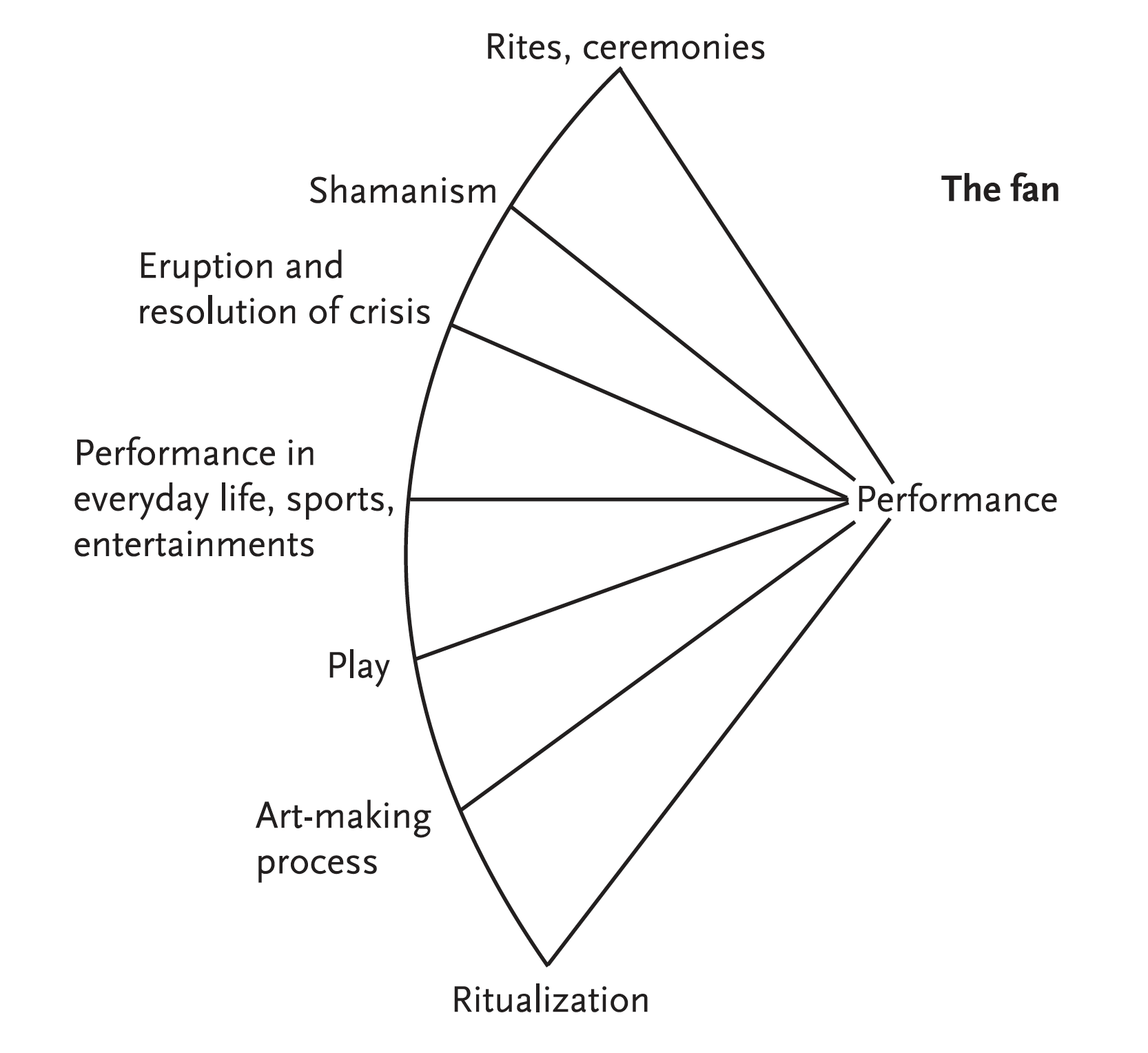
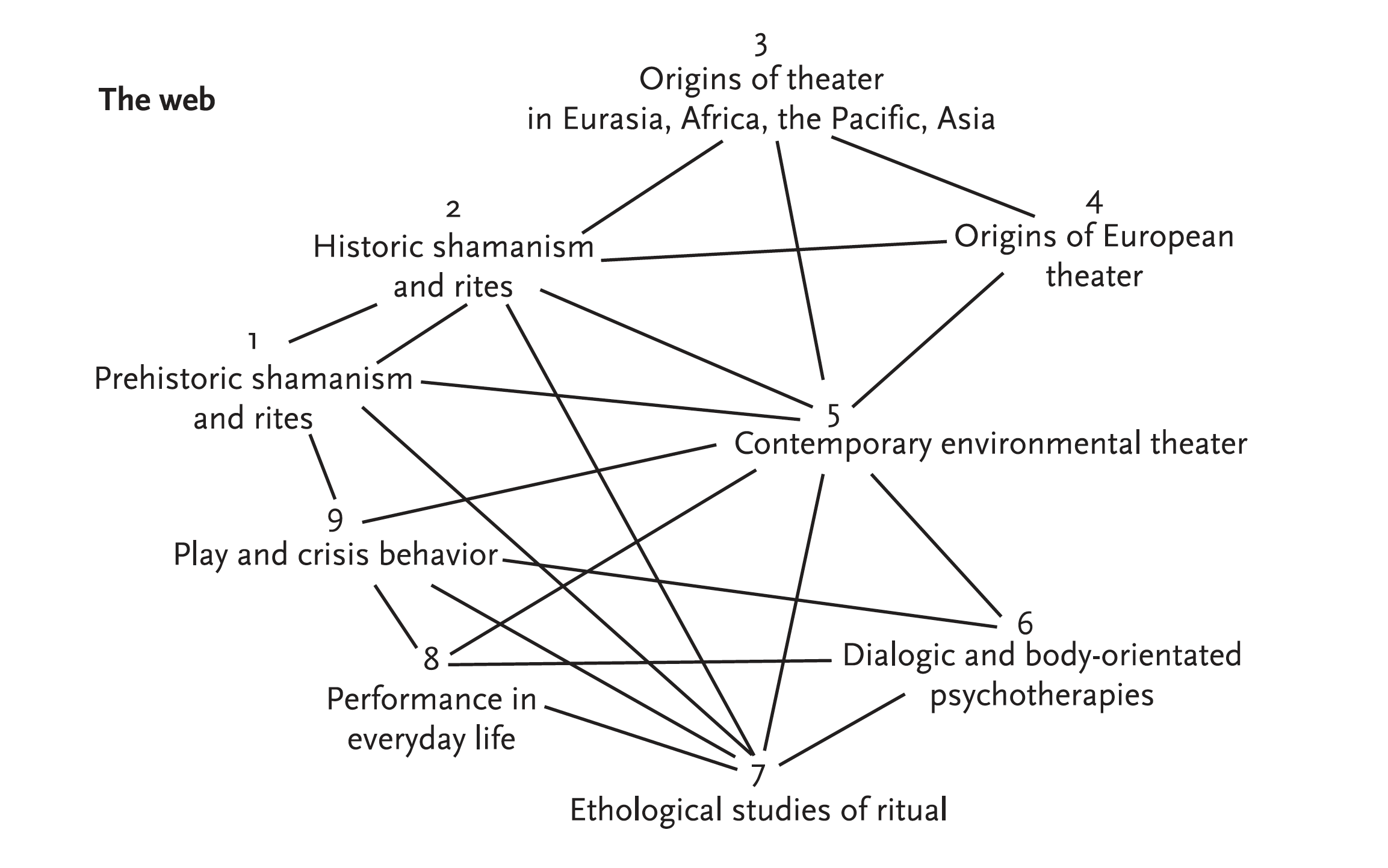
Richard Schechner conceives of the topics which relate to the term performance as a fan or as a web, as follows:

Performance1 Source: Richard Schechner, Performance Theory
Performance2 Source: Richard Schechner, Performance Theory

References

Parker, A. and Sedgwick, E. K. (eds) (1995) Performativity and performance. New York, NY: Routledge.

Schechner, R. (2004) Performance theory. Rev & exp.ed. New York, NY: Routledge.