The term nihilism is derived from the Latin nihil, nothing. Nihilism means belief in nothing. It represents a refusal to accept as given any values. In particular, nihilism questions the basis of ethical values. In one sense, it is an extreme form of scepticism, although its concern is not knowledge and knowing but believing as a basis for action.
Nihilism has undergone a number of interpretations. One interpretation derives from Ivan Turgenev’s characterisation of the younger generation of Russian intellectuals of the mid-19th century in his novel Fathers and Sons (1861). In that novel, the protagonist, Bazarov, is described as a nihilist, i.e. “a person who does not take any principle for granted, however much that principle may be revered” (Macey, 2000: 275-276). The point is not lack of belief per se but a questioning of existing belief structures. Thus, in the Russian context, nihilism came to mean an extreme intellectual radicalism or even terrorism aiming at the overturning of all existing institutions of society in order to build society anew on different principles. Here, it is not so much a belief in ‘nothing’ as a negation of all that is existing, which is very different. Nihilism, in this sense, may be said to incorporate a principle of ‘creative destruction’.
Similarly, Nietzsche is often said to be a nihilist. However, the opening section of The Will to Power (1901) describes the nihilism that stands at the door like the ‘uncanniest of all guests’, which is, rather, a plea for the overcoming of nihilism and for the adoption of new values, particularly those which Nietzsche assigns to the ‘superman’ or ‘higher man’ (Ubermensch), a development of his earlier thinking about free-sprited people who defy convention and its imposed values and thereby acquire a joyful or gay wisdom. In Nietzsche, the dynamic of creative destruction, its agonism, is played out as a recurrent tension between an Apollonian stress on order and individuation and a Dionysiac rapture, violence and destruction of individuality that underlies it.
In the context of avant-garde art movements, Poggioli (1968: 61-65) points out that an important aspect of nihilism lies in attaining non action by acting, a destructive, not a productive labour. This paradoxical combination of activism and antagonistic destruction can be found in Italian and Russian futurism and in English vorticism. However, it was with dadaism that the nihilistic tendency became the primary modality. In dada, nihilism took the form of an intransigent puerility or extreme form of infantilism. Thus, for Tristan Tzara, “There is a great, destructive, negative task to be done: sweeping out, cleaning up” (quoted in Poggioli, 1968: 63).
Poggioli (1968: 64) notes that the British Marxist Christopher Caudwell is sensitive to the dynamic tension that nihilism names in the context of avant-garde art movements. Caudwell suggests that this concerns two features of bourgeois or capitalistic culture: production for the market, which leads to commercialisation and vulgarisation; and a hypostatisation of the art work as the goal of the art process, which places the relation between art work and individual as paramount. The latter leads to a dissolution of those social values which makes the art in question a social relation. In turn, this results in the art work’s ceasing to be an art work and becoming instead a mere private fantasy.
References
Macey, D. (2000). The Penguin dictionary of critical theory. London, UK: Penguin Books.
Poggioli, R. (1968). Agonism and futurism. In: The Theory of the avant-garde. Cambridge, MA: Harvard University Press, 61–77.
Two ecological terms which may be of particular signficance for design practices are habitat and niche. Odum distinguishes the two terms in the following way:
“The ecological niche of an organism depends not only on where it lives but also on what it does. By analogy, it may be said that the habitat is the organism’s ‘address’, and the niche is its ‘profession’, biologically speaking.”
A habitat is an ecological or environmental area that is inhabited by a particular species. It is the natural environment in which an organism lives, or the physical environment that surrounds, i.e. influences and is utilized by, a species population.
The ecological niche describes how an organism or population responds to the distribution of resources and competitors.
Designs may intervene, deliberately or unintentionally, in the context of habitat, by impacting the ecological or environmental area, for example, through urbanisation, and in the context of niche, for example, by affecting how resources are distributed and how some competitors are advantaged over others.
References
Odum, E. P (1953) Fundamentals of Ecology. Philadelphia, PA: W B Saunders.
“The study of narrative has become so popular that the French have honored it with a term – la narratologie. … Modern narratology combines two powerful intellectual trends: the Anglo-American inheritance of Henry James, Percy Lubbock, E. M. Forster, and Wayne Booth; and the mingling of Russian formalist (Viktor Shklovsky, Boris Eichenbaum, Rom Jakobson, and Vladimir Propp) with French structuralist approach (Claude Levi-Strauss, Roland Barthes, Gerard Genette, and Tzvetan Todorov). … Another basis is the work of the philosopher Charles S. Peirce and his continuator, Charles W. Morris. These trees have borne elegant fruit … “(Seymour Chatman, 2016: 121)
“Whatever happened to narratology? … It got swallowed into story seems the obvious answer, it slid off the slippery methods of a million structures and became the story of its own functioning.” (Brooke-Rose, 1991: 16)
“When narratology was invented in the late sixties, three of the things that were lost were context, cultural history and interpretation.” (Nunning, 2009: 56)
Narratology: Disciplinary beginnings in the 1960s
If a date of birth could be given to narratology, Marie-Laure Ryan (2006) suggests, it would fall on the publication date of issue 8 of the French journal Communications in 1966, which contained articles by Claude Bremond, Gerard Genette, A. J. Greimas, Tzvetan Todorov, and Roland Barthes.
For Barthes (1975: 237),
“ … there is a prodigious variety of genres, each of which branches out into a variety of media … Among the vehicles of narrative are articulated language, whether oral or written, pictures, still or moving, gestures, and an ordered mixture of all those substances; narrative is present in myth, legend, fables, tales, short stories, epics, history, tragedy, drame [suspense drama], comedy, pantomime, paintings (in Santa Ursula by Carpaccio, for instance), stained-glass windows, movies, local news, conversation. … Like life itself, [narrative] is there, international, transhistorical, transcultural.”
Equally, for Bremond (quoted in Ryan, 2006: 3-4), story,
“may be transposed from one to another medium without losing its essential properties: the subject of a story may serve as argument for a ballet, that of a novel can be transposed to stage or screen, one can recount in words a film to someone who has not seen it.”
As these quotes from Barthes and Bremond demonstrate, narratology was conceived initially as a field of study that transcends discipline and medium. However, in the subsequent decades, under the influence of Genette, narratology took a different direction, and developed as a project almost exclusively concerned with written literary fiction.
Narratology: Expansion in the 1980s onwards
More recent work has repositioned the study of narrative back onto the transmedial and transdisciplinary track, as envisioned by Barthes. The design of narrative environments extends this study of narrative beyond the transmedial and transdisciplinary into the environmental and the experiential lifeworld.
It was not until 1980 that narrative theory took centre stage in North American literary contexts, ushering in the beginning of the narrativist decade of the 1980s, Martin Kreiswirth (1992) suggests. Kreiswirth points out that during the 1980-1981 academic year there were five special journal issues devoted solely to questions of narrative. Four of them, New Literary History‘s narrative sequel and the three issues of Poetics Today, examined various aspects of literary narratology and flowed along with the structuralist literary mainstream. The fifth, Critical Inquiry‘s special issue “On Narrative”, offered a rather different approach, pointing, in many ways, toward the kind of interrogation of narrative that would become increasingly prominent during the rest of the decade.
As outlined by David Herman in Narratologies, the expansion of narratology in the 1980s can be traced along three paths which he defines as:
firstly, the increase in digital and communications technologies’ and associated methodologies of narrative;
secondly, the progression of narrative beyond the domain of the literary; and
thirdly, the growth of narratology into new ‘narrative logics’.
Herman sketched a shift from classical to postclassical narratology, in the process highlighting new queer, ethnic, postcolonial and feminist narrative perspectives, as well as the expansion of narrative theory into new media such as the performing arts, computer games and film (Jamieson, 2014)
Marie-Laure Ryan, extending Herman, defines narrative as ‘a cognitive construct or mental image, built by the interpreter in response to the text’. From this definition, it is possible to substitute a range of semiotic objects and constructs, including architecture, for the word ‘text’. In this way, Ryan posits narrative as an active process on the part of the reader or viewer, similarly to reader response theory and reception theory. Werner Wolf describes this active process as ‘narrativisation’.
Narrativisation is the application of a narrative frame, i.e. a cognitive construct that is culturally acquired, which describes the way that we use narrative to organise and structure information. Applying the narrative frame to information, whether it be a text, a moving image, a painting, an object or a situation, causes us to ‘narrativise’ the information. This, for Wolf, is an active process which is an essential part of human thinking
Ryan (2006: 15-16) herself discusses the possibility of narrative environments as an example of metaphorical narration when she outlines the extension of narration to architecture. Thus, she argues,
“In the case of architecture, a metaphorical interpretation would draw an analogy between the temporality of plot and the experience of walking through a building. In a narratively conceived architecture, the visitor’s discovery tour is plotted as a meaningful succession of events. This occurs in Baroque churches, where the visitor’s tour is supposed to reenact the life of Christ.”
Other key figures in the theory and the study of narrative and narrative structure, and the ways that these affect our perceptions and actions, include Plato, Aristotle, Shklovsky, Bakhtin, Ricoeur, Foucault and Bal.
A Cautionary Word
To fill out the epigraph by Christine Brooke-Rose at the top of this post, it may be worth quoting the conclusion to her essay, ‘Whatever happened to narratology?” She writes,
“Narratology was thus immensely useful. But in the end, it couldn’t cope with narrative and its complexities, except at the price of either trivialization or of becoming a separate theoretical discourse, rarely relevant to the narrative discussed, when discussed. In other words, it became itself a story, or set of stories, of narratives not only extradiegetic, metalinguistic, transtextual, paratextual, hypotextual, extratextual, intertextual, but also, yes, sometimes, textual, all at the same time. And so, yes, a ‘good’ story. Nevertheless, the study of narratological phenomena, as happens so often, turned into an endless discussion about how to speak of them. The story of narratology became as self-reflexive as a ‘postmodern’ novel.” (Brooke-Rose, 1991: 27)
References
Barthes, R. (1975). An Introduction to the structural analysis of narrative. New Literary History, 6 (2), 237–272. Available from http://www.jstor.org/stable/468419 [Accessed 4 April 2016].
Brooke-Rose, C. (1991) Whatever happened to narratology?, in Stories, theories and things. Cambridge, UK: Cambridge University Press, pp. 16–27.
Chatman, S. (2016) What novels can do that films can’t (and vice versa), Critical Inquiry, 7(1), pp. 121–140.
Jamieson, C.A. (2014). NATO: Exploring architecture as a narrative medium in postmodern London [PhD thesis]. Royal College of Art. Available from http://researchonline.rca.ac.uk/1683/1/JAMIESON%2C Claire Thesis %28REDACTED VERSION%29.pdf [Accessed 4 February 2019].
Kreisworth, M. (1992). Trusting the tale: the narrativist turn in the human sciences. New Literary History, 23 (3), 629–657. Available from https://www.jstor.org/stable/469223 [Accessed 4 February 2019].
Nunning, A. F. (2009) Surveying contextualist and cultural narratologies: Towards an outline of approaches, concepts, and potentials, in Heinen, S. and Sommer, R. (eds) Narratology in the age of cross-disciplinary narrative research. Berlin, DE: De Gruyter, pp. 48–70.
Ryan, M.-L. (2006). Narrative, media, and modes. In: Avatars of story. Minneapolis, MN: University of Minnesota Press, 3–30.
Wolf, W. (2003). Narrative and narrativity: a narratological reconceptualization and its applicability to the visual arts. Word & Image, 19 (3), 180–197. Available from http://www.tandfonline.com/doi/abs/10.1080/02666286.2003.10406232 [Accessed 4 February 2019].
Further Reading
Alber, J. and Fludernik, M. (eds) (2010) Postclassical narratology: Approaches and analyses. Columbus, OH: Ohio State University Press.
Alber, J., Olson, G. and Christ, B. (eds) (2018) How to do things with narrative: Cognitive and diachronic perspectives. Berlin, DE: De Gruyter.
The term ‘narrative architecture’ has been used in many contexts. Two examples are discussed below.
Narrative Architecture: NATO
The term was used by a group calling itself NATO, an acronym for Narrative Architecture Today. Nigel Coates (1988), a major figure in NATO states that,
“Meaning and conventional function need not necessarily be linked. Buildings need to coax people back into working with them rather than against them … they need a time dimension, a mental dimension … or what we could call narrative.”
Coates, 1988
The conventional story or conventional myth (Jamieson, 2014: 27) about the founding of NATO runs as follows:
“A year earlier, the group had been marked out as les enfants terribles of the architectural profession by Architectural Association external examiners James Stirling and Edward Jones, who had considered Nigel Coates’s Unit 10 cohort of 1982-83 not worthy of their AA Diploma. Saved by the head of the school, Alvin Boyarsky, tutor Coates selected eight students (Mark Prizeman, Melanie Sainsbury, Carlos Villanueva Brant, Robert Mull, Catrina Beevor, Christina Norton, Peter Fleissig, and Martin Benson) to join him in forming a collective that would demonstrate a new mode of architectural thought – narrative architecture.”
Jameson, 2014
Dissociating themselves from the discourse of the contemporaneous architectural press, NATO sought to be part of the 1980s subcultural expression of identity in London, aligning themselves with a spectrum of emergent popular cultural modes, such as fanzines, lifestyle magazines, club culture, street style, pop videos, film, fashion design and product design. In particular, they identified with a specific post-punk expression which celebrated the abject, an aesthetic of entropy, and the provisional character of do-it-yourself (Jameson, 2014: 28). In one sense, the group undertook a strategy of subversion characteristic of postmodernism. However, in another sense, Jamieson argues, it was a strategy that cannot be contained by the conventional analysis that tresses the co-option of postmodernist architecture such that it becomes a corporate style and aesthetic of mainstream orthodoxy (Jameson, 2014: 28).
Narrative architecture: WAI Architecture Think Tank
The term ‘narrative architecture’ also features in the manifesto of the WAI Architecture Think Tank, an international studio practicing architecture, urbanism and architectural research that was founded in Brussels in 2008 by Puerto Rican architect, artist, author and theorist Cruz Garcia and French architect, artist, author and poet, Nathalie Frankowski.
In their Narrative Architecture manifesto, WAI state that,
“There is a form of architecture that aims at not getting built. An architecture on paper that should not be confused with paper architecture. An architecture based on pure statements in which real brick, mortar, and poured concrete are substituted by cut-and- pasted paper and narrative prose.”
WAI
They propose Narrative Architecture as,
“An architecture that through narrative texts and a vast repertoire of images (collages, photomontages, drawings, storyboards, comic strips, animations) – creates allegorical stories that aim to expose the impasse and misfires of architecture in theory and practice. This form of architecture is simultaneously both theory and practice. It is theory as practice; critique as architectural project.”
WAI
References
Coates, N. (1988). Street Signs. In Thackara, John, Ed. (1988), Design after Modernism. London: Thames and Hudson, 95-114.
Coates, N. (2012). Narrative architecture. Chichester: Wiley
Jamieson, C.A. (2014). NATO: Exploring architecture as a narrative medium in postmodern London [PhD thesis]. Royal College of Art. Available from http://researchonline.rca.ac.uk/1683/1/JAMIESON%2C Claire Thesis %28REDACTED VERSION%29.pdf [Accessed 4 February 2019].
WAI Architecture Think Tank (2008-2019). Narrative architecture manifesto. WAI Architecture Think Tank. Available from http://waithinktank.com/About-WAI-Think-Tank [Accessed 4 February 2019].
“The destruction of the story means the destruction of a basic instrument of human knowledge and self-knowledge.” (Vaclav Havel, 1988)
“narrative in its usual definition is a causal chain of events” (Chatman, 2016: 129)
Bruno Latour (1996: vii) poses the question: “can we turn a technological object into the central character of a narrative, restoring to literature the vast territories it should never have given up – namely, science and technology?” Rather than a ‘technological object’, however, what is of interest to us here is: can a ‘design’, which may perhaps be an object but may equally also be an experience or a system or ecology of techniques or technologies, be recognised as already being an actant in ongoing mediatised and dramatised social narratives?
In that case, it is not only science and technology that will be restored to ‘literature’, but also an enlarged ‘literature’, including drama and other media forms, will be restored to ‘design’. A study of this vast field of ‘literature’/’design’ will have to include an examination of its ontological, epistemological and axiological implications. ‘Design’, thereby, is no longer disregarded as part of the detritus of the everyday, the unworthy, inauthentic, alienated, ‘ontic’ existent beneath the dignity of a reflective thought that contemplates the ‘ontological’ import of the being of art, literature and science. ‘Design’, instead, becomes a cultural phenomenon deserving of engagement. Rather, the extent to which we are already engaged, and continue to engage, ontologically, epistemological and axiologically with ‘design’, ‘designs’ and ‘designing’ is openly acknowledged.
From a design practice perspective, the value of using narratives is manifold. For example, according to Louder and Wyborn (2020: 251), “narratives shape human understanding and underscore policy, practice and action”. They can be used to frame an issue, while defining which actants, human or otherwise, are included or excluded. Narrative may be constructed so as to assign culpability and prescribe action.
Rob Nixon (2014) concurs, arguing that, in a world drowning in data and measurements, stories matter immeasurably. Telling a story in one way rather than another can have profound imaginative, ethical and political consequences. Stories may also play a vital role in the making of publics and in the shaping of policy, for example, in the context of environmental concerns.
The reasons for adopting narrative, one of the three key nodes of the tripartite model guiding the design of narrative environments, the other two being people and environment, can be quickly grasped from Terry Eagleton’s review of Brian Boyd’s (2009) On the origin of stories: evolution, cognition, fiction. Eagleton outlines the perceived advantages of narrative storytelling, as suggested by Boyd. They include, for example:
Making people more skilled in social situations;
Speeding people’s capacity to process information;
Allowing people to test alternative scenarios;
Enabling people to think beyond the here and now (the present; the concrete);
Consolidating and communicating social norms; and
Providing models of co-operation.
Narrative storytelling, as a form of art, can enact a richly-patterned cognitive play that serves to:
stimulate a flexible mind;
modify key perceptual, cognitive and expressive systems;
improve our attunement to one another;
foster sociability within the group;
develop habits of imaginative exploration;
raise confidence, by enabling us to reshape the world on our own terms;
offer general principles and social information, guiding behaviour and improving decision-making;
increase our range of behavioural options;
acquaint us with risks and opportunities; and
supply the emotional resources needed to cope with inevitable setbacks.
Boyd adduces all these advantages in support of his evolutionary theory of narrative (as art) which he calls ‘evocriticism’. However, Eagleton points out that none of these functions of art or narrative, as listed above, is much illuminated by being re-described in evolutionary terms. There is no need, Eagleton (2009) maintains, to appeal to Darwin in order “to claim that art can refine our senses or yield us a sharper sense of other minds.” Nevertheless, there remains a need to understand art and narrative in terms that are less “doggedly utilitarian” than Boyd’s approach.
Bruner and narrative thinking
In an educational context, Jerome Bruner defines and defends the existence of two modes of thinking:
paradigmatic or logical-scientific thinking; and
narrative thinking.
These two modes operate with different means, ends and legitimacy criteria.
The narrative mode, as Monteagudo explains, taking his summary from Bruner (1985, 1987, 1991):
is based on common knowledge and stories;
is interested in the vicissitudes of human actions;
develops practical and situated knowledge;
has a temporal structure; and
emphasises the consequential agency of social actors.
References
Boyd, B. (2009) On the origin of stories: evolution, cognition, and fiction. Cambridge, MA: Belknap Press of Harvard University Press.
Bruner, J. (1985). Narrative and paradigmatic modes of thought. In J. Bruner (2006). In Search of Pedagogy. The Selected Works of Jerome Bruner. New York: Routledge, vol. 2, pp. 116-128.
Bruner, J. (1987). Life as narrative. In J. Bruner (2006). In Search of Pedagogy. The Selected Works of Jerome Bruner. New York: Routledge, vol. 2, pp. 129-140.
Bruner, J. (1991). The Narrative construal of reality. In J. Bruner (1996). The Culture of Education. Cambridge, MA: Harvard University Press, pp. 130-149.
Chatman, S. (2016) What novels can do that films can’t (and vice versa), Critical Inquiry, 7(1), pp. 121–140.
Eagleton, T. (2009). Darwin won’t help. London Review of Books, 31 (18), pp.20, 22.
Havel, V. (1988) Stories and totalitarianism, Index on Censorship, 17(3), pp. 14–21. doi: 10.1080/03064228808534381.
Latour, B. (1996) Aramis, or the love of technology. Translated by C. Porter. Cambridge, MA: Harvard University Press.
Louder, E. and Wyborn, C. (2020) Biodiversity narratives: stories of the evolving conservation landscape, Environmental Conservation, 47, pp. 251–259. doi: 10.1017/S0376892920000387.
Monteagudo, J. G. (2011) Jerome Bruner and the challenges of the narrative turn, Narrative Inquiry, 21(2), pp. 295–302. doi: 10.1075/ni.21.2.07gon
RELATED TERMS: Sensory Design; Research methodologies; Method and methodology; Mode and Medium
Since designing, creating or analysing a narrative environment requires paying attention to the ways in which narratives are woven together across many media, creating new modes of communication, narrative environment design could be argued to be a kind of multimodal practice.
Although the term ‘mode’ continues to be subject to debate, it is taken to refer to a set of socially and culturally shaped resources for making meaning. Kress and van Leeuwen, (2001) take mode to classify a ‘channel’ of representation or communication for which previously no overarching name had been proposed, for example, writing and image on the page, extending to moving image and sound on the screen, and speech, gesture, gaze and posture in embodied interaction.
A glossary of concepts that are of value in pursuing multimodal creativity and research has been developed under the aegis of the National Centre for Research Methods (MODE, 2012).
References
Kress, G. R. and Van Leeuwen, T. (2001). Multimodal discourse : the modes and media of contemporary communication. London: Arnold.
It has been argued, for example by Peruvian sociologist Anibal Quijani and Argentinian semiotician Walter Mignolo, that modernity and coloniality are inseparable, two sides of the same coin. ‘Coloniality’, Mignolo states, is short hand for colonial matrix or colonial order of power. In this view, modernity is an epistemological frame that is inseparably bound to the European colonial project. Thus, decolonialists seek to move beyond the overly geographical determinism of various critiques of Eurocentrism, while developing an epistemic conception of coloniality. In this way, it is seen that epistemic hegemony is not limited to particular places. Decolonial thinkers suggest that there is a history of epistemic violence in every geographical location, including the West.
For Stephen Toulmin, in Cosmopolis, The Hidden Agenda of Modernity (1990), the hidden agenda of modernity was the humanistic lineage running alongside instrumental reason; for Walter Mignolo, the hidden agenda, and darker side, of modernity was coloniality. Thus, Mignolo argues, ‘modernity’ is a European narrative that occludes its darker side, ‘coloniality’. Furthermore, Mignolo continues, if there cannot be modernity without coloniality, there cannot be either global modernities without global colonialities.
As Michael Baker (2012) explains, coloniality emerges, in part, from colonialism, but is distinct from it. Thus, “Coloniality articulates the logical structure of power/knowledge relations that emerged with the formation and expansion of Europe as a civilized/civilizational complex from the fifteenth century to the present (Alcoff, 2007). This worldwide political structure of power/knowledge relations controls the permissible forms of economic exchange, sexuality, gender, subjectivity, knowledge and education.”
Coloniality, De-coloniality, Post-modernity, Post-Structuralism and Post-colonialism
In Mignolo and Walsh’s (2018) view, decolonisation during the Cold War meant the struggle for liberation of Third World countries and, when successful, the formation of nation-states claiming sovereignty. By the 1990s, however, the failure of decolonisation in most nations had become clear. With states in the hands of minority elites, the patterns of colonial power continued both through internal colonialism and in relation to global structures. At that moment coloniality was unveiled, and simultaneously decoloniality was born.
The conjoint conception coloniality/decoloniality, introduced by Aníbal Quijano in 1990, was the moment at which the Cold War closed and neoliberal global designs opened. Mignolo (2007) insists that coloniality and de-coloniality imake a break with:
the Eurocentric project of post-modernity; and
a project of post-colonialism heavily dependent on post-structuralism.
The break with the post-colonial canon, which includes, for example, Edward Said, Gayatri Spivak and Homi Bhabha, is due to its reliance upon such European writers as Michel Foucault, Jacques Lacan and Jacques Derrida. The de-colonial shift is conceived as a project of de-linking; while post-colonialist criticism and theory is a project of scholarly transformation within the academy, Mignolo argues. Decoloniality, Mignolo states, starts from other sources. They include:
the de-colonial shift already implicit in works by Waman Puma de Ayala;
the de-colonial critique and activism of Mahatma Gandhi;
the fracture of Marxism in its encounter with colonial legacies in the Andes, articulated by Jose Carlos Mariategui; and
the radical political and epistemological shifts enacted by Amilcar Cabral, Aime Cesaire, Frantz Fanon, Rigoberta Menchu, Gloria Anzaldua, among others.
De-Linking
Mignolo (2007) argues that Samir Amin’s early version of de-linking, in which he proposed a ‘polycentric world’ as the path after de-linking, was conceived as an economic and political de-linking from the Imperial States, such as Western European capitalists countries and the USA. Such economic and political de-linking should now be accompanied by an epistemic de-linking from the rhetoric of modernity and the logic of coloniality, a delinking that leads to de-colonial epistemic shift and brings to the foreground other epistemologies, other principles of knowledge and understanding and, consequently, other economies, other politics, other ethics.
New inter-cultural communication should therefore be interpreted as new inter-epistemic communication, such as, for example, in the case of the concept of inter-culturality among indigenous intellectuals in Ecuador. Furthermore, such de-linking presupposes a move toward a geo-politics and a body politics of knowledge that, on the one hand, denounces the claimed universality of a particular ethnicity (body politics), located in a specific part of the planet (geo-politics), i.e. Europe, where capitalism accumulated as a consequence of colonialism. De-linking, then, can be understood as a de-colonial epistemic shift leading to pluri-versality, rather than to the hegemony of Eurocentric ethnic understanding, with its socio-historical specificity, posing as universal knowledge.
References
Baker, M. (2012). Modernity/coloniality and Eurocentric education: towards a post-Occidental self-understanding of the present. Policy Futures in Education, 10 (1), 4–22. Available from http://journals.sagepub.com/doi/10.2304/pfie.2012.10.1.4 [Accessed 1 June 2019].
RELATED TERMS: Critical thinking; Humanism; Modernism; Avant-Garde Movements; Design History; Design Practice and Functionalism;
‘Modernity’ may be taken as an example of a framing narrative, which concerns a particular historical narrative woven into the material and geographical environments of Western Europe and the USA at a particular moment in time, beginning in the mid-18th century but accelerating during the 19th century.
As well as being useful for specific designs, modernity may also be useful for contextualising and orienting design as a situated practice within the development of design practices since the 18th century. Modernity may be especially useful when considered alongside such related terms as modernism, the avant-garde and post-modernism; and when taking into account the ways in which everyday life and everyday experience (Dasein) is conceived within these frames.
Dallmayr (1989: 378-379) writes that the Renaissance and Reformation, along with the discovery of the ‘New World’, heralded a break with the classical and mediaeval past. However, the notion of a distinctly ‘modern’ period emerged only slowly in the aftermath of these events. Habermas suggests that Hegel was the first philosopher to develop a clear conception of modernity. Together with his philosophical precursors, Hegel situated the core of modernity in the principle of subjectivity, which carried for him the connotations of individualism, critical-rational competence and autonomy of action. While accepting the principle of subjectivity, Hegel also recognised both its emancipatory potential and its ambivalence, i.e. that it is both a world of progress and of alienated spirit.
While referring initially to a European and American socio-historical experience, the processes with which modernity is interwoven and co-arises, such as migration, urbanisation, industrialisation, technologisation and bureaucratisation, may be of relevance to other countries at other times, who thereby experience modernisation and modernity in their own distinct ways.
In socio-political terms, between 1840 and 1845, Lefebvre (1995: 170) argues, Marx found need of a concept of modernity, a concept which is primarily, but not exclusively, political. It defines a form of the state that is elevated above society. However, also important for Marx is the relation this form of state has with everyday life and with social practice in general: it separates everyday life, taken as private life, from social life and political life.
In academic terms, John Protevi (1999) states that modernity’s temporal range depends on which academic discipline is being discussed. What can safely be said is that it concerns post-1600 Europe at the earliest, i.e. the post-Renaissance period, in the Northern European version. Whatever the causes, the years after 1750 saw various governmental and cultural changes accompany and accelerate these economic changes, in “mutual presupposition”.
Habermas (1997: 39) writes that, “Anyone who, like Adorno, conceives of ‘modernity’ as beginning around 1850 is perceiving it through the eyes of Baudelaire and avant-garde art.”
Modern thought, as summarised by Protevi (1999), can be characterised as an admixture of:
1. Humanism: the human being is the source of meaning and value; the value of nature is its utility to humans; and the development of human potential is the highest goal of politics.
2. Individualism: the individual is both ethically and intellectually prior to society; humans have rights governments must acknowledge in limiting government action; and intellectual progress, and hence techno-economic progress, is made by leaps of genius.
3. Rationalism: the natural human faculty of theoretical and practical reason moves from universal principles to particular applications; while remaining antithetical to power, which is centralised and repressive.
4. Secular moralism: human reason alone can allow moral actions and moral society, if freed from the superstition and prejudice of religious dogmatism.
5. Progressivism. human history is progressive: people in the modern age are more humane and moral than in previous ages, because of the public use of reason in governmental rationality.
There are many different views on modernity. For Habermas, for example, the goal of modernity is the attainment of a fully democratic society. Modernity is to him, therefore, an ‘unfinished project’ which must be pursued if that potential is to be released (Terry, 1997).
For any particular design, it may be relevant to decide how it is situated in relation to the issues raised by modernity:
Is it assumed, like Habermas, that the goal of modernity remains an unfinished project, towards which the design contributes?
Alternatively, does the design operate under the sign of neo-avant-gardism or post-modernity, i.e. incorporating a degree of scepticism and a critical attitude towards the grand narratives of progress, in both the scientific-technic-epistemic realm (wholly integrated or systematised knowledge) and the political-ontological realm (complete human emancipation and salvation)?
Or does it seek to move beyond the problematics of modernity and engage in considerations of the post-human, new materialism and materialist feminism, opening up a new terrain that displaces the teleological and productivist orientation of modernity?
However, whichever direction one chooses, as Derridean deconstruction shows, one cannot simply make a complete break with modernity and its problematiques.
References
Dallmayr, F. (1989). The discourse of modernity: Hegel, Nietzsche, Heidegger (and Habermas). Praxis International, 8 (4), 377–406.
Habermas, J. (1996). Modernity: An unfinished project. In: Habermas and the Unfinished Project of Modernity: Critical essays on the philosophical discourse of modernity, edited by M. P. d’Entreves and S. Benhabib. Cambridge, MA: MIT Press, 38–55.
Lefebvre, H. (1995). Introduction to modernity: twelve preludes, September 1959-May 1961. London, UK: Verso.
RELATED TERMS: Multimodal research; Transmedia, Cross-Platform and Multimedia;
The notion of a medium cannot be understood simply as a technology of production and distribution. It must also be understood as social practice and as a cultural phenomenon. Thus, Jenkins (2006), for example, suggests a model of media that works on two levels:
a medium is a technology that enables communication; and
a medium is a set of associated protocols or social and cultural practices that have grown up around that technology.
Medium of production and dissemination and mode of representation are often conflated. This conflation reflects a recent history in which there was a congruence of a kind between medium, such as radio, and mode, for example, speech or music, or of the medium of book and the mode of writing.
This congruence has been largely superseded by the integration of different modes and media in single tools of production, such as a computer or an authoring software, which display, for example, authored storage media such as DVDs, or transmission, for example, digital television, online games, or online dictionaries (MODE, 2012). Hence, the need to refer to multimodal multimedia.
References
Jenkins, H (2006) Convergence Culture. New York: New York University Press.
“philosophers and literary theorists frequently refer to theories as stories (in this story we have to accept that … ). Or even scenarios. It is as if phiction and filosophy had changed places.” (Brooke-Rose, 1991: 19)
“Deconstruction is neither a theory nor a philosophy. It is neither a school nor a method. It is not even a discourse, nor an act, nor a practice. It is what happens, what is happening today in what they call society, politics, diplomacy, economics, historical reality, and so on and so forth.” (Derrida, 1990: 85)
METHOD Completely useless. (Flaubert, The Dictionary of received ideas)
Methodology, Methods and their Philosophical Assumptions and Presuppositions
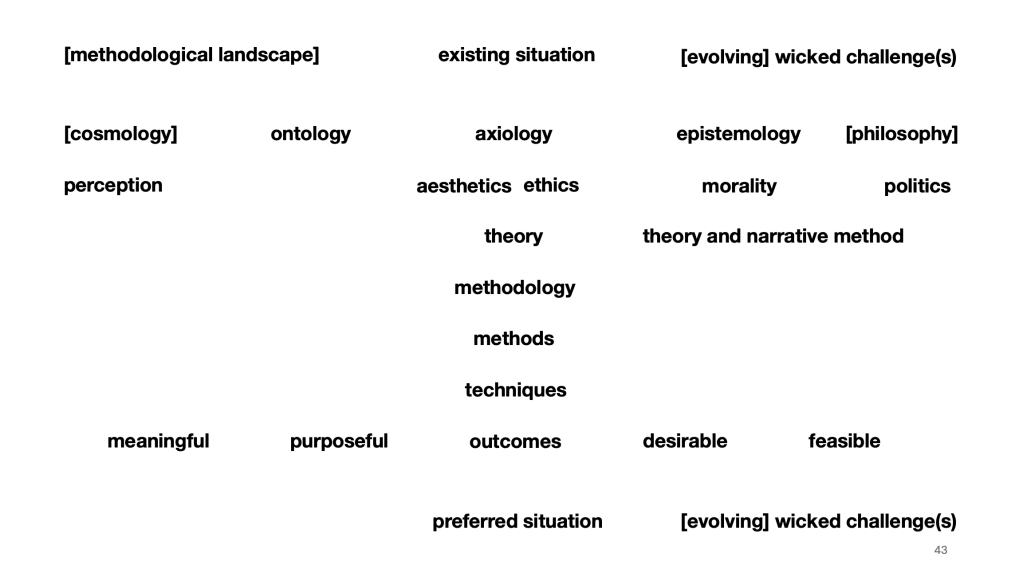
The design of narrative environments, as an example of a contemporary design practice, is research-based and may also be research-led. Indeed, it may even serve as an example of design-led research. In short, design and research are closely intertwined in many contemporary design practices. This is to acknowledge, along with Smith and Dean (2009: 1), the potentially close relationship between research and creative practice: creative practice can impact academic research positively while academic research can have a reciprocal impact on creative practice. The following text discusses the inter-relationships of theoretical perspectives, methodologies and methods to the epistemological, ontological and axiological – that is, philosophical or cosmological – presuppositions they assume, from the perspective of design practice and design education and its pedagogical principles.
In conducting research, a methodology guides the orientation of the research and frames the research question. Once these are decided, specific research methods are selected which generate the evidence, or the material outputs of practice in the case of practice-based research, to address the research question and/or the design challenge.
A methodology is a system of methods, principles and theories used in a particular discipline. It is akin to a philosophy or an approach which holds the methods and theories together as a coherent system. More narrowly, the term methodology may refer to the branch of philosophy concerned with the science of method.
A method a way of proceeding or doing something, i.e. a procedure, especially one that is systematic or regular; orderliness of thought or action. As methods, it refers to the techniques or arrangement of work for a particular field or subject.
In practice, matters are far less clear-cut than this division suggests. Adherence to a methodology both enables research to proceed but also limits research by establishing boundaries of what it is permissible to see, to say and to argue. It is this adherence which, if it become too rigid or mechanistic, gives some research its ‘artificial’ or ‘limited’ feel; or limits its field of application or relevance. All research, to some extent, has to deal with mismatches between methods and methodology and with the limits imposed by a methodology and its associated methods.
A methodology, in order to proceed, requires certain ontological assumptions about what already exists, how it exists and how new existents may be discovered, as well as certain epistemological assumptions about what is already known, how it is known and how new knowledge can be produced. It also makes certain axiological assumptions about what is valuable, how it is valued and how that value should be sustained or enhanced. These assumptions, as decisions, may not be wholly explicit in the methodology until it is thoroughly questioned.
 Incomplete ...