Installation Art

RELATED TERMS: Environments – Art; Happenings; Immersion; Ocular-Centrism; Sculpture

The term installation is usually applied to arrangements of materials and/or media in interior spaces, whereas exterior interventions are often called land art. However, the boundaries between these categories are fluid, as Rosalind Krauss (1979) discusses.

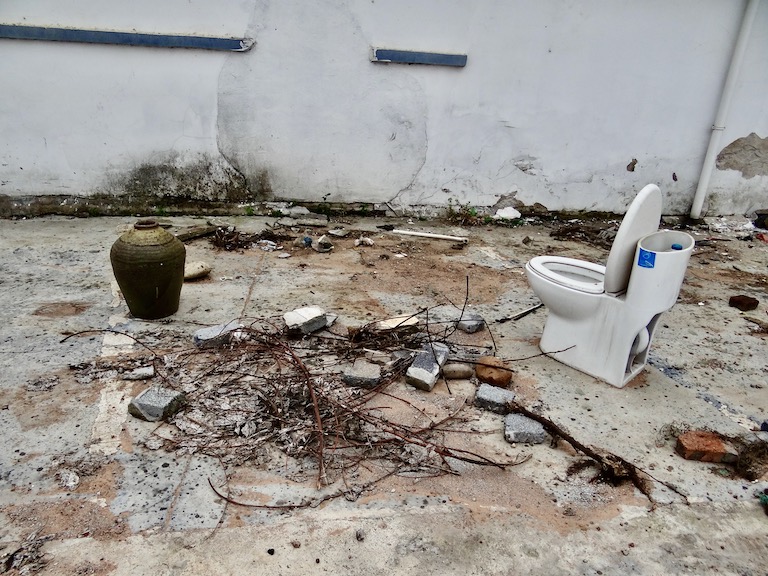
Installation artworks have been constructed in exhibition spaces such as museums and galleries, as well as public and private spaces. The genre incorporates a very broad range of everyday and natural materials, which are often chosen for their evocative qualities, as well as media such as video, sound, performance, interactive media, virtual reality and the internet.

Many installations are site-specific in that they are designed to only exist in the location for which they were created, taking into account such things as the nature, attributes, purpose and prior use of that space.

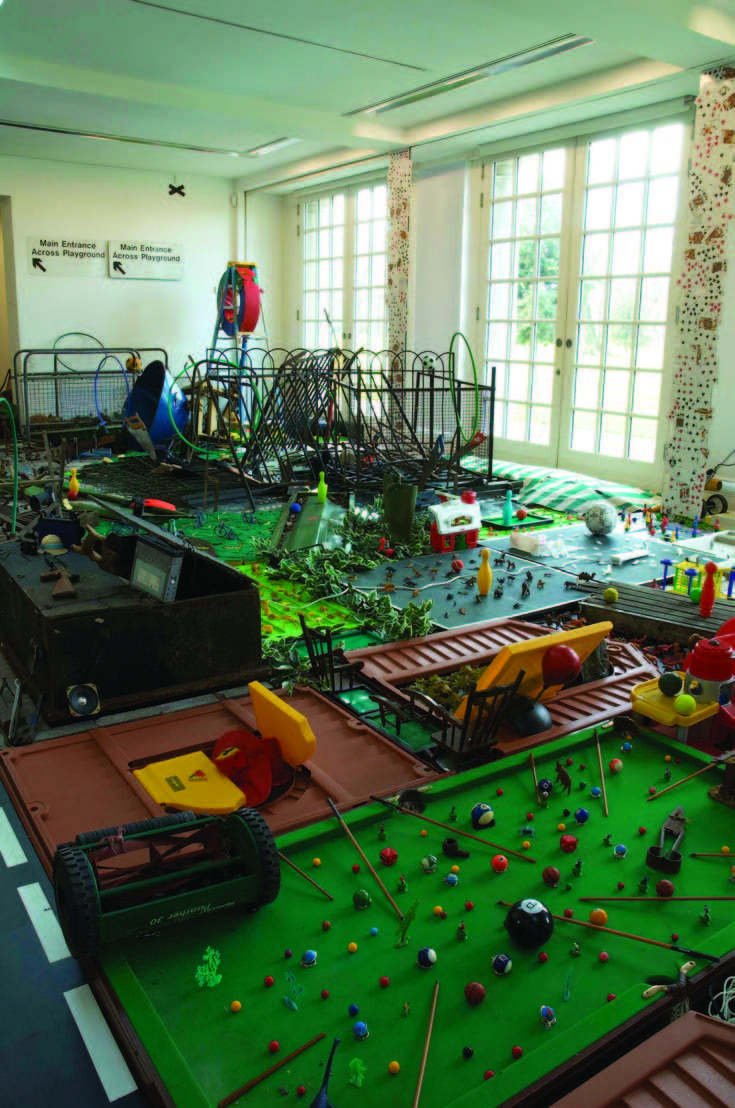
Installation art, according to Harriet Hawkins (2010) in discussing an installation work by Tomoko Takahashi, intertwines spatial politics with embodied visual politics through its configuration of bodies, spaces and objects. The history of installation art, particularly since the 1960s, demonstrates a critique of ocular-centric understandings of art and representation while witnessing the emerging dialogue among artist, viewer and artwork.

installation practice is often referred to as immersive. Installations create spaces into which you take your whole body.


Tomoko Takahashi, my play-station at serpentine 2005 – garden, Installation at Serpentine Gallery, London

References

Hawkins, H. (2010) The argument of the eye? The cultural geographies of installation art, Cultural Geographies, 17 (3), pp. 321–340. doi: 10.1177/1474474010368605.

Krauss, R. E. (1979) Sculpture in the expanded field, October, 8, pp. 30–44. Available at: http://www.jstor.org/stable/778224 (Accessed: 10 February 2016).

In Medias Res

RELATED TERMS: Story (fabula) and Plot (sjuzet or sjuzhet); Semiotic Square

“the world has always been in the middle of things in unruly and practical conversation, full of action and structured by a startling array of actants and of networking and unequal collectives.”

Donna Haraway, The Promises of Monsters

“As Frank Kermode has put it, man [sic] is always “in the middest,” without direct knowledge of origin or endpoint, seeking the imaginative equivalents of closure that will confer significance on experience.”

Peter Brooks, Reading for the Plot

Meir Sternberg (1992) counts Aristotle as taking the earliest and least explicit, but possibly the least unreasonable, anti-chronological position on narrative. This is due to his subordination of events to effects. Aristotle’s Poetics views the arrangement of events in functional terms, as a means to an end, or, more properly, in teleological terms: poetic ends determine or explain means, so as to inform their form. This teleo-logic runs all the way through from Aristotle’s universals of art to his plot rules and variables, silently incorporating temporal (dis)order.

Thus, at the most general level of teleology, the definition of art as mimesis finds its rationale for Aristotle in the universal pleasure felt in things imitated. As Aristotle’s argument descends from art through literary narrative or fiction to tragedy, it progressively refers specific forms and options of mimesis to their specific informing pleasurable effects, kinds of structure to kinds of pleasure, such as unity, surprise, catharsis.

Two of those steps, which concern the relation between chronology and teleology, bear further examination. The first lies within the arrangement of the “whole” (holos); and the second lies within the disarrangements open to “plot” (mythos).

The analysis of action outlined in the Poetics, starts by deriving the need for events to form a “whole”, which is marked by its beginning-to-middle-to-end (chrono-)logical concatenation, from the law of poetic unity. The whole will then cohere as a necessary or probable sequence between well-defined poles of human fortune and experience.

Aristotle’s “wholeness” opposes poetic structure to the mere alignment of events in history writing (chronicle, biography), with its allegedly misguided equivalents in history-like epic, because they abandon the chrono-logic of action for the chronology of an era, a life, or some other time-span covered in serial fashion to yield a “sum” or “total” of episodes.

For Aristotle, then, the opposition of integrative “whole” to additive “sum” in event linkage is all the more principled and value-laden because it ranges from the shape of chronology (tight versus loose) to its intelligibility (universal versus particular), from formal and perceptual aesthetics to ontological sense and coherence.

The next step advances from “whole” toward “plot,” no longer uniform but multiform in sequence and, ideally, even disordered for a time out of wholeness, again on poetic grounds.

Chrono-logic bends, temporarily at least, in response to a stronger, more determinate teleo-logic. Since tragedy and high epic aim for pity and fear, such effects are best produced when the events come on the reader/audience by surprise. Given this demand for surprise, the “whole” action needs to be “complicated”, i.e. in effect dechronologised, into “plot”, by way of discovery and/or reversal (Sternberg, 1992: 476).

The “complex” plot outranks the “simple” plot for Aristotle not because it breaks or deforms the natural temporality that the other preserves, but because its broken temporality best serves, indeed maximizes, the effect common to both types as tragic plots: catharsis.

Like the fiat of chrono-logising the action, the recommended dechrono-logising of the actual dramatic or epic presentation serves a purpose beyond itself: the teleology remains in control across forms and levels of sequence.

To become viable, indeed a virtue or a clear gain, disordering in these mimetic genres must involve the twisting of the “whole” into complex “plot” movement in the service of determinate and determinative tragic ends: catharsis, above all.

While the Aristotelian argument for the complex plot may well be found wanting, its logic may not. The positive thrust of this (teleo)logic culminates in the recommendation of deformed-and-reformed sequence for intensity. Given the first premise, all the rest follows by a long chain of reasoning from desired poetic end to necessary or contributory means: from pity and fear to surprise effect; from there to discovery (anagnorisis) and reversal (peripeteia); and from there to the twisting or “complication” of the chrono-logical “whole” (holos) into (de-chrono-logised) optimal “plot” (mythos).

Thus, as Meir Sternberg (1992: 479) explains the matter, the key antithesis for Aristotle’s conception of narrative is that between the chrono-logical “whole” (holos) and the optimal “plot” (mythos), the former twisted or “complicated” into the latter to form a complex plot, which is Aristotle’s preference because it better delivers, through plot surprise, the required effect upon the audience, ultimately catharsis.

Sternberg (1992: 481) notes that it is Aristotelian wholes that “begin at the beginning,” not plots. Plots may begin anywhere. Indeed, plots should preferably begin at a point later than the chronological beginning. This assists in developing both complexity and compactness. Furthermore, Sternberg continues, Horace’s in medias res originally urges the epic poet to select a coherent action, for example, that of The Iliad, from a loose extra-literary chronicle, for example, the Trojan War. The Horatian advice, then, bears on the ordering of the whole into unity, not on its disordering into late-before-early plot. It therefore derives, rather than diverges, from Aristotle.

References

Brooks, P. (1984) Reading for the plot: design and intention in narrative. Cambridge, MA: Harvard University Press.

Sternberg, M. (1992). Telling in time (II): chronology, teleology, narrativity. Poetics Today, 13 (3), 463–541. Available from http://www.jstor.org/stable/1772872 [Accessed 24 June 2016].

Imaginary

RELATED TERMS: Storyworld; Iconic Designs, Critical Designs

The imaginary mediates between abstract conception and material realisation. The storyworld, for example, takes place in the imaginary. In design practices, the imaginary does not carry a negative connotation in the sense of being a set of deceptive illusions mystifying or obscuring a real. As Adams and Smith (2019: xxiv) discuss, with the advent of modernity, a shift in thinking of the imagination occurred. It ceased to be considered as merely reproductive or imitative and became authentically creative. In this regard, Kant is a watershed figure through his re-discovery in the first Critique of the productivity of the imagination for understanding. In the meantime, others have continued to clarify and refine Kant’s reflections, expanding the creative imagination from the subjective to the intersubjective sphere; and then on up to the frontiers of the trans-subjective dimension of the social-historical.

In the psychoanalytic theory of Jacques Lacan, the Imaginary, the order of perception and hallucination, contrasts with the Symbolic, the order of discursive and symbolic action, and with the Real, which refers not just experiential ‘reality’ but also to what is imperceptible and unrepresentable. For Lacan, the Imaginary order, intertwined with the Symbolic order and the Real, refers to the fundamental narcissism by which human subjects create fantasy images of themselves, on the one hand, and their ideal objects of desire, on the other hand.

Continue reading “Imaginary”

Humanism

RELATED TERMS: Enlightenment; Posthumanism; Posthuman; Postanthropocentrism; Realism; Modernity

Michel Foucault argues that the term humanism should not be confused with that of Enlightenment. The importance of grasping the notions of humanism and Enlightenment for design practices is that it bears directly upon how the domain of humanity and the human is understood in the design process and in the designed artefacts, experiences and environments, i.e. how is human actantiality and potentiality understood in the ways the design continues to works (continues to design inn the world).

Foucault argues that the Enlightenment is a set of events and complex historical processes that is located at a certain point in the development of European societies which includes elements of social transformation, types of political institution, forms of knowledge, projects of rationalisation of knowledge and practices and technological mutations. All of this is very difficult to sum up in a word, even if many of these phenomena remain important today.

Rather than a set of events, Foucault (1984: 44) suggests that humanism is a set of themes that have reappeared on several occasions over time in European societies. These themes are always tied to value judgments and have varied greatly in their content as well as in the values they have preserved. Furthermore, they have served as a critical principle of differentiation. For example, in the seventeenth century, there was a humanism that presented itself as a critique of Christianity or of religion in general; and there was a Christian humanism opposed to an ascetic and much more theocentric humanism.

In the nineteenth century, there was a suspicious humanism hostile and critical toward science and another that, to the contrary, placed its hope in that same science. Marxism has been, for some, a humanism; as have existentialism and personalism.

In the twentieth century, there was a time when people supported the humanistic values represented by National Socialism and when the Stalinists themselves said they were humanists.

References

Foucault, M. (1984). What is Enlightenment? In: The Foucault Reader, edited by Paul Rabinow. New York, NY: Pantheon Books, 32–50.

Human Ecosystem

RELATED TERMS: Anthropocene – Capitalocene – Chthulucene; Plantationocene; Ecology and Economy

Hearth and Home

Systems as small as a household or as large as a nation state may be discussed as a human ecosystem. Human ecosystems interact in a complex web of human and ecological relationships, connecting human ecosystems to the biosphere. Human ecosystems have so thoroughly pervaded the biosphere that they are considered the major factor in a new geological era: the Anthropocene.

Designed artefacts, experiences and environments are the media through which the relationships among people and between people and their habitats and niches are realised.

Continue reading “Human Ecosystem”

Human Actantiality

RELATED TERMS: Actant; Actantial Model – Greimas; Actantiality; Agency; Agon; Audience; Design of Narrative Environments; (The) Heroic; Philosophy;

People are not exterior, whether anterior or posterior, to the design process nor the designed outcome. An important question, then, in designing such environments, is how this human dimension is to be theorised and practised. Are the people involved in the designed artefact, experience or environment participants, actors, agents, bodies, identities, selves, subjects, persons, or an admixture of some or all of these categories, and more besides?

Such questions concern who (actively) navigates (the guiding environment and/or the itinerant?) and who is learning (the pedagogue and/or the subject of pedagogy?) in the narrative or learning environment; how these actants are materialised; and the nature of what it is that they (whoever or whatever they are) are doing or learning, for example, a group of selves acts and learns differently from a group of subjects and both, in turn, act and learn differently from a group of individuals or a bunch of things.

Amelie Rorty (1988), in examining the concept of personhood and personal identity as it has developed in Western and Christian culture, explains that the vocabulary for describing persons, their powers, limitations and alliances is a rich one. She proposes to attend to the nuances of that vocabulary in order to preserve some important distinctions that have been made over the centuries. Thus, Rorty distinguishes among heroes, protagonists, characters, persons, souls, selves, figures, individuals, presences and subjects, while arguing that each inhabits a different space in fiction and in society.

Rorty’s analysis is important for narrative and learning environment design because it highlights that designing for a group or a society of persons differs from designing for a group or society of selves or a group or society of individuals. Equally, educating a group or society of persons differs from educating a group or society of selves or individuals, just as educating for (i.e. in order to to create) a group or society of persons differs from educating for a group or society of selves or individuals.

Rorty’s investigation, in part because of its scope in covering fictional and social worlds, is therefore of significance for narrative environment design and analysis, particularly for developing an actantial and agonistic approach which emphasises narrative environments as fields of human and non-human action, interaction, agency, conflict, functionality and actantiality, i.e. complex, world-forming, human-and-non-human inter-acting and intra-acting. Such an approach permits discussion of ‘causality’ in narrativity and learning or the ‘drivers’ of narrative or learning action in sequences of events and the consequences of prolonged inter-action.

Rorty’s insights may be of value, therefore, in developing a conception of what kind of actants and actantiality a particular narrative environment or learning environment constitutes; and what are the ‘drivers’, ‘causal’ determinations, power dynamics and fields of conflict or contest (agon) at play in that narrative environment or learning environment.

What this approach makes clear is that while narrativity and learning are not equivalent, they are co-implicated, and both have consequences for understanding what it means to follow a lead or to follow a clue or a sign, and to ‘come to know’ or to arrive at a destination or a conclusion: an end.

For a fuller outline of Rorty’s historical survey of the concepts of person and identity, see Parsons (2006).

References

Parsons, A (2016) Modes of actantiality. Poiesis and Prolepsis [Blog]. Available at http://prolepsis-ap.blogspot.co.uk/2016/12/modes-of-human-actantiality.html [Accessed 10 December 2016]

Rorty, A. (1988). Characters, persons, selves, individuals. In: Mind in action: essays in the philosophy of mind . Boston, MA: Beacon Press, 78–98.

History

RELATED TERMS: Historicism; Historical materialism – Marxism;

“History and ethnology became distinct disciplines only in the mid-nineteenth century, when evolutionism, triumphant even before Darwin, caused the study of developed societies to part company with the investigation of so-called primitive societies. Previously, history had embraced all societies, but with the emergence of a consciousness of progress, history limited itself to those portions of humanity liable to rapid transformations.” (Le Goff, 1980: 225)

“After a divorce lasting more than two centuries, historians and ethnologists are showing signs of converging once again.” (Le Goff, 1980: 227)

For Georg Lukacs (c.1971, 1923), in History and Class Consciousness, often said to be the inaugural text of Western Marxism, “history lies precisely in the changes undergone by those structural forms which are the focal points of man’s [sic] interaction with environment at any given moment and which determine the objective nature of both his [sic] inner and his outer life.” ‘Inner and outer life’ may be conceived in design practices as public imagination, while the imagination defined as both private (the Imaginary) and communal (the designed, material world and the Symbolic or public order it actively – i.e. actantially – maintains). The conjunction of the inner and the outer, or rather the interpenetration of the one and the other, constitutes a world and a storyworld as transmedia, environmental phenomenon.

Designs, in this context, are focalisers of historicity and ‘passing’. They are, thus, potential vehicles for re-articulating the public imagination through re-designing the public regime defined by ‘the order of things’. The Lukascian-Marxian approach is one way of translating the ‘thing-ness’ of designs into an understanding of the kind of interventions they make into socio-economic, socio-cultural, socio-political and socio-ecological practices and realities. For the Lukascian-Marxian approach, ‘things’ mask not just the transitoriness of all entities but also, more importantly, in their commodity form as fetish, the political economy, or the praxis, through which they were produced.

It is a question of how one understands the insight that the object or the objectification is, “not a thing but a social relation between persons mediated through things”. A double-edged sword, this may, on the one hand, be an anthropological recognition of our necessary dependence upon or entanglement with ‘things’, but, on the other hand, it may also be a political recognition of our vulnerability to being manipulated through specific articulations of ‘things’. This is a particularly knotted question for social semiotics.

References

Dilnot, C. (1984) ‘The State of design history, part II: problems and possibilities’, Design Issues, 1(2), pp. 3–30. doi: 10.2307/1511495.

Le Goff, J. (1980) Time, work & culture in the Middle Ages. Chicago, IL: University of Chicago Press.

Lukacs, G. (c.1971, 1923) History and class consciousness: studies in Marxist dialectics. Translated by R. Livingstone. Cambridge, MA: MIT Press.

Historicism

RELATED TERMS: History; Design of Narrative Environments; Metalepsis; Genealogy – Nietzsche; Aleatory

Historicism, Hal Foster (1996: 10) notes, can be negatively defined in the most simple terms as the conflation of before and after with cause and effect, by making the presumption that the prior event produces the later one.

Foster also notes that historicism in this sense pervades art history and modernist studies.

The question of how causality, temporality, narrativity and their inter-relationships are conceptualised and thought through is a crucial one for design practices. Particular care should be taken to consider whether, in your design, you are encouraging an historicist reading or reception of it, and whether this is what you intend. The issue might be expressed as follows: how can complex causality be articulated through the temporalities brought into play by the plotting of narrativity?

The issue of causality, in relation to temporality and narrativity, brings into play the notions of complexity, chaos, chance, fate and accident or, in another vocabulary, questions of determinism, over-determination and under-determination. Issues related to determination are raised in the understanding of metalepsis within the context of design practices.

Reference

Foster, H. (1996). Who’s afraid of the neo-avant-garde? In: The Return of the real: the avant-garde at the end of the century. Cambridge, MA: MIT Press, 1–33.

Historical Materialism – Marxism

RELATED TERMS: History; Critical Thinking; Cultural Studies; Design of Narrative Environments; Epic theatre – Brecht; Feminism and Materialism; Lefebvre; Methodology and Method;

Even though the crude teleological determinism, historicism and reductive economism of official communist ideology, or orthodox Marxism-Leninism, came to occupy the space of Marxist thinking, design practices may yet still benefit from considering a particular understanding of historical materialism, as inflected by the ‘western’ Marxist tradition (Merleau-Ponty, 1973), with its recovery of subjectivity, agency and culture. How might this be possible?

Jason Edwards (2010: 282-284) proposes that there are two ways of approaching an understanding of historical materialism.

The first is as a positivist science based on a humanist philosophical anthropology, human nature as the subject of history, and a teleological conception of history embodying a form of economic or technological determinism, as the successive development of modes of production.

The second is as the complex totality (as assemblage, a non-totalising totality?) of the material practices that are required to reproduce the relations of production over time. Thus, Edwards (2000: 284) contends, historical materialism, as a broad analysis of diverse social formations, recognises the diversity of the forms of practice that are necessary for sustaining the relations of production in very different kinds of societies.

Material practices, in this context, are taken to be regular forms of behaviour that are norm-governed and which involve a person’s relation to their body and to other bodies, as well as to experiential phenomena.

This complex whole (non-totalitarian totality) is instantiated in the everyday lives of people and, in turn, the material practices of everyday life are implicated in the political and economic power of the state and the international political economic system.

Edwards suggests that historical materialism, as conceived by Marx and Engels, needs to shed its humanism, historicism, economism and teleological determinism. This means that a more de-centred and relational conception of the subject is required, perhaps through such notions as the intercorporeal and the intersubjective conceived in materialist terms. So also is a less teleological and deterministic conception of historical change and societal organisation required, as is available, for example, through notions articulated by complexity theory.

Historical materialism, in this case, would focus on the character of everyday life and lived space, as discussed by Henri Lefebvre, for example. This examination would include the penetration of everyday life by various media and technologies of communication, as discussed by Benjamin, Adorno and Horkheimer. Furthermore, this discussion would now be extended to include internet-based, potentially participative, multimedia technologies. The relationships by means of which such ‘mass’ media and digital technologies are woven into the everyday, and the everyday is incorporated into the ordering of cities, regions, states and the international political economy, breaching the boundaries of the conception of place, can thus be seen to be multi-layered, involving both social, material and media modes of existence.

In this context, as has been noted and as Edwards (2000: 290) insists, the work of Lefebvre is of particular importance. His analyses of the experience of everyday life and the production of space through the interconnecting manifold of material and representational practices are vital for developing a meaningful historical materialism which may prove useful for the design of narrative environments.

Historical materialism, then, as one way of understanding antagonistic struggles or dramatic conflicts, may be of value in thinking about the design of narrative environments, particularly how their material aspects might be said to act within the horizon of a complex, contingent, contextual arrangement (dispositif, apparatus, assemblage, rhizome).

References

Edwards, J. (2010). The materialism of historical materialism. In D. Coole and S. Frost, eds., New materialisms: ontology, agency, and politics. Durham, NC: Duke University Press, pp. 281–297.

Merleau-Ponty, M. (1973) ‘“Western” Marxism’, in Bien, J. (tran.) Adventures in the dialectic. Evanston, IL: Northwestern University Press, pp. 30–58.

(The) Heroic

RELATED TERMS: Narratology; Protagonist; Human Actantiality

In The Hero with a thousand faces, Joseph Campbell examines many of the world’s heroic myths and stories. He ties the processes of transformation in those stories of the heroic journey to the quest to know the truest self, a task which, he avers, takes much time.

Campbell shows how,

“the heroic self seeks … a higher way of holding and conducting oneself. This heroic way offers depth of insight and meaning. It is attentive to guides along the way, and invigorates creative life. We see that the journey of the hero and heroine are most often deepened via ongoing perils. These include losing one’s way innumerable times, refusing the first call, thinking it is only one thing when it really is, in fact, quite another — as well as entanglements and confrontations with something of great and often frightening magnitude. Campbell points out that coming through such struggles causes the person to be infused with more vision, and to be strengthened by the spiritual life principle — which, more than anything else, encourages one to take courage to live with effrontery and mettle.”

(Clarissa Pinkola Estes, Introduction to the 2004 Commemorative Edition of The Hero with a thousand faces, p.xxiv)

Typically, in narratology, the hero is the protagonist of a story, the good guy or good girl with whom the audience might identify, empathise and sympathise. The notion of hero has the connotation of being ‘good’, which the notion of protagonist does not carry.

References

Campbell, J. (2004, 1949) The Hero with a thousand faces. Princeton, NJ: Princeton University Press.