Heidegger

RELATED TERMS: Arendt; The Everyday and Design; Lefebvre; Philosophy; Present-at-hand (Vorhanden) and Ready-to-hand (Zuhanden); Sloterdijk
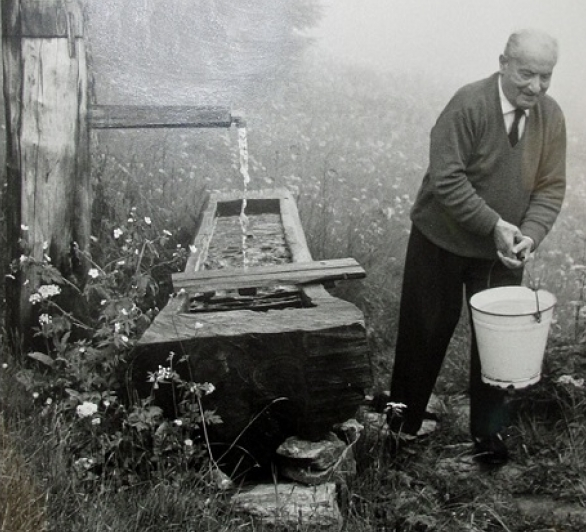
Heidegger1

The work of Martin Heidegger (1889–1976) is of great relevance to design practices and to the analysis of designs as elements of material culture because it deals with spatio-temporal ways of being in the world and contains concepts such as Dasein (ex-sistence), present-at-hand and ready-to-hand, which might be of value in design contexts, so long as they are not uncritically appropriated.

It has been argued that the importance of Heidegger’s book, Being and Time, is that it is the first serious attempt to provide a phenomenology of the everyday, reversing the hierarchy within philosophy in which the theoretical is valued over the practical. In extending this to design practices, the importance of a phenomenology of the everyday is that many of the ‘objects’ discussed have been designed: they are the products of design thinking, design practice and design manufacture. It is ‘design’ that shapes the everyday in many respects.

Heidegger’s work is also of relevance because of its influence on others, such as Henri Lefebvre, Michel Foucault and Peter Sloterdijk. For example, even as Lefebvre distanced himself from Heidegger, seeing Heidegger’s Holderlin-inspired poetic critique of habitat and industrial space as a critique from the right, nostalgic and old-fashioned, Lefebvre’s emphasis on space is indebted to Heidegger’s inauguration of space as a problematique, while Foucault took Heideggerean ideas forward in his analysis of the relation between history and space (Elden, 2004).

However, use of his work can only proceed with great caution. Firstly, he held a mostly negative view of modernity, the processes of modernisation and the modern world, and therefore his work will be of limited value in discussing modern and contemporary issues. He idealised rural life in late-19th-century Germany and experienced discomfort at the flourishing of German science and technology after 1860.

Secondly, and perhaps more importantly, a major difficulty in using Heidegger’s work lies in his involvement in politics, and the relation of that involvement to his philosophy. It is a topic that has generated acrimonious disagreement [1].

One central question is whether Heidegger’s Nazism was a passing aberration or a lasting commitment. There can be little doubt that his politics are connected to some enduring elements of his philosophy. Heidegger believed that a moment of communal authenticity, as discussed in section 74 of Being and Time, had arrived. Utilising his understanding of historicity, he held that a movement based on a particular people’s heritage was truer and deeper than any politics based on universal, abstract principles, such as liberal democracy or communism, as he understood them (Fried and Polt, 2014: xiv).

However, this is not to conclude that his philosophical ideas can only lead to fascist politics or that his ideas are exhausted by such politics. Heidegger distanced himself increasingly from Nazism, or rather from the actual practice and dominant mentality of the movement, as distinct from its “inner truth and greatness” (Heidegger, 2014: 222). By 1940, Heidegger had developed a metaphysical critique of standard Nazi ideology, without drawing closer to a liberal or leftist position.

In his thinking from the mid- to late-1930s, Heidegger shifts towards a new, historical understanding of Being: being is to be grasped as a fundamental happening, the appropriating event (das Ereignis). The event can found Dasein by opening a time-space or site of the moment where Dasein is appropriated. Genuine selfhood can then be achieved and people can learn to shelter truth in particular beings, such as works of art, but only if truth is understood as openness to the meaningfulness of things, not as a set of correct propositions about the world that we hide away and safeguard.

It was such an appropriating event that Heidegger had been hoping to find in the National Socialist revolution. Nevertheless, in Contributions to Philosophy, a text written in the mid-1930s but not published until after his death, Heidegger submits the typical Nazi worldview to strong criticism, insisting that a Volk is never an end in itself. From this point onwards, Heidegger begins to look less towards politics and more toward poetry, specifically that of Holderlin, in order to consider new ways for the Germans to seek themselves. Heidegger’s late writings move even further from the domains of wilful action and power, emphasising the need for patience.
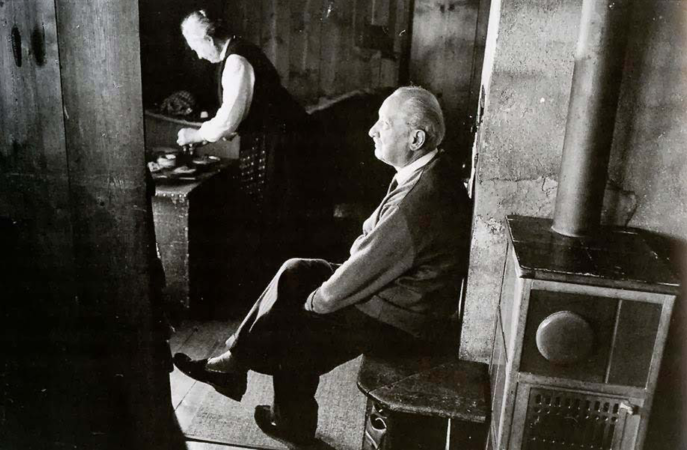
Heidegger2

In the speeches, lecture courses and seminars from his year as rector of the University of Freiburg in 1933-1934, Heidegger speaks as an enthusiast of National Socialism. By the time of writing Introduction to Metaphysics in 1935, his enthusiasm is waning and he has become engaged in an internal critique of National Socialism, in an effort to be more radically revolutionary than the Nazi revolution itself. Fried and Polt (2014: xviii) suggest that the question of whether Heidegger is a Nazi in Introduction to Metaphysics, because he surely is, is less interesting than the question of what it means to be a Nazi, a question which Heidegger raises in that text, as well as broader questions about what it means to be German, to be Western and to be human.

While the lines of questioning he begins are irreducible to a particular political party’s programme or ideology, the text nonetheless resonates with the most terrifying aspect of the Nazi movement, its readiness to commit violence and murder against its perceived enemies. Heidegger explores the idea that human beings, or at least great ones, are uncanny and violent. They must fight against other beings and against Being itself until they are inevitably and tragically crushed by the overwhelming power of Being. Throughout the mid-1930s, Heidegger seems to celebrate creative conflict (creative destruction). He seems also to believe that National Socialism may find an appropriate way to spur such creativity and revive an ancient understanding of techne a a forceful and disclosive struggle (Fried and Polt, 2014: xx).

However, with his turn away from power and will, and his development of a critique of modern technology, Heidegger develops a less violent understanding of human greatness, as he continues to explore the dimensions of what he considers to be primordial phenomena: beings, Being and Dasein or ex-sistence. Thomas Sheehan (2014) is of the view that Heidegger did not get beyond the essence of human being as ex-sistence, a term that Sheehan prefers to Dasein. Human ex-sistence, Sheehan explains,

“consists in our being made to “stand out ahead” of ourselves as a groundless “openness” or clearing.” Within this openness we can synthesize this object here with that meaning there and thus understand the thing’s current “being,” i.e., what it currently is for us or better, how it is meaningfully present to us. Thus our essence as ex-sistence is what allows for all forms of “being”… “

This, Sheehan concludes, answers Heidegger’s basic question: “Whence the ‘being’ of things?”

Notes

[1] To find out more about Heidegger, philosophy and politics, the following books are of great value:

Farias, V. (1989). Heidegger and nazism, edited by J. Margolis and T. Rockmore. Philadelphia, Temple University Press.

Faye, E. (2009). Heidegger, the introduction of Nazism into philosophy in light of the unpublished seminars of 1933-1935. New Haven, CT: Yale University Press.

Fried, G. (2000). Heidegger’s polemos: from being to politics. New Haven, CT: Yale University Press.

Ott, H. (1993). Martin Heidegger: a political life. Hammersmith, London: HarperCollinsPublishers.

Rockmore, T., & Margolis, J. (1992). The Heidegger case: on philosophy and politics. Philadelphia, PA: Temple University Press.

Safranski, R. (1998). Martin Heidegger: between good and evil. Cambridge, MA: Harvard University Press.

Wolin, R., ed. (1993). The Heidegger controversy: a critical reader. Cambridge, MA: MIT Press.

For a recent evaluation of Heidegger scholarship, see:

Sheehan, T. (2014). Making sense of Heidegger: a paradigm shift. London: Rowman and Littlefield International.

References

Elden, S. (2004). Between Marx and Heidegger: politics, philosophy and Lefebvre’s The Production of Space. Antipode, 36 (1), 86–105. Available from http://doi.wiley.com/10.1111/j.1467-8330.2004.00383.x

Fried, G. and Polt, R. (2014). Translators’ introduction to the second edition. In: Introduction to metaphysics, 2nd ed., by Martin Heidegger. New Haven, CT: Yale University Press.

Heidegger, M. (2014). Introduction to metaphysics. Revised and expanded translation by Gregory Fried and Richard Polt, 2nd ed. New Haven, CT: Yale University Press.

Sheehan, T., Polt, R. and Fried, G. (2014). No one can jump over his own shadow. 3:AM Magazine, (8 December). Available from http://www.3ammagazine.com/3am/no-one-can-jump-over-his-own-shadow/ [Accessed 1 September 2016].


Design and General Economic Anti-Epistemology

RELATED TERMS: Complementarity

General and restricted economies

Plotnitsky (1994: 2): “General economy denotes a mode of theory that relates the configurations it considers to the loss of meaning – a loss it regards as ineluctable within any given system. The concept of general economy was introduced by Bataille and deployed by Derrida, although Nietzsche may be seen as the first practitioner of general economy and Bohr as the second. According to Bataille, “the general economy . . . makes apparent that excesses of energy are produced, which, by definition, cannot be utilized. The excessive energy can only be lost without the slightest aim, consequently without any meaning.” The general economy is juxtaposed by Bataille to classical theories or restricted economies – such as, in particular, Hegel’s philosophy or Marx’s political economy. Restricted economy, however, defines classical theories across a broad spectrum of Western intellectual history: in philosophy, the social and human sciences, history, and other fields. Mathematics and the natural and exact sciences, too, can be seen as restricted economies, when their practice is governed by metaphysical epistemologico-ontological agendas, as they have often been even in the works of many revolutionary scientists, from Kepler to Einstein, and beyond.”

Design practice as restricted and general economy

Arkady Plotnitsky (1994: 2) states that, “Restricted economies consider their objects and the relationships between those objects as always meaningful and claim that the systems they deal with can avoid the unproductive expenditure of energy and control multiplicity and indeterminacy within themselves. General economy exposes such claims as untenable.”

The argument being developed in Incomplete … is that design has been conceived primarily as a restricted economy, one that promotes a conception of ‘total design’ in which there is no unproductive excess which escapes its meaning production and which is able to control multiplicity and indeterminacy. Design practice in the form of a restricted economy of total design takes as its model the onto-theology of divine creation, creatio ex nihilo, creation by divine fiat. Total design, as Wigley (1998) points out, will always be frustrated because it is untenable when understood in the context of a general economy. As Incomplete … argues, design must open up to that which exceeds it, to multiplicity and to indeterminacy.

The conception of design at which Incomplete … is aiming is one where it is understood in the context of a general economy. There are aspects of any design practice that generate an excess that escapes the frame of its meaning production, which open up unanticipated multiplicity and which give rise to outcomes which are not determined by the design. Not all of the world, as actantial entanglement, is, or can be, captured within the (restricted, restrictive) meaningfulness of design. The world does not conform to one, singular ‘total design’. The entangled actantiality of the world, as a general economy, will always exceed the actantiality of design intention (as a restricted economy).

The view that Incomplete … seeks to articulate is that a different approach to design is possible whereby designs open up to and acknowledge the general economy of the world, with its excess, multiplicity and indeterminacy, without seeking to encapsulate it within a restricted economy that designs, as future-oriented intentionality, must nevertheless articulate. A complementary approach to design, following Bohr’s insights, acknowledges both the conventional teleological character of design, as aiming toward a specific goal within a restricted economy, and the falling apart of design as end or closure within a general economy, as it admits its own excess, multiplicity and indeterminacy.

Design practice and processes are suspended (are in suspension) between general and restricted economies. Design as enacting a restricted economy and design as enacting a general economy are complementary: they are mutually exclusive but equally necessary for a comprehensive, complete description and analysis of design design actantiality (what design does). [“Complementarity, thus, connotes both mutual exclusivity and completeness of description” Plotnitsky, 1994: 5)]

Through this suspension, “the possibility of representation without loss” , in other words, design without loss, has to be acknowledged. Could we say, analogously to quantum mechanical configurations, that all design configurations (as re-entanglements of existing entanglements) are simultaneously both irreducibly incomplete and irreducibly rich.

Design as a general economy: “All general economies deal with arrangements (between and within the configurations they consider) that are complementary in the broad sense of being heterogeneous but interactive – heterogeneously interactive and interactively heterogeneous.” (Plotnitsky, 1994: 10-11) …”while they multiply interact, the elements or fields engaged in such relationships never allow for a complete synthesis, Hegelian or other.” (Plotnitsky, 1994: 11) forming a “general economy of asynthesis” (Plotnitsky, 1994: 11) [Arrangements – Entanglements]

The dislocation created by a general economy of design is never a simple or uncritical dismissal of conventional theories of design. Rather, it is their rigorous suspension, implying an analytical exposure of their limitations and a refiguring of the conventional concepts through a general economy.

An absolute abandonment of conventional design theories does not amount to a sufficiently radical transformation of the field; and transformation is not radical at all.

Radical suspensions imply the introduction of complementary modes of description and analysis.

Bohr and complementarity

(Plotnitsky, 1994: 5) “To offer a preliminary outline, complementarity as developed by Bohr enables one to describe comprehensively and employ productively the conflictual aspects of quantum phenomena that cannot be accommodated by classical theories. In Bohr’s interpretation such aspects become their complementary features – the features that are mutually exclusive but equally necessary for a comprehensive, complete, description and analysis of all quantum processes. Bohr speaks of “a new mode of description designated as complementary in the sense that any given application of classical concepts precludes the simultaneous use of other classical concepts which in a different connection are equally necessary for the elucidation of the phenomena.” Due to Heisenberg’s uncertainty relations, quantum mechanics introduces a certain irreducible-general economic loss in representation and thus irreducible incompleteness of knowledge as classically understood. Quantum mechanics, however, and specifically complementarity form, as Bohr argues, a complete theory of its data-as complete as a theory can be under these conditions of irreducible incompleteness. Complementarity, thus, connotes both mutual exclusivity and completeness of description, as the word complementarity, which carries both these meanings, would suggest.

“Two forms of complementarity are of particular significance in Bohr’s framework …

The first is the wave-particle complementarity, reflecting the duality of the behavior of quantum objects and relating the continuous and discontinuous representations of quantum processes. These two types of representation have always been unequivocally dissociated in classical physics. … Bohr’s complementarity equally deconstructs both the classical, unequivocal unifications and classical, unequivocal dissociations of features through which physics constructs, describes, and interprets its objects.

The second complementarity is the complementarity of coordination, defining a position or a configuration of positions of a quantum object or system, and causality, classically determining the behavior of such an object or system.

Coordination and causality are always united in classical theories, and these theories are in fact defined by this unity. In quantum mechanics, however, in Bohr’s defining formulation: “The very nature of the quantum theory … forces us to regard the space-time co-ordination and the claim of causality, the union of which characterizes the classical theories, as complementary but exclusive features of the description, symbolizing the idealization of observation and definition respectively.” Bohr’s word “idealization” is extremely important here. Both coordination and causality must be seen as idealizations, symbols, metaphors. This understanding is crucial in defining complementarity as a theoretical matrix and specifically in making it a general economy.

In contrast to the classical theories, then, we cannot ultimately establish or calculate, or postulate, the causal dynamics – or, one might say, the history of a system – given the positions of its elements at a given point.

This disjunction between the classically united observation of position and definition of causality leads to what may be seen as the anticausality or indeterminacy postulate of quantum theory.

A decisive feature of the quantum postulate, however, is that it also implies the acausal character of the quantum behavior of light, as against the causal character of the wave or continuous theory of light. Thus the quantum postulate leads to the anticausality and indeterminacy of quantum theory.

The complementarity of coordination and causality is directly connected to the complementarity of position and momentum, or the kinematic-dynamic complementarity as it is sometimes called, which precludes one from measuring or even meaningfully defining both variables – position and momentum-simultaneously at any given point. By virtue of this connection, the mathematical counterpart of the complementarity of coordination and causality becomes Werner Heisenberg’s uncertainty relations.

It can be said that uncertainty relations connote a radical, irreducible loss in representation affecting – in advance, always already – any quantum system and ultimately making all such representations idealizations.

Bohr directly invokes the inevitable loss of knowledge on several occasions. In terms of the present study, this loss defines Bohr’s complementarity as a general economy. This “loss” is so radical that, strictly speaking, it prohibits one from assuming that there is somewhere a complete or unified system, existing in itself or by itself, concerning which system some information is lost in the processes of observation, measurement, and interpretation.

As Bohr stressed throughout his writing, the statistical character of quantum mechanics is radical – irreducible – insofar as, contrary to Einstein’s hope, it does not imply some “hidden” large complete, unified, and causal system about which quantum mechanics provides partial, statistical information.

Quantum statistics appears to result from a radical – irreducible – multiplicity, which becomes particularly pronounced in modern quantum electrodynamics and field theory.

But such a multiplicity cannot be conceived in classical terms, and it could be contrasted to classical multiplicities, including those of classical statistical physics. Whether in physics or meta-physics, or philosophy, an assumption of a complete large system would restore the classical, metaphysical appurtenance to the interpretive and theoretical framework based on it.

One needs instead a very different and more complex economy of difference, exteriority, alterity – general economy. By the same token, the irreducible loss at issue leads to the irreducible fragmentation, the fracturing in advance of any quantum system. One thus is also prohibited from speaking of complete quantum systems, although within its limits quantum mechanics must, as I said, be seen as a complete theory as complete as a theory can be under these conditions of irreducible incompleteness. (Plotnitsky, 1994: 8)

Quantum electrodynamics (QED) suggests that if “the very nature of quantum theory forces us” to renounce the claims of causality and the possibility of representation without loss, it also forces us to regard all quantum systems as fields defined by an irreducible, infinite multiplicity and incessant, unending transformations of their constitutive elements. This multiplicity equally redefines one-particle systems, or rather the systems classically defined as one particle systems – one photon, one electron, and so forth – which are all transformed into irreducibly multiple fields. All quantum mechanical configurations are, thus, simultaneously both irreducibly incomplete and irreducibly rich.

The features just described allowed Bohr to develop complementarity into a comprehensive framework that encompasses both quantum physics and quantum meta-physics – the ontological-epistemological and, as it turned out, the anti-ontological and anti-epistemological dimensions of quantum theory.

In this sense, Bohr’s meta-physics is anti-metaphysics, as metaphysics has been developed from (or before) Plato and Aristotle, in their physics and metaphysics alike, to Heidegger, via Descartes, Leibniz, Spinoza, Kant, Hegel, Husserl, and most other major figures in the history of philosophy or intellectual history in general. Aristotle’s works after his Physics – ta meta ta physika – the phrase apparently introduced by commentators on Aristotle to refer collectively to these works, were seen as dealing with things beyond nature or physis. These works, however, continued and reinforced the grounding structures defining philosophical discourse as developed before Aristotle, particularly in Parmenides and Plato.

[In this sense, metaphysics = metaphysics of presence, ontotheology or restricted economy. On the other hand,] Bohr’s meta-physics implies and in fact practices an anti-epistemological general economy of physics, rather than any form of metaphysics developed in the history of philosophy.

As such, Bohr’s meta-physics can be used to dislocate all classical or, in terms of the present study, restricted economic metaphysics, the metaphysics of presence-all its ontology, epistemology, phenomenology, ontotheology, and so forth-and the philosophy of physics that such metaphysics has produced. This dislocation implies that one can neither fully separate physics and meta-physics nor fully unite them, for example, by encompassing physics within philosophy, as Hegel wanted to do. These relationships may instead be defined as complementary, even variably complementary, with shifting border lines between physics and meta-physics.

The anti-epistemology of my title refers, broadly, to the general possibility of a dislocation, or as we say now, deconstruction of classical or metaphysical theories-epistemologies, ontologies, phenomenologies, or, to return to Derrida’s more encompassing terms, forms of ontotheology, logocentrism, and the metaphysics of presence. The theoretical base of this dislocation in Bohr’s work is the general economic character of complementarity as a theoretical matrix. This character is, once again, codetermined by the irreducible loss – and thus indeterminacy – in the process of representation and by the equally irreducible heterogeneous multiplicity of all representations that such a matrix generates and employs.

All general economies deal with arrangements (between and within the configurations they consider) that are complementary in the broad sense of being heterogeneous but interactive – heterogeneously interactive and interactively heterogeneous.

… the general economy of asynthesis is a fundamental aspect of Bohr’s complementarity, which makes it a profoundly anti-Hegelian, or a-Hegelian, theory. In both Bataille and Derrida, general economy is explicitly defined in relation to Hegel and Hegelianism. Derrida, in fact, uses the name “Hegel” to connote the culmination of the history of the philosophical understanding of interpretive, theoretical, historical, and political processes, the history defining what he calls the closure of the epistemethe closure of the metaphysics of presence – on which we might still depend even in our anti-epistemological projects and practices. The pervasiveness and power of this closure is one of the main reasons why one is compelled to see general economy as “anti-epistemology.”

The dislocation created by a general economy is never a simple or uncritical dismissal of classical theories, but is instead their rigorous suspension – an analytical exposure of their limitations and a refiguring of classical concepts through a general economy.

an absolute abandonment of classical theories – or, for that matter, anything absolute – never amounts to a sufficiently radical transformation of the field, and in a great many cases such a transformation is not radical at all. Radical anti epistemology and anti-Hegelianism may be defined by their anti-absolutism; whether a positive or a negative absolute is at issue. Radical suspensions of epistemology are possible, however.

Radical suspensions do appear to imply the introduction of complementary modes of description and analysis.

References

Plotnitsky, A. (1994) Complementarity: Anti-epistemology after Bohr and Derrida. Durham, NC: Duke University Press.

Plato, Platonism and Neoplatonism

RELATED TERMS:

Myth and philosophy can be seen as two forms of narrative, Keum (2021) suggests.

Keum (2021) argues that during the 18th century, Plato was adopted as the original champion of philosophy’s long and continuing battle against myth. Prior to that, Europeans would have been more familiar with a different portrait of Plato’s thought: the one offered by Neoplatonism. Adherents of this wide-ranging philosophical tradition, which first flourished in late antiquity and was revived in Renaissance Italy, saw in Plato’s scattered writings a radically coherent metaphysical system, arranged around a highest, unifying Form of goodness. Neoplatonic interpretations of Plato’s philosophy often had a mystical bent – acquired, in part, as it gradually negotiated for itself a place alongside Christian orthodoxy. In order to reassure Christians, who were wary of granting too much influence to a pagan, Neoplatonists insisted that Plato had been divinely inspired as a prophetic instrument of God’s design for human history. Pointing to Plato’s descriptions of divine poetic inspiration in the Ion and Phaedrus, they argued that Plato himself was aware of his own role as a vessel of a higher power. Such readings of Plato gained an esoteric flavour. ?ey elevated the role of inspiration over that of reason, and they tended to focus on themes such as enthusiasm, love or – especially in the context of Renaissance humanism – the divine gift of eloquence.”

Keum (2021): Academic scepticism: “When Enlightenment thinkers such as Voltaire and his associates turned to Plato, however, they often did so in the spirit of a far older interpretive tradition, one that long predated the Neoplatonists. This was academic scepticism, which had been the dominant school of thought in Plato’s Academy from the 4th century BCE – about three generations after Plato’s death – and lasted into the 1st century BCE. Where the coherence of Plato’s metaphysical system was a central tenet of the Neoplatonic tradition, academic sceptics denied that Plato had any system of philosophy at all. Rather, their Plato was the antisystematist par excellence, resisting dogma at all costs in favour of the critical suspension of judgment. Plato’s sceptic interpreters emphasised the mercilessly rigorous nature of Socratic interrogation and the inconclusive endings of some of the early dialogues, which seemed to represent a disavowal of certain knowledge.”

“The sceptic portrait of Plato was especially appealing to Plato’s Enlightenment readers, who similarly adopted a principled programme of challenging authority and questioning received knowledge.”

“Enlightenment champions of Plato were unwilling, at the same time, to accept the fully sceptic conclusion that certain knowledge was impossible. Eventually, they negotiated a compromise between the Neoplatonist and sceptic accounts of Plato. They accepted that Plato had a coherent philosophical system, and that constructive and certain knowledge was indeed possible. But the path to knowledge was not through revelation or inspiration, but through the kind of critical reason that the academic sceptics so prized.”

“Plato’s Enlightenment readers also took him to be an embodiment of their own political values. His portrayal of the Socratic gadfly helped model an ideal of philosophical citizenship – of citizens as critical thinkers, refusing to take social norms for granted, but instead exposing unfounded pretences to knowledge and the vague and mystifying myths of society.”

“The dominance and popularity of the Enlightenment portrait of Plato meant that the interpretations that had preceded it largely fell out of sight … . This was the process by which the rationalist Plato, so despised by Nietzsche, was created.”

“For Plato was not just the champion of rational argument that the Enlightenment presented him to be. His dialogues, significantly, contained myths: carefully constructed narrative interludes, woven into the philosophical investigation, that reworked or mimicked existing material from the Greek mythological tradition.”

“This Enlightenment Plato is, by and large, the one we have inherited today, who coexists uneasily in our imaginations with the mythmaking Plato we encounter when we read his texts.”

“The lessons of Plato’s myths, however, point us to another way. If we remain allergic to the presence of myths in our cultural landscape, we miss the larger point, and risk throwing out the baby with the bathwater. Plato’s insight was that myth is a powerful, enduring force in politics and culture – a point of common ground in both Nietzsche’s and Popper’s critiques of Plato. Not taking this seriously risks falling into denialism about the very real ways in which such symbolically rich narratives influence our worldviews.”

” … Plato’s own philosophical reinvention of myth also suggests that myths can be reworked in creative ways. Myths are not monoliths impervious to change, but dynamic stories open to reinterpretation every time they are retold.”

“If myths turned out to be an inescapable part of modern life, Plato teaches us not to despair that our Enlightenment expectations of rational progress have gone unmet. Instead, he invites us to make theoretical space for the myths around us, and to remember our own capacity to rework them.”

References

Keum, T.-Y. (2021) ‘Why philosophy needs myth’, Aeon. Available at: https://aeon.co/essays/was-plato-a-mythmaker-or-the-mythbuster-of-western-thought (Accessed: 10 November 2021).

Design, Entwurf, Entwerfen

RELATED TERMS: Dasein; Libidinal Economy – Part 1; Technology, Writing, Design; World; World-Building

Before-After-Thought

In James Joyce’s terms, thrownness, or living in the wake, is expressed as,

“from the night we are and feel and fade with to the yesterselves we tread to turnupon” (FW473. I0-11, quoted by Heath,1984).

Design Projection

In relation to the potential of design practices, what is proposed here, through a consideration of the German word entwurf as it is used in Heidegger[1] and subsequent writers, is that:

first, designing can ‘throw open’, through inquiry;

second, designing can ‘throw-ahead’ as projection;

third, (completed) designs can continue to throw ahead and cast backwards through material and semiotic persistence and adaptation; and

fourth, designing and designs can ‘un-throw’ or ‘throw off’ what has already been thrown or, in other words, designing and designs can ‘over-throw’ and/or ‘re-throw’, through re-interpretation, re-making and re-contextualisation.

In short, designing and designs can ‘project’ in a process of prolonged retrojective-projective un-making, re-making and un-re-making [within a horizon of worlding (as) ending the world (as) affirmative engaging with worldlessness-designlessness].

In the words of Gary Shteyngart (2022), who sees the comedic potential of this condition of ‘being thrown’ or ‘thrownness’,

“We are all small individuals kicked ass-first on to the stage of history, given terrible lines and worse costumes…”

Continue reading “Design, Entwurf, Entwerfen”

Design and the Question of Technology

RELATED TERMS: Iconic Designs and Iconic Designers; Design (as) Art (as) Philosophy

Design differs from art, as discussed in Iconic Designs and Iconic Designers and
Design (as) Art (as) Philosophy (pending posting), even though the boundaries between them are no longer strict and admit a certain hybridity. Design also differs from technology, although it bears some relation to τέχνη [techne] and ποίησις [poiesis]. One starting point for understanding the conditionality of the design-technology distinction is Heidegger’s essay, Die Frage nach der Technik [The Question of Technik; The Question of Technology; The Question of Technique].

τέχνη [techne] and ποίησις [poiesis]

Thomas Sheehan (2015: 276-277) points out that in Die Frage nach der Technik, Heidegger employs three terms: das Technische, die Technik, and das Wesen der Technik. By das Technische, he seems to mean modern-day manufacturing machinery. This raises the question of how das Technische differs from die Technik. For example, does die Technik refer to ‘technology’?

In his texts, Heidegger seems to join together two major senses of technology: firstly, as a means to an end, as in the machines which are the means for generating products; and, secondly, as a human activity, which includes both the skill to carry out production and the skilled productive activity itself. If that were the case, the word ‘technology’ would cover everything, from the skills, programmes, instruments and processes to the products of production, held together in an ‘economy’ of technology, as Foucault might put it (Sheehan, 2015).

Despite this, Sheehan considers that It is more likely that Heidegger’s Technik is the modern incarnation of Aristotle’s τέχνη [techne], which refers to a knowing-how-to, rather than to the products of such know-how. This remains the case even if those products are machines producing even more machines. For Aristotle, Technik is an ‘intellectual virtue’ in the order of praxis, specifically the ‘habitual’ practical cognition that creates the programmes and manages the machines. Therefore, Sheehan reserves the word ‘technology’ solely for the machines and translates Technik by ‘technik’ broadly construed as practical know-how. In short, τέχνη [techne] is techno-thinking conjoined with ποίησις [poiesis] as techno-doing.

Therefore, Sheehan contends, the subject matter that Heidegger bears down on in his lecture is τέχνη (techne), understood as a way of disclosing things, specifically in its contemporary form. It is not all the technological stuff (das Technische) or the programmes and machines that churn it out (die modern Technologie).

Heidegger traces the current mode of disclosure back to Aristotle’s notion of τέχνη, [techne] understood as the human capacity to bring things into meaningful presence by making, producing or constructing them. For Aristotle, τέχνη, [techne] is contrasted with ϕύσις [phusis], whereby natural things emerge of and by themselves.

Heidegger declares that, whether in Aristotelian τέχνη or in its modern version as technik, what he is talking about is ἀληϑεύειν, the human disclosure of things by bringing them into their ἀλήϑεια [aletheia], their pre-theoretical intelligible availability. This is achieved by working on them, shaping and transforming them into something that they were not before, not by thinking or speaking about them. Thus, for Sheehan, much of what Heidegger says about technik is heavily indebted to Aristotle’s Nicomachean Ethics VI, specifically to its doctrine of the intellectual virtues. 

Technology and Technique

Michael Eldred, in examining the same Heidegger essay, Die Frage nach der Technik, argues that it harbours a fatal ambiguity between ‘technology’ and ‘technique’. This ambiguity, Eldred further contends, arises from Heidegger’s inheritance of an ambiguity at the heart of Aristotle’s metaphysical concept of power.

References

Eldred, M. (2013) Technology, technique, interplay: Questioning die Frage nach der Technik, IEEE Technology and Society Magazine. IEEE, 32(2), pp. 13–21. doi: 10.1109/MTS.2013.2259322.

Hainge, G., Nooy, J. D. E. and Hanna, B. E. (2011) Tekhnè, Technique, Technologie, Australian Journal of French Studies, 48(2), pp. 121–128. doi: 10.3828/AJFS.48.2.121.

Heidegger, M. (2006) Technique and the turn. The Question Concerning Technique [unpublished manuscript], Translated by R. Berkowitz and P. Nonet. Academia.edu. Available at: https://www.academia.edu/2083179/The_Question_Concerning_Technik_by_Martin_Heidegger (Accessed: 5 June 2024).

Sheehan, T. (2015) Making sense of Heidegger: a paradigm shift. London, UK: Rowman and Littlefield.

Design and Theory: Total Design, Total Theory

RELATED TERMS: Gesamtkunstwerk

Rooftops, Pingnan District

To say that design defines humanity is not quite the same as saying ‘Dasein is design’. In a material culture approach, humanity is shaped by its objects. As many of those objects are designed, it might be argued that humanity is shaped by its designs. However, many of those objects-as-designs, are themselves shaped by the practices in which they serve both instrumental and symbolic roles (‘functions’). A central thesis of Colomina and Wigley (2016) is that it is ‘design’ itself that defines humanity. Whatever the precise relation, or the degree of (mutual) determination, it would seem that design and humanity are inseparable.

A question that might arise is: how does the philosophy and theory of design presented in the web pages of Incomplete … differ from the view of design presented under the rubric of ‘total design’?

To say that design pervades the world is not to say that the world is a ‘total design’, analogous to a ‘total work of art’, and that design is ‘one great cognate whole’, in the words of Walter Gropius. In other words, to acknowledge the pervasiveness of designed artefacts, services and systems is not to say that the world is a designed totality, every aspect of which is designed as a singular, cohered, unitary design.

Continue reading “Design and Theory: Total Design, Total Theory”

Entanglement

RELATED TERMS: Actantiality; Agonism and Design; Incompletion

“I prefer to think of myself as being inside a tangled knot; tangled knots fascinate me. It’s necessary to recount the tangle of existence, both as it concerns individual lives and the life of generations. Searching to unravel things is useful, but literature is made out of tangles.”

Elena Ferranta, cited in Schappell and Ferrante (2015)

Following Ferrante’s lead, it is contended here that designs exist as parts of tangled knots, which they do not seek simply to untangle but to entangle otherwise. In that sense, designs are made out of tangles.

Quantum entanglement

Quantum entanglement was named ‘spooky action at a distance’ by Albert Einstein. It describes the phenomenon of two spatially separated particles influencing each other, even when the distances are large. The entanglement observed at the sub-atomic level in physics labs lasts only a tiny fraction of a second.

As Dean Radin (2007: 606) explains, the most useful mathematics used in quantum theory was wave mechanics. The interesting thing about waves is that they are not precisely located in the way that we regard an object as being specifically located here or there. A wave is spread out in both space and time. The theory predicted that if two particles interacted with each other then, according to the equations used to describe this interaction, the two separate particles would become a single, more complex particle-system. Contrary to common sense, the two particles could no longer be regarded as being completely separate. One consequence of this prediction is that if you perturb one of the two particles after they interacted, then the other particle would respond, regardless of how far apart the two particles were. This makes no sense from a classical physics point of view as we do not often experience the world in that “nonlocal” or interconnected way.

It took a further 30 years before physicist John Bell developed a way of testing this interconnection or entanglement prediction to see if nonlocal connections really did exist. Starting in the early 1970s and continuing until the present time, many laboratory demonstrations of entanglement have taken place. They first demonstrated the phenomenon at the level of photons and electrons and later in larger systems of atoms and molecules. Physicists continue to look for entanglement in larger objects because, in principle, any physical or energetic object, at any size, can become entangled. Once entanglement has occurred, the particles might appear to go their separate ways, but they are actually not quite so separate. They maintain connections that transcend time and space.

Radin, along with other scientists, poses the question of what if the concept of quantum entanglement, which we know exists in elementary particles, extended up through the domains of chemistry, biology and psychology, emerging into the realm of human experience? Could entanglement be useful as a metaphor for explaining some human experiences? Furthermore, what if this idea was more than a metaphor: what if the fabric of reality really was all quantum, all the time?

Extending the notion of entanglement to the mind, Radin (2007: 607) comments,

“What the entangled minds idea suggests is that the universe is not really located outside yourself, because if everything is truly entangled, then there is no clear distinction between inside and outside. Everything arises out of a single, holistic medium.”

Radin (2007: 607)

Intra-active entanglement

A distinct line of thinking about entanglement can be found in the work of Karen Barad (2007). Her notion of entanglement refers to a thoroughly relational account of ontology in which entities never preexist as discrete, atomic individuals with determinate boundaries that subsequently combine or interact with other preexisting individuals. Rather, as the quantum experiments that prompt this account demonstrate, not even atoms are “atomic” entities prior to their measurement or observation, but emerge as either particles or waves only intra-actively, that is, as part of mutually exclusive techno-scientific practices and discourses.

Following Barad, Denise Ferreira da Silva says she prefers the term ‘deep implicancies’ over ‘entanglement. because for Ferreira da Silva entanglement is still informed by the possibility of separation, of disentanglement or a return to a moment before the knot was made. In their film, ‘4 Waters: Deep Implicancy’, Ferreira Da Silva and Arjuna Neumann take implicancy to stand for entangled forms of responsibility that keep the operations of extraction, disposession, segregation, externalisation and optimisation in process.

Entanglement with the more-than-human world

O’Gorman and Gaynor (2020: 727) note that, since archives are teeming with multispecies exchanges, it is important to practice the “arts of noticing” and attentiveness to the entanglements of the more-than-human world in examining such kinds of historical sources. More-than-human histories which take seriously the notion of co-constitution require the abandonment of our commitment, however residual it may be, to the conceptual division between human and nonhuman, society and environment and instead narrate the multi-species and multi-natural entanglements present in all historical processes (O’Gorman and Gaynor, 2020: 728) .

Multi-species entanglement

For Donna Haraway (2008: 106), one of the implications of recognising the outrageousness of human exceptionalism requires working on behalf of the moral entanglements of human beings and other organisms in ways that one judges, without guarantees, to be good, that is, that appear to deserve a future. She seeks to imagine (2008: 273) ongoing animal–human lives that are attentive to complex histories of animal–human entanglements, fully contemporary and committed to a future of multispecies natural-cultural flourishing in both wild and domestic domains.

Communitarian entanglements

Arturo Escobar (2018: 177-178) writes that the Mexican sociologist Raquel Gutierrez Aguilar (2012) has proposed the concept of entramados comunitarios (communitarian entanglements) which she opposes to coalitions of transnational corporations. These are two contrasting modes of the organization of the social. By communitarian entanglements Gutierrez Aguilar means, as translated by Escobar, “the multiplicity of human worlds that populate and engender the world under diverse norms of respect, collaboration, dignity, love, and reciprocity, that are not completely subjected to the logic of capital accumulation even if often under attack and overwhelmed by it”

Terrestrial bias

The term ‘entanglement’ suggests something that can be knotted, like a rope or a vine. It remains a compelling metaphor in environmental humanities research. However, entanglement has a noticeably ‘terrestrial’ bias, as brought to attention by Melody Jue (2020), when used in the context of diffuse substances like water, sound-waves or gases. Understanding such diffuse substances may require a more liquid metaphor, such as ‘saturation’ (Jue and Ruiz, eds, 2021).

Implications for design practices

Forlano (2017: 17) observes that the hybrid figure of the posthuman, as well as related concepts such as post-humanism, the non-human, the multispecies, the anthropocene, the more-than-human, the transhuman and the decentring of the human, greatly expands our understandings of the multiple agencies, dependencies, entanglements and relations that make up our world. The consideration of humanity’s role in environmental and socio-technical changes, and the ways these changes shape humans and the world, makes it possible for us to reflect on the implications of these hybridised notions for epistemology, ontology and ethics. As we develop our understandings of human and non-human knowledge and ways of being in the world, we will also develop corresponding design methods, frameworks and practices that better address the challenges we face as a planetary species.

References

Davies, B. (2021) Entanglement in the world’s becoming and the doing of new materialist inquiry. London, UK: Routledge.

Escobar, A. (2018) Designs for the pluriverse: radical interdependence, autonomy, and the making of worlds. Durham, NC: Duke University Press.

Forlano, L. (2017) Posthumanism and design, She Ji: The Journal of Design, Economics, and Innovation. Elsevier, 3(1), pp. 16–29. doi: 10.1016/j.sheji.2017.08.001.

Gamble, C. N. and Hanan, J. S. (2016) Figures of entanglement: special issue introduction, Review of Communication, 16 (4), pp. 265–280. doi: 10.1080/15358593.2016.1221992

Gutierrez Aguilar, R. (2012) Pistas reflexivas para orientarnos en una turbulenta .poca de peligro. In Palabras para tejernos, resistir y transformar en la época que estamos viviendo, by Raquel Gutierrez Aguilar, Raul Zibechi, Natalia Sierra, Pablo Davalos, Pablo Mamani, Oscar Olivera, Hector Mondragón, Vilma Almendra, Emmanuel Rozental, 9–34. Oaxaca, Mexico: Pez en el Arbol.

Haraway, D. J. (2008) When species meet. Minneapolis, MN: University of Minnesota Press.

Jue, M. (2020) Wild blue media: thinking through seawater. Durham, NC: Duke University Press.

Jue, M. and Ruiz, R. (eds) (2021) Saturation: an elemental politics. Durham, NC: Duke University Press.

O’Gorman, E. and Gaynor, A. (2020) More-Than-Human Histories, Environmental History, 25(4), pp. 711–735. doi: 10.1093/envhis/emaa027

Radin, D. (2007) Consciousness and Our Entangled Reality, Explore: The Journal of Science and Healing, 3 (6), pp. 604–612. doi: 10.1016/j.explore.2007.09.005

Schappell, E. and Ferrante, E. (2015). The Mysterious, anonymous author Elena Ferrante on the conclusion of her Neapolitan novels. Vanity Fair, 27 August. Available from http://www.vanityfair.com/culture/2015/08/elena-ferrante-interview-the-story-of-the-lost-child [Accessed 30 August 2015].

Thiele, K. (2017) Entanglement, in Bunz, M., Kaiser, B. M., and Thiele, K. (eds) Symptoms of the planetary condition: a critical vocabulary. Luneburg, DE: Meson Press, pp. 43–48.

Design, Narratives, Futures

RELATED TERMS: Design, Narratives, Pasts

Henry Mance (2021) mentions two conflicting narratives by means of which we may project our possible futures: the continuation of an historical trend providing material and socio-political improvements; and the difficulties ahead suggested by the evidence of climate science and by ongoing geopolitical tensions.

Narratives are one way to manage the complexity of and our entanglement in the situations in which we find ourselves. Narratives reduce the number of decisions to be made, paths to be taken. Otherwise, faced with too many choices, we may be paralysed by indecision, as Mance points out, citing the work of psychologist Barry Schwartz.

What criteria do we bring to bear on any specific decision? The role of design practices here in guiding decisions, by providing narratives (pathways) and axiological hierarchies, is crucial.

References

Mance, H. (2021) The End of convenience might not be a bad thing. Financial Times Weekend, 16 October 2021, p.16.

Walking

RELATED TERMS: Actantiality; Derive; Enaction Paradigm – Cognitive Science

“Only thoughts which come from walking have any value.”

(Nietzsche, 1998: 9)

Nietzsche, in the above epithet, is arguing against the over-valuation of a sedentary life, as does, in another context, Arendt argue against the valuing of the contemplative life over and above the active life. While thoughts which come through sedentary contemplation are not dismissed as having no value, nevertheless, the emphasis here is on the moving body as the generator of thinking and meaning. The body, moving through and interacting with an environment thick with material signs of many valences, is the focus of attention. There is no simple body-mind duality here. The body is in the midst of a mutable, multi-dimensional cognitive enactment involving several orders of intelligence, from the bio-semiotic to the digital semiotic through the semiosis of language and culture.

Rebecca Solnit (2001) comments that, “thinking is generally thought of as doing nothing in a production-oriented culture, and doing nothing is hard to do. It’s best done by disguising it as doing something, and the something closest to doing nothing is walking.”

She continues, walking “strikes a delicate balance between working and idling, being and doing. It is a bodily labor that produces nothing but thoughts, experiences, arrivals”.

Walking and Speaking

Michel de Certeau (1988: 97-99) argues that the act of walking has the same relationship to the urban system as the speech act has to language or to the statement uttered. Walking has, de Certeau contends, a threefold ‘enunciative’ function. 

Firstly, it is an act of appropriation of the topographical system by the pedestrian. It articulates or carves a ‘my space’ from the midst of the common, communal or shared space. In that sense, it stakes a temporary claim for an ‘inappropriable’, in Agamben’s terms. Agamben (2016) suggests that the body, language and landscape (place) are inappropriable in as far as they do and do not belong to me.

Secondly, walking is a spatial acting-out of the place, a realisation or actualisation of it as place. 

Thirdly, walking implies relations among differentiated positions. Movements serve as a mode of addressing other pedestrians, initiating a dialogic ‘contract’ with them to which their movements respond.

The pedestrian act of walking, considered as analogous to the speech act, has, according to de Certeau, three characteristics that distinguish it from the spatial system: the present; the discrete; and the phatic. 

Firstly, while a spatial order organises an ensemble of possibilities or affordances, that is, directions in which one can move, and interdictions, that is, obstacles which prevent movement in particular directions, the walker actualises some of these possibilities. The walker makes such possibilities exist and emerge. However, the walker also may move these possibilities around and invent others, transforming or abandoning certain spatial elements. The walker makes a selection, actualising only a few of the possibilities offered by the constructed spatial order but also increasing the number of possibilities and prohibitions, by, for example, creating shortcuts and detours or by forbidding themselves to take certain paths.

Secondly, in acting thus, the walker creates discreteness by making choices among the signifiers of the spatial ‘language’ or by displacing them through the use made of them. The walker condemns certain places to inertia or disappearance while composing others with spatial choices that are unusual, rare, accidental or illegitimate.

Thirdly, in this framework of enunciation, the walker constitutes, in relation to their position, a near and a far, a here and a there, as well as, it might be added, a now and a then. This location, a here-now in relation to a there-then, implied by walking and indicative of a temporary appropriation of space by an ‘I’, also introduces an other (‘you’ or ‘they’) in relation to this ‘I’. Thereby, a conjunctive and disjunctive articulation of places is established. Such places are sustained by movements considered as phatic communication, a series of ‘hellos’, ‘well wells’ and ‘uh huhs’ that initiate, maintain or interrupt contact. 

Walking and Pedagogy

For a discussion of the relationship between walking, embodiment and pedagogic practice, see Jarow (2002: 23), who notes that, “the scholastic traditions inherited from Descartes, and from humanistic disciplines trying to prove their worth by imitating the natural sciences, do not favor embodiment. Mind is to be developed and sharpened; a reasonably healthy body is needed to carry the mind on its way, but the two shall rarely if ever … meet.”

Jarow describes how he used his ‘peripatetic experiments’ walking through the Vassar College campus to bring to attention the ways in which an engagement with the terrain and the environment can deepen our understanding and experience, in this case, of Buddhist traditions. He comments, “The teacher and the text pale before the panorama of nature. There is no need to sit, study, and memorize concepts here; for they are being coded into the body.”

The relevance for design, particularly of environmental design, is clear. Designs work with graphic, linguistic, embodied and environmental codes as part of the processes of hypomnesis, as both memory and cognition.

References

Agamben, G. (2016) The Inappropriable, in Kotsko, A. (tran.) The Use of bodies. Stanford, CA: Stanford University Press, pp. 80–94.

De Certeau, M. (1988) Walking in the city, in Rendell, S. (tran.) The Practice of everyday life. Berkeley, CA: University of California Press, pp. 91–110.

Jarow, E. H. R. (2002) ‘The peripatetic class: Buddhist traditions and myths of pedagogy’, Religion & Education, 29 (1), pp. 23–30. doi: 10.1080/15507394.2002.10012290

Nietzsche, F. W. (1998) Twilight of the idols, or How to philosophize with a hammer. Translated by D. Large. Cambridge, UK: Cambridge University Press.

Solnit, R. (2001) Wanderlust: a history of walking. London, UK: Penguin Books.

Additional Reading

O’Mara, S. (2019) In praise of walking: The New science of how we walk and why it’s good for us. London, UK: Bodley Head.

Techne

RELATED TERMS:

David Roochnik (2007: xi) states that techne, variously translated as skill, art, craft, expertise, profession, science, knowledge, technical knowledge, is not only a crucial term in the Platonic dialogues but has also been crucial in the development of Western culture itself. We currently use descendants of the term to discuss the technologies with which we live, the technocrats who rule our institutions, the technical expertise which we admire and the ever more high-tech to which we aspire.

Our lives are pervaded by the works of techne, by much of which we are awed because of its power, speed and intelligence. Furthermore, it is through works of techne that we often project our future planetary existence.

References

Roochnik, D. (2007) Of art and wisdom: Plato’s understanding of techne. University Park, PA: Pennsylvania State University Press.