Jean-Luc Nancy, in critically rearticulating the political philosophy of Carl Schmitt, that is, Schmitt’s conception of the theologicopolitical, argues that, in terms of “becoming-secular”, the necessity of decision … is the impossibility of assigning a Subject of law and the State that would not be first of all an existent in action. [an actant, in the sense being developed in Incomplete …]
Nancy argues that the process in question is not that of becoming secular but rather “becoming-worldly.”
“Decision is existence as such, and existence, inasmuch as it does not take place for one alone or for two but for many, decides itself as a certain in of the in-common. Which one? Decision consists precisely in that we have to decide on it, in and for our world, and thus, first of all, to decide on the “we,” on who “we” are, on how we can say “we” and can call ourselves we.” (Nancy, 1997: 93)
Dasein is design.
References
Nancy, J.-L. (1997) The Sense of the world. Minneapolis, MN: University of Minnesota Press.
Ben Thompson, a technology commentator, suggests that there have been three epochs in the evolution of the networked world in which we currently live (Naughton, 2021). Each is defined by its core technology and ‘killer app’. The first epoch was that of the personal computer (PC), beginning in August 1981. Its core technology was the computer’s open architecture and the MS-DOS operating system, later reconfigured as Windows. The killer pp was the spreadsheet.
The second epoch was that of the internet which began with the Netscape initial public offering in August 1995. The core technology was the web browser and the search engine was the killer app. The dominant use came to be social networking, with Facebook capturing the dominant market share.
The third epoch is that of mobility, beginning in January 2007 when Apple announced the iPhone, launching the the smartphone revolution. The core technology is a duopoly shared between Apple’s iOS and Google’s Android system. The killer app is the so-called sharing economy, or, more properly the data-gathering economy, and the dominant communications medium is messaging.
John Naughton (2021) speculates what the fourth epoch might be. The most obvious candidates, he suggests, are metaverses, conceived as massive virtual reality environments, cryptography in the sense of blockchain technology and quantum computing. The latter two, cryptography and quantum computing, Naughton proposes, might be at odds with one another since quantum computing would undermine the security offered by cryptography.
Reference
Naughton, J. (2021) PC, internet, smartphine: what’s the next big technological epoch? The Observer, 12 September, p.23.
Theatrical devices may be of great value when considering the impacts, or rather the actantiality, of designs, whatever their character. In this context, it is well worth looking at the aims and techniques of Brecht’s ‘epic theatre’.
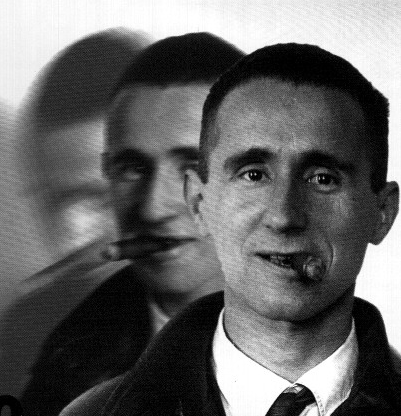
The Aristotelian model of tragic theatre remains a strong influence over dramatic construction in Western theatrical traditions. It is a model with which Bertolt Brecht takes issue [1]. The questions that Brecht poses for tragic theatre are important for design practice because he makes explicit an emphasis on how drama can provoke critical thinking in the audience rather than simply please the audience; he re-thinks the role of emotional responses and intellectual responses to dramas, and questions the role of ‘empathy’, all of which are important concerns for design. Furthermore, he raises the issue of the social and historical contextualisation of human suffering, rather than assuming its inevitable and universal character.
Brecht argues that Aristotelian dramatic practices lead the audience to conclude that human suffering is an inescapable or inevitable part of the human condition. He proposes, in its stead, ‘epic theatre’, although towards the end of his career he came to prefer the name ‘dialectical theatre’ to describe the kind of theatre that he had developed earlier in his career. Epic or dialectical theatre presents human suffering as something that can be changed through the social transformation of political institutions. This is the first major distinction that Brecht makes between tragic or Aristotelian theatre and epic theatre.
The second distinction Brecht makes is to question the audience’s identification with the drama’s protagonist, as the basis from which the audience then takes on the protagonist’s emotional states. Thus, Brecht’s epic theatre, through its staging practices, seeks to put into question the empathic and sympathic relations between protagonist and audience, so that the audience neither feels with the character nor feels for the character. For Brecht, such empathic and sympathic responses or shared feelings prevent critical reflection on the social dimension of tragedy.
In order to block empathic and sympathic responses, Brecht’s epic theatre employed alienation effects, Verfremdungseffekt, so that a critical mode of engagement with the protagonist and his or her predicament is encouraged. Brechtian performance techniques also sought to prevent the actor from engaging empthically with the character that he or she is playing [2].
In Brecht’s characterisation, Aristotelian drama creates a central protagonist whose thoughts and feelings serve as the focal point and guide the action of the drama, although it has to be said that nowhere does Aristotle claim to have as an aim an exact congruence of feelings between the tragic protagonist and the audience.
Brecht’s objections to the Aristotelian model are summarised as follows by Curran (2001: 172). First, plots that represent the protagonist’s error as central to his or her misfortune do not permit the playwright to write a play that is socially critical. The focus is solely on the representation of misfortune arising from individual error, rather than the fault-lines in the social and political structure that makes for needless misfortune. Brecht contends that to facilitate a critical perspective on the social relations presented in the drama, the drama should go beyond revealing the thoughts and feelings of the protagonist to consider the larger social network in which the protagonist operates.
Second, dramatic practices that feature empathy along with some kind of affinity with the tragic protagonist and a shared feeling as a result of this connection, impede the adoption of a critical perspective on the social dimension of the character’s situation, by not enabling the audience to move from the individual perspective to the social perspective.
Third, Aristotelian tragic theatre uses a mode of engagement that gives the audience pleasure but does not provide instruction or genuine learning.
However, nothing in Aristotelian aesthetic practices is inconsistent with going beyond the dramatic focus on immediate familial relationships and loss to reflect on the wider social dimension of the drama. Nevertheless, the practices of Aristotelian drama do not support this kind of critical reflection in the audience without being supplemented by dramatic devices that prompt this sort of wider consideration of the play’s significance.
Brecht understood that effective drama can never instruct by forcing specific conclusions on the audience, and he recognised that critical engagement is something that playwrights can encourage or enable through the use of techniques that challenge the audience to rethink the basic assumptions he or she uses to make sense of the drama.
Thus, if the aim is to see how tragedy can function as a social criticism, the practices of the Aristotelian aesthetic framework need to be supplemented by Brecht’s recommendations, i.e. those useful dramatic devices that can reveal the relationship between the individual protagonist and the social environment in which he or she acts.
Notes
[1] Martin Esslin (1984) points out that, rather than Aristotle directly, it was Goethe’s and Schiller’s 1797 essay, “On Epic and Dramatic Poetry” (Schiller and Goethe, 2001, 1797) that was Brecht’s target. It was because he knew that Goethe and Schiller had based their theory on Aristotle’s Poetics, that Brecht called what he was critical of Aristotelian theatre. Through a critique of Goethe and Schiller, Brecht sought to overturn the Aristotelian concept of drama, the drama of catharsis by terror and pity, the drama of spectator identification with the actors, the drama of illusion, which tries to create magical effects by conjuring up events which are represented as totally present, while palpably they are not.
It was against this Goethean and Schillerian formulation of the theory that Brecht offered his counter-theory. Esslin summarises Goethe and Schiller’s position in the following terms:
“Goethe and Schiller said that the epic poet presents the event as totally past, while the dramatic poet presents it as totally present. The epic poet relates what has happened in calm contemplation. The actor, on the other hand, is in exactly the opposite position: he represents himself as a definite individual; he wants the spectators to participate in his action, to feel the sufferings of his soul and of his body with him, share his embarrassments and forget their own personalities for the sake of his. The spectator must not be allowed to rise to thoughtful contemplation; he must passionately follow the action; his imagination is completely silenced.”
Brecht considered such a theatre to be a fraud. Ever the rationalist, Brecht demanded a theatre of critical thoughtfulness, a theatre that aims to prevent the identification of the audience with the characters; nor can it allow the identification of the actor with the character.
In this way, the study of (abstract, universal) human nature is replaced by a study of (concrete, particular) human, social relations.
[2] At the time when Brecht was developing his concept of epic theatre, melodrama, realism and naturalism were popular as forms of theatre. In one very obvious respect, Brecht’s epic theatre was a reaction against the naturalistic approach pioneered by Constantin Stanislavski. Like Stanislavski, Brecht disliked the shallow spectacle, manipulative plots, and heightened emotion of melodrama. However, where Stanislavski attempted to engender real human behaviour in acting through his system and to absorb the audience completely in the fictional world of the play, Brecht thought that Stanislavski’s methodology merely produced escapism. Brecht’s social and political focus led him to distinguish his approach from that of surrealism and also the Theatre of Cruelty developed in the writings and dramaturgy of Antonin Artaud, who sought to affect audiences viscerally, psychologically, physically, and irrationally (Escenastur, 2011).
References
Benjamin, W. (1999). The Author as producer. In: Jennings, M.W., Eiland, H., and Smith, G., eds. Walter Benjamin: selected writings. Volume 2. Part 2, 1931-1934. Cambridge, MA: Belknap Press.
Brecht, B. (1978). The Street scene: a basic model for an epic theatre. In: Brecht on Theatre: The Development of an Aesthetic. London, UK: Methuen Drama, 121–129.
Brecht, B. (1978). Brecht on theatre, edited by J. Willett. London, UK: Methuen Drama.
Brecht, B. (1961). On Chinese acting. Tulane Drama Review, 6 (1), 130–136.
Curran, A. (2001). Brecht’s criticisms of Aristotle’s aesthetics of tragedy. Journal of Aesthetics and Art Criticism, 59 (2), 167–184. Available from http://www.jstor.org/stable/432222 [Accessed 25 June 2016].
In an art practice context, environments are mixed-media constructions or assemblages usually designed for a specific place and for a temporary period of time. It is an alternative term for installation art.
The term was first used by artist Allan Kaprow in 1958 to describe his own large-scale artworks which transformed interior spaces.
References
Kaprow, A. (2014) ‘Assemblages, environments and happenings’, in Brayshaw, T. and Witts, N. (eds) The Twentieth-Century Performance Reader. 3rd ed. London, UK: Routledge, pp. 277–287.
One of the domains of psychology most relevant to design practices is environmental psychology, which is a relatively new branch of psychology. Its key objective is to improve the relationship between humankind and the environment using theory, research and practice.
Among the major theories in environmental psychology are geographical determinism, which believes that environmental pararmeters, such as climate, topography, vegetation and water availability, are the foundation and lifespan of civilizations; ecological biology, which focuses on the biological and sociological interconnectedness and interdependencies between the organism and its environment; behaviorism, according to which our responses to environmental stimuli shape our actions; and Gestalt psychology, which argues that our minds perceive objects as part of a greater whole and as elements of more complex systems.
The sub-discipline of ecopsychology views human well-being as being integrally dependent on environmental well-being, with an emphasis on environmental justice.
Environment is the name given to the outcome of the active processes of environing, which create an immunological sphere, in Sloterdijk’s terms, and which thereby create a meaningful context for the actants who are engaged in creating, sustaining and changing it. Environment, in this sense, is close to the notions of habitat and niche.
Environment, along with people and narrative, is one of the nodes in the tripartite model by means of which the methodological approach of design of narrative environments unfolds and is elaborated.
All three nodes are complex terms whose deictic or concrete content changes over time as the interactive dynamic among people, narrative and environments continues. Some light can be shed on what is meant by ‘environment’ by referring to the work of J. J. Gibson (1986, 1979), who writes,
“Why has man [sic] changed the shapes and substances of his environment? To change what it affords him […] this is not a new environment – an artificial environment distinct from the natural environment – but the same old environment modified by man. It is a mistake to separate the natural from the artificial as if there were two environments, […] It is also a mistake to separate the cultural environment from the natural environment, as if there were a world of mental products distinct from the world of material products. There is only one world, however diverse, and all animals live in it, although we human animals have altered it to suit ourselves. We have done so wastefully, thoughtlessly and, if we do not mend our ways, fatally.”
References
Gibson, J. J. (1986, 1979) The ecological approach to visual perception. Hillsdale, NJ: Lawrence Erlbaum.
Michel Foucault argues that the term humanism should not be confused with that of Enlightenment. The importance of grasping the notions of humanism and Enlightenment for design practices is that it bears directly upon how the human is understood in the design process and in relation to the created design, that is, how human actantiality and potentiality are implicated in the ways the design acts.
Foucault argues that the Enlightenment is a set of events and complex historical processes that is located at a certain point in the development of European societies. It includes elements of social transformation, types of political institution, forms of knowledge, projects of rationalisation of knowledge and practices and technological change. All of this is very difficult to sum up in a word, even if many of these phenomena remain important today.
In contrast, Foucault characterises humanism as a set of themes that have reappeared on several occasions, over time, in European societies.
Design as understood in Incomplete … takes up a position that is critical of humanism, the view of what it means to be human that re-emerged during the societal changes signified by the name of Enlightenment.
References
Foucault, M. (1984). What is Enlightenment? In: The Foucault Reader, edited by Paul Rabinow. New York, NY: Pantheon Books, 32–50.
Boever et al. (2012: x) suggest that intellectual currents in the humanities in recent decades have moved towards a context that is more receptive to the thought of Gilbert Simondon. This shift has been characterised by Brian Massumi as turning away from a prevailing acceptance of ‘constructivism’ towards what he calls ‘inventivism’. The distinction is defined in the following way: constructivism focuses on the cultural construction of reality, while remaining sceptical towards the claims of the natural sciences; inventivism, on the other hand, seeks to think the natural processes involved in any and all constructions.”
Elizabeth Grosz argues that that the constructivism associated with structuralism and poststructuralism, while necessary as a corrective to essentialist forms of thought, in the end overcompensated. In any case, contemporary philosophical thought is increasingly engaged in explicitly ontological investigations, which is more in line with Simondon’s approach to ‘being’ and ‘technology’.
Reference
Boever, A. De et al. (2012) ‘Editors’ introduction: Simondon, finally’, in Boever, A. De et al. (eds) Gilbert Simondon: Being and Technology. Edinburgh, UK: Edinburgh University Press, pp. vii–xi.
Gilbert Simondon (2017: 231), in a text written in the 1950s but not translated into English until 2017, makes an interesting claim about the articulation of technologies and three major socio-political regimes of the 20th century. Each has incorporated, in a different way, a representation and a valorisation of integrated technical systems.
He argues that National Socialist thought is attached to a certain conception that links the destiny of a people to a technical expansion. This thinking goes as far as conceiving the role of neighbouring peoples as a function of this master expansion.
The American democratic doctrine has an alternative definition of technical progress and of its incorporation into civilisation. Thus, he argues, the content of the notion of the standard of living, which is a social concept that constitutes a cultural reality, is such that important terms are technological. This is not only through the possession of particular instruments or utensils, but also through the fact of knowing how to use this or that network, of knowing how to be functionally connected.
Finally, the Communist Marxist doctrine, as it is lived and has been realised, takes technical development to be an essential aspect of the social and political effort to be made. It gains self-awareness through, for example, the use of tractors in agriculture and the foundation of factories in industry.
Simondon argues that, as individual technologies becomes increasingly integrated within a world, in the form of fixed ensembles attached to one another, they begin to constrain human individuals into the links these ensembles (dispositifs) determine. How this differs from Heidegger’s notion of ‘enframing’ (Ge-stell) is a topic to be pursued.
Reference
Simondon, G. (2017) On the mode of existence of technical objects. Translated by C. Malaspina and J. Rogove. Minneapolis, MN: Univocal.
Barry Watt, a psychotherapist working mainly with young homeless people, situates the popularity of the South Korean drama series Squid Game within a larger movement of young people towards Japanese and Korean anime and manga. They are looking, he conjectures, for a response to their experience that is not being met by western European media outputs The characters in anime and manga, by shifting back and forth between low affect and high violence, demonstrate a narrow emotional range. Watt suggests that this narrowness might appeal to the growing number of people who identify as neurodiverse, for whom old-school storytelling, with its complex plotting and layers of characterisation, is a perplexing phenomenon.
Neurodiversity is an umbrella term covering a number of neurodevelopmental conditions. These include ADHD, Autism, Dyslexia, Dyspraxia, Dyscalculia and Dysgraphia.
Literary Examples
In The Book of Form and Emptiness, Ruth Ozeki establishes a complex neurodivergent subjectivity as she traces the character Benny Oh’s journey into schizoaffective disorder (Harrison, 2021).

 Incomplete ...