Things

RELATED TERMS: Collecting; Defamiliarisation; Events; Material Culture; New Materialism; Representation; Tangled Hierarchy and Strange Loop

“a kiss is an ‘event’. It makes no sense to ask where the kiss will be tomorrow.
The world is made up of networks of kisses, not of stones.” (Rovelli, 2018)

“the thing really names less an object than a particular subject-object relation.” (Brown, 2001: 4)

“Thing theory is at its best … when it focuses on this sense of failure, or partial failure, to name or to classify. Thing theory highlights, or ought to highlight, approaches to the margins—of language, of cognition, of material substance. “Things” do not lie beyond the bounds of reason … but at times they may seem to. That seeming is significant: these are limit cases at which our ordinary categories for classifying signs and substances, meaning and materiality, appear to break down.” (Plotz, 2005: 110)

What the epigraph above from Plotz raises is the question of the relationship between a ‘design’ and a ‘thing’. A design, it could be argued, is easily named and categorised. It is, so to speak, fully ‘scripted’ and ‘framed’ so that what it is, what kind of thing it is and what it does are clearly recognised. Furthermore, its symbolic narration and dramatisation are easily unfolded from this grounded naming and categorising. The wager of some forms of critical design and speculative design is that a ‘design’ may be such that its material qualities, its ‘thingness,’ may interfere with its script and frame, making it susceptible to an analysis using thing theory which allows us to question in specific ways our conventional or accepted techniques of classifying signs and substances. It may become a limit case, in Plotz’s terms. In turn, this may be recognised as a particular instance of defamiliarisation or ‘making strange’. This process may be more effective in the context of what Buchanan (2021) calls levels 1 and 2 of design practice, which concern the design of artefacts and communications, and less effective when it comes to levels 3 and 4 of design practice, which concern system and service (inter-action) design and design as a method for organisational, political, financial or social development, although it might be interesting to experiment with defamilarisation in these latter contexts.

Thing Theory

Since the late 20th century, there has been a ‘return to things’ in the social sciences and humanities, to the extent that Bill Brown (2001), a scholar of American literature, has called for a ‘thing theory’. This movement contravenes an earlier focus on representation and the long scholarly tradition that separated subject from object, mind from matter. Among these approaches, human existence and social life are understood to depend on material things and are entangled with them. People and things are relationally produced (Hodder, 2014), along with, it should be added, the ‘worlds’ in which such ‘things’ are recognised as ‘objective realities’ and the (co-related and simultaneous) ‘worldlessness’ or ‘worldlessnesses’ that such world-forming practices also create.

The design of narrative environments is in accord with these perspectives: in being world forming, narrative environments also create worldlessness, while at the same time creating entities that raise the question the boundary between a ‘design’, replete with value(s), and a ‘thing’, without value or actively dis-valued.

Continue reading “Things”

New Materialism

RELATED TERMS: Affordances; Object-Oriented Ontology; Speculative Realism;

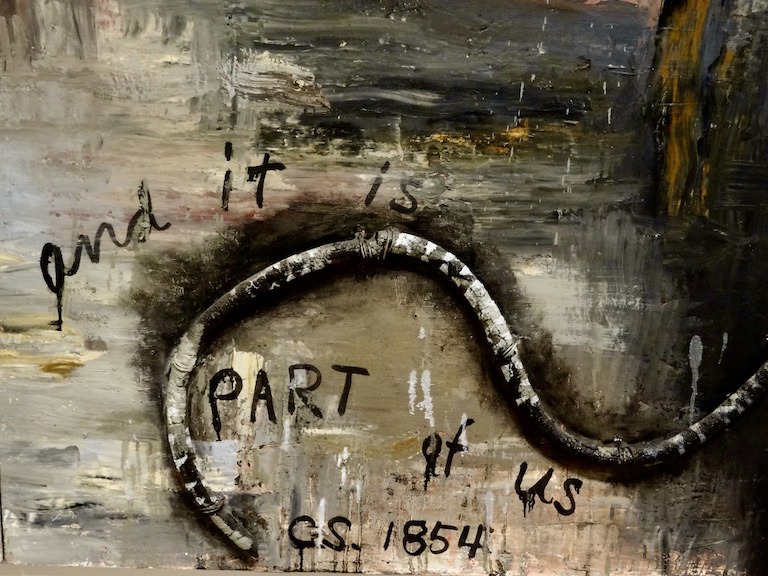
Jaune Quick-to-See Smith, The Garden, 1989: “We are Part of the Earth and It Is Part of Us,” Chief Seattle

Like new materialism, design practice is interested in, “understanding things as active agents rather than passive instruments or backdrops for human activity” (Barnett and Boyle, 2016).

Certain aspects of new materialist thinking, which Sara Ahmed has called white feminist materialism (Hickey-Moody, 2015: 169), may be of value in design practice and for analysing how designs work, for example, its emphasis on meaning production, on the ‘performative’ character of the world and on the fact of being environed by artefacts fashioned by human design. As a theoretical resource, it could be useful to re-think the interrelationships among the material, the agential or actantial and the human dimensions of designs in situ.

Keith Ansell-Pearson argues that although it is stated by some of its proponents that new materialism is a term coined by Rosi Braidotti and Manuel de Landa in the second half of the 1990s (Dolphijn and Tuin 2011: 383), this overlooks the fact that, in the 1960s, Deleuze was using this term in connection with his reading of Spinoza.

New materialism seeks to demonstrate that the mind, in being ‘bodily’, is always already material but that, nevertheless, the mind takes ‘bodiliness’ as its object, and that nature and culture are always already ‘nature cultures’, in Donna Haraway’s term.

New materialism critiques the dualism inherent in transcendental and humanist traditions which still linger in some cultural theory. The transcendental and humanist traditions continue to stir debates that are being opened up by new materialists who seek to shift these dualist structures by allowing for the fluxes of nature and culture, matter and mind, thereby opening up active theory formation. (Dolphijn and Tuin, 2012)

New Materialism as Media Theory

Jussi Parrika (2012) argues that,

“[n]ew materialism is not only about intensities of bodies and their capacities such as voice or dance, of movement and relationality, of fleshyness, of ontological monism and alternative epistemologies of generative matter, and active meaning-making of objects themselves non-reducible to signification. New materialism is already present in the way technical media transmits and processes ‘‘culture,’’ and engages in its own version of the continuum of natureculture (to use Donna Haraway’s term) or in this case, medianatures.”

Parikka uses the term medianatures to make sense of the continuum between mediatic apparatuses and their material contexts in the exploitation of nature.
New materialism as media theory, Parikka suggests, can be seen as the intensive excavation of the materiality of media, where and when that materiality actually is or takes place. This means that materiality is not simply discovered in technological specificity or scientific contexts, for example. Rather, materialism has to be invented continuously anew.

In consequence, Parrika proposes a multiplicity of materialisms. The task of new materialism, therefore, is to address how to think that multiplicity methodologically so that it facilitates a grounded analysis of contemporary culture. This implies being able to talk about non-solids and the processual, the ‘weird materiality’, as Parrika calls it, inherent in the mode of abstraction of technical media, just as much as being able to talk about objects. This step is necessary so that we are able to understand what the specificity of this kind of materialism might be that we encounter, but do not always perceive, in contemporary media culture.

Parikka cautions that it should not be assumed that the agency of matter is always simply ‘good’. The materiality of waste, for example, is one concrete way to think in a more nuanced way about the agency of matter in a new materialist perspective. The materialism of dirt and bad matter is not only about ‘thing-power’ but about how things can disempower through encounters that reduce the vitalities of material assemblages.

References

Ansell-Pearson, K. (2015). Deleuze and new materialism: naturalism, norms and ethics [Essay]. Academia.edu. Available from https://www.academia.edu/20063620/Deleuze_and_New_Materialism_Naturalism_Norms_and_Ethics?auto=view&campaign=weekly_digest [Accessed 17 February 2016].

Barnett, S and Boyle, C. eds. (2016) Rhetoric, through everyday things. Tuscaloosa, AL: University of Alabama.

Coole, D. and Frost, S. (eds) (2010) New materialisms: ontology, agency, and politics. Durham, NC: Duke University Press.

Dolphijn, R. and van der Tuin, I. (2011), Pushing dualism to an extreme: On the Philosophical Impetus of a new materialism’, Continental Philosophy Review, 44, 383-400.

Dolphijn, R. and van der Tuin, I. (2012). New Materialism: Interviews & Cartographies, Ann Arbor, MI: Open Humanities Press. Available at: http://hdl.handle.net/2027/spo.11515701.0001.001 Accessed on 29 July 2014

Hickey-Moody, A. (2015). Manifesto: The rhizomatics of practice as research. In: Arts, Pedagogy and Cultural Resistance. London, UK: Rowman & Littlefield.


Parikka, J. (2012) Forum: New materialism new materialism as media theory: Medianatures and dirty matter, Communication and Critical/ Cultural Studies, 9(1), pp. 95–100. doi: 10.1080/14791420.2011.626252.

For a discussion of the many lines of flight of new materialism, see New Materialist Cartographies

Apparatus – Dispositif

RELATED TERMS: Actor-Network Theory; Collage, Montage, Assemblage and Bricolage; Biopolitics and Biopower; Cinema and Film Theory; Disciplinary Societies and Societies of Control; Distribution of the Sensible; Genealogy – Nietzsche; Practice

” ‘échafaudage‘ is the term Axelos suggests best translates the Heideggerian notion of das Ge-stell, usually translated as ‘en-framing,’ or, in French, as arraissonment or dispositif.” (Elden, 2015: 15)

A narrative environment could be conceived as a ‘dispositif’ or a concrete social apparatus, understood as a ‘practical system’; or as being inscribed or situated within an apparatus. Other terms with similar or overlapping meanings which are used in this context are ‘agencement‘ and ‘assemblage‘ and possibly ‘arrangement’ and ‘distribution’.

Jerome Fletcher notes that the term ‘apparatus’ is often used as a translation of the French term dispositif, a term employed initially by Foucault and elaborated by Agamben and Deleuze. In this usage, apparatus does not simply refer to a mechanism, device or physical object, such as, for example, computer hardware, but is more like an arrangement, for example, of hardware, software, code, writing, performance, usage, texts, ideology, writers, readers, coders, decoders, executions (of programs) and so on, together.

Continue reading “Apparatus – Dispositif”

Anthropology

RELATED TERMS: Sociology; Ethnomethodology; Agency; Actor Network Theory; Cyborg Anthropology

Anthropological research may provide some methodological guidance in the understanding of design practices as complex socio-cultural, techno-economic practices. For example, Anusas and Harkness (2014) suggest that, “in both anthropology and design … there is and perhaps always should be a concern with that other which is possible. Work in both realms can possess this critical orientation towards the possibility of difference.” Thus, both anthropology and design can be seen as practices that share a concern with alternative and possible others: “the others of contemporary cultures; the other and multiple histories revealed in reinterpretations; the other ways of living that might emerge with alternative shapings of the future” (Anusas and Harkness, 2014). Such others, Anusas and Harkness (2014) continue, are intertwined: reinterpretations of the past influence formations of the future; and vice versa.

Much like the discipline of anthropology since the 1980s, design practices are concerned to engage with two sets of closely interrelated terms. As listed by Ortner (1984), they are practice, praxis, action, interaction, activity, experience, performance, on the one hand; and, on the other hand, the doer of all that doing, agent, actor, person, self, individual, subject. It is in the context of the relationship or, more properly, the entanglement, of the doer and the doing that the notions of actant and actantiality have arisen, for example in the context of actor-network theory.

The use of terms such as actantiality seeks to de-centre the subject as the sole source and origin of meaning-production, knowledge production and action. The aim is to understand how meaning-production, knowledge-production and agency are distributed among human, non-human and more-than-human actants. All such actants may be said to be non-originary or, in other words, equally originary. This is a situation for which the Derridean term différance or the Buddhist concept of co-dependent arising, dependent co-arising or interdependent co-arising may be appropriate. The notions of actant-network and actant-rhizome also seek to engage with such distributed non-originary agency.

Ortner further comments that even though she has taken practice to be the key symbol of the anthropology of the 1980s, another key symbol might equally have been chosen: history. The set of terms clustered around history includes time, process, duration, reproduction, change, development, evolution and transformation. Taking history as the key term, the theoretical shift in anthropology, rather than being seen as a move from structures and systems to persons and practices, might instead be seen as a shift from static, synchronic analyses to diachronic, processual ones. Seen in this light, the shift to practice becomes one wing in the move to diachrony, one which emphasises micro-developmental processes-transactions, projects, careers, developmental cycles, and so on.

The other wing of the move to diachrony, the macro-processual or macro-historical. itself has at least two trends, Ortner argues. The first, the political economy school, seeks to understand change in the small-scale societies typically studied by anthropologists by relating that change to large-scale historical developments, especially colonialism and capitalist expansion, external to the societies in question. The second is a more ethnographic kind of historical investigation, paying greater attention to the internal developmental dynamics of particular societies over time.

Design practices are attentive to the concepts clustered around practice and agency; to the concepts clustered around history and change; to the practices of ordinary living; and to the intertwining of the local and small scale with the more global and large scale.

Design practices seek to take into account all three aspects of Peter Berger and Thomas Luckmann’s (1967:61) epigraph: “Society is a human product. Society is an objective reality. Man is a social product”. In other words, design practices acknowledge that society is a system, the system is powerfully constraining, yet the system can be made and unmade through human action and interaction. In addition, however, design practices further recognise that human action and interaction is thoroughly mediated by designs of different kinds and dimensions. Design practices are also aware of the paradox that although the human world is pervaded by designs of different ages, kinds and scales, the world as a whole is not ‘designed’ as such; or, rather, does not adhere to a single, homogeneous design.

A further paradox is that although actors’ intentions are accorded central place, major social change does not for the most part come about as an intended consequence of such actions. Change is largely a by-product, an unintended consequence of action, however rational action may have been (Ortner, 1984). Thus, to say that society and history are products of human action is true only in a certain paradoxical sense. They are rarely the outcomes the actors themselves set out to achieve. As Michel Foucault puts it: “People know what they do; they frequently know why they do what they do; but what they don’t know is what what they do does”. (Personal communication, quoted in Dreyfus and Rabinow, 1983, 187).

Design practices thoroughly engage with these paradoxes, inherent in design processes: design outcomes diverge from design intention; and design practices are most often engaged with situations that are themselves the unintended consequences of prior design intentions and actions. They are in that sense re-designs in a process of continual re-designing.

Digital Ethnography

Digital ethnography is the exploration of the impact of digital technologies on cultures and the constraints of cultures on the development of digital technologies.

Physical Anthropology

Physical anthropology has re-positioned itself in recent decades within the larger field of evolutionary biology. Along with this repositioning, it has developed and incorporated new techniques as well as the recognition of broader responsibilities in the modern world. Many programmes formerly known as ‘physical anthropology’ have changed their names, most commonly to biological anthropology. A more accurate name might be ‘evolutionary anthropology’, reflecting the fact that the core of the discipline is the study of human evolution and that the guiding theoretical framework is evolutionary theory (Ellison, 2018).

References

Anusas, M. and Harkness, R. (2014) Things Could Be Different: Design Anthropology as Hopeful, Critical, Ecological, in Ethnographies of the Possible Seminar, April 10th, 2014, Aarhus, DK, The Research Network for Design Anthropology. Available at: https://strathprints.strath.ac.uk/48850/ (Accessed: 23 August 2022).

Berger, Peter, and Luckmann, Thomas. 1967. The Social Construction of Reality. Garden City, New York: Doubleday.

Dreyfus, H. L. and Rabinow, P. (1983) Michel Foucault: beyond structuralism and hermeneutics. 2nd edn. Chicago, IL: University of Chicago Press.

Ellison, P. T. (2018) The evolution of physical anthropology. American Journal of Physical Anthropology, 165, 615–625. https://doi.org/10.1002/ajpa.23408

Ortner, S. B. (1984) Theory in anthropology since the sixties, Comparative Studies in Society and History, 26(1), pp. 126–166. doi: 10.1017/S0010417500010811

Anthropocene – Capitalocene – Chthulucene; Plantationocene

RELATED TERMS: Anthropo-Scenes; Human Ecosystem; Postanthropocentrism; Posthuman; Posthumanism; Symbiocene; World; World-as-Milieu; World-Building

“the Earth … is leaving the relatively stable and benign state that is known as the Holocene, the geological period of the last 11,700 or so years which is now retrospectively perceived as a rather unique period, the rare ‘long summer’ (Fagan 2004, Dumanoski 2009) that allowed for the rise and flourishing of civilizations based on agriculture and later industrialization, and is entering a much more instable and unpredictable state now which has been termed the Anthropocene” (Lemmens, Blok and Zwier, 2017: 115)

Eugene Stoermer, a freshwater biologist who studies diatoms in the Great Lakes of North America, proposed the name the Anthropocene in 2000 to indicate the anthropogenic processes that are acidifying the waters and changing the nature of life on Earth. The term was picked up and re-used by Paul Crutzen, an atmospheric chemist, who joined together with Eugene Stoermer to popularise the name Anthropocene specifically in relationship to those sorts of processes emanating from the mid-18th century related to the steam engine and the extraordinary expansion in the use of fossil fuels that acidify the oceans and bleach the corals. They were particularly worried about a vibrio infection in coral reefs that is responsible for the bleaching (Haraway, 2014).

Continue reading “Anthropocene – Capitalocene – Chthulucene; Plantationocene”

Anthropo-Scenes

RELATED TERMS; Anthropocene – Capitalocene – Chthulucene; Platationocene; Cultural geography; Postanthropocentrism; Posthuman; Posthumanism;

One strand of narrative environments may be defined as Anthropo-Scenes: they concern what the world is like both now, what it might be like in times to come and what life, including human life, in those present and future worlds is like and might be like. This is to acknowledge the importance of narrative in understanding and communicating issues related to the notion of an ‘anthropocene’, a concept which begins its life in the discourse of Earth System Science but which has given rise to a wider intellectual event-space termed the Anthropo-Scene, a term denoting “a flurry of activity with far-reaching ontological, epistemic, political and aesthetic consequences” (Lorimer, 2016).

Castree (2015) argues that,

“The current Anthroposcene is far too science led. It is dominated by those who regard planetary change, and human responses to it, as amenable to analysis and influence absent any deep engagement with other forms of knowing and acting. While we should thank geoscientists for sounding the environmental alarm, other epistemic communities beyond a few social science fields (notably environmental economics) need to shape the discourse before it solidifies. The stakes are much too high for people not yet part of ‘global change science’ (GCS) to watch from the sidelines.”

In the context of the design of narrative environments, Anthropo-Scenes bring together design and science to characterise the historicity of the ’present moment’, historicity here including futurity. In other words, the historicity or historical being of ‘anthropocene’ acknowledges the entangling of its distinct temporalities, such as the cultural, economic, ecological and geological, in narrativity. [Historicity as the narrativisation of temporality, to create factual historiographies and fictional stories].

References

Castree N (2015) Changing the Anthropo(s)cene: Geographers, global environmental change and the politics of knowledge. Dialogues in Human Geography 5(3): 301–316.

Lorimer, J. (2017). The Anthropo-scene: A guide for the perplexed. Social Studies of Science, 47 (1), 117–142. Available from http://journals.sagepub.com/doi/10.1177/0306312716671039 [Accessed 22 August 2019].

Other sources

Anthropo-scene: art and nature in a manufactured era [Art exhibition website] http://Anthroposcene.weebly.com/

Climaginaries [Website] https://www.climaginaries.org

Narrating Climate Futures [Website] https://www.climatefutures.lu.se/climate-fiction/anthropo-scenes

Technology is our next nature: Anthropo-Scene:  https://www.nextnature.net/search/Anthropo-scene/

The Anthropo.scene [Blog] http://jeremyjschmidt.com/

Antagonist

RELATED TERMS: Actant; Actantial Model – Greimas; Agon; Narratology; Protagonist

The term antagonist is derived from the Greek word antagonistes, meaning opponent, competitor or rival. The antagonist may be a character, group of characters, or an institution representing the difficulties and obstacles against which the protagonist must struggle, preventing the protagonist from achieving his/her/its/their quest, goal, destination or destiny. In an agonistic model of narrative, such as that conceived by A. J. Greimas for example, which conceptualises the helper and the opponent as actantial contraries, the actantial role of opponent may be played by a single character, who may be human or non-human, or by a series of human or non-human characters.

Drawing upon another binary distinction, that of friend and enemy, the antagonist may also be called the archenemy or arch-foe of the protagonist.

Employing a yet further dualism, that of hero versus villain, the former may be regarded as protagonist and the latter as antagonist.

The antagonist may also represent a major threat or obstacle to the main character simply by their very existence, without necessarily actively targeting him, her or them. In short, as John Yorke (2013) says, in discussing screenwriting and cinema, antagonism is “the sum total of all the obstacles that obstruct a character in the pursuit of their desires.”

Yorke further suggests that, while antagonists can be external, such as in the James Bond films, antagonism can manifest itself in many different ways, perhaps most interestingly when it lies within the protagonist, such as in The Diving Bell and the Butterfly. Thus, cowardice, drunkenness or lack of self-esteem can serve as internal obstacles that prevent a character reaching fulfilment. Furthermore, antagonists can be both external and internal, as in the film, Jaws. Nevertheless, Yorke claims, in the context of cinema, quoting Alfred Hitchcock, they all have one thing in common: “The more successful the villain, the more successful the picture.”

References

Yorke, J. (2013) What makes a great screenplay?, Guardian, p. Review 2-4. Available at: http://www.guardian.co.uk/books/2013/mar/15/john-yorke-best-screenwriting (Accessed: 16 March 2013).

Analepsis and Prolepsis

RELATED TERMS: Tragic theatre – Aristotle; Metalepsis

A Greek tragedy usually starts with a ‘flashback’ or analepsis, a recapitulation of the incidents of the story which occurred prior to those which were selected for the plot. The reader is plunged in medias res (‘into the middle of things’), and earlier incidents in the story are introduced artfully at various stages in the plot, often in the form of retrospective narration. (Selden, Widdowson and Brooker, 2005: 34)

It is analepsis which allows for prolepsis, or ‘flash forward’, to various other moments in the narration by means of which the story is unfolded through the plot.

In the design of narrative environments, such plot movements back and forth in time against a (pre-existing) story timeline may be parallelled or contradicted by the spatial movements of the body against the contours of a (pre-constructed) place, to reinforce or to unsettle the the deictic centre of the narrative environment world by playing with the narrative and spatial parameters of orientation, dis-orientation and re-orientation, as an articulation of storyworld, world of the story, the spatial processional and the embodied experiential worlds of imagination, logic and emotion.

References

Selden, R., Widdowson, P. and Brooker, P. (2005). A Reader’s guide to contemporary literary theory, 5th ed. Harlow, UK: Pearson Longman.

Alienation effect (Verfremdungseffekt)

Use for Distancing effect; estrangement effect

RELATED TERMS: Avant-garde movements; Defamiliarisation; Literary theory; Psychogeography; Situationist International; Epic theatre – Brecht; Theatre of Cruelty – Artaud

Mode of address and mode of engagement of audience and/or participant are important aspects of the threshold and immersive experience of design interaction, in terms of narrative beginning and sequential progression as well as environmental entrance and situational flow. They concern the character of the performative invitation to engage with, and persist with, the designed entity. The question that arises, then, is whether this constitutes an empathic engagement or some mixture of empathic and intellectual engagement, which may prompt consideration of the value of the alienation effect discussed by Brecht and the defamiliarisation process discussed by Shklovsky, as devices for guiding responses and interactions.

Alienation effect is a term derived from the theoretical and theatrical practice of the German Marxist playwright and poet, Bertolt Brecht, 1898-1956. Brecht sought to discover ways of dramatising Marx’s insights into the ways capitalism works. To this end, he sought to create a ‘dialectical theatre’ by means of a set of devices in staging, music, acting, and the telling of parable. The goals was to confound an audience’s comfortable empathic identification with characters and story, as is encouraged by conventional realism [1] or naturalism (Brooker, 2003: 5), through the illusion of the real, the natural and/or the inevitable, i,e, as ‘matters-of-fact’ in contrast to ‘matters of concern’, in Latour’s terms.

Brecht introduces the term Verfremdungseffekt, translated as ‘alienation effect’ [2], in an article entitled “On Chinese Acting” [3], arguing thatthe term had been used in Germany with reference to plays that were of a non-Aristotelian kind, by which he means plays that did not rely on an identification on the audience’s part with the characters on the stage. In Brecht’s (1961: 130) words, the alienation effect refers to,

“… attempts to act in such a manner that the spectator is prevented from feeling his way into the characters. Acceptance or rejection of the characters’ words is thus placed in the conscious realm, not, as hitherto, in the spectator’s subconscious.”

Together these techniques produced the ‘alienation effect’.

Martin Esslin (1960) writes that Brecht could never successfully achieve his famous ‘Verfremdungseffekt, the inhibition of any identification between spectator and actor, in his own highly rational theatre. ‘Verfremdungseffekt’ really comes into its own in the Theatre of the Absurd, where it is impossible to identify oneself with characters one does not understand or whose motives remain a closed book, and so the distance between the public and the happenings on the stage can be maintained.

As Selden, Widdowson and Brooker (2005: 89) explain, Brecht rejected what he called Aristotelian theatre, referring to Aristotle’s formalisation of the practices of Greek tragedy, a form of drama performed in theatres across ancient Greece from the late 6th century BCE whose main proponents were Aeschylus, Sophocles, and Euripides (Cartwright, 2013). Aristotle emphasised the universality and unity of the tragic action, and the identification of audience and hero in an empathic relation which produces a catharsis of emotions. In contrast, Brecht urges that the dramatist avoid a smoothly interconnected plot and prevent any sense of inevitability or universality. The facts of social injustice, Brecht contended, needed to be presented as if they were shockingly unnatural and totally surprising.

To avoid lulling the audience into a state of passive acceptance, the illusion of reality, achieved through the audience’s empathic identification with the tragic hero figure, must be shattered by the use of the alienation effect. The actors must not lose themselves in their roles or seek to promote a purely empathic audience identification. They must present a role to the audience as both recognizable and unfamiliar (recalling Freud’s notion of the uncanny), so that a process of critical assessment can be initiated. The situation, emotions and dilemmas of the characters must be understood from the outside and presented as strange and problematic. This is not to say that actors should avoid the use of emotion, simply that they should not resort to empathy. This is achieved by ‘baring the device’, to use the Formalist term (Selden, Widdowson and Brooker, 2005: 90).

Brecht did not seek, through this effect, to reinforce alienation in Marx’s sense. Marx depicts a condition of human alienation from nature, from other people and from the products of his/her own labour. The latter, in particular, is induced by the exploitation of the worker under capitalism, enforcing an identification of the worker with the commodity value of the products of labour. Ultimately, this is seen by Marx to produce a profound alienation of humans from themselves.

Brecht’s intentions were precisely the opposite: to induce a ‘critical attitude’ which would dispel the acceptance necessary to the maintenance of the conditions producing alienation under capitalism. Brecht intended to describe a technique of distancing the audience from intense empathic involvement in the action of a play, in order to encourage and enable them to reflect objectively on the content, themes and messages inherent in that action.

This difference can be seen in the term Brecht used in German. Marx used the word Entfremdung while Brecht wrote of the Verfremdungseffekt, for which a better translation would be ‘de-alienation’ effect. As such, it is related to similar devices in modernist theory and art such as ‘defamiliarization’ or ostranenie and ‘making strange’ or ‘estrangement’, though these have not always had the overtly politicizing intention of Brecht’s method.

Brecht’s ideas were widely adopted, often in association with feminism, psychoanalysis and the Marxism of Louis Althusser, in the film theory of the 1970s associated with the British film journal Screen.

Brecht’s concept is to a degree indebted to the theories of montage developed in Soviet cinema theory and practice of the 1920s, notably in the cinema of Sergei Eisenstein. Later examples in the ‘Brechtian’ tradition in theatre are Heiner Müller, John Arden, Edward Bond, Dario Fo; and in cinema, Jean-Luc Godard, Jean Marie Straub, and Hal Hartley and Peter Greenaway, the latter two more indirectly.

The alienation effect is now pervasive. It can be found in advertising and television programming as well as cinema and theatre. Consequently such devices are no longer the province of a critical avant-garde. Scepticism about its continued value is related to arguments about a loss of distinction between the image and the real in postmodern society and the frustrations therefore attending any form of artistic or theoretical ideology critique.

Notes

[1] In particular, Brecht opposed Socialist Realism. This offended the East German authorities after he settled there in 1949. Socialist Realism favoured realistic illusion, formal unity and ‘positive’ heroes. He called his theory of realism ‘anti-Aristotelian’, a covert way of attacking the theory of his opponents (Selden, Widdowson and Brooker, 2005: 89)

[2] Henri Lefebvre discusses the adequacy of this translation and also the risks and dangers inherent in Brecht’s dialectical theatre in a passage in the Introduction to volume 1 of Critique of Everyday Life. Thus, Lefebvre (1995: 23) argues that in Brecht’s theatre,

“The spectator wavers between an externalized judgement – an intellectual state which implies high culture – and an immersion in the image proposed. Perhaps this is what the dialectic of the Verfremdungseffekt is. The spectator is meant to disalienate himself in and through the consciousness of alienation. He is meant to feel wrenched from his self but only in order to enter more effectively into his self and become conscious of the real and the contradictions of the real.”

(Lefebvre 1995: 23)

However, Lefebvre (1995: 24) continues, there is a risk that this dialectic process will fail and take on the disturbing form of fascination, which is a worse outcome than the identification that takes place in the Aristotelian model of tragic theatre: rather than ‘classic’, tragic completeness, the audience will look for satisfaction in “ a sort of bloody ecstasy” (Lefebvre, 1995: 24). Furthermore, Lefebvre (1995: 24) notes, “generalized strangeness entails a danger”, one that was avoided by Brecht but is not necessarily avoided by the people who produce his plays or write about them.

The danger is that in seeking to construct a drama that, while based on alienation, seeks to struggle against it, the drama will end up sanctioning alienation. It is significant, in this respect, that Brecht’s term Verfremdungseffekt is translated as ‘effet d’alienation’ in French and as ‘alienation effect’ in English, as if alienation were the goal of the effect rather than that which it seeks to overcome.

Lefebvre (1995: 24) concludes that it would be a cruel paradox if Brecht’s drama were “to sanction alienation by giving it all the glamour of violence”, a danger, Lefebvre thinks, that is more evident in Antonin Artaud’s theatre of cruelty that Brecht’s epic or dialectical theatre.

[3] Min Tian (1997) warns that Chinese acting does not in fact generate anything identical with, or even similar to, the Brechtian Alienation effect, and that the influence of Asian theatre on Brecht should not be overemphasised. Long before he saw Mei Lan-fang’s performance in 1935, Brecht had formulated in his theoretical writings and theatrical practices his new conceptions of theatre and acting, in particuliar his theory of the epic style of acting. What later came to be called the Alienation effect was already firmly established and clearly articulated as the core of his epic theatre, as outlined, for example, in “The Street Scene” (Brecht, 1978a). While he later elaborated the theory in greater detail, none of the basic ideas were changed (Hecht 1961, 95-96). John Willett, furthermore, contends that Brecht’s term Verfremdung, which was virtually a neologism, appears to be a precise translation of Viktor Shklovsky’s term “priem ostranenniya”, i.e. the device of making strange (Brecht 1978b, 99).

Rather than deriving from elements of Chinese theatre, Tian argues that, to a large extent, Brechtian theatre represents a return to the mainstream of the European classical tradition. A similar point is made by Jacques Derrida (1978, 244) who, while citing Antonin Artaud’s discussion of the theatre of cruelty, noted that,

“The Verfremdungseffekt [alienation effect] remains the prisoner of a classical paradox and of “the European ideal of art” which “attempts to cast the mind into an attitude distinct from force but addicted to exaltation” (TD, p. 10). Since “in the ‘theater of cruelty’ the spectator is in the center and the spectacle surrounds him” (TD, p. 81), the distance of vision is no longer pure, cannot be abstracted from the totality of the sensory milieu; the infused spectator can no longer constitute his spectacle and provide himself with its object. There is no longer spectator or spectacle, but festival (cf. TD, p. 85).”

(Derrida, 1978, 244)

References

Brecht, B. (1961). On Chinese acting. Tulane Drama Review, 6 (1), 130–136.

Brecht, B. (1978a). The Street scene: a basic model for an epic theatre. In: Brecht on Theatre: The Development of an Aesthetic, edited by John Willett. London, UK: Methuen Drama, 121–129.

Brecht, B. (1978b). Brecht on theatre, edited by John Willett. London, UK: Methuen Drama.

Brooker, P. (2003). A Glossary of Cultural Theory, 2nd ed. London, UK: Arnold.

Derrida, J. (1978). The Theater of cruelty and the closure of represenation. In: Writing and difference. London: Routledge, 232-250.

Esslin, M. (1960) ‘The Theatre of the absurd’, The Tulane Drama Review, 4(2), pp. 68–70. Available at: http://web.iitd.ac.in/~angelie/courses_files/TOA/esslin essay tdr.pdf.

Hecht, W. (1961). The Development of Brecht’s theory of the epic theatre, 1918-1933. Tulane Drama Review, 6 (1), 40–97. Available from http://www.jstor.org/stable/1125006 [Accessed 22 March 2016].

Lefebvre, H. (1995). Critique of everyday life. Volume 1: Introduction. London, UK: Verso.

Selden, R., Widdowson, P. and Brooker, P. (2005). A Reader’s guide to contemporary literary theory, 5th ed. Harlow, UK: Pearson Longman.

Tian, M. (1997). ‘Alienation-effect’ for whom? Brecht’s (mis)interpretation of the classical Chinese theatre. Asian Theatre Journal, 14 (2), 200–222. Available from http://www.jstor.org/stable/1124277 [Accessed 11 March 2016].

Alienation

Related terms; Alienation-effect (Verfremdungseffekt); Alltäglichkeit; The Commodity; Historical materialism – Marxism; Lefebvre; Reification;

In general, alienation refers to the sense of distance from nature, separation from others, and helplessness that is an effect of modern existence since the time of the Industrial Revolution in the West, from approximately 1750 onwards.

In Karl Marx’s writings, alienation is depicted as a condition of human alienation from nature; from other people; and of a person from the products of his/her own labour. The last form of alienation, from the products of one’s own labour, is induced by the exploitation of the worker under capitalism, Marx argues, enforcing an identification of the worker with the commodity value of the products of labour. Ultimately, this is seen by Marx to produce a profound alienation of humans from themselves.

In psychoanalytic theory, alienation refers to the split in subjectivity between the ego cogito and the unconscious, and the recognition that one is not in control of one’s thoughts, actions, and desires because of the existence of unconscious drives brought into play in interaction with one’s social and material environments.

Continue reading “Alienation”