Critical Thinking

RELATED TERMS: Arendt; Creative Thinking; Critical Theory; Design Practice and Functionalism; Feminism and Materialism; Genealogy – Nietzsche; Historical Materialism – Marxism; Methodology and Method; Modernism and Avant-Garde Art Practice; Modernity; Postmodernism; Theoretical Practice;

Critical thinking in the West can be traced back back to the Socratic-Platonic tradition, with Plato formalising the Socratic critique of received opinions into a distinction between knowledge, in the form of episteme, and doxa, in the form of belief. This serves as the basis for distinguishing the elevated position of the philosopher, as having epistemic knowledge, from the common man, who has only doxic belief (Biesta and Stams, 2001).

However, Biesta and Stams insist, it is Kant’s three Critiques which remain, for the contemporary 21st century reader, a major attempt to articulate what it could mean for a philosophy to be critical. Kant also provided an explicit argument for linking critique and education. Judith Butler (2009: 775) contends that Kant extended the scope of critique yet further, arguing that while critique arrives at its modern formulation within philosophy, it also makes claims that exceed the particular disciplinary domain of the philosophical. In Kant, Butler states, critique operates not only outside of philosophy and in the university more generally but is also a way of calling into question the legitimating grounds of various public and governmental agencies.

The term ‘critical theory‘, which develops within the same conceptual frame, has a narrower scope, however, referring to the thought of several generations of scholars within the Frankfurt School.

What is particular interest in the context of narrative environment design is the relationship between critical thinking and creative thinking. Thinking about the relationship between the critical and the creative can be assisted by considering the thought of Bruno Latour and Jacques Derrida, amongst others, who consider what has been called a ‘crisis of the critical’.

Latour, for example, starting from a materialist anthropological perspective, sees critical thinking as a ‘modern’ conception based on the separation of the subject (critic) from the object (the criticised), as in Cartesian-derived dualistic thinking. Contemporary problems, Latour argues, require overcoming this dualism by recognising the implication of the critic in the problematique, not standing apart from it, and as part of the constitution of the ‘object’, ‘subject’ and the ongoing situation in which they are inter-related.

Derrida similarly, but with a very different style derived from philosophical discourse, questions the binary assumptions concerning the ground upon which the critic stands, arguing that this cannot be simply outside or above, in the sense of ‘exterior and ‘transcendental’, but rather must remain on a level with that with which there is a critical engagement. The critical engagement is both an intervention, or event, and an invention, or creation, for Derrida.

References

Biesta, G. and Stams, G.J.J.M. (2001). Critical thinking and the question of critique: some lessons from deconstruction. Studies in Philosophy and Education, 20 (1), 57–74.

Butler, J. (2009). Critique, dissent, disciplinarity. Critical Inquiry, 35, 773–795.

Critical Theory

RELATED TERMS: Avant-Garde Movements; Critical Thinking; Methodology and Method; Situationist International; Theoretical Practice;

Design requires critical thinking and creative thinking, but does it need critical theory, in the more narrow sense?

Bohman (2005) explains that critical theory in the narrow sense designates several generations of German philosophers and social theorists in the Western European Marxist tradition known as the Frankfurt School. In traditional approaches, Max Horkheimer argues, the general goal of all theory is a universal systematic science, not limited to any particular subject matter but embracing all possible objects. However, for Horkheimer, a ‘critical’ theory may be distinguished from a ‘traditional’ theory on the basis of a specific practical purpose: a theory is critical to the extent that it seeks human emancipation, acts as a liberating influence, and serves to create a world in which human needs and powers are satisfied (Horkheimer, 2002).

As Horkheimer defines it, critical theory never aims simply at an increase of knowledge as such. Rather, critical theory is adequate only if it meets three criteria: it must be explanatory, practical, and normative, at once (Bohman, 2005). Thus, it must explain what is considered to be problematic with current social reality and in what ways it is a problem; identify the actors to address it and change it; and provide both clear norms for criticism and achievable practical goals for social transformation.

For Horkheimer, a capitalist society could be transformed only by becoming more democratic, such that the conditions of social life that are controllable by human beings depend on real consensus in a rational society. The normative orientation of critical theory, as critical social inquiry, is towards the transformation of capitalism into a real democracy in which such control could be exercised. In such formulations, there are striking similarities between critical theory and American pragmatism.

Critical theories are forms of knowledge which, as Raymond Guess writes in The Idea of Critical Theory ,differ from theories in the natural sciences because they are ‘reflective’ rather than ‘objectifying’, that is to say, they take into account their own procedures and methods. Critical theories aim neither to prove a hypothesis nor prescribe a particular methodology or solution to a problem. Rather, in differing ways, critical theorists offer self-reflective modes of thought that seek to change the world, or at least the world in which the inequalities of market capitalism, as well as patriarchal and colonial, or post-colonial, interests, still prevail.

Thus, the term ‘critical theory’ can be extended, as Jane Rendell suggests, to include the work of later theorists, such as those included under the labels of poststructuralism, postcolonialism, feminism and others, whose thinking is also self-critical and seeks to effect social change. This kind of theoretical work provides the opportunity not only to reflect on existing conditions, but also to imagine something different, to transform rather than simply describe them. More importantly, Rendell argues, it is possible to extend the ‘critical’ as defined through critical theory into practice, to include critical practices, i.e. those practices that involve social critique, self-reflection and social change.

References

Bohman, J. (2005). Critical theory. Stanford Encyclopedia of Philosophy. Available from http://plato.stanford.edu/entries/critical-theory/ [Accessed 24 February 2016].

Horkheimer, M. (2002). Traditional and critical theory. In: Critical Theory: Selected Essays. New York, NY: Continuum, 188-252.

Rendell, J. (2007). Critical spatial practice. Jane Rendell [Website]. Available from http://www.janerendell.co.uk/wp-content/uploads/2009/06/critical-spatial-practice.pdf [Accessed 12 March 2016].

Creative Thinking

RELATED TERMS: Critical Thinking; Design of Narrative Environments; Design Practice and Functionalism; Theoretical Practice

“Above all, and very familiar by now, is the view that critical and creative writing have become one and are indistinguishable.”

(Brooke-Rose, 1991: 19)

While a design may serve a critical purpose, it does so creatively, so to speak. Designing, therefore, involves both creative and critical thinking.

The relationship between critical and creative thinking continues to generate debate. While some theorists view critical thinking and creative thinking as distinct but complementary, others believe that they are opposites. For those who view them as opposites, the assumption is that the generation of new ideas requires the abandonment of the logic and criteria of assessment that characterise critical thinking (Bailin and Siegel, 2002: 186).

From this dualist perspective, it is also assumed that critical thinking is strictly analytic and evaluative, an algorithmic process that consists in arriving at the correct evaluations of ideas, arguments, or products. In this view, critical thinking is categorised as noncreative, a mechanical process of following existing rules, and for that reason unable to transcend frameworks or result in new ideas (Bailin and Siegel, 2002: 186).

Again, in this dichotomous view, creative thinking is seen as solely generative, allowing for the breaking of rules, the transcending of frameworks, and the creation of novel outcomes. In this view, creative thinking is considered to be noncritical, since criticism must take place according to prevailing criteria while being creative involves violating these criteria.

Nevertheless, while it is often assumed that they are two different and distinct kinds of thinking, critical thinking and creative thinking need not necessarily be viewed as opposites: there are evaluative, analytic, logical aspects to creating new ideas or products and there is an imaginative, constructive dimension to their assessment. A conceptualisation that proposes two distinct types of thinking, critical and creative, is seriously problematic.

To a large extent, it might be argued, critical and creative thinking overlap. Indeed, it may be the direction in which such thinking is taken or is developed, or the frame/context in which such thinking is developed, that distinguishes them.

According to Gray and Malins (2004: 39), critical thinking involves thinking about thinking, or ‘meta-thinking’, which concerns considering where one, as thinker, stands within such thinking and in relation to such thinking.

One stands in relation to that thinking as a member of an ‘objective’ speech, thinking or discourse community, applying various standards of ‘logic’, reason or rationality. It is not simply ‘my thinking’ but any one’s thinking according to generally accepted terms, rules and methods.

One stands within that thinking, however, through an emotive or affective attachment to it, as one’s own thinking, ‘my thoughts’, ‘my way of thinking’, implying belief, adherence and affiliation, beyond mere rule-following.

Thus, for Gray and Malins (2004: 39), critical thinking is equivalent to creative thinking in as far as: it encourages questioning why something is the case; it requires imagining ‘what if’ something were the case or proceeding ‘as if’ something were the case, i.e. speculation about conditionality and consequence and/or inconsequence; it involves speculative connecting in linking elements that have not been considered in relation to one another before; it involves interpreting possible meanings; and it encourages applying ideas and methods to particular situations and experimenting with novel configurations. It might be added here that critical thinking requires acceptance of chance, accidence or emergence (unanticipated consequences, from unconsidered aspects of conditionality).

In a research context, Gray and Malins (2004: 39) suggest, critical thinking is essential for developing a convincing research proposition, i.e. an argument, in relation to what already exists in the field of study, in order to make a creative contribution to that field.

An argument, Gray and Malins continue, is a process of reasoning in which one attempts to influence someone’s belief that what one is proposing is the case, to convince others of the validity of how you see the world and convince others that they, too, can and should see it the way you do. However, this process itself should be open to the possibility of what cannot be foreseen, predicted and calculated as a possibility, i.e. to the surprise of the invention of the other (Applebaum, 2011) whom you are trying to convince.

Another way of understanding the relationship between critical and creative thinking is suggested by Karen Barad through her notion of diffraction, itself borrowed from Donna Haraway. Barad (2014: 186n) contrasts her diffractive analysis with that of critique, or at least some forms of critique. Diffraction takes its lead from forms of critical analysis, such as those put forward by Marx, Nietzsche and Foucault. Both critique and diffractive analysis take account of the material-discursive conditions of possibility in their historical-social-political-naturalcultural contingency.

However, Barad argues, whereas critique operates in a mode of disclosure, exposure and demystification, diffraction might be understood as a form of affirmative engagement. Diffraction is an iterative practice of intra-actively reworking and being reworked by patterns of mattering. A diffractive methodology seeks to work constructively and deconstructively, but not destructively, to make new patterns of understanding-becoming.

Bruno Latour (2004) develops a separate but related line of argumentation to Barad when he considers what has become of the critical spirit. He points out that it has been a long time since intellectuals were in the vanguard and a very long time since the notions of a proletarian avant-garde and an artistic avant-garde passed away. It is still possible to go through the motions of a critical avant-garde, but the animating spirit or drive has gone, Latour suggests.

If the critical mind is to renew itself, Latour argues, it has to cultivate a stubbornly realist attitude, but a realism that deals with matters of concern, i.e. ‘actual occasions’ or ‘actual situations’ or ‘actual occurrences’, and not matters of fact. The mistake, Latour contends, is to accept too uncritically what matters of fact are, and to think that the most effective way to criticise them is to focus on the conditions that make them possible, as in the Kantian and subsequent critical attitude. [seeing them as constructed; relation to constructivism?]

Such a refusal, i.e. refusing to accept uncritically what matters of fact are and to equate critique with the Kantian move to conditions of possibility, makes it possible to recognise that reality is not defined by matters of fact; and that matters of fact are not all that is given to experience. Matters of fact are not only partial but are also polemical. They are renderings of matters of concern, a subset of states of affairs.

Latour outlines this return to realism in the following way. Enlightenment thinking developed matters of cat as a powerful descriptive tool for debunking prevailing beliefs, powers and illusions. However, this Enlightenment thinking found itself disarmed when matters of fact were submitted to this same process of debunking.

Following Donna Haraway, Latour suggests that one way out of this impasse is to devise or design another powerful tool which focuses on matters of concern and whose impulse is no longer simply to debunk but rather to protect and to care. The critical urge is thereby transformed into an ethos by means of which reality is added to matters of fact rather than subtracted.

Critique is useless when it begins to use the results of one science or domain of knowledge uncritically, i.e. takes them as foundational, inalienable matters of fact. Nevertheless, to retrieve a realist attitude, it is not enough to disseminate the critical weapons uncritically created by previous generations. The split in the realist attitude, embodying a “bifurcation of nature”, as Alfred North Whitehead calls it, must be repaired, so that it no longer continues to be the case that matters of fact take the best or main part, i.e. the substance or substrate, while matters of concern are limited to a rich but void or irrelevant history, accidence or contingency. For Whitehead, it is events (‘actual occasions’ ) which are, in some sense, the ultimate ‘substance’ of nature.

For Latour, Whitehead is the philosopher who can effect this repair. Whitehead considers matters of fact to be poor renderings of what is given in experience that muddle the question. Thus, as Latour explains it, Whitehead does not take the path of critique, which directs attention away from facts, as is done in the critical attitude, but instead digs further into the realist attitude, which recognises that matters of fact are implausible, unrealistic, unjustified definitions of what it is to deal with matter, i.e. the matter at hand, material practices and the material world as ‘actual occasions’.

Thus, for Latour, Whitehead avoids the distractions that are pursuant upon taking the path of the critical attitude, for example, in the Kantian direction, which emphasises the conditions of possibility of facts, the Husserlian direction, which adds flesh to the bare bones of the facts, or the Heideggerian direction, which seeks to avoid as much as possible the fate of the domination of facts or the framing (Gestell) by facts.

Thus, Latour (2004: 245) quotes Whitehead (2006: 20) as saying that, “ … matter represents the refusal to think away spatial and temporal characteristics and to arrive at the bare concept of an individual entity.”

[From a design perspective, this operates as a refusal to think away the environmental (spatial) and the narrative (temporal) characteristics of an ‘actual situation’.]

Given this Whiteheadian insight, Latour argues, it is not the case that there exist solid matters of fact after which it is then for us to decide whether they will be used to explain something. Furthermore, it is not the case either that the other solution is to attack, criticise, expose or historicise those matters of fact in order to show that they are made-up, interpreted, flexible. Nor is ti the case that we should flee out of them into the mind; or add to them symbolic and cultural dimensions.

Rather, it should be clearly recognised that matters of fact are a poor proxy of experience and experimentation. Moreover, matters of fact are a confusing bundle of polemics, epistemology and modernist politics that cannot claim to represent what is required of a realist attitude.

The direction a new critical attitude might take is that of a multifarious inquiry, using a range of tools from different disciplines, in order to detect how many participants are gathered in an occasion or situation or occurrence (i.e. a “thing” in the Heideggerian sense of ‘a gathering’) to bring it into existence and sustain its existence.

By this means, the critic, rather than being one who debunks, is one who assembles; one who offers participants arenas in which to gather, rather than pulling the rug from under the feet of naive believers; one for whom, if something is constructed (designed, artifactual or artificial) it means that it is fragile and is in great need of care and caution, not one who alternates between anti-fetishism and positivism.

The practical problem this generates is to associate the word criticism with a whole set of new positive metaphors, gestures, attitudes, reactions and habits of thought, such that critique is associated with more, not less, with addition, not subtraction, and with multiplication, not division, generating more ideas than have been received.

This would require that all entities cease to be objects defined by their inputs and outputs and become again “things’, mediating, assembling and enfolding.

References

Applebaum, B. (2011). Critique of critique: on suspending judgment and making judgment. In: Philosophy of Education Yearbook, 55–64.

Bailin, S. and Siegel, H. (2002). Critical thinking. In Blake, N. et al., eds. (2003). The Blackwell guide to the philosophy of education. Oxford, UK: Blackwell Publishing.

Barad, K. (2014). Diffracting diffraction: cutting together-apart. Parallax, 20 (3), pp.168–187. Available at: http://www.tandfonline.com/doi/abs/10.1080/13534645.2014.927623 [Accessed July 15, 2014].

Gray, C. and Malins, J. (2004). Visualizing research: a guide to the research process in art and design. Aldershot, Hants.: Ashgate.

Latour, B. (2004). Why has critique run out of steam? From matters of fact to matters of concern. Critical Inquiry, 30 (2), 225–248.

Parsons, A. (2015, 15 December). Critical thinking, creative thinking and the right to dissent. Poiesis and Prolepsis [Blog]. Available from http://prolepsis-ap.blogspot.co.uk/2015/12/critical-thinking-creative-thinking-and.html [Accessed 25 March 2016].

Whitehead, A.N. (2006). The Concept of nature: the Tarner Lectures delivered in Trinity College, November 1919. Project Gutenberg. Available from http://www.gutenberg.org/files/18835/18835-h/18835-h.htm [25 March 2016].
Design Paradoxes

RELATED TERMS:

Rodgers, Inella and Bremner (2017) discuss seven paradoxes of design practice, which they characterise as follows:

  • Design is very undisciplined as a discipline
  • The easier it becomes to design, the harder it is to design
  • Design has become impoverished by the claim that good design equals good business
  • The originality claimed by design is in reality derivative
  • The usefulness of design research lies in its uselessness
  • The claim by design to be responsible is irresponsible
  • The devotion of design to sustainability is unsustainable

Steven Vial points to the following paradoxical injunctions to which designers are called upon to respond and resolve:

  • The meta-market injunction: Be a socialist and a capitalist at one and the same time!
  • The disruptive injunction: Be innovative!
  • The global problem-solving injunction: Save the world!

References

Rodgers, P. A., Innella, G. and Bremner, C. (2017) ‘Paradoxes in design thinking’, The Design Journal, 20(sup1), pp. S4444–S4458. doi: 10.1080/14606925.2017.1352941.

Vial, S. (2013) ‘Designers and paradoxical injunctions’, in IASDR 2013: 5th International Congress of the International Association of Societies of Design Research (August 2013, Tokyo Japan). Available at: http://design-cu.jp/iasdr2013/papers/2124-1b.pdf (Accessed: 15 July 2018).

Conceptual Art

**RELATED TERMS: **

Design practices, because they have strong conceptual, theoretical and critical components, may be able to learn from the strategies and techniques of conceptual art.

As an art movement, conceptual art arose in the mid-1960s, its influence remaining strong until the mid-1970s before waning. Even so, some artists continue to make conceptual art into the 21st century.

The term was first used in an article written by Sol LeWitt in 1967 in which he states that, “In conceptual art the idea or concept is the most important aspect of the work. When an artist uses a conceptual form of art, it means that all of the planning and decisions are made beforehand and the execution is a perfunctory affair.”

The prehistory of conceptual art can be traced back to Marcel Duchamp, who is often seen as an important forefather.

Conceptual artists were questioning the structures of the art world, but there was often also a strong socio-political dimension to much of the work they produced, reflecting wider dissatisfaction with society and government policies. This is very clear in the work of Joseph Beuys, for example.

References

LeWitt, S. (1967) ‘Paragraphs on Conceptual Art’, Artforum, 5 (10), 79-83

Tate, Art Terms, https://www.tate.org.uk/art/art-terms/c/conceptual-art

Computer Science

RELATED TERMS: Interaction; Interaction design; Taxonomy

Paul Dourish (2004) brings to attention Matthew Chalmers’ observation that computer science is based on philosophical assumptions and arguments that were prevalent before the 1930s. Dourish continues,

“Computer-science in practice involves reducing high-level behaviors to low-level, mechanical explanations, formalizing them through pure scientific rationality; in this, computer science reveals its history as part of a positivist, reductionist tradition. Similarly, much of contemporary cognitive science is based on a rigorous Cartesian separation between mind and matter, cognition and action. These are philosophical positions of long standing, dating from the nineteenth century or earlier.”

This dualist, positivist, reductionist philosophical approach has been questioned by the phenomenological approaches of, for example, Martin Heidegger and Ludwig Wittgenstein, as well as other 20th-century philosophers. Such phenomenological questioning informs the embodied interaction approach to human interaction with software systems.

The phenomenological tradition, by emphasising the primacy of social practice over abstract cognition in everyday activity, can shed light on the foundational underpinnings of current research on embodied interaction. Such approaches, extended through what has been called post-phenomenological research into technologies, for example as pursued by Don Ihde (2009, 2010), can be of value for design, not just those which are digital or which incorporate a digital component.

References

Dourish, P. (2004) Where the Action Is: The Foundations of Embodied Interaction. Cambridge, MA: MIT Press.

Ihde, D. (2009) ‘What Is postphenomenology?’, in Postphenomenology and Technoscience: The Peking University Lectures. New York, NY: State University of New York Press, pp. 5–23.

Ihde, D. (2010) Heidegger’s technologies: postphenomenological perspectives. New York, NY: Fordham University Press.

Co-Design

RELATED TERMS: Design Practice and Functionalism; User-Centred and User-Driven Design

As defined by Koskinen and Thomson (2012: 77) co-design is a community centred methodology that designers use to enable people who will be served by a designed outcome to participate in designing solutions to their problems.

This assumes a utilitarian, design-as-problem-solving approach. It should be noted that designs may, in solving one ‘problem’, generate others. An alternative approach is to suggest that design may be most valuable in problem-setting, that is, in considering what are the parameters of a problem, rather than simply problem-solving.

References

Koskinen, T. and Thomson, M. (2012). Design for Growth & Prosperity. Brussels: European Commission. Available from https://op.europa.eu/en/publication-detail/-/publication/a207fc64-d4ef-4923-a8d1-4878d4d04520 [Accessed 10 October 2014].

Cinema and Film Theory

RELATED TERMS: Filmmaking; Theoretical practice; Apparatus – Dispositif; Rhythm

David Macey (2000: 252) informs us that the French film theorist Christian Metz, in his later work, expands on the distinction that he made between film and cinema. He defines cinema as the extra-filmic apparatus of an industry, but also all the psychological forces that make an audience wish to watch a film.

The cinema, thus, includes cinematic writing and history. It is the sum total of discourses about cinema as well as the actual institutions. As Metz begins to incorporate Jacques Lacan’s notion of a scopic drive, or urge to look, into his analysis, the imaginary dimension of film comes to the fore through analyses of processes of identification with characters and with the camera itself, an approach which can be articulated with the concern for point of view, perspective and focalisation.

Rather than simply a psychic unconscious, films are seen to articulate an ideological ‘unconscious’. Films are thus doubly articulated with the life-world: through the apparatus of cinema, which requires a desire to engage with the institutions of the cinema; and through the imaginary of the film, by means which both a psychic unconscious and an ideological unconscious are articulated.

In the context of design, the notions of psychic and ideological unconscious must be seen in the light of the notion of ‘storyworld’, the imaginary counterpart of ‘the world of the story’, the elements and techniques whereby the story is told in the narration. In film, the ‘world of the story’ is articulated through the series of ‘pro-filmic events’.

References

Macey, D. (2000). The Penguin dictionary of critical theory. London, UK: Penguin Books.

Body

RELATED TERMS: Biopolitics and Biopower; Disciplinary Societies and Societies of Control; Place, Space, Placiality, Spatiality; Sensorimotor System; Somatosensory System

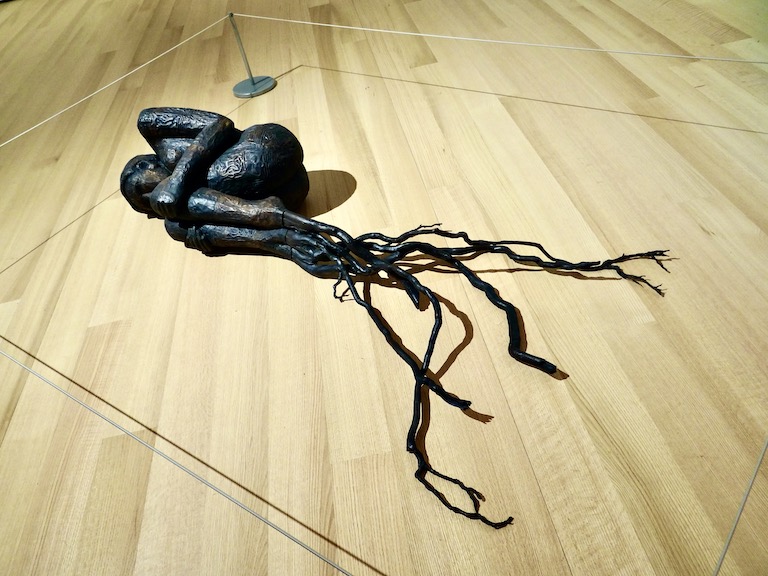
Alison Saar, Bareroot, 2007

“Simone de Beauvoir argues that the body is a situation — a set of material givens whose value shifts depending on context … [For Donna Haraway,] the body is the vantage point from which one makes sense of the world … [while for Sara Ahmed,] bodies take shape through tending toward objects that are reachable, that are available within the bodily horizon … forms of extension, aversion, and movement are … how we reside in space.” (Musser, 2024)

Aside from narratology, for example, the approaches of Greimas and Genette, and environmental theories of various kinds, for example, those of Peter Sloterdijk or Henri Lefebvre, the human body is a key area of research for design practice. This is particularly the case if the body is understood through phenomenology and neuroscience, while being inflected by a feminist epistemological, ontological, axiological and political stance. In the mutual contextualisation of narrative, discursive progression and processional environmental immersion, the human body can be grasped as an integrative actantiality and potentiality. The body’s being and becoming mediate and intervene, draw together and pull apart. They organise the levels of deixis whereby a here-and-now and a there-and-then are constructed, intertwined and altered. All this happens through an ongoing you-and-I dialogue of call and response wherein the real is constituted, de-constituted and re-constituted.

Continue reading “Body”

Biopolitics and Biopower

RELATED TERMS: Apparatus – Dispositif; Body; Politics and the political; Disciplinary societies and Societies of control; Psychopower

The term biopolitics or biopower is defined by Foucault (2007: 16) as,

“the set of mechanisms through which the basic biological features of the human species became the object of a political strategy, of a general strategy of power, or, in other words, how, starting from the eighteenth century, modern western societies took on board the fundamental biological fact that human beings are a species.”

(Foucault, 2007: 16)

Many believe that this regime, inaugurated in the late 18th and early 19th centuries, was consolidated during the 1970s (Povenelli, 2016). Prior to this, in the age of European kings, sovereign power, a very different formation of power, reigned.

Foucault contrasts three formations of power: sovereign power; disciplinary power; and biopower. All three formations of power are always co-present, although arranged and expressed differently relative to each other across social time and space.

Foucault also differentiates between technologies of discipline and technologies of security, which he defines as two distinct concatenated series (McCormack and Salmenniemi, 2016):

  • body–organism–discipline–institution; and
  • population–biological processes–regulatory mechanisms–State

Aslam (2010: 97-98) points out that “[U]nlike the disciplinary techniques that have their grid on the surface of the individual, where the individual stands in relation to a central panoptic tower whose gaze is internalized, biopolitics correspond to conditions of de-centralized sovereignty. Under these new permissive conditions of circulation and mobility, static modes of control are impossible.”

Such concepts may be useful in thinking about how power is distributed across a particular design considered as part of a (political) ‘space of appearance’, in Arendt’s terms, or a ‘partition of the sensible’, in Ranciere’s terms.

References

Aslam, A. (2010). Building the good life: architecture and politics [PhD thesis]. Department of Political Science, Duke University. Available from http://dukespace.lib.duke.edu/dspace/bitstream/handle/10161/2993/D_Aslam_Ali_a_2010.pdf?sequence=1 [Accessed 17 April 2012].

Foucault, M. (2007). Security, territory, population. Lectures at the College de France, 1977-78. Basingstoke, Hampshire: Palgrave Macmillan.

McCormack, D. and Salmenniemi, S. (2016). The biopolitics of precarity and the self. European Journal of Cultural Studies, 19 (1), 3–15. Available from http://ecs.sagepub.com/cgi/doi/10.1177/1367549415585559 [Accessed 27 January 2016].

Povenelli, E.A. (2016). Geontologies: a requiem to late liberalism. Durham, NC: Duke University Press.