Vocatives

RELATED TERMS: Remembering;

A vocative expression is one in which a person is directly referred to in dialogue, for example, by their name, their job title or position or by a term of endearment, respect or disrespect.

In the context of writing, vocatives can serve several purposes, such as, to help readers to keep track of who is saying what to whom; to enrich characters’ emotions by conveying a deeper sense of urgency, frustration, surprise or patience; or to show how characters relate to one other.

In the design of narrative environments, vocative expressions are often distributed across media, for example, a welcoming architectural threshold accompanied by a graphic sign reinforcing the invitation to enter. Once inside, the visitor or participant needs to be repeatedly addressed vocatively in order to be guided through the experience.

References

Harnby, L. (2019) Addressing others in dialogue: using vocatives, The Editing Blog. Available at: https://www.louiseharnbyproofreader.com/blog/addressing-others-in-dialogue-using-vocatives (Accessed: 6 April 2021).

Tunis, C. (2007) Scopic / vocative, The Chicago School of Media Theory. Available at: https://lucian.uchicago.edu/blogs/mediatheory/keywords/scopic-vocative/ (Accessed: 6 April 2021).

Remembering: Mnemonics, Mnemotechne and Memory

RELATED TERMS: [Of] Grammatography; Hypomnesis, Hypermnesis and Anamnesis; Exosomatisation; Learning

“Cities are made of sedimented strata of memory” (Adams, 2021)

Frances Joseph (2010: 302) points out that mnemotechne is an archaic term for how memory and thought are fundamentally related to the inorganic through the world’s materiality. As such, she comments, it may well be the oldest name for design. Design, from this perspective, is itself fundamentally and primordially a mnemotechne. The human world is remembered, mediated and understood through designs of various kinds and orders, within particular socio-historical design ecologies.

Scott Newstok (2021) comments that contemporary cognitive science validates what ancient memory practitioners already knew: that physical configurations reinforce recollection, whether on the page of a book, on the stage of a theatre or, we would add, in a designed environment. The Romans called their spatial art of memory the method of loci, or method of places; in ancient Greek, this is the method of topoi. This method was widely used by by orators and others from classical, through medieval, up until early modern times.

As Thomas (2014) notes, in discussing the use of imagery in mnemonics, “The method of loci was originally mainly used by orators to remember the points to be made in a speech, in their proper order, although related imagery based techniques would later come to be used for other purposes, such as spiritual exercises.” In the Middle Ages and the Renaissance, very elaborate versions of the method of loci were developed. They used specially learned imaginary spaces, called memory theatres or memory palaces, accompanied by complex systems of predetermined symbolic images, often imbued with occult or spiritual significances.

In the context of design practice, it is recognised that we need constantly to be re-minded, we need constantly to be re-called, to be called back into recollection, in order to follow a ‘responsible’ (life-)path and to construct and re-construct a coherent identity.

The mind, without signs in the form of physical markers, image markers or language markers, tends to wandering and errancy, to a different kind of semiosis, one characterised as ‘dreaming’. The experience of embodiment, of which the imaginary and dreaming are creative displacements and counterbalances, is threaded through the mnemotechnics of emplacement. Design practices play upon embodiment and emplacement in their relation to the imaginary and to dreaming.

Design practice, therefore, incorporates and integrates several levels of mnemotechnics or technologies of rememoration: objects, architectures and imagery with particular symbolic meanings combined with graphic, linguistic and alphanumeric signs, to guide visitor-participants through the constructed pathway or pathways. In that sense, they may be called mnemotechnologies, in Stiegler’s sense.

The argument presented in Incomplete … is that designs impact the relationship between living memory and other kinds of memory. This multiplicity of memory types is highlighted by Bernard Stiegler (2004), who states that,

“The brain is not an abstract machine, on the one hand because “abstract machines” do not exist, and on the other, because this organ is in no respect a machine: a machine is not a living organism, and therein lies its force. The brain is a living memory —that is to say a fallible memory, in a permanent process of destruction, constantly under the sway of what I call retentional finitude. This biological living memory is, however, only one memory among others: particularly alive, it is nevertheless nothing outside its inert memories — i.e., its technical memories: the essential point being the relation between what is living in the brain and what is dead in its technics qua memories.”

Stiegler, 2004

In short, designs are ‘technical memories’ but ‘memories’ which nonetheless guide acting and thinking. This is a part of what is meant by the term ‘affordance’, as ‘opportunity’ for thought and action; and part of what is meant by ‘actantiality’, as a moment of acting (or not-acting, remaining impassive) while being acted upon, situated action. Human actantiality is marked by the potential for becoming self-conscious of that moment of acting while being acted upon, that is, of reconfiguring the relationships among organic, living memory, technical memory and social memory, in Stiegler’s terms.

References

Adams, T. (2021) The big picture [Photographer Janet Delaney]. The Observer, 17 October 2021. The New Review p.3

Joseph, F. (2010) Mnemotechne of design – ontology and design research theories [PhD thesis]. Auckland, NZ: Auckland University of Technology. Available at: https://core.ac.uk/download/pdf/56361944.pdf (Accessed: 10 February 2019).

Newstok, S. (2021) By going virtual during the pandemic, we’ve lost our sense of place, Dallas Morning News, 28 March. Available at: https://www.dallasnews.com/opinion/commentary/2021/03/28/by-going-virtual-during-the-pandemic-weve-lost-our-sense-of-place/?outputType=amp&__twitter_impression=true (Accessed: 6 April 2021).

Rubinelli, S. (2009) Ars Topica: The classical technique of constructing arguments from Aristotle to Cicero. Dordrecht, NL: Springer.

Stiegler, B. (2004) Desire and knowledge. The Dead seized by the living: elements of an organology of the libido [Lecture delivered at at a conference at Tate Modern, London], Ars Industrialis. Translated by D. Ross. Available at: https://arsindustrialis.org/desire-and-knowledge-dead-seize-living.

Thomas, N. J. T. (2014) Ancient imagery mnemonics, Stanford Encyclopedia of Philosophy. Available at: https://plato.stanford.edu/entries/mental-imagery/ancient-imagery-mnemonics.html (Accessed: 6 April 2021).

Technology

RELATED TERMS: Remembering: Mnemonics, Mnemotechne and Memory

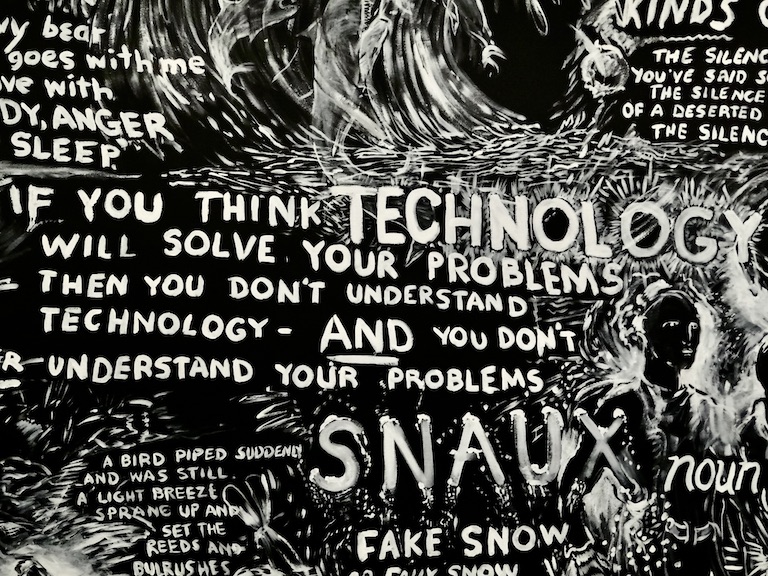
Laurie Anderson, The Weather, Hirshhorn Museum, Washington, DC

[Katie] Hafner: I’ve heard Bran [Ferren] say before that he thinks technology should be invisible.

[Danny] Hillis: Good technology ceases to become technology. You don’t think of a pencil as technology, because it just does what it’s supposed to do. You don’t think of a book as technology, because it’s been refined enough that it becomes invisible. You probably don’t think of the telephone much. You still think about computers a lot, because they’re so bad.

[Marvin] Minsky: I have a slogan: when you confront something new you should try to understand it.

[Alan] Kay: I’ll give you a slogan: technology is all that stuff that wasn’t around when we were born, because the stuff that was around when you were born was just part of the landscape. Like the pencil.

[Bran] Ferren: I think of technology as just being one of the byproducts of human imagination.

[Danny] Hillis: I think technology is all the stuff that doesn’t work yet.

[Alan] Kay: I think it’s all the stuff people [have] gotten used to. At a lecture there was an anti-technologist up on the stage, and I said, “Let me come up on the stage and relieve you of all the technology you have on you,” and I took off his watch and started taking off his clothes, and at some point this guy realized he was surrounded by technology. (Hafner et al. 1997)

In the context of the design of narrative environments, technologies are understood to be interconnected systems, media or frames. At any one time, there is an accumulation or ecology of systems-media-frames. Over time, within such ecologies, certain systemic media frames achieve dominance, while previously dominant systems become subordinate. They do not simply disappear, however.

Continue reading “Technology”

Performance and Performativity

RELATED TERMS: Actant; Happenings; Metalepsis; Methodology and Method; Paradigm; Performance Art;

“You are more than entitled to know what the word ‘performative’ means. It is a new word and an ugly word, and perhaps it does not mean anything very much. But at any rate there is one thing in its favour, it is not a profound word. I remember once when I had been talking on this subject that somebody afterwards said: ‘You know, I haven’t the least idea what he means, unless it could be that he simply means what he says’.”

Austin, J. L. (1970). Philosophical papers. 2nd ed.. Oxford: Oxford University Press.

“The last two decades or so have seen a small paradigm shift throughout the arts and humanities. Where, not so long ago, everything was regarded as ‘text’ or ‘discourse’, scholars are now more likely to talk about ‘performance’ and ‘the performative’ and ‘the body’ or ‘the bodily’. It is easy to be cynical about fashionable jargon, but, when cogently employed, the nomenclature does suggest, if not a revolution, then a significant shift in emphasis.”

Heile, B. (2006). Recent approaches to experimental music theatre and contemporary opera, Music & Letters, 87 (1), pp.72-81.

Gregson and Rose (2000) distinguish performance and performativity in the following way:

“…our argument is that performance – what individual subjects do, say, ‘act-out’ – and performativity – the citational practices which reproduce and/or subvert discourse and which enable and discipline subjects and their performances – are intrinsically connected, through the saturation of performers with power.”

From the perspective of design practices, Gregson and Rose (2000) indicate that their argument needs to be extended to space:

“Space too needs to be thought of as brought into being through performances and as a performative articulation of power.”

Finally, they emphasise the importance of recognising, “the complexity and uncertainty of performances and performed spaces”.

The relevance of the notions of performative and performativity, alongside that of performance, to the design of narrative environments is that narrative environments are performed or enacted. In being enacted, they constitute a field of actantiality or performativity in which different levels of narrative, different levels of existence and different modes of existence are intertwined, forming a tangled hierarchy in which specific diegetic or ontological metalepses (transgressions from one level of narrative to another or from a narrative modality of existence to a more everyday mode of existence) may be realised. In these ways, the interweaving of the material and the immaterial aspects of cultural practices can be explored as well as the inter-relationships between the actual (the ‘is’) and the potential (the ‘as if’).

Chris Salter (2010: xxi) writes that,

“Performance as practice, method, and worldview is becoming one of the major paradigms of the twenty-first century, not only in the arts but also the sciences. As euphoria for the simulated and the virtual that marked the end of the twentieth century subsides, suddenly everyone from new media artists to architects, physicists, ethnographers, archaeologists, and interaction designers are speaking of embodiment, situatedness, presence, and materiality. In short, everything has become performative.” 

Performative in design

In design practices, performative typically applies to the behaviour that is evoked in participants when they, through engagement with designs and/or design contexts, express themselves ‘unconsciously’, as part of a system or network of performativity or actantiality, rather than ‘consciously’ and deliberately, as ‘users’, which is more in the realm of scripted or improvised (unscripted), but framed, performance.

Performative in Philosophy

A performative utterance is one which does what it says. For example, if a person says “I promise to be there”, in normal circumstances this constitutes a promise to be at the specified place at the specified time, i.e. implies a course of action to fulfil the promise. The concept was originated by J. L. Austin, who contrasted performatives with constatives. Constatives make statements about the world which are either true or false. Performatives are neither true nor false (although whether the person making the promise turns up at the specified time and place will determine whether a promise was actually made or a deceit uttered).

The difficulties, and indeed the more interesting questions, arise when it is realised, as Austin did, that any utterance may be performative and that a clear and permanent distinction between performative and constative is hard to maintain. More depends on the circumstances of the utterance than the form of the utterance, although both have significance, e.g. barking out an order (Halt!) does much to constitute its status as ‘a command’ to act in a specified way.

Matters get even more interesting when the notion of “in normal circumstances” is opened to question (what are they?) and the question of whether the person uttering the performative fully intends to do what they say they will do, for example, whether they really intend to be there at the specified place at the specified time when they say “I promise to be there” (as noted above, concerning whether a promise was actually made, or some other act performed, such as a deception). The utterer may be lying, joking or may have forgotten a previous arrangement that they have made in which they promised to be somewhere else, i.e. intentionally or unintentionally invalidating the performative act. Alternatively, they may be uttering the sentence in the context of acting in a play.

In short, circumstances are the important factor, and their ‘normality’ should not simply be assumed but carefully considered.

The Performative: From the 1950s to the 21st Century

For a survey of the pathways along which the notion of the performative has travelled, see Jeffrey Nealon’s (2021) Fates of the Performative. Nealon traces it from J. L. Austin’s ordinary language philosophy of the 1950s, through its becoming
a linchpin for deconstruction in Derrida’s philosophy and associated American deconstructive literary theorists, to its value in thinking about resistant identities in the feminism and queer theory of the 1980s and 1990s, for example, in the work of Judith Butler and Eve Kosofsky Sedgwick. It subsequently became important as a concept in ethnic studies and its overlaps with performance studies, such as in the work of José Estaban Muñoz, Fred Moten and Diana Taylor. Furthermore, it became key to understanding the ‘agency’ or ‘actantiality’ not just subjects and identities but also of objects, for example, in Bruno Latour’s actor-network theory and Jane Bennett’s concept of vibrant matter. Eventually, Karen Barad applied it to matter itself. Thus, for Barad (2007: 152) in Meeting the Universe Halfway, “All bodies, not merely ‘human’ bodies, come to matter through the world’s iterative intra-activity — its performativity.” 

The illocutionary, the performative and collective assemblages of enunciation: Order words and social obligation

In A Thousand Plateaus, Gilles Deleuze and Felix Guattari make the distinction between the performative, as that which one does by saying it, for example, I swear by saying “I swear”, and the illocutionary, as that which one does in speaking, for example, I ask a question by saying “Is…?”, I make a promise by saying “I promise” and I give a command by using the imperative, and so on. In this way, they make the performative sphere (doing by saying) part of a larger illocutionary sphere (what one does in saying). Thus, they argue,

“The performative itself is explained by the illocutionary, not the opposite. It is the illocutionary that constitutes the nondiscursive or implicit presuppositions. And the illocutionary is in turn explained by collective assemblages of enunciation, by juridical acts or equivalents of juridical acts, which, far from depending on subjectification proceedings or assignations of subjects in language, in fact determine their distribution… these “statements-acts” assemblages…in each language delimit the role and range of subjective morphemes.” (Deleuze and Guattari, 1988: 78).

They call these illocutionary acts, these “statements-acts” assemblages, “order-words”. They continue,

“Order-words do not concern commands only, but every act that is linked to statements by a “social obligation”. Every statement displays this link, directly or indirectly. Questions, promises, are order-words. The only possible definition of language is the set of all order-words, implicit presuppositions, or speech acts current in a language at a given moment.” (Deleuze and Guattari, 1988: 79)

For Deleuze and Guattari, the relation between the statement and the act is internal or immanent. It is not one of identity, however, but of redundancy. Given this,

“Language is neither informational nor communicational. It is…the transmission of order-words, either from one statement to another or within each statement, insofar as each statement accomplishes an act and the act is acomplished in the statement.” (Deleuze and Guattari, 1988: 79)

In this way, the collective assemblage of enunciation is the redundant complex of the act and the statement that necessarily accomplishes it. These acts, in turn, are the set of all incorporeal transformations in a given society, and these incorporeal transformations are attributed to the bodies of that society.

Performance Theory – Schechter

The terms performance and performative are important for designs because, it is argued, they are performed by a participant. This performance takes on a different character depending on the design itself and may involve a combination of consumption by a consumer; reception by a reader, spectator or audience; or instrumental use by a user, as well as scripted or unscripted (improvisational) actions and decisions by the participant.

The performativity of ta design may also be discussed in terms of actantiality or actantiality-passantiality. In any case, through performance, the ‘as if’ is brought together with the ‘is’, to explore actual or potential transformations from one state of being to another. Systems of performative transformations, whatever their material aspects, Schechner (2004, xviii) notes, “also include incomplete, unbalanced transformations of time and space: doing a specific “there and then” in this particular “here and now” in such a way that all four dimensions are kept in play.”

Richard Schechner conceives of the topics which relate to the term performance as a fan or as a web, as follows:
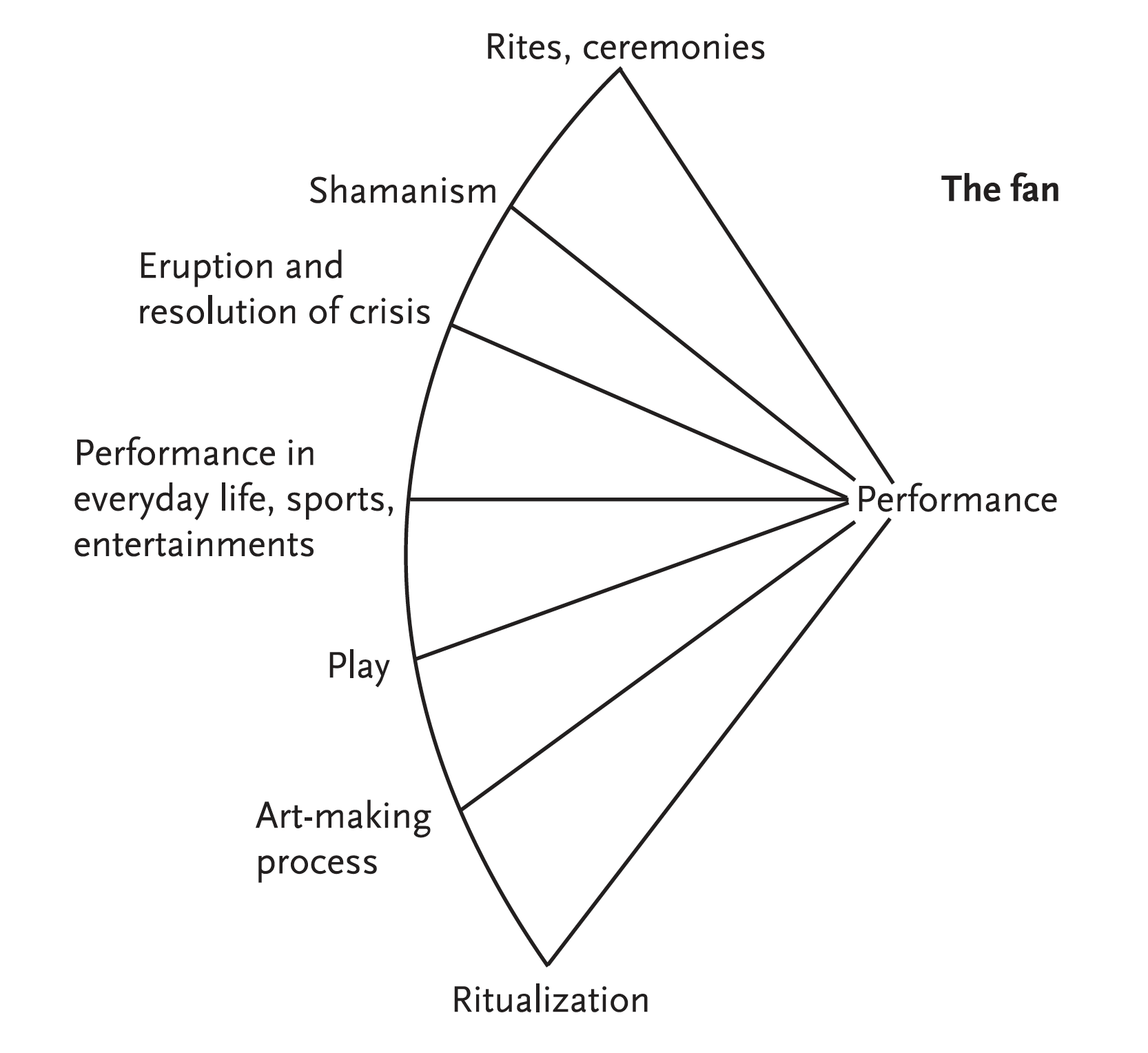
Performance1 Source: Richard Schechner, Performance Theory
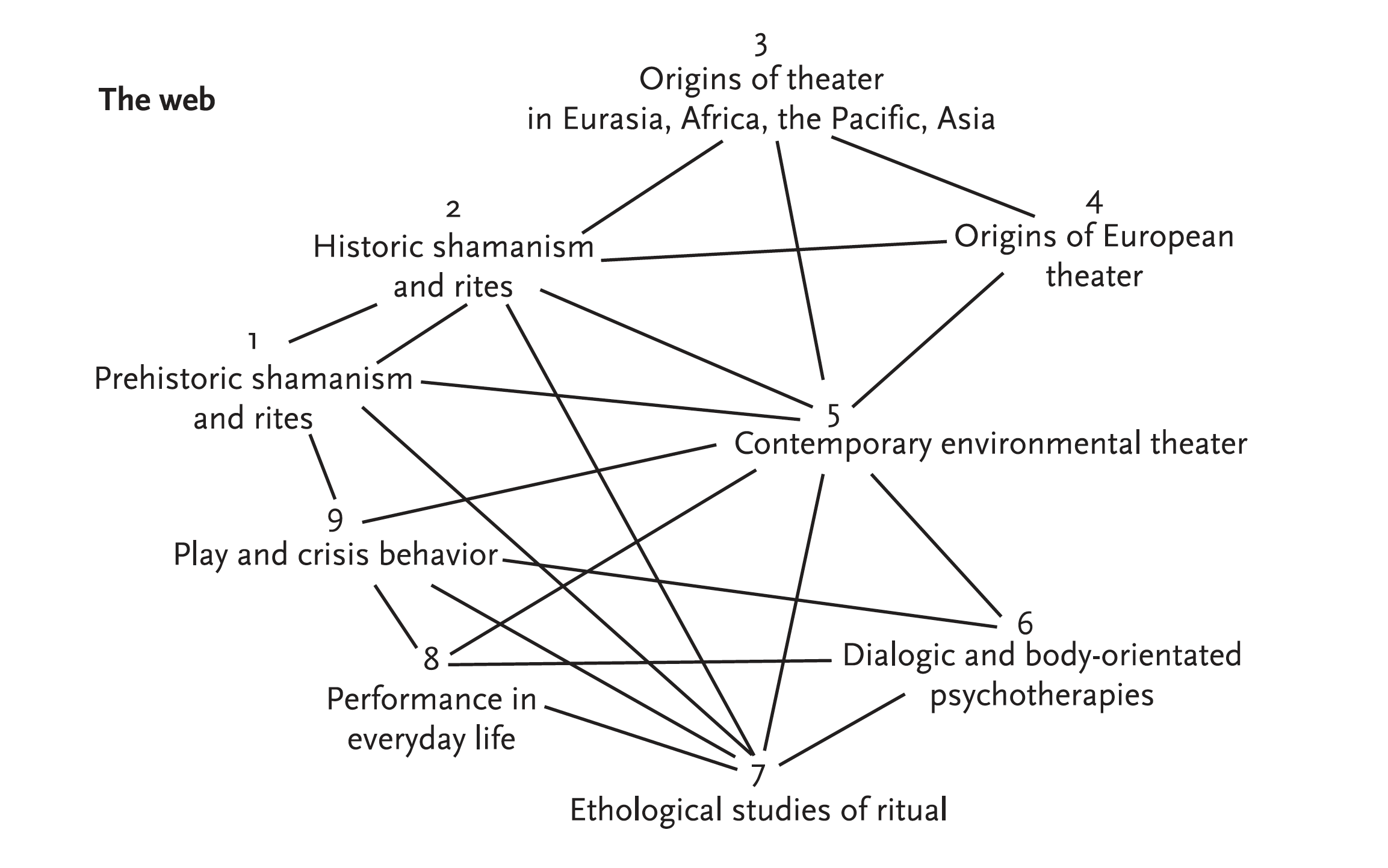
Performance2 Source: Richard Schechner, Performance Theory

References

Austin, J. L. (1970) Performative utterances, in Philosophical papers. 2nd edn. Oxford: Oxford University Press.

Barad,K. (2007) Meeting the Universe Halfway: Quantum Physics and the Entanglement of Matter and Meaning. Durham, NC: Duke University Press. 

Gregson, N. and Rose, G. (2000) Taking Butler elsewhere: performativities, spatialities and subjectivities. Environment and Planning D: Society and Space, 18, pp. 433-452.

Nealon, J. T. (2021) Fates of the performative: From the linguistic turn to the new materialism. Minneapolis, MN: Minnesota University Press.

Parker, A. and Sedgwick, E. K. (eds) (1995) Performativity and performance. New York, NY: Routledge.

Salter, C. (2010). Introduction. In: Entangled: technology and the transformation of performance. Cambridge, MA: MIT Press, xxi–xxxix.

Schechner, R. (2004) Performance theory. Rev & exp.ed. New York, NY: Routledge.

Phenomenology

RELATED TERMS: Affordances; Arendt; Feminism and Materialism; Heidegger; Lifeworld – Lebenswelt – Umwelt; Ontology; Philosophy; Place, Space, Placiality, Spatiality; Present-at-hand (Vorhanden) and Ready-to-hand (Zuhanden);

If it is accepted that the human is one of the main constituents or domains of actantiality in the realisation of a design, then the relevance of phenomenology becomes apparent, as a tool for grasping the nature of that human actantiality or performativity.

This is particularly so because of phenomenology’s concern for the lifeworld, with its emphasis on the human body, especially the moving body, the recognition of embodiment as intersubjectivity and inter-corporeality, in its relation to narration and temporalisation, on the one hand, and to environing and spatialisation, on the other hand, themselves conceived as forms of actantiality or performativity. As Thomas Sheehan (2014) expresses it in an interview, phenomenology is about the meaningful presence of things within contexts of human concerns and interests.

Phenomenology, from the Greek word phainomenon, itself derived from phainein, meaning to show, is “the study of givenness, of the world as it is lived rather than the world as it is objectified, abstracted, and conceptualized.” (Garner, 1993: 448)

A phenomenological approach recognises that the essentially analytic space of Euclidian geometry, Cartesian philosophy or Newtonian physics is very different from lived, or inhabited, spatiality, with its perceptual contours and structures of orientation. (Garner, 1993: 448)

In investigating affective, aesthetic and action-oriented experience as it is influenced and informed by environmental factors and by actual and potential bodily movement, and by exploring the ways that our physical and social environments matter for experience, cognition, problem-solving and for shaping our intersubjective and social interactions, phenomenology can be a very useful resource for research in narrative environment design.

Within phenomenology, spatiality, as lived space, is felt space. Lived space is a category for inquiring into the ways we experience spatial dimensions of our everyday existence, alongside the other themes of lived body (corporeality), lived time (temporality), and lived human relation (relationality or communality). Lived time (temporality) is subjective time as distinct from clock time or objective time.

As Jennifer Bullington (2013: 20) and Dermot Moran (2000) explain, phenomenology is the central strand of 20th-century European philosophy. It stems from the works of Edmund Husserl, 1859-1938, who announced it in 1900-1901 as a bold, radically new way of doing philosophy. To Husserl, it sought to bring philosophy back from abstract metaphysical speculation, with its attendant pseudo-problems, in order to return to concrete living experience. The term ‘phenomenology’ means the logos, or inherent meaning or order, of phenomena, i.e. the meaning of that which appears or shows itself to human beings. How human beings perceive, understand and live the world is the subject matter of phenomenological study.

Phenomenology does not make statements about how the world is in-itself, outside of human beings’ experiences of it. The subject matter of phenomenological studies is an examination of various human phenomena, such as, for example, perception, time consciousness, sexuality, religious and cultural practices, the body, the experience of the Holy and so on, from the point of view of meaning constitution. The central motif of phenomenology is the phenomenological description of things as they are, in the manner in which they appear (Moran, 2000: xiii).

In his later years, Husserl thought that phenomenological practice required a radical shift in viewpoint, one that suspended or bracketed the everyday natural attitude and ‘world-positing’ intentional acts which assumed the existence of the world. In this way, the practitioner will be led back to the domain of pure transcendental subjectivity (Moran, 2000: 2).

When this is done, Husserl further argues that we find two poles of experience: the streaming of consciousness, which he called noesis or noetic acts; and that to which consciousness attends, which he called noema or noematic objects. In place of the objective ‘real’ object we find, under the phenomenological reduction, the streaming of consciousness towards the object-as-meant. This bracketed realm of noesis and noema is the study proper of phenomenology, in this phase of Husserl’s thought. (Bullington, 2013: 22)

However, many of Husserl’s students were unconvinced by the value of this reduction or the possibility of carrying it out, and felt that Husserl had lapsed back into the very Neo-Kantian idealism from which phenomenology has originally struggled to free philosophy (Moran, 2000: 2).

This brings to attention the recognition, as explained by Moran (2000: xiv), that phenomenology cannot be understood simply as a method, a project or a set of tasks. In its historical form, it is primarily a set of people, beginning with Husserl and his personal assistants, Edith Stein, Martin Heidegger, Eugen Fink and Ludwig Landgrebe, and extending to his students, Roman Ingarden, Hedwig Conrad-Martius, Marvin Farber, Dorion Cairns, Alfred Schutz and Aron Gurwitsch, as well as others including Max Scheler and Karl Jaspers. Moran also points out that phenomenology changes when introduced into a new language and philosophical climate, such as when it was interpreted by Emmanual Levinas, Jean-Paul Sartre, Simone de Beauvoir, Maurice Merleau-Ponty, Michel Henry and Paul Ricoeur in France, a tradition that was itself later deconstructed by Jacques Derrida.

For a discussion of Heidegger’s objections to Husserl’s reductions, the transcendental and the eidetic, Taylor Carman’s (2006) chapter on The Principle of phenomenology is particularly useful. By taking human existence as mere objective presence, Heidegger points out, Husserl infers that the essence of intentionality can be grasped apart from any interest in existence. For Heidegger, we do not understand things, least of all ourselves in such an objective fashion. Rather,

“we make use of things, we rely on them, we avail ourselves of them, we take them for granted by manipulating, adjusting, wearing, stepping on, and ignoring them. Only rarely do they stand over against us as mere objects. In short, we do not simply intuit them as “occurrent” (vorhanden), we treat them as “available” [zuhanden] (Carman, 2006: 109).

For Heidegger, the eidetic reduction suppresses what is most essential to intentionality, that is, its existential moment, because our existence is constitutive of our self-understanding. The bracketing of existence in favour of essence blinds Husserl to the distinctive ontological character of Dasein (human being), whose essence lies in its existence. The traditional concepts of essentia (whatness) and existentia (thatness) fail to capture the way in which the very being of human beings is inextricably bound up with what they take themselves to be.

One of the major French exponents of the practice begun under the heading of phenomenology was Maurice Merleau-Ponty, 1908-1961, who implicitly endorses Husserl’s opposition to scientific realism. That is, they both reject the view that the privileged status of the natural sciences provides descriptions of the real nature of the world, however much these depart from our pre-scientific, common sense conceptions of it. Husserl maintains that the ‘real’ world is a world of phenomena, i.e. of things that appear to us; but not of ‘appearances’, in the sense of that behind or beyond which lies ‘the real’. Nor are those ‘phenomena’ the sense-data of empiricism: colour-patches, shapes, sounds, and so on. Rather, they are the objects as they appear to us, objects-for-consciousness. Conversely, our consciousness is (always) of objects. In other words, it is ‘intentional’, aimed or directed at something.” (Keat, 1982: 1)

Merleau-Ponty calls the lived unity of the mind–body-world system ‘the lived body’. The body understood as a lived body is both material and self-conscious, physiological and psychological. These terms, Merleau-Ponty argues, are not as dichotomous as may be imagined: there is mind in the body and body in the mind. The lived body is always oriented towards the world outside itself, i.e. towards otherness, in a constant reciprocal flow (Bullington, 2013: 25).

That otherness, in the context of design, is understood both in terms of the performative realisation of temporality and spatiality, as environing and ‘immunising’, in Sloterdijk’s terms.

Allan Parsons, revised April 2021

References

Bullington, J. (2013). The Expression of the psychosomatic body from a phenomenological perspective. In: The Expression of the Psychosomatic Body from a Phenomenological Perspective. Dordrecht, NL: Springer, 19–37.

Carman, T. (2006). The principle of phenomenology, In The Cambridge Companion to Heidegger, 2nd ed., edited by Charles B. Guignon. Cambridge: Cambridge University Press.

Garner, S.B. (1993). ‘Still living flesh’: Beckett, Merleau-Ponty, and the phenomenological body. Theatre Journal, 45 (4), 443–460. Available from http://www.jstor.org/stable/3209015 [Accessed 5 February 2018].

Keat, R. (1982). Merleau-Ponty and the phenomenology of the body [Online paper]. _Russell Keat.ne_t [Website]. Available from http://www.russellkeat.net/admin/papers/51.pdf [Accessed 22 March 2016].

Moran, D. (2000). Introduction to phenomenology. London: Routledge.

Phenomenology Online [Website]. Available at http://www.phenomenologyonline.com/ [Accessed 23 March 2016].

Sheehan, T., Polt, R. and Fried, G. (2014). No one can jump over his own shadow. 3:AM Magazine, (8 December). Available from http://www.3ammagazine.com/3am/no-one-can-jump-over-his-own-shadow/ [Accessed 1 September 2016].

s-o-f-t.agency [Soft Agency]

RELATED TERMS:

According to their website, Soft Agency is a group of female architects, artists, curators, scholars and writers from across the world who work with spatial practices. Their work is rooted in feminist methodological practices and formats, at the intersection of critical spatial practice, radical pedagogies, collectivities of becoming otherwise and alternative modes of participation. By creating spaces, workshops, events, exhibitions, publications and public programs, Soft Agency seeks to disrupt and re-imagine the lively entanglements through which civic life is organised. Through these means, they seek to rethink economic, political and social relationships.

The Agency was founded in Its members are Ana FilipovicFiona ShipwrightGilly KarjevskyRosario TaleviValentina Karga and Teresa Dillon

Links

Soft Agency http://s-o-f-t.agency

Organology

RELATED TERMS:

A general organology is an account of life when it involves not just organic matter but organised inorganic matter.

As Stiegler (2020: 73) puts it, “General organology attempts to establish a theory of technical life, conceived here as a process whose evolution is indissolubly psycho-socio-techno-logical, in addition to being relatively bio-logical, which means that the general laws of biology are put under other auspices …, if not modified strictly speaking.”

Stiegler distinguishes the organic from the organological: the organological is composed of generally inorganic and yet organised matter, as with any technical object. Organology modifies the general laws of biology. However, this does not mean that it contradicts biology.Rather, it localises biological constraints.

General organology is a method that makes possible transdisciplinary approaches. Such approaches have become absolutely essential in the current stage of organological development, that is, of technical development, which modifies both psychosomatic and social organizations. However, it does so today in an accelerated fashion. This raises completely new questions which induce an epistemological or even an ‘anthropological’ break. Stiegler prefers to refer to neganthropology rather than to an anthropological break. These questions also encounter irreducible critical problems that fall under what Stiegler calls ‘pharmacology’.

References

Stiegler, B. (2020) ‘Elements for a general organology’, Derrida Today, 13(1), pp. 72–94. doi: 10.3366/DRT.2020.0220

Defamiliarisation

USE for: Defamiliarization; Ostranenie; Making Strange

RELATED TERMS: Avant-garde movements; Modernism; Psychogeography; Situationist International; Alienation effect (Verfremdungseffekt); Epic theatre – Brecht; Xu Zhen Supermarket; Dissensus – Ranciere; Genre – and Story (fabula) and Plot (sjuzet); Story (fabula) and Plot (sjuzet or sjuzhet); Realism

Defamiliarisation, Ostranenie or making strange is a literary device that was brought to attention by Victor Shklovsky (1991), a Russian Formalist, in an essay first published in 1917 entitled “Art as Device”, sometimes translated as “Art as Technique”. Formalism was a school of literary theory and analysis that emerged in Russia around 1915, devoting itself to the study of literariness, i.e. the sum of ‘devices’ that distinguish literary language from ordinary language.

The purpose of defamiliarisation is to put the mind in a state of radical unpreparedness; to cultivate the willing suspension of disbelief. We see and hear things as if for the first time. The conventionality of our perceptions is put into question. By ‘making strange’, ostranenie, we force the mind to rethink its situation in the world, to see the world afresh, and this requires an expenditure of effort (Wall, 2009: 20). A similar idea can be found in some English Romantic poets.

All vivid writing and art is to some degree defamiliarising. It could be argued, as does Wall (2009), that figures of speech aim to defamiliarize; to render the familiar unfamiliar in order to break with conventional perceptions. If those figures fail it is likely because they are either inept or clichéd. A cliché is a figure of speech which has had its time and become familiar, losing its power to defamiliarise.

Constantin Brancusi said that modernism in the arts had become a necessity because the techniques of realism were had become all too familiar.

In the period of Czech Formalism, Jan Mukarovsky further refined this notion of defamiliarisation in terms of foregrounding. A distinct Russian group is the ‘Bakhtin school’ comprising Mikhail Bakhtin, Pavlev Medvedev, and Valentin Voloshinov, theorists who combined elements of Formalism and Marxism in their accounts of verbal multi-accentuality and of the dialogic text.

If taken together, the Russian avant-garde and Russian Formalism might be seen to offer a coherent argument for linking modernist formalism with avant-garde social action. Thus, Shklovsky’s defamiliarisation or ostranenie suggests that formal innovations might have the consequence of revealing “false consciousness”. In this is the case, this conception of defamiliarisation closely resembles Bertolt Brecht’s concept of Verfremdungseffekt, or ‘alienation effect’.

In their studies of narrative, the Russian Formalists also clarified the distinction between plot (sjuzet) and story (fabula).

Sources

Behler, C. (2001). CB’s glossary for students. Available from http://faculty.washington.edu/cbehler/glossary/glossary.html#defamiliarization [Accessed 6 March 2016]

Shklovsky, V. (1991). Art as device. In: Theory of Prose. Champaign, IL: Dalkey Archive Press, 1–14.

Wall, A. (2009). A note on defamiliarization. In: Myth, metaphor and science. Chester, UK: Chester Academic Press, 20–22.

Decolonisation and Decoloniality

RELATED TERMS: Modernity and Coloniality

Decolonisation is the historical struggle for national sovereignty against colonialism. In recent history, the term is most often applied to the decolonisations that took place in the period after World War II, when European countries generally lacked the wealth and political support necessary to suppress faraway revolts in their colonies. Furthermore, they faced opposition from the newly emergent international powers, the USA and the USSR, both of whom were opposed to European colonialism.

Decoloniality, on the other hand, is an epistemological category that takes colonialism as constitutive of modernity. Decoloniality seeks to dismantle the colonialist ‘distribution of the sensible’ (Ranciere, 2004), the frameworks of thinking and sensing, while delinking from the habitus of colonialism, its forms of life and its characteristic forms of subjectification and objectification. Analytically, decoloniality seeks to reconstruct histories excluded from the universalist frameworks of modernity and restore them to those from whom they were taken. As a programme, decoloniality seeks to establish a pluriversal or polyversal epistemology.

Online resources

The Decolonising Design Group of Bloomsbury Publishing has produced a lesson plan that examines how design practitioners and theorists can make sense of the concepts of decolonisation and decoloniality in the context of our own situated practices. It is available here: https://www.bloomsburydesignlibrary.com/article?docid=b-9781350097964&tocid=b-9781350097964-003

References

ISLAA (2021). Decoloniality and the Politics of History, Columbia University, April 29–May 28, 2021 [Online event]. Institute for Studies on Latin American Art (ISLAA). Available at https://www.islaa.org/decoloniality-2021 [Accessed 22 April 2021]

Ranciere, J. (2004). The Politics of aesthetics: the distribution of the sensible. London, UK: Continuum.

Reiter, B. (ed.) (2018) Constructing the pluriverse: the geopolitics of knowledge. Durham, NC: Duke University Press.

Dau Project

RELATED TERMS: Realism; World, World of the Story and World of the Narrative Environment

Dau1

An interesting question for the narrative environment designer is: to what extent was the Dau project, enacted in 2009-2011, and reiterated in 2019, a narrative environment? It also raises, obliquely, the question of the boundaries between (voluntary) ‘participation’ and (involuntary) ‘subjection’ particularly, as in this case, in a fictional reconstruction of an oppressive regime where the participants enact the subjection in a recursive cycle.

The Dau project brought into existence a fictional world that sought, as an experimental art piece, to blur the distinctions between art and life. The project was initially conceived by the Russian film director Ilya Khrzhanovsky in Moscow in 2005 as a film about the Soviet physicist Lev Landau. The project title, Dau, is an abbreviation of Landau’s surname. However, what was initially conceived as a biographical portrait of a physicist transformed into a ‘staged reality experience’ when Khrzhanovsky decided that Landau’s life story was too large and potent to be confined to a conventional narrative.

In 2009, Khrzhanovsky built a huge sealed set in the northeastern Ukrainian city of Kharkiv, where Landau worked and taught in the 1930s. The film’s set, which became a cult of historical verisimilitude, was known locally as ‘the Institute’. It was built in Kharkiv’s derelict outdoor swimming pool complex, which offered a natural courtyard surrounded by low Stalin-era buildings.

In the process, the constructed environment became less a film set than a parallel world. It functioned as a mini-state, trapped in the period 1938-1968, sealed off from the contemporary world outside it. This world was populated with hundreds participants, some actors, some non-actors, some celebrities, some scientists, who lived as faithfully as possible as Soviet citizens of the time. The obsessive drive for period authenticity went into such details as clothes, hairstyles, food packaging, cigarette brands, and so on. As well was having a spatial existence, time also moved forwards inside Dau’s world. As it passed from 1938 to 1968, the period detail was continually updated (Rose, 2019).

Dau2

James Meek (2015) summarises concisely the events of this ‘staged reality’, “For more than two years, between 2009 and 2011, hundreds of volunteers, few of them professional actors, were filmed living, sleeping, eating, gossiping, working, loving, betraying each other and being punished in character, in costume, with nothing by way of a script, on the Kharkiv set, their clothes and possessions altered, fake decade by fake decade, to represent the privileged, cloistered life of the Soviet scientific elite between 1938 and 1968.”

The strangest aspect of this project was that only a tiny proportion of this daily living was actually filmed. It was not like a giant Big Brother house. There were no hidden cameras. A single cinematographer, Jürgen Jürges, roamed the set with a three-person crew. Between 2009 and 2011, he filmed 700 hours of footage, a very small amount, considering the two-year duration of the “experiment”. The rest of the time, people went about their Soviet business, unobserved.

Some of the nature of Dau’s realism or verisimilitude can be gleaned from the casting. Dau’s man-child son is played by Nikolay Voronov, who turns out to be a Ukrainian YouTube star. Sasha and Valera, two gay lovers in the Dau world, were formerly homeless people. The mother of Nora, Landau’s wife, is played by Lidiya who is the real-life mother of the Russian actor, Radmila Shchyogoleva, who plays Nora.

As expressed by, Teodor Currentzis, one of the points of participating in this experiment is how to be yourself and yet not to be yourself at the same time. You are in an environment that you know is a game, but it does not work if you are not also yourself. Indeed, so successful was this ‘immersion’, this double articulation of one’s game-participant self and one’s ‘real self, that when leaving the world of Dau and re-entering the outside world, the participants felt it was like visiting another time. The real world became like a stage or film set to them.

The Dau experiment in Kharkiv ended definitively in November 2011, when Khrzhanovsky ordered the destruction of the Institute. According to a report in Kommersant, the director hired a group of real-life Russian neo-Nazis to storm the set, destroy it and performatively enact a massacre of its staff.

Dau3

From the seven hundred hours of footage shot in Kharkiv of the myriad threads of an ultra-elaborate artistic experiment, editors in London were said to be fashioning a dozen or more movies, a television series, and a user-directed internet narrative system. Finally, in October 2018, the film, DAU Freiheit, or DAU Freedom, is to be shown to the public for the first time at an art installation in Berlin.

However, it may be that , as James Meek concludes, “the significance of a representative spectacle was, perhaps, most fully realised in the emotions of those who enacted it, rather than those who will merely witness its two-dimensional, unscented, intangible afterglow on a flat screen”, which raises the issue of the different kinds of ‘immersion’ that are possible for narrative environments, immersion in a cinema diegese and narrative being different from that of theatre and theatre being different from that of a ‘staged reality experience’.

To rekindle that degree of significance for the visitor to the installation, Mark Brown reports that a large section of the Berlin Wall will be rebuilt on Unter den Linden boulevard, creating a walled-in city within a city. Before entering this city, visitors will have to buy ‘visas’ online and hand over their phones. The project will end with a ritualistic tearing down of the wall on 9 November 2018, exactly 29 years after the event in 1989.

A report on the project by Alina Simone can be heard here: https://www.youtube.com/watch?v=wWwf_uvcsCk

A review of the Parisian version of the Dau project, which opens in early 2019, can be seen below from the programme Encore

References

Brown, M. (2018). Stalinist Truman Show: artist paid 400 people to live as Soviet citizens. Guardian, 1 September. Available from https://www.theguardian.com/world/2018/aug/31/stalinist-truman-show-artist-paid-400-people-to-live-as-soviet-citizens [Accessed 2 September 2018].

Meek, J. (2015). Diary. London Review of Books, 37 (19), 42-43. Available from https://www.lrb.co.uk/v37/n19/james-meek/diary [Accessed 2 September 2018].

Rose, S. (2019). Inside Dau, the ‘Stalinist Truman Show’: ‘I had absolute freedom – until the KGB grabbed me’. Guardian, 26 January. Available from https://www.theguardian.com/film/2019/jan/26/inside-the-stalinist-truman-show-dau-i-had-absolute-freedom-until-the-kgb-grabbed-me [Accessed 27 January 2019].