Co-Design

RELATED TERMS: Design Practice and Functionalism; User-Centred and User-Driven Design

As defined by Koskinen and Thomson (2012: 77) co-design is a community centred methodology that designers use to enable people who will be served by a designed outcome to participate in designing solutions to their problems.

This assumes a utilitarian, design-as-problem-solving approach. It should be noted that designs may, in solving one ‘problem’, generate others. An alternative approach is to suggest that design may be most valuable in problem-setting, that is, in considering what are the parameters of a problem, rather than simply problem-solving.

References

Koskinen, T. and Thomson, M. (2012). Design for Growth & Prosperity. Brussels: European Commission. Available from https://op.europa.eu/en/publication-detail/-/publication/a207fc64-d4ef-4923-a8d1-4878d4d04520 [Accessed 10 October 2014].

Cinema and Film Theory

RELATED TERMS: Filmmaking; Theoretical practice; Apparatus – Dispositif; Rhythm

David Macey (2000: 252) informs us that the French film theorist Christian Metz, in his later work, expands on the distinction that he made between film and cinema. He defines cinema as the extra-filmic apparatus of an industry, but also all the psychological forces that make an audience wish to watch a film.

The cinema, thus, includes cinematic writing and history. It is the sum total of discourses about cinema as well as the actual institutions. As Metz begins to incorporate Jacques Lacan’s notion of a scopic drive, or urge to look, into his analysis, the imaginary dimension of film comes to the fore through analyses of processes of identification with characters and with the camera itself, an approach which can be articulated with the concern for point of view, perspective and focalisation.

Rather than simply a psychic unconscious, films are seen to articulate an ideological ‘unconscious’. Films are thus doubly articulated with the life-world: through the apparatus of cinema, which requires a desire to engage with the institutions of the cinema; and through the imaginary of the film, by means which both a psychic unconscious and an ideological unconscious are articulated.

In the context of design, the notions of psychic and ideological unconscious must be seen in the light of the notion of ‘storyworld’, the imaginary counterpart of ‘the world of the story’, the elements and techniques whereby the story is told in the narration. In film, the ‘world of the story’ is articulated through the series of ‘pro-filmic events’.

References

Macey, D. (2000). The Penguin dictionary of critical theory. London, UK: Penguin Books.

Body

RELATED TERMS: Biopolitics and Biopower; Disciplinary Societies and Societies of Control; Place, Space, Placiality, Spatiality; Sensorimotor System; Somatosensory System

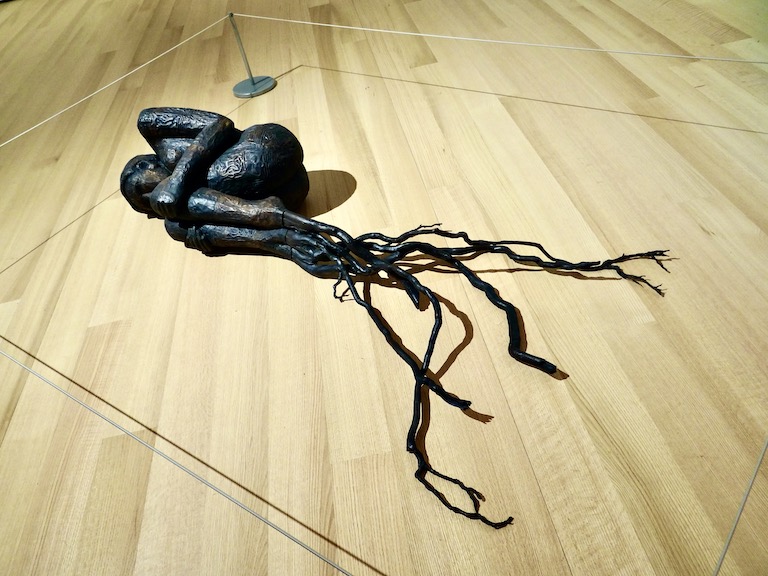
Alison Saar, Bareroot, 2007

“Simone de Beauvoir argues that the body is a situation — a set of material givens whose value shifts depending on context … [For Donna Haraway,] the body is the vantage point from which one makes sense of the world … [while for Sara Ahmed,] bodies take shape through tending toward objects that are reachable, that are available within the bodily horizon … forms of extension, aversion, and movement are … how we reside in space.” (Musser, 2024)

Aside from narratology, for example, the approaches of Greimas and Genette, and environmental theories of various kinds, for example, those of Peter Sloterdijk or Henri Lefebvre, the human body is a key area of research for design practice. This is particularly the case if the body is understood through phenomenology and neuroscience, while being inflected by a feminist epistemological, ontological, axiological and political stance. In the mutual contextualisation of narrative, discursive progression and processional environmental immersion, the human body can be grasped as an integrative actantiality and potentiality. The body’s being and becoming mediate and intervene, draw together and pull apart. They organise the levels of deixis whereby a here-and-now and a there-and-then are constructed, intertwined and altered. All this happens through an ongoing you-and-I dialogue of call and response wherein the real is constituted, de-constituted and re-constituted.

Continue reading “Body”

Biopolitics and Biopower

RELATED TERMS: Apparatus – Dispositif; Body; Politics and the political; Disciplinary societies and Societies of control; Psychopower

The term biopolitics or biopower is defined by Foucault (2007: 16) as,

“the set of mechanisms through which the basic biological features of the human species became the object of a political strategy, of a general strategy of power, or, in other words, how, starting from the eighteenth century, modern western societies took on board the fundamental biological fact that human beings are a species.”

(Foucault, 2007: 16)

Many believe that this regime, inaugurated in the late 18th and early 19th centuries, was consolidated during the 1970s (Povenelli, 2016). Prior to this, in the age of European kings, sovereign power, a very different formation of power, reigned.

Foucault contrasts three formations of power: sovereign power; disciplinary power; and biopower. All three formations of power are always co-present, although arranged and expressed differently relative to each other across social time and space.

Foucault also differentiates between technologies of discipline and technologies of security, which he defines as two distinct concatenated series (McCormack and Salmenniemi, 2016):

  • body–organism–discipline–institution; and
  • population–biological processes–regulatory mechanisms–State

Aslam (2010: 97-98) points out that “[U]nlike the disciplinary techniques that have their grid on the surface of the individual, where the individual stands in relation to a central panoptic tower whose gaze is internalized, biopolitics correspond to conditions of de-centralized sovereignty. Under these new permissive conditions of circulation and mobility, static modes of control are impossible.”

Such concepts may be useful in thinking about how power is distributed across a particular design considered as part of a (political) ‘space of appearance’, in Arendt’s terms, or a ‘partition of the sensible’, in Ranciere’s terms.

References

Aslam, A. (2010). Building the good life: architecture and politics [PhD thesis]. Department of Political Science, Duke University. Available from http://dukespace.lib.duke.edu/dspace/bitstream/handle/10161/2993/D_Aslam_Ali_a_2010.pdf?sequence=1 [Accessed 17 April 2012].

Foucault, M. (2007). Security, territory, population. Lectures at the College de France, 1977-78. Basingstoke, Hampshire: Palgrave Macmillan.

McCormack, D. and Salmenniemi, S. (2016). The biopolitics of precarity and the self. European Journal of Cultural Studies, 19 (1), 3–15. Available from http://ecs.sagepub.com/cgi/doi/10.1177/1367549415585559 [Accessed 27 January 2016].

Povenelli, E.A. (2016). Geontologies: a requiem to late liberalism. Durham, NC: Duke University Press.

Being, Doing, Having

RELATED TERMS: Objects and Events;

A design ‘is’ what it ‘does’. Although constituted by materiality in the form of ‘objects’ and ‘things’, a design ‘takes place’ as an ‘event’ in a situation. It ‘happens’, in a particular place, at a particular time for particular people.

One could argue, and it is only an argument, that such an event ‘has’ meaning, with meaning interpreted along the lines of action and actantiality.

Avant-Garde Movements

RELATED TERMS: Agonism and Avant-Gardism; Aleatory; Alienation Effect (Verfremdungseffekt); Critical Theory; Defamiliarisation; Design of Narrative Environments; Dissensus – Ranciere; Distribution of the Sensible – Ranciere; Epic Theatre – Brecht; Feminist Avant-Garde Art Practices; Happenings; Methodology and Method; Modernism; Modernism and Avant-Garde Art Practices; Modernity; Ontological Metalepsis; Research Methodologies; Sabi and Wabi-Sabi; Situationist International; Theatre of Cruelty – Artaud; Theoretical Practice; Utopia and Utopian Thinking;

Since designed environments are concerned with the relationship(s) between cultural (narrative) phenomena in various media and embodied, enacted phenomena in various material environments or -spheres, the work of the European avant-garde movements, with their concern for the relationships among art practices, aesthetic practices and political practices is of great interest and relevance, from technical, methodological and purposive perspectives. Avant-garde practices can be linked to the discussion of ontological metalepsis.

The figurative use of the word avant-garde to denote radically progressive leaders of both art and society can be traced to the French utopian socialist Henri de Saint-Simon, I760-I825, Donald Egbert (1967: 340) states.

Saint-Simon’s conception of artists’ dual role leads to a persistent dilemma for radically avant-garde artists. As members of an elite social avant-garde, they may be expected to make art that directly promotes radical social ideas, in accordance with the later doctrines of Saint-Simon, and still later those of Marxists and Marxist-Leninists. Such art, this doctrine maintains, should be socially realistic, so as to be more readily understood by the masses, and thus be socially useful for propaganda, as Lenin, Stalin, and their official successors in the Soviet Union maintained. However, as members of a purely artistic avant-garde elite, should they divorce themselves, as well as their art, entirely from all social interests, as the more extreme upholders of art for art’s sake have insisted? Alternatively, should they, like Oscar Wilde, be socially concerned in some way, but keep their art and their social ideas essentially separate? (Egbert, 1967: 346)

Ales Erjavec (2015) argues that part of twentieth-century art can be designated specifically as an ‘aesthetic’ avant-garde. The term ‘aesthetic’ itself is of very specific provenance. It derives from Friedrich Schiller’s use of the term. For Schiller, the aesthetic conjoins art, the individual and the community, bringing together the art of the beautiful and the art of living.

Schiller, Ales explains, taking a lead from Ranciere (2004), was the first thinker to connect explicitly the domains of aesthetics and politics, arguing that the problem of politics in practice cannot be approached other than through the problem of the aesthetic because “it is only through Beauty that man makes his way to Freedom”.

Ranciere (2004), discussing what he calls the ‘aesthetic regime of art.’, locates the seeds of modern aesthetic education in the writings of the German Romantic, Friedrich Schiller. Rancière considers that, by suspending the opposition between active understanding and passive sensibility, Schiller’s aesthetic state seeks to break down an idea of society based on the opposition between those who think and decide and those who are doomed to material tasks. This breakdown is achieved using an idea of art. Rancière thereby offers a historical and philosophical account of the link between modern aesthetics and a democratic principle. (Frimer, 2011)

Erjavec, thus, classifies twentieth-century avant-gardes in two ways. First, he divides them into generations: the early twentieth century from 1905-1930; the later neo-avant-gardes emerging in the USA and Europe in the wake of the Second World War; and the postsocialist avant-gardes of Eastern Europe and other post-Soviet-era former-communist countries . Second, he considers that within each generation there is a spectrum running from artistic avant-gardes at one end to aesthetic avant-gardes at the other end. Artistic avant-garde’s introduce into art new styles and techniques, such as those to be found in Cubism and Surrealism. Through such styles and techniques, new representations of the lived world emerge.

At the other end of the spectrum, aesthetic avant-gardes seek to reach beyond art into ‘life’, and aim to transform not just artistic styles and techniques but also the world. The artistic elements of such works are set within an experience-transforming orientation.

Aesthetic avant-gardes seek to affect our ways of experiencing and sensing the world, to change in significant ways the modalities in which we perceive and experience reality. In the words of Jacques Ranciere, they aim at a “redistribution of the sensible”, bringing attention to the ways in which systems of classification assign parts, supply meanings and define relationships among entities in the (common) world.

‘Postsocialist avant-garde’ is the name given by Erjavec (2015) to movements from present or former socialist countries whose art had features common to other avant-garde art of the twentieth century.

Erjavec looks forward to the possibility of a fourth generation ‘aesthetic’ avant-garde.

References

Egbert, D.D. (1967). The Idea of ‘Avant-garde’ in art and politics. American Historical Review, 73 (2), 339–366. Available from http://www.jstor.org/stable/1866164 [Accessed 6 June 2016].

Erjavec, A. (2015). Introduction. In: Erjavec, A., ed. Aesthetic revolutions and twentieth-century avant-garde movements. Durham, NC: Duke University Press, 1–18.

Frimer, D. (2011). Pedagogical paradigms: Documenta’s reinvention. Art & Education. Available from http://www.artandeducation.net/paper/pedagogical-paradigms-documentas-reinvention/ [Accessed 16 December 2015].

Ranciere, J. (2004). The Politics of aesthetics: the distribution of the sensible. London, UK: Continuum.
Author, Authority

RELATED TERMS: Intertextuality; Intersemioticity

In the context of design practices, the concept of authorship is troubled, in part because the purity of the kind of ‘authorship’ that pertains to the writer of a book, as sole author, and the kind of ‘authority’ which accrues to such an author over time, does not often apply to design practice, where elements are borrowed from existing materials and designs and often involves collaborations of various kinds.

The practice of design is, more often that not, re-design. [It might be argued that, retrospectively, the same applies to literary authors, as indeed Barthes did, in that they partake in a broader intertextuality in which and against which their specific text takes shape and differs].

Author is perhaps not a good metaphor for designer. Author and designer differ radically. Perhaps the notion of ‘bricoleur’ may be more appropriate, a terms used by Claude Levi-Strauss for cultural production, recently picked up by Etzio Manzini.

As Susanne Hauser (2017: 50) comments, in discussing the concept of the architect as authoring designer and as artist: “Beginning fifty years ago, the idea of authorship has tended to focus on the elimination or vanishing of the author, rather than on his or her presence or endurance.”

References

Hauser, S. (2017) ‘Design/Entwurf: Observations’, arq: Architectural Research Quarterly, 21(1), pp. 45–51. doi: 10.1017/S1359135517000136

Audience

RELATED TERMS: Film making; Graphic Design; Music; Narrative environment design; Performance; Theatre; Human Actantiality; Realism; Reception theory and reader-response criticism; Epic theatre – Brecht

Audience comes from the latin audire meaning to hear. Nonetheless, it is used in film, theatre and performance to describe what might more naturally be called the spectators or viewers, as it is sight that tends to be prioritised in these media.

An audience consists of a person, more usually a group of people, who have gathered to experience a work that is presented to them. While each person has their own experience, they also share a collective experience, at a performance of theatre, music, dance or other performance formats; or the screening of a film.

It is also used as a collective noun to refer to the remote and dispersed groups who experience mass media broadcasts, such as those of television and radio.

The term can also be applied to the readership of a book, newspaper or other printed publication.

From audience to participant in the design of environments

In the context of the design practice, if the participation in a designed environment takes the form of being an audience, for example of a video, this is at the more ‘passive’ end of the spectrum, although this still requires participation, for example, in the form of being able to read and decode the meanings that the text or performance articulates. Because they are often multi-modal and multi-media, it is rare that designed environments call solely for an audience in this sense, which maintains a stage-auditorium relationship or a screen-auditorium relationship. Thus, many designed environments require a more ‘active’ form of participation, both at the level of physical movement and at the level of intellectual engagement which, in turn, may lead to emotional engagement and through that positioning to ethical and political engagement.

The term audience seems to imply that the person or persons attending remain still and/or seated, with the body disengaged from the intellect. At the level of intellectual engagement, a designed environment invites the participant to take part in the meaning production, not simply to receive a fully-developed moral or lesson, and be ready to learn, in which case the designed environment is also a learning environment with its own pedagogic strategies and techniques. It is through this combined physical and intellectual movement, with its various forms of synaesthesia, that a designed environment articulates its emotional import and its truth values, whether material, logical, emotional, ethical or political.

Thus, designed environments, because they do not often retain the stage-auditorium or screen-auditorium as a structuring binary division, encourage audience participation to varying levels, bringing the audience as a whole, or members of it, like some variants of experimental theatre since the 1960s, inside the performance, even to a level that could be considered a form of co-authorship. This has implications for the way we think about designed environments, where those who might be considered the audience are often inside the environment and therefore may, or may be caused to, experience the design as a narrative or a dramaturgy as if they are characters within it, becoming participants in the ‘performance’ or ‘realisation’ of the designed environment.

Even in conventional theatre, where the stage-auditorium divide is rigidly maintained, or indeed in the conventional classroom where the lectern-auditorium divide is similarly maintained, the audience has an effect on the performance. Actors and lecturers often talk about this effect, the way the energy and behaviour of the audience or the students affects their performance, hence giving rise to such notions as good, bad, lively, responsive or unresponsive audiences or students.

Note to follow up: audienceship, the appropriate way to behave as a member of an audience, is a learned behaviour: a theatre audience differs from a cinema audience which in turn differs from an opera audience; and all those from spectator sport audiences (spectators).

Political significance of ‘audience’ in the era of pervasive social media and the ubiquitous interactive screen

Daniel Ross (2018: 11) notes that “a polity of performatively-generated filter bubbles, of ‘audiences’ rather than citizens” has emerged in the 2010s. Such a system, “no longer conforms to the minimum requirements of ‘democracy’ understood as a representative system in which the power to make collective decisions resides in the demos”.

In this context, the ‘Trumpocene’ of 2016-2021 is “a ‘post-democratic’ worldless world in which collective decision becomes strictly speaking impossible, because truth itself, losing its effective actuality, has somehow come to seem an irrelevant and obsolescent criterion.”

References

Bennett, S. (1988) The role of the audience: a theory of production and reception. McMaster University. Available at: https://macsphere.mcmaster.ca/bitstream/11375/6827/1/fulltext.pdf (Accessed: 31 March 2019).

Ross, D. (2018) Introduction. In Stiegler, B. The Neganthropocene. London, UK: Open Humanities Press.

Arendt

RELATED TERMS: Heidegger; Critical Thinking

See also essay: Arendt, Phenomenology and the Design of Narrative Environments

The young Hannah Arendt

Why are the writings of Hannah Arendt, 1906-1975, important for design practices?

They are important because she focuses on the active life in its many aspects: we labour, we work, we act and we think or judge, as she puts it. She has a distinct political phenomenology of action that emphasises spatial, perceptual and performative relations; and, within that phenomenology of action, she has a distinctive interest in storytelling and narrative. All of those aspects are important when considering design and Arendt’s thinking permits an opening towards a performative conception of the relations among narrative, environment and human elements of the overall design.

Why does her thinking need to be critiqued and extended?

Her thinking needs to be critiqued and extended because she might seem to treat labour, work, action and thinking/judging as separate spheres in a strict hierarchy, with (political) action at the top, framing thinking/judgment. She might seem to propose an elitist and anti-egalitarian concept of politics, restricting freedom of action to a limited group of wealthy men (heads of households) by following too strictly an ancient Athenian model. Also, she might seem to propose that the sole content of politics is politics itself, as speech or exchange of views, to the exclusion of social or economic policies.

Her work needs to be extended in the direction of allowing these categories to be seen to flow through one another, by means of the bodies and environments that constitute the intersubjective and intercorporeal, or ‘worldliness’ in Arendt’s terms. Rather than the material world being simply the product of work or fabrication, it takes part in articulating labour/life and action/politics and the relations among labour/life, work/world and action/politics. A narrative environment is a domain, a ‘space of appearance’ in Arendt’s terms, of such intersubjective, intercorporeal ‘worldliness’. A dynamic, fluid model of the relationships among labour, work, action and thinking/judging, drawing upon the body in its intercorporeal constitution, a direction opened up by Judith Butler, for example, is needed.

Why does Arendt place such emphasis on the active life, as labour, work, action and thinking/judging?

She creates her categories as part of a process of reversing or inverting the ascendancy of the vita contemplativa (contemplative life) over the vita activa (active life). She perceives the contemplative life, as a withdrawal from action, to have been in the ascendant in Western thinking since Plato, an emphasis strengthened by Christianity, with its notion of ‘otherworldliness’ and postponed gratification or ‘realisation’. Arendt stresses the ‘thisworldliness’ of human reality through labour, work and action. This places her alongside Marx, Nietzsche and Heidegger, each of whom emphasises the active life, although in different ways, and puts the human body at the centre of thought/judgment.

Another purpose in creating her categories is that they provide a means for her to critique Marxian thought about labour, work and action, as the constituents of the vita activa. She seeks to undo what she sees as Marx’s overestimation of the value of labour and work and his underestimation of the value of action, as politics or political action.

Arendt, on the one hand, is critical of the contemplative life. Instead, she proposes a thoughtful life, closely related to action. On the other hand, she is critical of the active life reduced solely to labour and work. Instead, she emphasises the importance of the political life, as action.

Vita activa is Arendt’s interpretation of the Greek notion of praxis, a notion that came to her attention through the work of Heidegger. It is a notion that is also developed by Marx. However, according to Arendt, Marx is mistaken to see the pinnacle of human life as the expression of labour, through which humans come to recognise themselves and their value. Instead, she proposes action as the means whereby humans disclose themselves to one another through word and deed in a specific space of appearance constituting the public realm/public space.

It is this notion of a ‘space of appearance’, constituted through (political) action, which sustains freedom of action, that is of great significance for thinking about the kind of environment, as a ’space of appearance’, that any specific narrative environment can be said to bring into existence.

What does Arendt conceive of as being authentically political?

Arendt’s examples of moments of the authentically political are Greek city states, as well as Greek (tragic) theatre; the Roman res publica; the American Revolution; the French Revolution; the working-class rebellion in Europe from 1848 to the 1930s, particularly the workers’ councils; and, later in her life, the American civil disobedience of the 1960s. For Arendt, “politics is all the more authentic when it is eruptive rather than when it is a regular and already institutionalised practice” (Kateb, 2000: 134-135).

She focuses on these positive examples in order to draw out what she considers to be deeply problematic in the negative examples of German Fascism and Soviet Communism, which she characterises as ’totalitarian’.

The work of Hannah Arendt is useful for considering whether any specific narrative environment acts politically and in what sense it might be argued to do so. This engagement with Arendt’s thought, like that with any other theorist, requires an understanding of both her value and her limitations in conceiving action and the political.

References

Kateb, G. (2000). Political actions: its nature and advantages. In The Cambridge Companion to Hannah Arendt, edited by Dana Villa. Cambridge, UK: Cambridge University Press.

Selected Reading List

Arendt, H. (1958) The Origins of totalitarianism. 2nd edn. Cleveland and New York: Meridian Books.

Arendt, H. (1998) The Human condition. introduction by Margaret Canovan. 2nd edn. Chicago, IL: University of Chicago Press.

Arendt, H. (2005) The Promise of politics. Edited by J. Kohn. New York, NY: Schocken Books.

Architecture

RELATED TERMS: Distribution of the Sensible – Ranciere; Interaction Design; Narratology; Sculpture; Urban design;

Liangzhu District

“the sense of architectural space is … related to the political distribution of the sensible and the way it frames reality through fiction.” (Grabar, 2021: 279)

Rowan Moore (2014) argues that it is a terrible misconception to think that architecture is a visual art. To the extent that you do indeed see architecture, it is still not a purely visual experience. When you look at something, you interpret it, you make associations, find memories evoked, gain a greater or lesser sense of the physical efforts and skill that went into making a structure. Architecture does not work with one sense alone, but with synaesthetic hybrids. Synaesthetic hybrids is one way of understanding designed environments and indeed, narrative environments.

Philip Johnson thinks that it is the modern perversion of photography that freezes architecture to three dimensions or, in some buildings, to two dimensions. However, Johnson argues, architecture is surely not the design of space, certainly not the massing or organizing of volumes. These are auxiliary to the main point which is the organization of procession. Architecture exists only in time.

At the dawn of the 21st century, Charles Jencks (2003) perceived the beginnings of a new paradigm emerging in architecture. It related, Jencks thought, to a deep transformation going on in the sciences, which, in time, will permeate all other areas of life. The new sciences of complexity, which concern such notions as fractals, nonlinear dynamics, the new cosmology and self-organising systems, have brought about this change in perspective. We have moved from a mechanistic view of the universe to one that is self-organising at all levels, from the atom to the galaxy. Illuminated by the computer, this new worldview is paralleled by changes now occurring in architecture.

Sam Jacobs (2012) argues that, “Through re-enactment, architecture rewrites itself, making fictions a part of the real landscape that surrounds us.” Understanding architecture in this way opens up the path to the ways in which the materialities of designed environments operate as real-fictions and fictional-realities at once, but with a critical element that draws attention to the constitution of the real, not to any simple acceptance of it ‘being-there’.

Nika Grabar (2021: 267-268) similarly points to the importance of the interweaving of fiction and reality. Grabar cites Ranciere (2022), who argues that fiction is, “the construction of a framework within which subjects, things and situations are seen as belonging to a common world, while events can be identified and linked in terms of coexistence, succession and causal linkage. Fiction is required whenever a certain sense of reality needs to be produced.”

Alessandro Calvi Rollino (2019) notes that formal innovation in architecture provides a means of access to new modes of understanding space and place. This is because, Rollino argues, architecture is one of the most conspicuous media through which a society materialises and reifies the core concepts around which are shaped its values and beliefs. Thus, architecture embodies,

“the way society understands the fundamentals of reality, that is ‘the where’ of entities and their relations” (Rollino, 2019).  

References

Derrida, J. (1986). Point de Folie – maintenant l’architecture. Available from http://isites.harvard.edu/fs/docs/icb.topic1412058.files/Week 8/DerridaPointdeFolie.pdf [Accessed 1 June 2017].

Grabar, N. (2021) Architecture and the distribution of the sensible, Filozofski vestnik, 42(2), pp. 259–280. doi: 10.3986/fv.42.2.12.

Jacob, S. (2012) Make it real: architecture as enactment. Moscow, RU: Strelka Press.

Jencks, C. (2003). The New paradigm in architecture. Hunch. Available from http://www.charlesjencks.com/articles.html [Accessed 8 October 2011].

Johnson, P. (1965). Whence & whither: the processional element in architecture. Perspectiva, 9/10 167–178. Available from http://www.jstor.or/stable/1566915 [Accessed 8 June 2011].

Moore, R. (2014). A masterclass in spatial awareness. [Sensing Spaces : Architecture Reimagined – review]. Observer, 26 January, 33. Available from http://www.theguardian.com/artanddesign/2014/jan/26/sensing-spaces-royal-academy-review [Accessed 30 January 2014].

Ranciere, J. (2022) Modern times: Temporality in art and politics. Translated by G. Elliott. London, UK: Verso.

Rollino, A. C. (2019) Place and space: a philosophical history, Rethinking Space and Place {Blog]. Available at: https://rethinkingspaceandplace.com/2019/09/12/place-and-space-a-philosophical-history/ (Accessed: 21 August 2024).

Resources

Architectuul