Organology

RELATED TERMS:

A general organology is an account of life when it involves not just organic matter but organised inorganic matter.

As Stiegler (2020: 73) puts it, “General organology attempts to establish a theory of technical life, conceived here as a process whose evolution is indissolubly psycho-socio-techno-logical, in addition to being relatively bio-logical, which means that the general laws of biology are put under other auspices …, if not modified strictly speaking.”

Stiegler distinguishes the organic from the organological: the organological is composed of generally inorganic and yet organised matter, as with any technical object. Organology modifies the general laws of biology. However, this does not mean that it contradicts biology.Rather, it localises biological constraints.

General organology is a method that makes possible transdisciplinary approaches. Such approaches have become absolutely essential in the current stage of organological development, that is, of technical development, which modifies both psychosomatic and social organizations. However, it does so today in an accelerated fashion. This raises completely new questions which induce an epistemological or even an ‘anthropological’ break. Stiegler prefers to refer to neganthropology rather than to an anthropological break. These questions also encounter irreducible critical problems that fall under what Stiegler calls ‘pharmacology’.

References

Stiegler, B. (2020) ‘Elements for a general organology’, Derrida Today, 13(1), pp. 72–94. doi: 10.3366/DRT.2020.0220

Defamiliarisation

USE for: Defamiliarization; Ostranenie; Making Strange

RELATED TERMS: Avant-garde movements; Modernism; Psychogeography; Situationist International; Alienation effect (Verfremdungseffekt); Epic theatre – Brecht; Xu Zhen Supermarket; Dissensus – Ranciere; Genre – and Story (fabula) and Plot (sjuzet); Story (fabula) and Plot (sjuzet or sjuzhet); Realism

Defamiliarisation, Ostranenie or making strange is a literary device that was brought to attention by Victor Shklovsky (1991), a Russian Formalist, in an essay first published in 1917 entitled “Art as Device”, sometimes translated as “Art as Technique”. Formalism was a school of literary theory and analysis that emerged in Russia around 1915, devoting itself to the study of literariness, i.e. the sum of ‘devices’ that distinguish literary language from ordinary language.

The purpose of defamiliarisation is to put the mind in a state of radical unpreparedness; to cultivate the willing suspension of disbelief. We see and hear things as if for the first time. The conventionality of our perceptions is put into question. By ‘making strange’, ostranenie, we force the mind to rethink its situation in the world, to see the world afresh, and this requires an expenditure of effort (Wall, 2009: 20). A similar idea can be found in some English Romantic poets.

All vivid writing and art is to some degree defamiliarising. It could be argued, as does Wall (2009), that figures of speech aim to defamiliarize; to render the familiar unfamiliar in order to break with conventional perceptions. If those figures fail it is likely because they are either inept or clichéd. A cliché is a figure of speech which has had its time and become familiar, losing its power to defamiliarise.

Constantin Brancusi said that modernism in the arts had become a necessity because the techniques of realism were had become all too familiar.

In the period of Czech Formalism, Jan Mukarovsky further refined this notion of defamiliarisation in terms of foregrounding. A distinct Russian group is the ‘Bakhtin school’ comprising Mikhail Bakhtin, Pavlev Medvedev, and Valentin Voloshinov, theorists who combined elements of Formalism and Marxism in their accounts of verbal multi-accentuality and of the dialogic text.

If taken together, the Russian avant-garde and Russian Formalism might be seen to offer a coherent argument for linking modernist formalism with avant-garde social action. Thus, Shklovsky’s defamiliarisation or ostranenie suggests that formal innovations might have the consequence of revealing “false consciousness”. In this is the case, this conception of defamiliarisation closely resembles Bertolt Brecht’s concept of Verfremdungseffekt, or ‘alienation effect’.

In their studies of narrative, the Russian Formalists also clarified the distinction between plot (sjuzet) and story (fabula).

Sources

Behler, C. (2001). CB’s glossary for students. Available from http://faculty.washington.edu/cbehler/glossary/glossary.html#defamiliarization [Accessed 6 March 2016]

Shklovsky, V. (1991). Art as device. In: Theory of Prose. Champaign, IL: Dalkey Archive Press, 1–14.

Wall, A. (2009). A note on defamiliarization. In: Myth, metaphor and science. Chester, UK: Chester Academic Press, 20–22.

Decolonisation and Decoloniality

RELATED TERMS: Modernity and Coloniality

Decolonisation is the historical struggle for national sovereignty against colonialism. In recent history, the term is most often applied to the decolonisations that took place in the period after World War II, when European countries generally lacked the wealth and political support necessary to suppress faraway revolts in their colonies. Furthermore, they faced opposition from the newly emergent international powers, the USA and the USSR, both of whom were opposed to European colonialism.

Decoloniality, on the other hand, is an epistemological category that takes colonialism as constitutive of modernity. Decoloniality seeks to dismantle the colonialist ‘distribution of the sensible’ (Ranciere, 2004), the frameworks of thinking and sensing, while delinking from the habitus of colonialism, its forms of life and its characteristic forms of subjectification and objectification. Analytically, decoloniality seeks to reconstruct histories excluded from the universalist frameworks of modernity and restore them to those from whom they were taken. As a programme, decoloniality seeks to establish a pluriversal or polyversal epistemology.

Online resources

The Decolonising Design Group of Bloomsbury Publishing has produced a lesson plan that examines how design practitioners and theorists can make sense of the concepts of decolonisation and decoloniality in the context of our own situated practices. It is available here: https://www.bloomsburydesignlibrary.com/article?docid=b-9781350097964&tocid=b-9781350097964-003

References

ISLAA (2021). Decoloniality and the Politics of History, Columbia University, April 29–May 28, 2021 [Online event]. Institute for Studies on Latin American Art (ISLAA). Available at https://www.islaa.org/decoloniality-2021 [Accessed 22 April 2021]

Ranciere, J. (2004). The Politics of aesthetics: the distribution of the sensible. London, UK: Continuum.

Reiter, B. (ed.) (2018) Constructing the pluriverse: the geopolitics of knowledge. Durham, NC: Duke University Press.

Dau Project

RELATED TERMS: Realism; World, World of the Story and World of the Narrative Environment

Dau1

An interesting question for the narrative environment designer is: to what extent was the Dau project, enacted in 2009-2011, and reiterated in 2019, a narrative environment? It also raises, obliquely, the question of the boundaries between (voluntary) ‘participation’ and (involuntary) ‘subjection’ particularly, as in this case, in a fictional reconstruction of an oppressive regime where the participants enact the subjection in a recursive cycle.

The Dau project brought into existence a fictional world that sought, as an experimental art piece, to blur the distinctions between art and life. The project was initially conceived by the Russian film director Ilya Khrzhanovsky in Moscow in 2005 as a film about the Soviet physicist Lev Landau. The project title, Dau, is an abbreviation of Landau’s surname. However, what was initially conceived as a biographical portrait of a physicist transformed into a ‘staged reality experience’ when Khrzhanovsky decided that Landau’s life story was too large and potent to be confined to a conventional narrative.

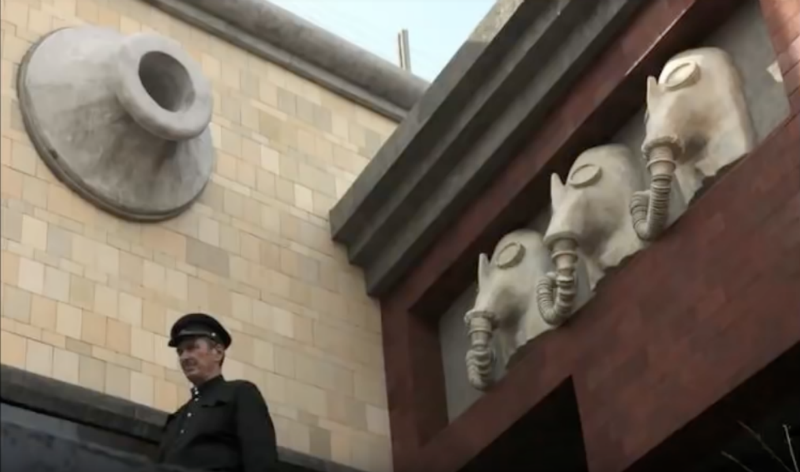
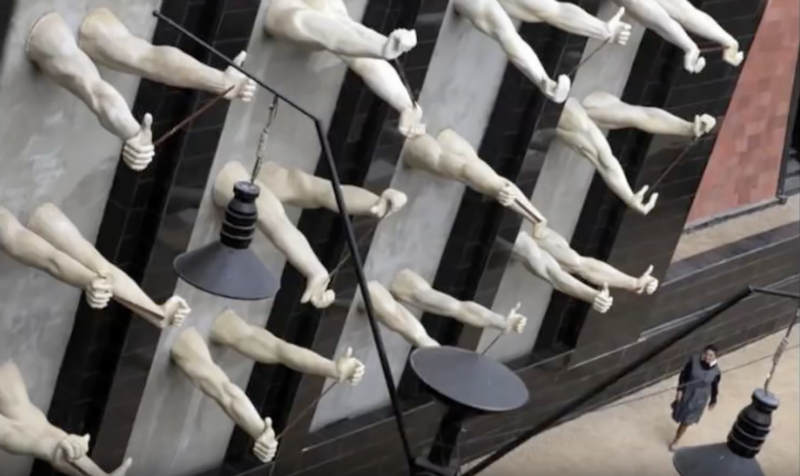
In 2009, Khrzhanovsky built a huge sealed set in the northeastern Ukrainian city of Kharkiv, where Landau worked and taught in the 1930s. The film’s set, which became a cult of historical verisimilitude, was known locally as ‘the Institute’. It was built in Kharkiv’s derelict outdoor swimming pool complex, which offered a natural courtyard surrounded by low Stalin-era buildings.

In the process, the constructed environment became less a film set than a parallel world. It functioned as a mini-state, trapped in the period 1938-1968, sealed off from the contemporary world outside it. This world was populated with hundreds participants, some actors, some non-actors, some celebrities, some scientists, who lived as faithfully as possible as Soviet citizens of the time. The obsessive drive for period authenticity went into such details as clothes, hairstyles, food packaging, cigarette brands, and so on. As well was having a spatial existence, time also moved forwards inside Dau’s world. As it passed from 1938 to 1968, the period detail was continually updated (Rose, 2019).

Dau2

James Meek (2015) summarises concisely the events of this ‘staged reality’, “For more than two years, between 2009 and 2011, hundreds of volunteers, few of them professional actors, were filmed living, sleeping, eating, gossiping, working, loving, betraying each other and being punished in character, in costume, with nothing by way of a script, on the Kharkiv set, their clothes and possessions altered, fake decade by fake decade, to represent the privileged, cloistered life of the Soviet scientific elite between 1938 and 1968.”

The strangest aspect of this project was that only a tiny proportion of this daily living was actually filmed. It was not like a giant Big Brother house. There were no hidden cameras. A single cinematographer, Jürgen Jürges, roamed the set with a three-person crew. Between 2009 and 2011, he filmed 700 hours of footage, a very small amount, considering the two-year duration of the “experiment”. The rest of the time, people went about their Soviet business, unobserved.

Some of the nature of Dau’s realism or verisimilitude can be gleaned from the casting. Dau’s man-child son is played by Nikolay Voronov, who turns out to be a Ukrainian YouTube star. Sasha and Valera, two gay lovers in the Dau world, were formerly homeless people. The mother of Nora, Landau’s wife, is played by Lidiya who is the real-life mother of the Russian actor, Radmila Shchyogoleva, who plays Nora.

As expressed by, Teodor Currentzis, one of the points of participating in this experiment is how to be yourself and yet not to be yourself at the same time. You are in an environment that you know is a game, but it does not work if you are not also yourself. Indeed, so successful was this ‘immersion’, this double articulation of one’s game-participant self and one’s ‘real self, that when leaving the world of Dau and re-entering the outside world, the participants felt it was like visiting another time. The real world became like a stage or film set to them.

The Dau experiment in Kharkiv ended definitively in November 2011, when Khrzhanovsky ordered the destruction of the Institute. According to a report in Kommersant, the director hired a group of real-life Russian neo-Nazis to storm the set, destroy it and performatively enact a massacre of its staff.

Dau3

From the seven hundred hours of footage shot in Kharkiv of the myriad threads of an ultra-elaborate artistic experiment, editors in London were said to be fashioning a dozen or more movies, a television series, and a user-directed internet narrative system. Finally, in October 2018, the film, DAU Freiheit, or DAU Freedom, is to be shown to the public for the first time at an art installation in Berlin.

However, it may be that , as James Meek concludes, “the significance of a representative spectacle was, perhaps, most fully realised in the emotions of those who enacted it, rather than those who will merely witness its two-dimensional, unscented, intangible afterglow on a flat screen”, which raises the issue of the different kinds of ‘immersion’ that are possible for narrative environments, immersion in a cinema diegese and narrative being different from that of theatre and theatre being different from that of a ‘staged reality experience’.

To rekindle that degree of significance for the visitor to the installation, Mark Brown reports that a large section of the Berlin Wall will be rebuilt on Unter den Linden boulevard, creating a walled-in city within a city. Before entering this city, visitors will have to buy ‘visas’ online and hand over their phones. The project will end with a ritualistic tearing down of the wall on 9 November 2018, exactly 29 years after the event in 1989.

A report on the project by Alina Simone can be heard here: https://www.youtube.com/watch?v=wWwf_uvcsCk

A review of the Parisian version of the Dau project, which opens in early 2019, can be seen below from the programme Encore

References

Brown, M. (2018). Stalinist Truman Show: artist paid 400 people to live as Soviet citizens. Guardian, 1 September. Available from https://www.theguardian.com/world/2018/aug/31/stalinist-truman-show-artist-paid-400-people-to-live-as-soviet-citizens [Accessed 2 September 2018].

Meek, J. (2015). Diary. London Review of Books, 37 (19), 42-43. Available from https://www.lrb.co.uk/v37/n19/james-meek/diary [Accessed 2 September 2018].

Rose, S. (2019). Inside Dau, the ‘Stalinist Truman Show’: ‘I had absolute freedom – until the KGB grabbed me’. Guardian, 26 January. Available from https://www.theguardian.com/film/2019/jan/26/inside-the-stalinist-truman-show-dau-i-had-absolute-freedom-until-the-kgb-grabbed-me [Accessed 27 January 2019].

Dasein

RELATED TERMS: Design, Entwurf, Entwerfen; Storyworld; Everyday; Present-at-hand (Vorhanden) and Ready-to-hand (Zuhanden); Lifeworld – Lebenswelt – Umwelt; Modernism; Philosophy; Sloterdijk; Heidegger; Nietzsche

“There is a Dasein whose thrownness consists precisely in the overcoming of its thrownness.”

Herbert Marcuse (2005, 1928: 32).

As one particular understanding or interpretation of ‘lifeworld’ or ‘being-in-the-world’ or, indeed, the everyday, the notion of Dasein may be of particular interest in the design and understanding of narrative environments. It may also be of use in seeking to grasp the character of human action, whether understood in the form of will, agency, performativity or actantiality, in the context of an articulated narrative world (diegesis, storyworld) and lifeworld (e.g. actant-network ontology or actant-rhizome ontology).

Dasein is a German word that translates literally as ‘there [da] being [Sein]’ or ‘being there’. While Dasein’s root meaning is usually rendered in English as ‘Being there’, it is equally valid to translate it as ‘Being-here’. Dasein means inhabiting and existing as a Here, a site within which Being and beings can meaningfully appear (Fried and Polt, 2014: xi).

In everyday German, the word Dasein is used just as the word ‘existence’ is used in English. However, Heidegger viewed the Latin term existentia as misleading and superficial. In Being and Time (1927) Heidegger, gives the term a specific philosophical significance. Prior to Heidegger, Dasein commonly referred to the being of persons. Heidegger follows and intensifies the common usage.

Dasein is defined in Being and Time as that being for whom Being itself is at issue, for whom Being, especially its own Being, is in question. For the most part, for Heidegger, this being is the human being although, as Fried and Polt (2014: xi) note, Dasein not simply equivalent to humans. It may help to think of Dasein, Fried and Polt suggest, as a condition into which human beings enter, either individually or collectively, at a historical juncture when the Being of beings becomes an issue for them, or Being as the event of meaningful disclosure takes place for them.

As distinct from the mode of being of a present-at-hand entity (object or artefact) or a ready-to-hand entity (tool or instrument), Dasein is by existing as a self-related being, for whom its own Being, as an individuality through a collectivity, is at issue as it goes about inhabiting the world. Each of us interacts with artefacts, instruments and other human beings in terms of some possible ways for us to be, such as being a doctor, being a teacher, being a parent or being a craftsperson.

Usually, we do not choose our identity, but behave in the way ‘one’ does in the community to which one belongs. In short, one conforms to (or struggles with) the norm. However, experiences such as anxiety and the call of conscience can shock or provoke one into choosing who one is, in the face of one’s own mortality. One then exists ‘authentically’, at least for a time.

An authentic individual, in this account, lives in a way that is appropriate to a temporal being, a being who has always already been thrown into some situation, who projects possibilities, and who dwells among other beings in a present world. Our temporality is historical, as each of us is a member of a community with a shared inheritance. Through communicating and struggling (agonism), a people or community may find a way to forge a future from its past (Fried and Polt, 2014: xii).

Mitcham (2001: 28) explains Dasein in the following terms,

“Heidegger undertakes an extended phenomenological analysis of human experience, concluding that Dasein is being-in-the-world characterized existentially as care, concern, solicitude – both about its own being and about the being of the world. That is, underlying all of Dasein’s modes of being and fundamental to it is the experience of care or worry, uncertainty.”

While this general orientation to Dasein may be accepted, in which matters of fact are understood simultaneously as matters of concern, to adopt a Latourian (2004) expression, difficulties arise in the interpretation of what Heidegger means by saying that Dasein is a question of ‘being-thrown’.

Thus, Mitcham (2001: 29), for example, argues that when Heidegger hyphenates the German word Da-sein, he does so in order to emphasise the specificity, as this-ness or there-ness, of the human as that which finds itself thrown into a particular body, dwelling in this country, now at this specific historical period, as well as the care or concern that arises in the specific human being about so finding itself.

Basing himself on the assumption that this is what Heidegger suggests that the term Da-sein implies, Mitcham contends that only from such ineluctable particularity may one be truly human, may one think authentically. It is this sense of grounded being or being-in-the-world, in an individual body, in a unique place, and with an exclusive history, that Mitcham emphasises by adopting the term.

Peter Sloterdijk attempts a similar specification of the notion of Dasein when he argues that ‘being thrown into the world’, is to be thrown into an envelope of some kind, To define humans is to define the envelopes, the life support systems, that make it possible for them to breathe, to live.

Such interpretations, however, assume that the condition of ‘being thrown’ implies a sense of ‘being thrown into the world’, rather than a more prolonged contingency, i.e. simply that of being in a condition of thrownness, without cessation, without origin, without arrival, without destination, without telos, or without ground, so to speak.

This may lead to a further interpretation of the sense of anxiety of which Heidegger speaks, in that the human subject may recognise both its groundedness, in a specific body, in a specific place with a specific history, and its groundlessness, as an unending passage of being-as-thrownness. Expressing the matter in this way opens it to a potential relationship with some postmodernist writings, i.e. post-high-modernist or post-1945 writings. For example, Samuel Beckett and other authors of the literature of the absurd, undertook to subvert the foundations of accepted modes of thought and experience so as to reveal the meaninglessness of existence and the underlying “abyss,” or “void,” or “nothingness” on which any supposed security is conceived to be precariously suspended (Abrams, 1999: 168-169).

In Nietzsche’s (2010) terms, “My humanity is a constant self-overcoming.” In other words, as Golding (2014: 218) glosses, “This, and nothing less, are the here/now groundless grounds of one’s humanity; a used, slightly soiled present-tense ‘is’…”.

This Nietzschean ‘self-overcoming’ is being interpreted here as a self-overthrowing, a constant ‘designing’ and ‘re-designing’, developed through a particular understanding of the Heideggerian structural movement of thrown-ahead-and-returning in terms of existential thrown-openness (“thrown projectedness”: geworfener Entwurf). In terms of design practices, such a characterisation of the human condition resonates with Manzini (2015) who considers that, in the 21st century, we are living in “a world in which everybody constantly has to design and redesign their existence”.

Although Heidegger would not use this terminology, the ground-less groundedness of Dasein lies in its inter-subjectivity and inter-corporeality. Thus, as Dalmayr (1989: 393) writes, the “worldliness” of Dasein entails inter-human linkage, an aspect discussed in Being and Time under the heading of “co-being”, of “being-with”, or Mitsein. Heidegger repeatedly insists in Being and Time that the ontological construal of being-in-the-world implies that the world is, “always a world already shared with others: the world of Dasein is a co-world; being-in signifies a co-being with others.” (Dallmayr, 1989: 394)

References

Abrams, M.H. (1999). A Glossary of Literary Terms, 7th ed. Boston, MA: Heinle & Heinle.

Dallmayr, F. (1989). The discourse of modernity: Hegel, Nietzsche, Heidegger (and Habermas). Praxis International, 8 (4), 377–406.

Fried, G. and Polt, R. (2014). Translators’ introduction to the second edition. In: Introduction to metaphysics, 2nd ed., by Martin Heidegger_._ New Haven, CT: Yale University Press.

Golding, J. (2014) Ecce Homo Sexual: Ontology and Eros in the Age of Incompleteness and Entanglement, Parallax, 20 (3), pp. 217–230. doi: 10.1080/13534645.2014.927628.

Latour, B. (2004). Why has critique run out of steam? From matters of fact to matters of concern. Critical Inquiry, 30 (2), 225–248.

Manzini, E. (2015) Design, when everybody designs: An introduction to design for social innovation. Translated by R. Coad. Cambridge, MA: MIT Press.

Marcuse, H. (2005, 1928) Contributions to a phenomenology of historical materialism, in Wolin, R. and Abromeit, J. (eds) Heideggerian Marxism. Lincoln, NE: University of Nebraska Press, pp. 1–33.

Mitcham, C. (2001). Dasein versus design: the problematics of turning making into thinking. International Journal of Technology and Design Education, 11 (1), 27–36. Available from http://link.springer.com/article/10.1023/A:1011282121513 [Accessed 20 August 2014]

Nietzsche, F (2010). Genealogy of Morals and Ecce Homo, trans. Walter Kaufman New York: Vintage Books, Section 4, p.218 and Section 8, p.223

Daoism

USE for: Taoism

RELATED TERMS:

The notion of dao (tao), in as far as it indicates a path, a way or a set of principles, may have importance for considering the kind of pathway or passage that occurs in a narrative environment. Also, reference to the dao is important in highlighting that a narrative environment is always, to some extent, a learning environment, because, as the Xueji (On Teaching and Learning) asserts, “A person will never come to understand the Dao without learning”. Similarly, engagement with or participation in a narrative environment involves learning.

As Di (2016: 45) explains, the character dao literally means the road one travels, but it also signifies the journey one takes in life. Furthermore, dao signifies a holistic conception of humans and nature, a humanistic worldview that forms the basis of ancient Chinese thought. The term dao (tao) is very widely used in ancient Chinese philosophical texts. From its literal meaning of ‘way’ or ‘path’, it is a short step to its use to mean ‘way of doing something’ and hence to mean ‘principle’ or ‘set of principles’. (Wilkinson, 1997: viii)

It is in the sense of ‘set of principles’ that it is used in the Analects of Confucius. To follow the dao in Confucian terms is to follow the set of moral principles expounded in that text (Wilkinson, 1997: viii). For Confucius, the essence of education is to study, pursue and live the dao, and to teach and learn holistically (Di, 2016: 45).

In order to effect a translation of the principles of the dao into human daily learning, experience and existence, Xueji, like many Chinese classic writings, advocates the cultivation of character and moral development (Di, 2016: 47).

While, in Daoism, the term ‘Dao’ is used to mean way, path and set of principles, it also has another sense. The fundamental assertion of Daoist philosophy is that there is an ultimate reality, and this is referred to as the Dao, as something formless yet complete, something that is real, ultimate and in some way the basis of all there is.

Dao in narrative environments, while it exploits the senses of path and set of principles and implies learning, does not necessarily imply a belief in an ultimate ground or an ultimate reality; unless that ultimate ground is understood not as a prior grounding but as a simultaneous modality of ‘chaos’ and/or ‘spontaneity’.

References

Di, X. (2016). The Teaching and learning principles of Xueji in the educational practice of the world today. In: Chinese philosophy on teaching and learning: Xueji in the twenty-first century. New York, NY: State University of New York Press, 39–59.

Wilkinson, R. (1997). Introduction. In: Tao te ching by Lao Tzu, translated by Arthur Waley. Ware, Hertfordshire: Wordsworth Classics of World Literature, vii–xix.

Cultural Studies

RELATED TERMS: Feminism and Materialism; Historical Materialism – Marxism; Methodology and Method; Modernity and Coloniality; Postmodernism

For narrative environment design, cultural studies is an important area of research because, like narrative environments, it is inherently interdisciplinary, or perhaps transdisciplinary, and because of its emphasis upon social practices, including spatial practices. There is therefore a lot to learn both from its subject matter, for example, the topics of power, ethnicity and gender, but also the ways in which it seeks to weave together different traditions of thought to come up with novel insights into social practice.

Cultural Studies

Cultural studies is the engaged, self-conscious study of cultures. While cultural studies has drawn upon the ideas of Marxism, feminism, poststructuralism and postmodernism, its discipline base has shifted from literary studies to sociology and ethnography. In addition, its intellectual agenda has also shifted from an interest in popular culture and (mass) media cultural forms to questions of ideology, power, gender and ethnicity. In recent times, its focus has extended to include questions of representation and the formation of cultural identities (Brooker, 2003: viii).

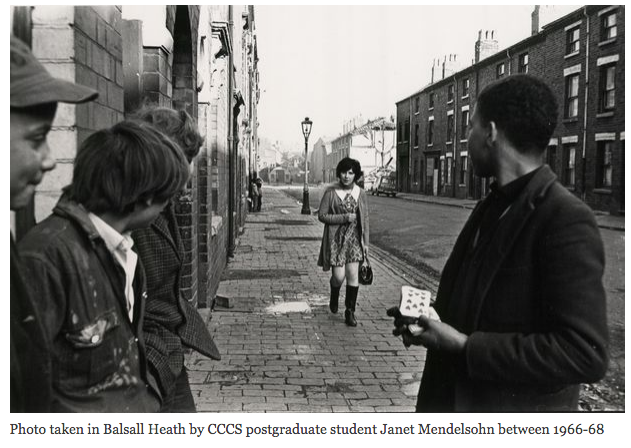
Abrams (1999: 53) notes that one of the chief precursors of modern cultural studies was Roland Barthes. In his book, Mythologies, Barthes analysed the social conventions and codes that confer meanings in a wide range of social practices and topics , such as ornamental cookery, striptease, the poor and the proletariat. Another precursor was the British school of neo-Marxist studies of literature and art, especially in their popular and working-class modes, as an integral part of the general culture. Among the early texts in this movement were Raymond Williams’ Culture and Society (1958) and Richard Hoggart’s The Uses of Literacy (1958). This strand of thinking became institutionalised in the influential Birmingham Centre for Contemporary Cultural Studies (CCCS), founded by Hoggart in 1964 (Abrams,1999: 53)

The establishment of the CCCS in Birmingham in 1964 may mark an historic turning point in the foundation of the field. However, as Stuart Hall stressed, cultural studies was actually initiated elsewhere, in earlier political movements, for example, the New Left, and in subject areas such as English studies, history and sociology. Thus, while the CCCS constitutes one kind of institutional origin, its original curriculum consisted in a diverse range of writings first published a decade earlier (Procter, 2004: 37).

In the United States, the vogue for cultural studies had its roots mainly in the mode of literary and cultural criticism known as new historicism, with its antecedents both in poststructural theorists such as Louis Althusser and Michel Foucault and in the treatment of culture as a set of signifying systems by Clifford Geertz and other cultural anthropologists.

References

Abrams, M.H. (1999). A Glossary of Literary Terms, 7th ed. Boston, MA: Heinle & Heinle.

Brooker, P. (2003). A Glossary of Cultural Theory, 2nd ed. London, UK: Arnold.

Procter, J. (2004). Stuart Hall. London, UK: Routledge.

Cultural Geography

USE for: Human geography, Social geography

RELATED TERMS: Geography; Scape metaphors; Anthropo-Scenes

Those parts of the discipline of geography which are of most value to narrative environment design and analysis are cultural geography, human geography or social geography.

According to Merle Patchett (2010), three eras of cultural geography can be identified: the traditional; the new; and the more-than-representational.

Traditional cultural geography is primarily an American field of scholarship, linked closely to the mid-20c work of Carl Sauer. He took the landscape as the defining unit of geographic study. For Sauer, while cultures and societies both developed out of their landscape, they also shaped their landscape. It is this interaction between the ‘natural’ or ‘physical’ landscape and human communities which creates the ‘cultural landscape’. Cultural geographers following this tradition focused on studying the range of human interventions in transforming the ‘natural’ or ‘physical’ landscape. They were most interested in quantifying material culture, such as buildings and architectures, agricultural technologies and other industries.

The 1960s and 1970s saw a quantitative revolution in geography and interest in cultural geography declined as human geographers turned their attention to developing the discipline as a spatial science. However, during the 1980s, the critique of positivism in geography instigated a renewed interest in cultural geography in North America and particularly in the UK.

This ‘new’ cultural geography had different theoretical assumptions, methods and subjects than those of traditional cultural geography. Rather than focusing on material culture, mostly of non-modern and rural societies, the ‘new’ cultural geographers of the 1980s and 1990s examined culture in contemporary and urban societies, and focused primarily on investigating non-material culture, such as, for example, identity, ideology, power, meaning and values. Among the main themes that were incorporated into ‘new’ cultural geography were colonialism and post-colonialism; postmodernism; popular culture and consumption; gender and sexuality; ‘race’, anti- racism and ethnicity; ideology; language; and media. ‘New’ cultural geographers also drew on a diverse set of theoretical traditions, including Marxism, feminism, post-colonial theory, post-structuralism and psychoanalysis.

In turn, this ‘new’ cultural geography, with its emphasis on identity, is challenged by non-representational theory, as formulated by Nigel Thrift. Instead of studying and representing social relationships, non-representational theory focuses upon practices, i.e. how human and nonhuman formations are enacted or performed, not simply on what is produced. This is a post-structuralist theory drawing in part from the works of Michel Foucault, Maurice Merleau-Ponty and phenomenonologists such as Martin Heidegger. However, it also weaves into its rich tapestry the perspectives of Gilles Deleuze and Félix Guattari, Bruno Latour and Michel Serres. Non-representational theory’s focus upon hybrid formations parallels the conception of ‘hybrid geographies’ developed by Sarah Whatmore, where she prompted cultural geographers to attend to the ‘more-than-human’ geographies in which we live.

It is perhaps this last approach, with its emphasis on hybrid formations, that is of most interest from a narrative environment perspective, although not in the form of abstract accounts of body-practices and phenomenological accounts of ‘being-in-the-world’ but rather in the form of an approach which enables exploration of the interactions between representations, discourses, material entities, spaces and practices, considered as actants and moments of actantiality.

As Patchett notes, given the diversity of approaches available, cultural geography is perhaps best characterised as a living tradition of disagreements, passions, commitments and enthusiasms.

At a general level, Anderson (2009) contends that cultural geography seeks to explore the intersections of context and culture, exploring how cultural activities and contexts interact, influence and perhaps even become synonymous with one another. The product of the intersection between context and culture is identified as place, constituted by imbroglios of traces, i.e. marks, residues or remnants left in place by cultural life. Traces are most commonly considered as material in nature, including buildings, signs, statues, graffiti, in the form of discernible marks on physical surroundings. Nevertheless, they can also be non-material, including, for example, activities, events, performances or emotions.

Traces tie cultures and geographies together, influencing the identity of both. As a consequence of the constant production of traces, places are dynamic entities in fluid states of transition, as new traces react with existing or older ones to change the meaning and identity of the location.

Cultural geography, by interrogating these traces, their interactions, and repercussions, critically appraises the cultural ideas and preferences motivating them, and the reasons for their significance, popularity and effect. Cultural geographers, therefore, Anderson argues, analyse and interrogate all the agents, activities, ideas and contexts that combine together to leave traces in places.

Again, this resonates with how a narrative environment might be understood.

References

Anderson, J. (2009). Understanding cultural geography: places and traces. London, UK: Routledge.

Patchett, M. (2010). What is cultural geography? Experimental Geography in Practice. Available from https://merlepatchett.wordpress.com/2010/09/03/cultural-geography/ [Accessed 2 September 2016].

Global Challenges – Learning

RELATED TERMS: Global Challenges; Wicked Problems – Wicked Challenges

Jean Dubuffet, La ronde des images, 1977

According to Nicholas Maxwell (2021), humanity is confronted by two great challenges of learning:

  • learning about the universe; and about ourselves and other living things as a part of the universe; and
  • learning how to create civilisation.

The first challenge, Maxwell contends, has been addressed by modern science and technology from the 17th century onwards. The second, how to create civilisation, remains problematic.

[Paraphrasing Maxwell’s challenges in terms of the debates ongoing within European philosophy and as applied in this website to design practices, it might be said that ‘creating civilisation’ is similar to, if not equivalent to, the task of ‘world-building’, in its socio-technical, socio-cultural, socio-economc and socio-ecological dimensions, in which design takes up both material and strategic roles. The question of how world-building relates to the Earth systems (or planetary or global systems) in which it takes place, both in harmony and in disharmony, might be a way of paraphrasing Maxwell’s first challenge – learning about the universe and our (changing, evolving?) place within it.

The challenges are inter-related. They may be posed as the challenge of how to formulate and understand the relationship between socio-genesis (development of civilisation) and techno-genesis (technological development). They both seem to precede each other: techno-genesis arrives through socio-genesis; and socio-genesis arrives through techno-genesis.

This brings to attention the socio-technical character of the human, at once animal-social, governed by a milieu that is ecosystemic, and machinic-technical, governed by a milieu that is economic. The animal-human-machinic ternary seems to open a path to a bio-techno-logic, a form of logic that must, but possibly cannot, reflexively take into account its own complex co-genesis. This is because, as a metaphor, it fails to acknowledge that the bio- and the socio- themselves arise from the eco- and that the eco-, perceived through a technical economy, is always mis-recognised because incomprehensible (cannot be wholly encompassed) within technical, economic terms. Clashes of civilisations are expressed as clashes of technologies in the form of weapons.

Maxwell (2021) acknowledges this duality and/or co-determination of the human when he says that,

“In order to promote human welfare, the problems we fundamentally need to solve are problems we encounter in life, problems of suffering, injustice, avoidable death. These are problems solved by action, by what we do, or refrain from doing. When knowledge or technological know-how is required, as it is in medicine or agriculture, it is always what this knowledge or technology enables us to do that solves the problem [address the challenge, AP], not the knowledge or technology as such. Thus, a kind of inquiry that helps promote human welfare rationally would give intellectual priority to the tasks of (a) articulating, and improving the articulation, of the problems of living [challenges of living, AP] to be solved, and (b) proposing and critically assessing possible solutions [possible responses, AP] — possible actions, policies, political programmes, philosophies of life, ways of living. Solving problems of knowledge and technology [proposing responses to epistemological and technical challenges, AP] would be important, but secondary. But knowledge-inquiry, in giving priority to problems of knowledge [epistemological challenges, AP], violates both (a) and (b). The two most basic rules of reason are violated, in a structural way.”

For Maxwell, modern universities, by prioritising knowledge creation and acquisition, fail to give priority to helping humanity solve challenges of living and thereby also fail to help the public improve its understanding of what our challenges are, and what we need to do about them.

Challenges of a socio-genetic character, because they necessarily imply techno-genetic challenges, are, or become, design issues. However, as is argued in this website, design practices are not solely or primarily problem solving. Perhaps the position could be stated in the following way: ‘wicked problems’ as ‘wicked challenges’, as that which design addresses, are more than simply problems; they relate to ways of living. Design, in one sense, then, seeks to intervene so as to prevent or avert ‘wicked challenges’ from arising, by proposing and enacting, for example, ways of living that seem to pre-empt certain kinds of suffering, particular injustices and avoidable deaths.

A ‘design practice’ orientation, articulated through explicit design pedagogies, within the university may therefore assist in shifting the academy away from its knowledge-creation priorities towards addressing the pressing eco-socio-cultural-techno-systemic matters, which Maxwell characterises as the creation of civilisation. Those civilisational priorities although woven through the practices of modern science and technology are often not prioritised by dominant techno-scientific practices and institutions, geared as they often are to weapons development in international power politics and to the development of instruments which facilitate the domination of ‘nature’ or Erath systems.

References

Maxwell, N.  (2021) How universities have betrayed reason and humanity – and what’s to be done about it, Frontiers in Sustainability, Available at https://www.frontiersin.org/articles/10.3389/frsus.2021.631631/full [Accessed 22 August 2021]

Global Challenges

Related Terms: Wicked Problems – Wicked Challenges; World-Building 

“Yet here’s a spot.” Lady Macbeth, Act 5, Scene 1, The Tragedy of Macbeth, cited in Joyce, Ulysses, p.18

“We are confronted in the twenty-first century with an array of serious problems but among them two immense challenges stand out: on the one hand, those problems presented by carbon technologies, and, on the other hand, those posed by silicon technologies.” (Daniel Ross, 2019)

In the philosophy of design emerging (incompletely) in these web pages, design practices are not defined primarily in terms of their ‘problem-solving’ capabilities. Rather, they are considered as provisional responses to challenges of different kinds and orders, many of which are deemed ‘wicked’ in character. These responses, then, while far from necessarily providing ‘solutions’, nevertheless address the challenges in substantive ways. 

In doing so, they may alleviate some of the stresses within the challenge but they may also change the character of the challenge which remains, albeit in altered form, and which calls for further design responses. Some of these further responses may address the remaining stresses of the initial challenge. Others may address the novel challenges raised by the design response in a world that remains pervaded by challenges and is increasingly defined by the remnants of prior design responses to those challenges which evolve over time. The legacies of some of these designed responses, given the changing terrain, may turn into explicit obstacles rather than having the character of remaining a ‘solution’ to a past challenge.

The question of what design practices and designs ‘do’ is framed by this schema, as a theorised ‘context’ for designing, a context which incorporates relevant design responses to ongoing challenges and the remnants of past design responses that now operate as obstacles to, or misdirections for, emergent designing.

Since theorising and philosophising tend to operate using generalities (part of their limitations as design practices), which are no longer easily discussed as ‘universals’ due to the perceived limitations of European thinking particularly in its historical development in defining a ‘modern’ anthropo-Eurocentric world, discussion of the challenges to which designing may respond have tended to take the form of the outlining the tensions between ‘man’ (the human) and ‘world’ (the natural). 

This ‘general’, ‘universal’ or ‘global’ perspective was seldom in the past adopted in (professional) design practices as the horizon in which designers perceived themselves to operate. However, design practices themselves have expanded to incorporate wider horizons through the development of such fields as participatory design, ecological design and design as policy-making. Nevertheless, a ‘gap’ or an ‘aporia’ remains between ‘design thinking’ and ‘thinking about global challenges’.  

To illustrate this ‘aporia’, let us take, for example, a number of global challenges identified by Bernard Stiegler, as outlined by Daniel Ross (2018: 11) in the Introduction to the English translation of Neganthropocene. They are:

  • the rise of online social networks; 
  • the growth of the ubiquitous interactive screen; 
  • the global financial crisis as symptomatic of the tendency of investment to become increasingly short-term and speculative; 
  • the proliferation of geopolitical crises, terrorism and related forms of individual and collective ‘acting out’; 
  • automation as a threat to a consumerist macro-economic system founded on employment-based purchasing power; 
  • the Anthropocene as an ‘existential threat’ to human existence and the biosphere; and 
  • the unravelling of the consequences of industrially-generated populism, including the entrance into a so-called ‘post-truth’ age where alternative facts proliferate.

Ross and Stiegler in this listing are taking up an explicitly, even if ‘critical’, ‘Western’ or anthropo-Eurocentric positioning in relation to ‘the human’ and ‘the world’. Kevin Rudd similarly specifies a number of global policy domains or global change-drivers which pose significant challenges for the world. However, Rudd’s perspective seeks to understand China’s evolving role in these domains. Rudd cites:

  • China as a powerful global economic actor (geo-economic challenges)
  • the world after the collapse of the Soviet Union (geo-political challenges)
  • the ongoing digital revolution (emerging, disruptive technological challenges)
  • climate change (environmental challenges exacerbated by anthropocentric action)
  • demographic change (the challenges of human groupings and of being-human)

These positionalities, as any other, seek to determine an abstract ‘universality’ of the condition of ‘the world’, but the question remains of the ‘for whom’ these issues are ‘challenges’ to be met.

Each of these challenges or policy domains might be defined as wicked’ or, indeed, as aspects of one great entangled ‘wicked challenge’, that of how to sustain human existence in the world or how to sustain the world grasped through the lens of ‘being-human’: the ‘world-as-human’. Are ‘world’ and ‘human’ permanently and inevitably at odds or are they part of an ongoing ‘evolutionary dialogue’ in which neither is, or can be, ‘aware’? 

Professional design practices may be drawn upon to address aspects of these challenges through their employment by government, in explicit or implicit policy-making and policy implementation, or by business and industry, both in their traditional roles in design for production and in design for consumption. The academic disciplines around teaching and research on designing remains largely associated with professional development for operation within these two major contexts.

The question remains as to whether there is any other role designing (un-professionally, un-disciplinedly) can play in bringing to attention the limits of designing’s own deployment in addressing the ‘global’ challenges in which design practices play, contradictorily, both a minor and a major part. Does designing have a significant part to play, in its participatory forms, in what used to be called ‘civil society’ and in those institutions that are defined as non-governmental and charitable. The problem of the ‘humanitarian’ remains tied up in the complex consequences of the Post-World War Two settlement and the bases of a rights-based system which claims an abstract universality but practices concrete differentiations.

Even if there is such a space for designing, in this context, practices of designing will remain ‘compromised’, their goals necessarily always incomplete, as they must engage with their own pasts and the ongoing challenges with which they must become engaged and through which they must re-define or un-design themselves and the residual world in which we (individuals, citizens, consumers, workers?), or rather we-they, reside.

Reference

Joyce, J. (2000) Ulysses [with an introduction by Declan Kiberd]. London, UK: Penguin Books.

Ross, D. (2018) Introduction. In Stiegler, B. (2018) The Neganthropocene. London, UK: Open Humanities Press, pp.7-32.

Ross, D. (2019) Carbon and silicon: contribution to a critique of political economy. Available at https://internation.world/arguments-on-transition/chapter-10/

Rudd, K. (2024) On Xi Jinping: How X’s Marxist nationalism is shaping China and the world. Oxford, UK: Oxford University Press.