A design may explicitly and deliberately address one or all of the human body’s sensory systems. It may also be the case that a design addresses more that one of these senses implicitly or unintentionally; or unintentionally prioritises or hierarchises one of the sense over the others. Juhani Pallasmaa, for example, suggests that architectural practice has become dominated by ocularity and that architectural designs should seek to prioritise senses other than that of sight.
Together, the sensory systems enable us to constitute the world through our bodies and enable our bodies to navigate that world. They ‘ground’ and ‘orient’ us, a grounding which may be altered through proprioception, the feeling of being in our own skin, which is changed by the introduction of new objects, as actants, in the body’s space (Cranny-Francis, 2008).
The term Anglosphere has been used as part of an endeavour to redefine British identity in a post-Brexit world by some right-wing Eurosceptics. Although the word was introduced fairly recently by Neal Stephenson in his 1995 science fiction novel The Diamond Age, it plays upon older 19th century notions of Anglo-Saxon racial greatness.
The connection between the older Anglo-Saxonism and contemporary Anglospherism is that Englishness is seen in both as a unique culture that invented freedom. Ironically, as Kenan Malik (2021) points out, in drawing together ideas about language, culture and history, this view draws heavily upon German Romantic philosophy, for example, Johann Gottfried Herder’s Volksgeist or ahistorical spirit of the people.
It is only in a reductionist conception, in which the free market, small government and common law predominate, that the Anglosphere can be imagined as the primary fount of of liberty. Continental European thinkers such as Spinoza and Diderot, Malik comments, offered a more expansive conception of liberty than that of the English philosopher Locke, often seen as a founder of liberalism and tolerance, who, while arguing in Two Treatises of Government, first published in 1690, that all men are by nature equal, at the same time made the case for the legitimacy of slavery.
“So Hiro’s not actually here at all. He’s in a computer-generated universe that his computer is drawing onto his goggles and pumping into his earphones. In the lingo, this imaginary place is known as the Metaverse. Hiro spends a lot of time in the Metaverse. It beats the shit out of the U-Stor-It.”
Neal Stephenson, Snow Crash
The notion of the ‘metaverse’ was first mentioned in Neal Stephenson’s 1992 science fiction novel Snow Crash. In the novel, it referred to a place to which people flee in order to escape a world dominated by corporations. Since then it has come to refer to a wide range of virtual experiences and grown to include aspects of the physical world: objects, actors, interfaces and networks that construct and interact with virtual environments.
Already political in Stephenson’s usage, the concept has become more prominent and problematic with the announcement that Facebook and other gaming corporations intend to become a ‘metaverse company’, creating an online world where people wearing virtual reality headsets would not just view content but be inside it.
The socio-political concerns associated with the metaverse are similar to those for existing social media platforms but on a larger scale. They include, for example, profiteering from data collection, surveillance, regulation and representation of gender, race and ethnicity. Regulators are already struggling to catch up with the impact of the first wave of social media.
One definition of the metaverse is that it is, “the convergence of 1) virtually enhanced physical reality and 2) physically persistent virtual space. It is a fusion of both, while allowing users to experience it as either.” (Smart et al., 2007). Thus, Smart et al. suggest thinking of the metaverse not as virtual space but as the conjoining of our physical and virtual worlds.
Open system theory was initially developed by Ludwig von Bertanlanffy in the 1950s. Although conceived in the context of biology, the theory is applicable in other disciplines. The theory defines systems as being “characterized by an assemblage or combination of parts whose relations make them interdependent” (Scott, 1992: 77).
As one moves from mechanical to organic and social systems, the the interactions between the assembled parts in the system become more complex and variable.
Narrative environments are at the more complex end of the spectrum.
References
Bertalanffy, L. von (1968). General system theory: foundations, development, applications. New York, NY: George Braziller.
Scott, W. R. (1992). Organizations: Rational, Natural, and Open Systems. Englewood Cliffs, NJ, Prentice Hall.
The concepts of complexity, emergence and relationality were introduced in 20th century science and philosophy as means of counteracting the effects of positivism and reductionism. They are crucial for understanding the operation of designed outputs as material, semiotic phenomena and therefore important to consider in conceptualisation and design processes.
In a technical sense, in the context of the sciences of complexity, “emergent properties or processes constitute a certain class of higher-level properties or processes related in a certain way to the microstructure of a class of systems.” (Gomes et al., 2007). While there is no unified emergence theory, it may be possible to discern within the diversity of emergence theories a set of common characteristics. For example, emergence theories require a distinction between systemic and non-systemic properties and an assumption of a hierarchy of levels of existence (Gomes et al., 2007).
References
Gomes, A. et al. (2007) ‘Towards the emergence of meaning processes in computers from Peircean semiotics’, Mind and Society, 6 (2), pp. 173–187. doi: 10.1007/s11299-007-0031-9.
“The economist Kate Raworth believes she has a solution. It is possible, she argues, to design an economy that allows humans and the environment to thrive.” (O’Brien, 2023)
The Greek word oikos, meaning whole house or household, lies at the root of both the notions of economy and ecology. When oikos is combined with nomos, meaning law or custom, to form economy, it is concerned with the management of the household. When it is combined with logos, meaning reason, word, speech, principle, or thought, to form ecology, it is concerned with knowledge of the household.
The dramatic conflict is the persistent tension, the driving force, from which the content of the story is gestated and produced. According to Robert McKee (1999: 210): “Nothing moves forward in a story except through conflict.”
The dramatic conflict might be described as equivalent to the nub of the problem in design conventions or the striking opportunity the designer identifies from research.
Dramatic conflict can be seen as a struggle or contest, bringing into view an agonistic conception of narrative, in which protagonist and antagonist are engaged in a prolonged contestation. In Greimasian actantial terms, this is constituted through unfolding of the relationships among the subject, the helper and the opponent in relation to the desired object, goal or end (telos).
A narrative environment could be conceived of as a ‘distribution of the sensible’; or, if it is a political act, a disruption of a ‘distribution of the sensible’. Ranciere’s phrase, partage du sensible, is sometime translated as ‘partition of the sensible’.
Jacques Ranciere (2004: 12) defines the distribution of the sensible as, “the system of self-evident facts of sense perception that simultaneously discloses the existence of something in common and the delimitations that define the respective parts and positions within it.”
Such a system, Ranciere continues, as distribution or partition of the sensible, establishes, at one and the same time, something common that is shared (inclusively) as well as parts that are exclusive.
From the perspective of the design of narrative environments, it is important to note that such an apportionment of parts and positions is based on a distribution of spaces, times, and forms of activity that determines the way in which something in common lends itself to participation and in what way various individuals have a part, or do not, in the enactment of this distribution.
Some designed narrative environments may be said to constitute a form of dissensus or, “a dissensual re-configuration of the common experience of the sensible,” in the words of Jacques Ranciere (2010: 140). Thinking of narrative environments as dissensual permits consideration of the regimes of sense-making that are aligned, albeit non-correspondingly, with the material and symbolic arrangement of the environment.
Such alignments and mis-alignments provoke thought as the participants seek to make sense of their perceptions and to act or respond appropriately, properly or improperly, obediently of disobediently to the particular form of agonistic struggle presented and represented. To show the relevance of the notion of dissensus for narrative environment design, we have to examine how Ranciere uses the term.
“How can one apply the semiotic square to the analysis of a non-Western and/or noncontemporary text, if the framework of meaning in which this text is usually read, for instance native American cosmologies, systematically disregards that principle of dialectic opposition on which the semiotic square is essentially based?” (Leone, 2020: 192)
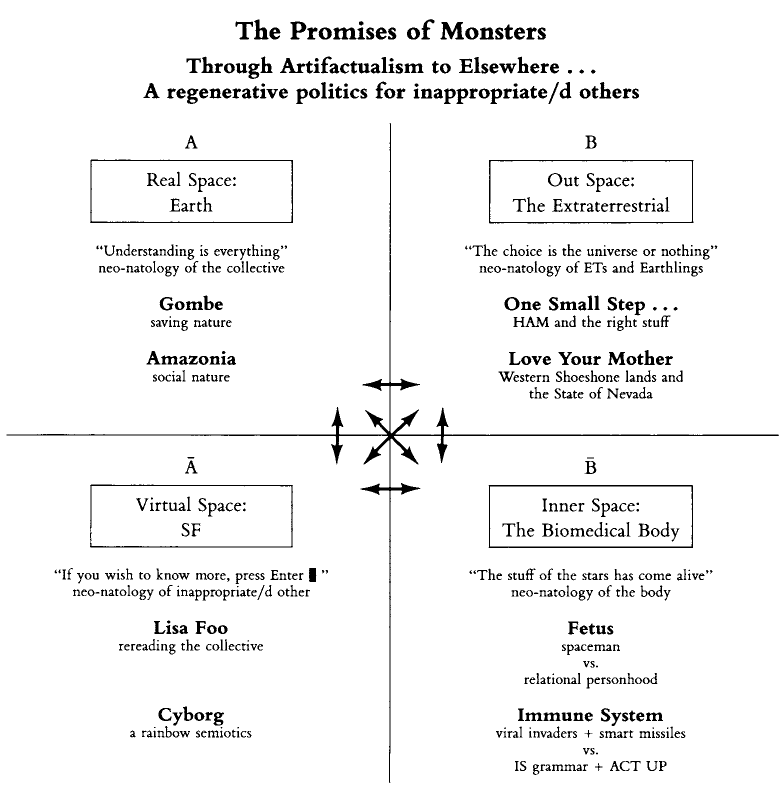
The kind of use that is made of Greimas’ semiotic square in the design of narrative environments is similar to that of Donna Haraway (1992: 304) in ‘The Promises of Monsters’. She notes that, in alliance with Bruno Latour, she will use “this clackety, structuralist meaning-making machine” to create a narrative other than, “the rational progress of science, in potential league with progressive politics, patiently unveiling a grounding nature.” Equally, she will not create a tale that will be a demonstration of the social construction of science and nature that locates all agency firmly on the side of humanity.
Haraway uses the term amodern to refer to “a view of the history of science as culture that insists on the absence of beginnings, enlightenments, and endings: the world has always been in the middle of things, in unruly and practical conversation, full of action and structured by a startling array of actants and of networking and unequal collectives.”
She treats as a virtue the much-criticized inability of structuralist devices like the semiotic square to provide diachronic narratives. Instead, Haraway’s amodern history will have a geometry, “not of progress, but of permanent and multi-patterned interaction through which lives and worlds get built, human and unhuman.”
Thus, she uses the semiotic square to define four spaces as a means to explore how certain local-global struggles for meanings and embodiments of nature are occurring within those spaces. This, a contestable collective world comes into view that takes shape for us out of structures of difference.
Haraway’s (mis)interpretation of the structure of semiotic square is as follows:
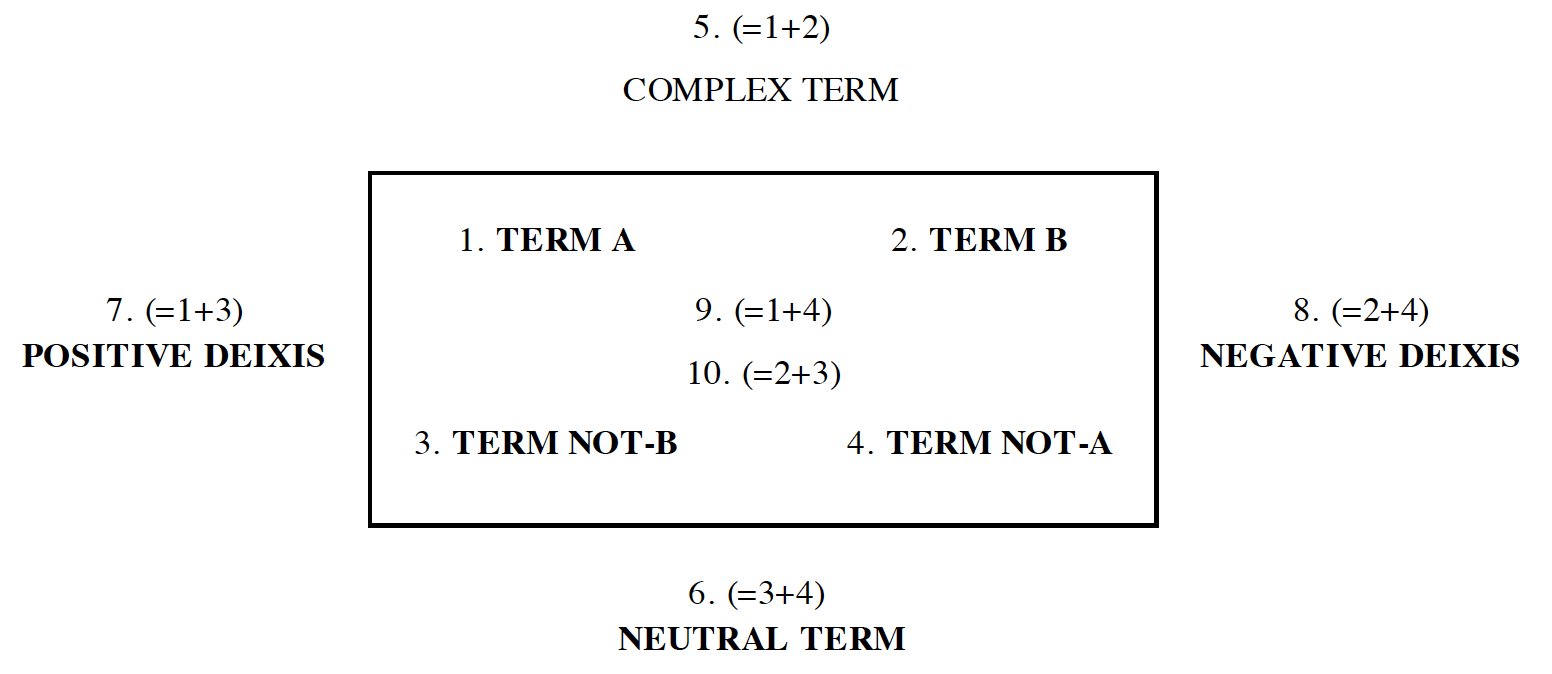
The semiotic square as set out by Greimas is as follows:
Source, Louis Hebert, 2006, The Semiotic Square
The similarity to the traditional diagram for the square of opposition, as presented below by Terence Parsons (2014), is striking. The top terms (A-B and A-E) are both in a relationship of contrariety (contraries); the diagonal terms (A-C, B-D, A-O, E-I) are in a relationship of contradiction (contradictions); the bottom terms (C and D, O and I) are also in a relationship of contrariety, but subordinate to the more general contrariety between the top terms (A and B, A and E) (sub-contraries), while the relationships between A-D and B-C, similarly to that between A-I and E-O, are sub-alterity (subalterns).
Greimas and the Semiotic Square
John Corso (2014) explains that Greimas introduced the diagram of the semiotic square in his 1966 essay, “Les jeux des contraintes ‘sémiotiques,’”. This essay was translated into English as “The Interaction of Semiotic Constraints” (Greimas and Rastier, 1968), published in Yale French Studies. In the essay, Greimas and Rastier (1968: 88) state that this “presentation makes it isomorphic to the logical hexagon of R. Blanché … as well as to the structures called, in mathematics, the Klein group, and, in psychology, the Piaget group”. Frederic Jameson (1972: 166) also notes a similarity to Levi-Strauss’s “culinary triangle” of raw-cooked-rotten.
References
Corso, J. J. (2014) What does Greimas’s semiotic square really do?, Mosaic: a journal for the interdisciplinary study of literature, 47(1), pp. 69–89. doi: 10.1353/mos.2014.0006.
Greimas, A. J. and Rastier, F. (1968) The Interaction of semiotic constraints, Yale French Studies, (41), pp. 86–105. Available at: http://www.jstor.org/stable/2929667 (Accessed: 14 December 2014).
Haraway, D. J. (1992) The Promises of monsters: a regenerative politics for inappropriate/d others, in Grossberg, L., Nelson, C., and Treicher, P. A. (eds) Cultural theory. New York, NY: Routledge, pp. 295–337.


 Source, Louis Hebert, 2006, The Semiotic Square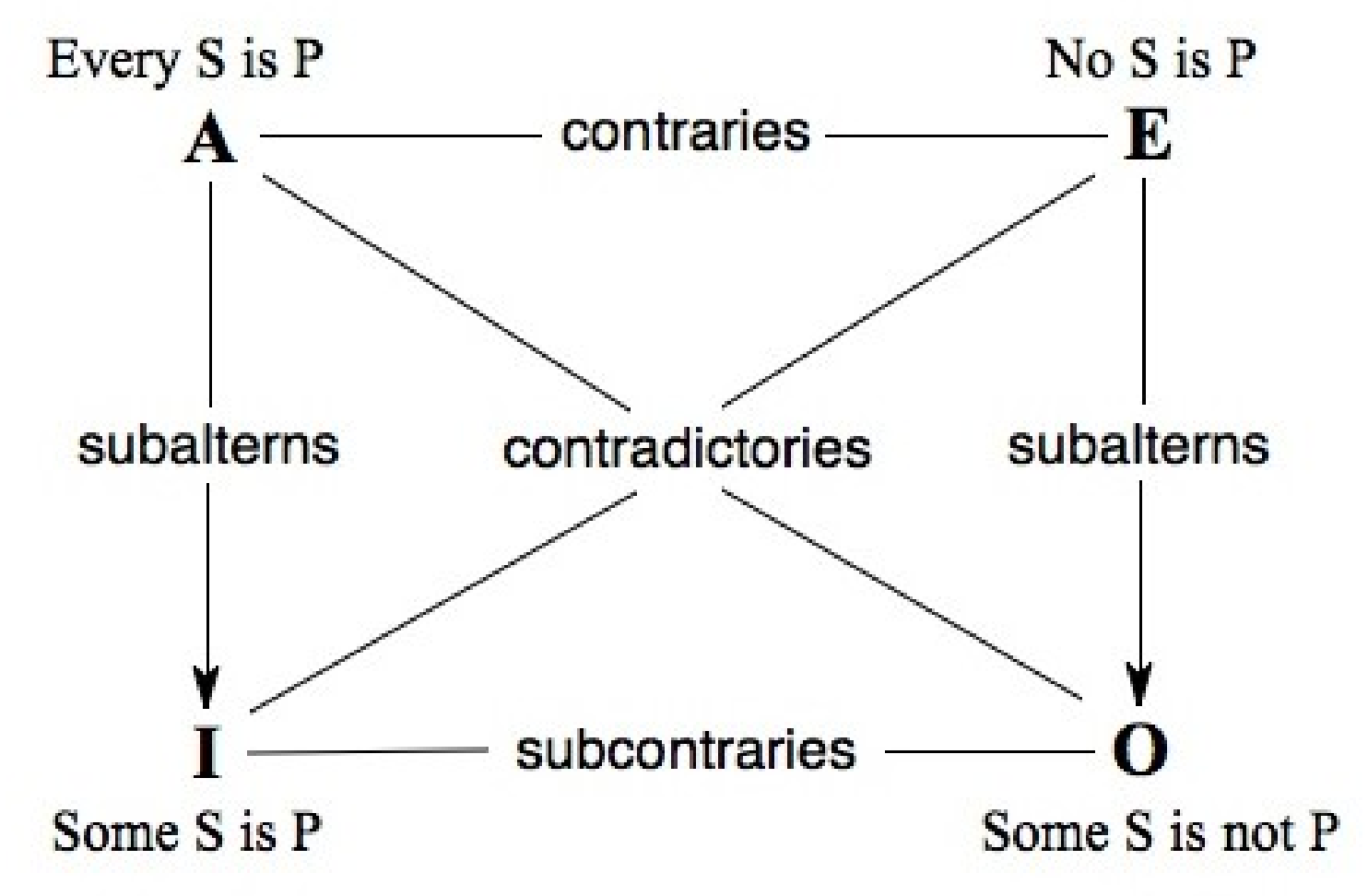
 Incomplete ...