Modernity and Coloniality

RELATED TERMS: Cultural StudiesDecolonisation and Decoloniality

Coloniality

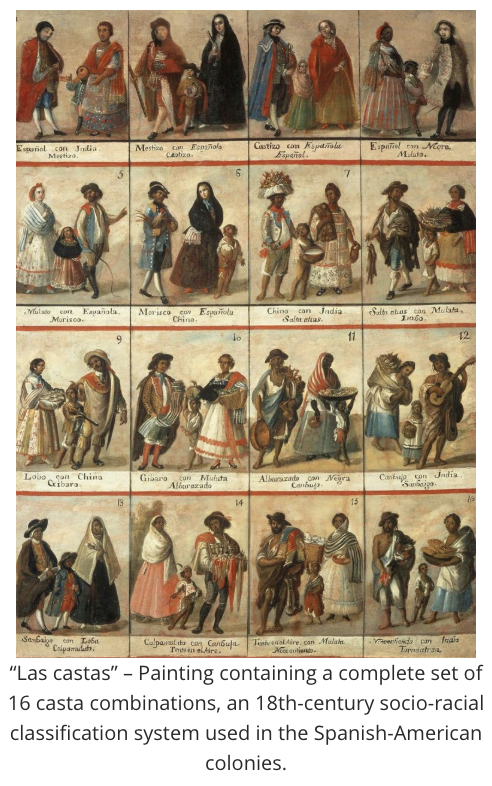
It has been argued, for example by Peruvian sociologist Anibal Quijani and Argentinian semiotician Walter Mignolo, that modernity and coloniality are inseparable, two sides of the same coin. ‘Coloniality’, Mignolo states, is short hand for colonial matrix or colonial order of power. In this view, modernity is an epistemological frame that is inseparably bound to the European colonial project. Thus, decolonialists seek to move beyond the overly geographical determinism of various critiques of Eurocentrism, while developing an epistemic conception of coloniality. In this way, it is seen that epistemic hegemony is not limited to particular places. Decolonial thinkers suggest that there is a history of epistemic violence in every geographical location, including the West.

For Stephen Toulmin, in Cosmopolis, The Hidden Agenda of Modernity (1990), the hidden agenda of modernity was the humanistic lineage running alongside instrumental reason; for Walter Mignolo, the hidden agenda, and darker side, of modernity was coloniality. Thus, Mignolo argues, ‘modernity’ is a European narrative that occludes its darker side, ‘coloniality’. Furthermore, Mignolo continues, if there cannot be modernity without coloniality, there cannot be either global modernities without global colonialities.

As Michael Baker (2012) explains, coloniality emerges, in part, from colonialism, but is distinct from it. Thus, “Coloniality articulates the logical structure of power/knowledge relations that emerged with the formation and expansion of Europe as a civilized/civilizational complex from the fifteenth century to the present (Alcoff, 2007). This worldwide political structure of power/knowledge relations controls the permissible forms of economic exchange, sexuality, gender, subjectivity, knowledge and education.”

Coloniality, De-coloniality, Post-modernity, Post-Structuralism and Post-colonialism

In Mignolo and Walsh’s (2018) view, decolonisation during the Cold War meant the struggle for liberation of Third World countries and, when successful, the formation of nation-states claiming sovereignty. By the 1990s, however, the failure of decolonisation in most nations had become clear. With states in the hands of minority elites, the patterns of colonial power continued both through internal colonialism and in relation to global structures. At that moment coloniality was unveiled, and simultaneously decoloniality was born.

The conjoint conception coloniality/decoloniality, introduced by Aníbal Quijano in 1990, was the moment at which the Cold War closed and neoliberal global designs opened. Mignolo (2007) insists that coloniality and de-coloniality imake a break with:

  • the Eurocentric project of post-modernity; and
  • a project of post-colonialism heavily dependent on post-structuralism.

The break with the post-colonial canon, which includes, for example, Edward Said, Gayatri Spivak and Homi Bhabha, is due to its reliance upon such European writers as Michel Foucault, Jacques Lacan and Jacques Derrida. The de-colonial shift is conceived as a project of de-linking; while post-colonialist criticism and theory is a project of scholarly transformation within the academy, Mignolo argues. Decoloniality, Mignolo states, starts from other sources. They include:

  • the de-colonial shift already implicit in works by Waman Puma de Ayala;
  • the de-colonial critique and activism of Mahatma Gandhi;
  • the fracture of Marxism in its encounter with colonial legacies in the Andes, articulated by Jose Carlos Mariategui; and
  • the radical political and epistemological shifts enacted by Amilcar Cabral, Aime Cesaire, Frantz Fanon, Rigoberta Menchu, Gloria Anzaldua, among others.

De-Linking

Mignolo (2007) argues that Samir Amin’s early version of de-linking, in which he proposed a ‘polycentric world’ as the path after de-linking, was conceived as an economic and political de-linking from the Imperial States, such as Western European capitalists countries and the USA. Such economic and political de-linking should now be accompanied by an epistemic de-linking from the rhetoric of modernity and the logic of coloniality, a delinking that leads to de-colonial epistemic shift and brings to the foreground other epistemologies, other principles of knowledge and understanding and, consequently, other economies, other politics, other ethics.

New inter-cultural communication should therefore be interpreted as new inter-epistemic communication, such as, for example, in the case of the concept of inter-culturality among indigenous intellectuals in Ecuador. Furthermore, such de-linking presupposes a move toward a geo-politics and a body politics of knowledge that, on the one hand, denounces the claimed universality of a particular ethnicity (body politics), located in a specific part of the planet (geo-politics), i.e. Europe, where capitalism accumulated as a consequence of colonialism. De-linking, then, can be understood as a de-colonial epistemic shift leading to pluri-versality, rather than to the hegemony of Eurocentric ethnic understanding, with its socio-historical specificity, posing as universal knowledge.

References

Baker, M. (2012). Modernity/coloniality and Eurocentric education: towards a post-Occidental self-understanding of the present. Policy Futures in Education, 10 (1), 4–22. Available from http://journals.sagepub.com/doi/10.2304/pfie.2012.10.1.4 [Accessed 1 June 2019].

Mayblin, L. (No date). Modernity / Coloniality. Global Social Theory. Available from https://globalsocialtheory.org/concepts/colonialitymodernity/ [Accessed 1 June 2019]

Mignolo, W.D. (2007). Delinking. Cultural Studies, 21 (2–3), 449–514. Available from https://www.tandfonline.com/doi/full/10.1080/09502380601162647 [Accessed 2 June 2019].

Mignolo, W.D. and Walsh, C.E. (2018). On decoloniality: concepts, analytics, praxis. Durham, NC: Duke University Press.

Quijano, A. (2007). Coloniality and modernity/rationality. Cultural Studies, 21 (2–3), 168–178. Available from https://www.tandfonline.com/doi/full/10.1080/09502380601164353 [Accessed 2 June 2019].</div>

Modernity

RELATED TERMS: Critical thinking; Humanism; Modernism; Avant-Garde Movements; Design History; Design Practice and Functionalism;

‘Modernity’ may be taken as an example of a framing narrative, which concerns a particular historical narrative woven into the material and geographical environments of Western Europe and the USA at a particular moment in time, beginning in the mid-18th century but accelerating during the 19th century.

As well as being useful for specific designs, modernity may also be useful for contextualising and orienting design as a situated practice within the development of design practices since the 18th century. Modernity may be especially useful when considered alongside such related terms as modernism, the avant-garde and post-modernism; and when taking into account the ways in which everyday life and everyday experience (Dasein) is conceived within these frames.

Dallmayr (1989: 378-379) writes that the Renaissance and Reformation, along with the discovery of the ‘New World’, heralded a break with the classical and mediaeval past. However, the notion of a distinctly ‘modern’ period emerged only slowly in the aftermath of these events. Habermas suggests that Hegel was the first philosopher to develop a clear conception of modernity. Together with his philosophical precursors, Hegel situated the core of modernity in the principle of subjectivity, which carried for him the connotations of individualism, critical-rational competence and autonomy of action. While accepting the principle of subjectivity, Hegel also recognised both its emancipatory potential and its ambivalence, i.e. that it is both a world of progress and of alienated spirit.

While referring initially to a European and American socio-historical experience, the processes with which modernity is interwoven and co-arises, such as migration, urbanisation, industrialisation, technologisation and bureaucratisation, may be of relevance to other countries at other times, who thereby experience modernisation and modernity in their own distinct ways.

In socio-political terms, between 1840 and 1845, Lefebvre (1995: 170) argues, Marx found need of a concept of modernity, a concept which is primarily, but not exclusively, political. It defines a form of the state that is elevated above society. However, also important for Marx is the relation this form of state has with everyday life and with social practice in general: it separates everyday life, taken as private life, from social life and political life.

In academic terms, John Protevi (1999) states that modernity’s temporal range depends on which academic discipline is being discussed. What can safely be said is that it concerns post-1600 Europe at the earliest, i.e. the post-Renaissance period, in the Northern European version. Whatever the causes, the years after 1750 saw various governmental and cultural changes accompany and accelerate these economic changes, in “mutual presupposition”.

Habermas (1997: 39) writes that, “Anyone who, like Adorno, conceives of ‘modernity’ as beginning around 1850 is perceiving it through the eyes of Baudelaire and avant-garde art.”

Modern thought, as summarised by Protevi (1999), can be characterised as an admixture of:

1. Humanism: the human being is the source of meaning and value; the value of nature is its utility to humans; and the development of human potential is the highest goal of politics.

2. Individualism: the individual is both ethically and intellectually prior to society; humans have rights governments must acknowledge in limiting government action; and intellectual progress, and hence techno-economic progress, is made by leaps of genius.

3. Rationalism: the natural human faculty of theoretical and practical reason moves from universal principles to particular applications; while remaining antithetical to power, which is centralised and repressive.

4. Secular moralism: human reason alone can allow moral actions and moral society, if freed from the superstition and prejudice of religious dogmatism.

5. Progressivism. human history is progressive: people in the modern age are more humane and moral than in previous ages, because of the public use of reason in governmental rationality.

There are many different views on modernity. For Habermas, for example, the goal of modernity is the attainment of a fully democratic society. Modernity is to him, therefore, an ‘unfinished project’ which must be pursued if that potential is to be released (Terry, 1997).

For any particular design, it may be relevant to decide how it is situated in relation to the issues raised by modernity:

Is it assumed, like Habermas, that the goal of modernity remains an unfinished project, towards which the design contributes?

Alternatively, does the design operate under the sign of neo-avant-gardism or post-modernity, i.e. incorporating a degree of scepticism and a critical attitude towards the grand narratives of progress, in both the scientific-technic-epistemic realm (wholly integrated or systematised knowledge) and the political-ontological realm (complete human emancipation and salvation)?

Or does it seek to move beyond the problematics of modernity and engage in considerations of the post-human, new materialism and materialist feminism, opening up a new terrain that displaces the teleological and productivist orientation of modernity?

However, whichever direction one chooses, as Derridean deconstruction shows, one cannot simply make a complete break with modernity and its problematiques.

References

Dallmayr, F. (1989). The discourse of modernity: Hegel, Nietzsche, Heidegger (and Habermas). Praxis International, 8 (4), 377–406.

Habermas, J. (1996). Modernity: An unfinished project. In: Habermas and the Unfinished Project of Modernity: Critical essays on the philosophical discourse of modernity, edited by M. P. d’Entreves and S. Benhabib. Cambridge, MA: MIT Press, 38–55.

Lefebvre, H. (1995). Introduction to modernity: twelve preludes, September 1959-May 1961. London, UK: Verso.

Protevi, J. (1999). Some remarks on Modernity and Post-modernism and/or Post-structuralism [Webpage]. Available at: http://www.protevi.com/john/DG/PDF/Remarks_on_Modernity_and_Post-Modernism.pdf [Accessed 24 September 2013].

Terry, P. (1997). Habermas and education: knowledge, communication, discourse. Pedagogy, Culture and Society, 5 (3), pp.269–279. Available at: http://www.tandfonline.com/doi/abs/10.1080/14681369700200019 [Accessed 4 March 2014].

Mode and Medium

RELATED TERMS: Multimodal research; Transmedia, Cross-Platform and Multimedia;

The notion of a medium cannot be understood simply as a technology of production and distribution. It must also be understood as social practice and as a cultural phenomenon. Thus, Jenkins (2006), for example, suggests a model of media that works on two levels:

  • a medium is a technology that enables communication; and
  • a medium is a set of associated protocols or social and cultural practices that have grown up around that technology.

Medium of production and dissemination and mode of representation are often conflated. This conflation reflects a recent history in which there was a congruence of a kind between medium, such as radio, and mode, for example, speech or music, or of the medium of book and the mode of writing.

This congruence has been largely superseded by the integration of different modes and media in single tools of production, such as a computer or an authoring software, which display, for example, authored storage media such as DVDs, or transmission, for example, digital television, online games, or online dictionaries (MODE, 2012). Hence, the need to refer to multimodal multimedia.

References

Jenkins, H (2006) Convergence Culture. New York: New York University Press.

MODE (2012). Glossary of multimodal terms. Available at https://multimodalityglossary.wordpress.com/ [Accessed 9 October 2017]..

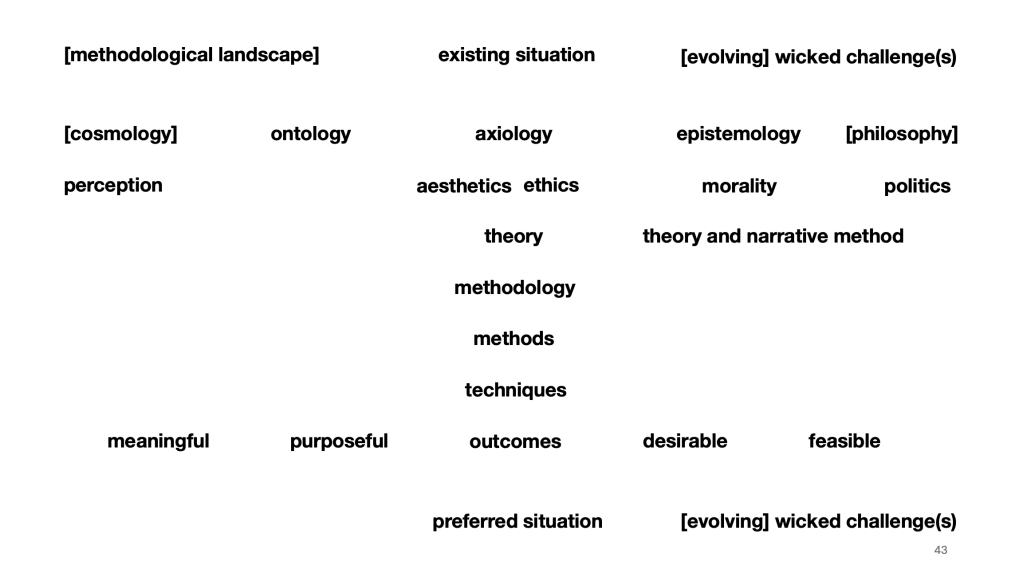
Methodology and Method

RELATED TERMS: Affordances; Avant-garde movements; Critical Theory; Critical thinking; Cultural Studies; Dissensus – Ranciere; Ethnomethodology; Feminism and Materialism; Historical materialism – Marxism; Multimodal research; OntologyPerformance and Performativity; Postmodernism; Poststructuralism; Psychogeography; Research Methodologies; Storyworld; Theoretical Practice; Wicked Problems – Wicked Challenges

“philosophers and literary theorists frequently refer to theories as stories (in this story we have to accept that … ). Or even scenarios. It is as if phiction and filosophy had changed places.” (Brooke-Rose, 1991: 19)

“Deconstruction is neither a theory nor a philosophy. It is neither a school nor a method. It is not even a discourse, nor an act, nor a practice. It is what happens, what is happening today in what they call society, politics, diplomacy, economics, historical reality, and so on and so forth.” (Derrida, 1990: 85)

Methodology, Methods and their Philosophical Assumptions and Presuppositions

The design of narrative environments, as an example of a contemporary design practice, is research-based and may also be research-led. Indeed, it may even serve as an example of design-led research. In short, design and research are closely intertwined in many contemporary design practices. This is to acknowledge, along with Smith and Dean (2009: 1), the potentially close relationship between research and creative practice: creative practice can impact academic research positively while academic research can have a reciprocal impact on creative practice. The following text discusses the inter-relationships of theoretical perspectives, methodologies and methods to the epistemological, ontological and axiological – that is, philosophical or cosmological – presuppositions they assume, from the perspective of design practice and design education and its pedagogical principles.

In conducting research, a methodology guides the orientation of the research and frames the research question. Once these are decided, specific research methods are selected which generate the evidence, or the material outputs of practice in the case of practice-based research, to address the research question and/or the design challenge.

A methodology is a system of methods, principles and theories used in a particular discipline. It is akin to a philosophy or an approach which holds the methods and theories together as a coherent system. More narrowly, the term methodology may refer to the branch of philosophy concerned with the science of method.

A method a way of proceeding or doing something, i.e. a procedure, especially one that is systematic or regular; orderliness of thought or action. As methods, it refers to the techniques or arrangement of work for a particular field or subject.

In practice, matters are far less clear-cut than this division suggests. Adherence to a methodology both enables research to proceed but also limits research by establishing boundaries of what it is permissible to see, to say and to argue. It is this adherence which, if it become too rigid or mechanistic, gives some research its ‘artificial’ or ‘limited’ feel; or limits its field of application or relevance. All research, to some extent, has to deal with mismatches between methods and methodology and with the limits imposed by a methodology and its associated methods.

A methodology, in order to proceed, requires certain ontological assumptions about what already exists, how it exists and how new existents may be discovered, as well as certain epistemological assumptions about what is already known, how it is known and how new knowledge can be produced. It also makes certain axiological assumptions about what is valuable, how it is valued and how that value should be sustained or enhanced. These assumptions, as decisions, may not be wholly explicit in the methodology until it is thoroughly questioned.

Continue reading “Methodology and Method”

Metanarrative

RELATED TERMS: Metalepsis; Postmodernism

A metanarrative may be understood as a narrative about narration, for example, experimenting with or exploring the idea of storytelling by drawing attention to its own artificiality. In this sense, there are resonances with a Genettian conception of literary or narrative metalepsis, where boundaries between narrative levels are transgressed.

Possibly more importantly for design practices, a metanarrative, otherwise known as a grand narrative, a master narrative or a narrative of mastery, is a term developed by Jean-François Lyotard, by which he intends a theory that seeks to give a totalising, comprehensive account to various historical events, experiences, and social, cultural phenomena based upon the appeal to universal truth or universal values.

In Lyotard’s theorisation, a narrative is a story that functions to legitimise power, authority and social customs. Thus, a metanarrative is one that claims to explain various events in history, giving them meaning by inter-connecting disparate events and phenomena through an appeal to some kind of universal knowledge or universal schema. Examples of such, often teleological, metanarratives include Marxism, religious doctrines, belief in progress and belief in universal reason.

As expressed by Christine Brooke-Rose (1991), “Our ‘postmodern’ situation … has been defined by Lyotard … as one of ‘incredulity with regard to metanarratives’ (in the sense of universalist Big Ideas, such as the emancipation of man, of reason; from ignorance, from inequality; the Hegelian or the Marxist metanarratives, etc.) and a recommended preference for ‘little’ narratives.”

Environmental design practices may wish to draw to attention the metanarrative assumptions at play in particular sites, for example, monuments or squares that evoke a country’s imperial or colonial past.

References

Brooke-Rose, C. (1991) Whatever happened to narratology?, in Stories, theories and things. Cambridge, UK: Cambridge University Press, pp. 16–27.

Lyotard, J.-F. (1984) The Postmodern condition: a report on knowledge. Manchester, UK: Manchester University Press.

New World Encyclopedia contributors (2018) ‘Metanarrative’. New World Encyclopediahttps://www.newworldencyclopedia.org/p/index.php?title=Metanarrative&oldid=1014622 [Accessed 12 March 2021]

Metalepsis

RELATED TERMS: Cinema and Film Studies; Deixis and Deictic Acts; Diegese and Diegesis; Diegetic Levels; Intradiegetic and Extradiegetic; Ontological Designing; Ontological Metalepsis; Performance and Performativity; Tangled Hierarchy and Strange Loop; Theatre

Metalepsis in Rhetoric

Metalepsis in rhetoric has a different meaning from the use of metalepsis in narratology, theatre studies and cinema studies. In a yet further extended sense, metalepsis has an important role to play in transmedia phenomena and, most importantly, in the design of narrative environments.

In rhetoric, metalepsis is a trope which is similar to metaphor and metonymy, or perhaps combines them, as when metonymy (use of one word for another with which it is associated) is used to replace a word already used figuratively (metaphorically). For example, if the word ‘sable’ replaces the word ’black’ in the phrase ‘black caverns’, black is already figurative, standing for ‘dark’ or ‘gloomy’ or perhaps ‘dark and gloomy’. Thus, ‘sable’, already in a metonymic relation to ‘black’, in this new context takes on additional meanings of ‘dark’ and ‘gloomy’, with which it was not necessarily associated previously.

A metalepsis, as the example above shows, is a transgression of a common usage, such as the association of sable and black, through which the figure of speech is used in a new and innovative context, sable as connoting dark and gloomy rather than simply the colour black.

Metalepsis in Narratology

Gerard Genette extended the realm of metalepsis from rhetoric to fiction, in the process transforming it into a narratological concept (Petho, 2010). For Genette, fiction itself is an extension of the logic of the trope which relies on our capacity to imagine something as if it were real. Thus, for Genette, metalepsis creates a paradoxical loop through the ontological levels of the real and the fictional. This is a common feature of meta-fictional works, in which such shifts serve to foreground the artifice of the fictional world as well as the illusory nature of any ontological boundary between the story and narration. As a narrative device, it can be understood as a breaking of the narrative frame which separates distinct narrative levels, for example, between an embedded tale and primary story or when a third-person narrator appears within the fictional world of which s/he narrates.

As Macrae explains, interpreting Genette, in the context of literary fiction, the simplest ontological structure has three levels: the level of the story (the diegesis), at which the characters exist; the level of the narration (the extradiegesis), at which the narrator exists, for example, through third-person narration; and the level of the real, at which the reader and author exist. In contrast to the reality of the world in which the book is authored and read, the diegesis and the extradiegesis are both fictional.

Metalepsis has been used in the context of theatre, when characters onstage refer directly to the audience as if they are a character in the play, and into cinema, for example, when a screen actor steps out of a projected film within a film, as in Woody Allen’s 1985 film, The Purple Rose of Cairo. Such techniques are sometimes referred to as ‘breaking the fourth wall’, a metaphor taken from the architecture of the theatre, where three walls enclose the stage and an invisible fourth wall is omitted for the sake of the viewer. The (cinema, television, computer) screen technologises this ‘fourth wall’.

Brian McHale (1987) argues that a characteristic of postmodernist fiction is the foregrounding, through metalepsis, of the ontological dimension of recursive embedding. It is this emphasis on the ontological implications of transgressions of narrative levels that is of particular interest to the design of narrative environments.

When it comes to the specificity of the use of the term metalepsis within the design of narrative environments, taken as phenomena that examine how the metalepsis of ‘artifice’ and ‘life’ is becoming part of the real in the everyday experience of our lives, the insights of Jamie Freestone (2017) are particularly relevant. Freestone notes that recent scholars of narrative, such as Bell and Alber (2012) and Ryan (1995; 2006), following McHale (1987), it should be noted, identify metalepsis as part of a more general category of strange loops. Beyond describing the tangle of levels in a fictional text, metalepsis, as well as being extended to other media, increasingly figures in other discourses, such as logic, computer science, linguistics, and the natural sciences, where it is used to refer to the way physical (‘real’) levels are tangled as much as diegetic or representational levels.

The example which Freestone explores is that of gene editing. He points out that narratives of evolutionary history, such as Richard Dawkins’ The Selfish Gene, employ two techniques that contribute to metaleptic effects: a pervasive textual metaphor, which figures the genome as a text to be read and copied, and nowadays to be edited through gene manipulation technologies; and a personification of genes, such that the genome is presented as the author of organisms’ behaviour, including humans behaviour. Freestone reasons that, taking into account recent developments in gene-editing technologies and their potential future advances, the genome-as-text and genome-as-author metaphors implicate us as readers in a novel configuration: we find ourselves editing a text that itself has authored us. This, he concludes, is a novel kind of metalepsis. As he explains, “The term “editing” designates an intervention from a high level into a low level, where the higher level is dependent on the lower level to exist”. This relationship is characteristic of a tangled hierarchy or a strange loop.

The proliferation of different kinds of metalepsis led Monika Fludernik (2003: 396) to distinguish between real ontological metalepsis and metaphorical ontological metalepsis. The former involves the transgression of ontological levels in the story (diegesis), for example, when a narrator enters a story-within-a-story. The latter occurs when, for example, the narrator positions him- or herself as an invisible observer in the scene of the story without affecting it. However, these concern the relations between the diegetic and the extradigetic. Freestone, as indeed is the design of narrative environments, is more concerned with actual ontological metalepsis, in which real nontextual levels are tangled, such as when an actual strange loop occurs in the real world with an edit of the text of the genome.

Metalepsis and the Design of Narrative Environments

When used in the design of narrative environment design, it not just the transgressive character of metalepsis which is important, that is, taking something from one context and placing it in another, thereby giving it new meanings. This a manoeuvre that it shares with other literary and avant-garde practices such as collage, assemblage, detournement and Ostranenie (making strange). Rather, it is the combination of this transgression with the extension of transgression to ontological levels beyond the diegetic-extradiegetic boundary, towards the reflexive re-writing or re-making of the creative or the authoring level by the created or authored level, thereby putting into question the ontological status of the subjective entity involved in the ‘re-writing’ of its own self, along with the assumptions that the subjective entity makes about the ontological structuring of the real in which it is immersed and upon which it depends.

This is the kind of tangled hierarchy or strange loop which the design of narrative environments seeks to evoke and create, in which the narratee, as the authored level, enters into the re-writing of its self and its own world. Gene-editing is but one metaphor and example of such processes. This possibility arises because of the inseparability of the subjective, the narrative and the environmental dimensions of the narrative environment, each of which may serve as the top level for the other’s bottom level, with the third term intervening, in a series of interconnected tangled hierarchies or strange loops. In this way, for example, what is assumed to be environmental emerges, through the subjective, in the midst of the narrative, and vice versa; what is assumed to be subjective emerges, through the narrative, in the midst of the environmental, and vice versa; and what is assumed to be narrative emerges, through the environmental, in the midst of the subjective, and vice versa.

One feature that may distinguish the design of narrative environments from other modes of design, then, is that it consciously takes into account the condition of all design: that it seeks to un-throw or over-throw the world into which it has been ‘thrown’, a world full of existing ‘designs’. In this condition, design is always re-design. Equally, design presents a paradox or an aporia: design is the ‘solution’ to the ‘problem’ that is ‘design’. Perhaps this is the terrain in which the notions of ontological metalepsis and ontological design have value, enabling us to recognise the ‘fiction’, the construction, the mediation, the performativity and the immersivity of our ‘being’, or our being in-between, which is a process of constantly being thrown-over-thrown, made-re-made or designed-re-designed.

A warning note

Hal Foster (2002: 193) sounds a warning note in respect of the metalepses and transgressions that may occur in a narrative environment, borrowed from modernist and avant-garde art practices and their reiteration in post-modernism, when he proposes the thesis that, “contemporary design is part of a greater revenge taken by advanced capitalism on postmodernist culture – a recouping of its crossings of arts and disciplines, a routinization of its transgressions.”

Allan Parsons, May 2021

References

Bell, Alice, and Jan Alber (2012) “Ontological Metalepsis and Unnatural Narratology.” Journal of Narrative Theory, 42(2), 166– 92.

Fludernik, Monika (2003) “Scene Shift , Metalepsis, and the Metaleptic Mode.” Style, 37(4), 382– 400.

Foster, H. (2002) ‘The ABCs of contemporary design’, October, 100, pp. 191–199. Available at: http://www.jstor.org/stable/779099 (Accessed: 7 September 2016).

Freestone, J. M. (2017) ‘The Selfish Genre’, Storyworlds: A Journal of Narrative Studies, 9(1), pp. 225–246. Available at: https://www.jstor.org/stable/10.5250/storyworlds.9.1-2.0225 (Accessed: 10 March 2021).

Macrae, A. (2019) Discourse deixis in metafiction: the language of metanarration, metalepsis and disnarration. New York, NY: Routledge.

McHale, B. (1987) Postmodernist fiction. London, UK: Routledge.

Petho, A. (2010) ‘Intermediality as Metalepsis in the “Cinécriture” of Agnès Varda’, Acta Universitatis Sapientiae, Film and Media Studies, 3(3), pp. 69–94. Available at: http://www.acta.sapientia.ro/acta-film/C3/film3-5.pdf (Accessed: 27 October 2019).

Ryan, Marie- Laure (1995) “Allegories of Immersion: Virtual Narration in Postmodern Fiction.” Style 29.2: 262– 86.

Ryan, Marie- Laure (2006). Avatars of Story. Minneapolis: University of Minnesota Press.
Material Culture

RELATED TERMS: Anthropology; Practice

Material culture is a notion crucial to design practices. As Daniel Miller (2005) highlights, the less aware we are of the objects that surround us, the more powerfully they can determine our anticipated actions by setting the scene and encouraging normative behaviour, without being open to challenge. They assert without seeming to assert. Thus, objects determine what takes place to the extent that we remain unconscious of their capacity to do so.

Part of the task of a critical design practice is to make explicit the capacity of objects and environments to act, that is, their actantiality, their status as actants, and to use that awareness of ‘objective’ actantiality to bring to attention, and possibly to alter, the ways we act and interact with each other through environmental actants.

Such a perspective, Miller (2005, 5) argues, can properly be described as that of ‘material culture’, “since it implies that much of what we are, exists not through our consciousness or body, but as an exterior environment that habituates and prompts us.”

This capacity of objects to fade out of focus and to remain peripheral to our vision yet determinant of our behaviour and identity also becomes, according to Bourdieu, the primary means by which people are socialised as social beings, an insight that Bourdieu forged by developing the thought of Levi-Strauss. Levi-Strauss demonstrated how anthropologists needed to abandon the study of entities and consider things only as defined by the relationships that constituted them. For Levi-Strauss, this became a grand ordering implying a largely intellectual foundation, with myth as philosophy. Bourdieu, however, turned this into a much more contextualised theory of practice.

He did so by stressing that the expectations characteristic of our particular social group are to a large extent inculcated through what we learn in our engagement with the relationships found between everyday things. The categories, orders and the placements of objects, such as the spatial oppositions in the home or the relationship between agricultural implements and the seasons. Each order is taken to be homologous with other orders, such as gender or social hierarchy. In this way, the less tangible aspects of a society are groundeded in the more tangible. Once these associations are fixed, they become habitual ways of being in the world which, as an underlying order, emerged as second nature or habitus. Bourdieu thus combined a Marxian emphasis on material practice with the phenomenological insights of figures such as Merleau-Ponty (1989) into a fundamental deictic system, enabling us to point to the world and to orient ourselves within it.

Historical notes

Daniel Miller (1998) comments that material culture studies developed through a two-stage process. In the first phase, it was demonstrated that things matter and that to focus upon material worlds does not fetishize them since they are not a separate superstructure to social worlds. The key theories of material culture developed in the 1980s, for example, those of Bourdieu, Appardurai and Miller himself, showed that social worlds were as much constituted by materiality as the other way around. This gave rise to a variety of approaches to the issue of materiality, for example, on an analogy with text or through the application of models from social psychology.

The second phase focuses on the diversity of material worlds which become each other’s contexts, rather than reducing them to models of the social world, on the one hand, or to specific subdisciplinary concerns, such as the study of textiles or architecture, on the other hand. In this situation, studies of the house do not have to be reduced to housing studies, nor studies of design to design studies.

Material culture studies does not exist as a given discipline. There are many advantages to remaining ‘undisciplined’ and many disadvantages and constraints imposed by trying to claim disciplinary status. Much the same could be said of the design of narrative environments, which can explore the advantages of being multi-, inter- or trans-disciplinary and, as a result, ‘undisciplined’.

References

Miller, D. (ed.) (1998) Material cultures: why some things matter. London, UK: UCL Press.

Miller, D. (2005). Materiality. Durham, NC: Duke University Press.

Liminality

RELATED TERMS: Anthropology;

In anthropology, as discused by Victor Turner, liminality, from the Latin word līmen, meaning ‘a threshold’, is the quality of ambiguity or disorientation that occurs in the middle stage of rituals, defined as a psychic-temporal-physical space. At this moment, participants no longer hold their pre-ritual status but have not yet begun the transition to the status they will hold when the ritual is complete. During a ritual’s liminal stage, that is, in the liminal space, participants ‘stand at the threshold’ between their previous way of structuring their identity, time, or community, and a new way, which the ritual establishes.

What is interest in the design of narrative environments is the condition of being in-between, or betwixt and between, the world of the story, on the one hand, and the world of the everyday, the lifeworld, on the other hand, which occurs when the participant generates and enters the storyworld instantiated by the narrative environment. In that sense, a narrative environment might be said to constitute a liminal space and progress through it similar to engaging in a ritual practice. Narrative environments may, however, only be ‘liminoid’ or ‘liminal-like’, rather than ‘authentically’ liminal, as Stephen Bigger (2009) discusses:

“The concept of liminality (the state of being on a threshold) was applied [by Turner] both to major upheavals and to performances generally, distinguishing only between ‘authentic’ liminality, and playful artifices such as the theatre which are named liminoid, or liminal-like. Liminality is viewed as an in-between state of mind, in between fact and fiction (in Turner’s language indicative and subjunctive), in between statuses. This concept has endured in performance studies and has the potential for wider usage.”

A liminal space can be a key component of a narrative environment. A liminal space can be either a physical or a temporal space, and often both at the same time, but it is always a psychic space.

Liminal spaces are places/times in which the audience is disorientated/moved from their normative assessment of ‘reality’ in order to prepare them for a different ‘reality’ presented in the main narrative space.

An account of a temporal liminal space is given by Daisetz Suzuki, a 20th century Zen Master, as cited by John Cage (1973: 88) in Silence:

“Before studying Zen, men are men and mountains are mountains. While studying Zen, things become confused. After studying Zen, men are men and mountains are mountains. After telling this, Dr. Suzuki. was asked, “What is the difference between before and after?” He said, “No difference, only the feet are a little bit off the ground.”

Victor Turner, 1920–1983, working with his wife Edith Turner, was an anthropologist deeply concerned with ritual both in tribal communities and in the contemporary developed world. Since the work of Turner in the 1960s, usage of the term liminality has broadened to refer to political and cultural change. During liminal periods of all kinds, social hierarchies may be reversed or temporarily dissolved, continuity of tradition may become uncertain, and future outcomes once taken for granted may be thrown into doubt. The dissolution of order during liminality creates a fluid, malleable situation that enables new institutions and customs to become established.

References

Bigger, S. (2009) Victor Turner, liminality, and cultural performance [Review of Victor Turner and contemporary cultural performance, edited by Graham St. John, New York and Oxford, Berghahn Books, 2008], Journal of Beliefs & Values, 30(2), pp. 209–212. doi: 10.1080/13617670903175238.

Cage, J. (1973) Silence: lectures and writings by John Cage. Hanover, NH: Wesleyan University Press.

Thomassen, B. (2009) The Uses and Meanings of Liminality. International Political Anthropology, 2 (1), 5-28.

Horvath, A., Thomassen, B. and Wydra, H. (2009) Introduction: Liminality and Cultures of Change. International Political Anthropology, 2 (1), 1-4

Szakolczai, A. (2009) Liminality and experience: Structuring transitory situations and transformative events. International Political Anthropology 2 (1), 141-172

Lifeworld – Lebenswelt

RELATED TERMS: Affordances; Arendt; Dasein; Design History; Diégèse and Diegesis; The Everyday and Design; Metalepsis; Ontological Designing; Ontological Metalepsis; Phenomenology; Storyworld; WorldWorld-Building

Jaune Quick-to-See Smith

“Man did not weave the web of life; he is merely a strand in it. Whatever he does to the web, he does to himself.” Chief Seattle

Designs, particularly within the approach of the design of narrative environments, can be understood to bring together: the (material-semiotic) world of the story (diegesis or diegese); the (imaginary) storyworld generated by the interaction of (a) that semiotic materiality and (b) the reader-participant’s own (imaginary, intellectual) identity-consciousness (Eigenwelt); and the (symbolic-real-embodied) Mitwelt, or world-with-others, that the human participant carries with them into the designed environment. All of which takes place in active relation to specific more-than human and other-than-human lived-living contexts or Umwelt.

Together, they give rise to a field of interaction or, more theoretically, a field of distributed agential potential (actantiality). The interesting questions for the design of narrative environments arise arise when this seemingly straightforward nested hierarchy of determinations, with the Umwelt at the bottom framing the Mitwelt in the middle which, in turn,frames the world of the story, with the storyworld at the top (Eigenwelt), becomes tangled so that the world of the story, as that which has been authored-narrated-enacted, becomes the author, narrator and actor in a newly emergent hierarchy.

Continue reading “Lifeworld – Lebenswelt”

Lefebvre

RELATED TERMS: The Everyday and Design; Historical materialism – Marxism; Cybernetics; Structuralism

Lefebvre

Henri Lefebvre is one of the core writers, along with Michel de Certeau, for examining, understanding and deploying social, spatial and environmental practices in a narrative environment. Lefebvre distinguished between three spatial spheres: the ‘perceived space’ of everyday social life; the ‘conceived space’ of planners and speculators; and the sphere of ‘lived space’, as part of lived experience.

Lafontaine (2007) points out that, during the years when structuralist thought prevailed, Henri Lefebvre was one of the rare figures to perceive the crucial influence exerted by cybernetics on the development of postwar French thought. Objecting to the theoretical erasure of the subject in favour of the system, Lefebvre saw structuralism as resulting from the importation of American concepts. He reproached Lévi-Strauss, Foucault and Lacan for having two homelands: the United States and France1.

Poster (2002) notes that Lefebvre borrowed the notion of “lived experience”, i.e. le vecu or erlebnis, from phenomenology and existentialism. The category of lived experience functioned as a critique of rationalist metaphysics deriving from Cartesian, Kantian, and Hegelian traditions, and can be found in Edmund Husserl’s Phenomenology and the Crisis of the European Sciences, in Martin Heidegger’s early existentialism of Being and Time, and in French translations and adaptations of these works such as Jean-Paul Sartre’s Being and Nothingness and Maurice Merleau-Ponty’s Phenomenology of Perception. Elden (2004) further notes that Lefebvre’s reading of space is heavily indebted to Heidegger, although his understanding of production, in The Production of Space, is a development of Marx’s thinking.

Lefebvre associates his last term, lived space or lived experience, with a symbolic re-imagining of urban space that reconfigures the banality of the first term, perceived space. Art and literature, he believes, have helped keep such alternatives alive. Everyday life under capitalism, which is the focus of Lefebvre’s critical thinking, particularly modern life in the post-1945 period, can therefore be redeemed and given new social meanings through the creative re-appropriation of its given products and structures (Brooker, 2003: 97).

Lefebvre argues that insofar as a ‘science’ of the human is possible, its material resides in the ‘trivial’ and the ‘everyday’. This argument can perhaps be derived, ultimately, from the writings of Walter Benjamin and his attempt to redeem the detritus of modern experience from anonymity (Evans, 1997: 223). We might also postulate that it seeks to undo the ontic-ontological difference that Heidegger asserts, when he seemingly relegates the ontic to the fallenness or inauthenticity of the everyday.

Lefebvre writes in Critique of Everyday Life in 1947 that, “the critique of everyday life involves a critique of political life, in that everyday life already contains and constitutes such a critique: in that it is that critique.” The issue at stake in the concept of daily life, therefore, was, and is, the recognition of the failure of Big Politics to offer anything like an adequate domain for human life (Poster, 2002: 743).

Notes

[1] Stuart Elden (2016) summarises Lefebvre’s main disagreements with structuralism as threefold:

  • Form, function and structure are all significant. To privilege only one of them is ideology. Such an ideological ontology becomes formalist, functionalist or structuralist. 
  • The relation between the diachronic and the synchronic is equally significant. By privileging the synchronic, structuralism denies history and becoming. 
  • Content and form must be examined together in linguistics and semiology. Language (la langue) must not take precedence over discourse (la parole).

References

Brooker, P. (2003). A Glossary of Cultural Theory, 2nd ed. London, UK: Arnold.

Elden, S. (2016) Introduction: a study of productive tensions, in Fernbach, D. (tran.) Henri Lefebvre, Metaphilosophy. London, UK: Verso, pp. vii–xx.

Evans, D. (1997). Michel Maffesoli’s sociology of modernity and postmodernity: an introduction and critical assessment. Sociological Review, 45 (2), 220–243. Available from http://doi.wiley.com/10.1111/1467-954X.00062 [Accessed 7 May 2016].

Lafontaine, C. (2007) The Cybernetic Matrix of “French Theory”, Theory, Culture & Society, 24(5), pp. 27–46. doi: 10.1177/0263276407084637.

Lefebvre, H. (1976). The Survival of capitalism: reproduction of the relations of production. New York, NY: St Martins Press.

Lefebvre, H. (1987). The Everyday and everydayness. Yale French Studies, 73, 7–11. Available from http://links.jstor.org/sici?sici=0044-0078%281987%290%3A73%3C7%3ATEAE%3E2.0.CO%3B2-U [Accessed 7 April 2014].

Lefebvre, H. (1991). The production of space. Oxford, UK: Blackwell.

Lefebvre, H. (1996). Writings on cities, edited by E. Kofman and E. Lebas. Oxford, UK: Blackwell.

Lefebvre, H. (2004). Rhythmanalysis: space, time and everyday life. London, UK: Continuum.

Lefebvre, H. (2009). State, space, world: selected essays, edited by N. Brenner and S. Elden. Minneapolis, MN: University of Minnesota Press.

Lefebvre, H. (2014). Critique of everyday life. The one-volume edition. London, UK: Verso.

Poster, M. (2002). Everyday (virtual) life. New Literary History, 33 (4), 743–760. Available from http://www.jstor.org/stable/20057754 [Accessed 7 May 2016].