Painting

RELATED TERMS: Visual Arts and Visual MediaPhotography

Mount Sainte-Victoire, about 1904, Paul Cezanne

Painting is the central, canonical medium of art history.

‘The truth in painting’ is a saying of Cezanne’s. Cezanne wrote to Emile Bernard in 1905 that, “I owe you the truth in painting and I will tell it to you”.

The power ascribed to painting, Derrida (1987) argues, is the power of direct reproduction or restitution, adequation or transparency. The truth in painting could be taken to mean truth itself restored, in person, without mediation, makeup, mask, or veil. In other words, the true truth or the truth of the truth, restituted in its power of restitution, truth looking sufficiently like itself to escape any misprision, any illusion; and even any representation, yet sufficiently divided already to resemble, produce, or engender itself twice over, in accordance with the two genitives: truth of truth (the true truth) and the truth of the truth.

References

Derrida, J. (1987) The Truth in painting. Chicago, IL: University of Chicago Press.

Photography

RELATED TERMS: Painting; Apparatus – Dispositif; Promptography

In the context of design practices, photography is one of the many media that may be employed, often as part of a multi-media, multi-modal environment or assemblage. As the history of the cultural and artistic disruption caused by photography shows, the use of any particular medium alters the balance of roles among media in engaging with materiality through what might be called a media ecology.

(Media) History of Photography

Wallerstein describes the invention of photography as posing a serious challenge to the system of the fine arts, prompting, first, a crisis in painting. The idea of the subjective and expressive quality of image making, and implicitly the hierarchy between the artes liberals and artes mechanicae that informs the concept of ‘fine art’, underwent a profound upheaval. The question of the image began to be discused in ontological terms. Thus, the question of “what is…” was gradually seen to precede questions of beauty, composition, and so on. This precedence was, in turn, gradually generalized so as to encompass not only painting, but also sculpture, literature, music and finally art in general, becoming an essential feature of modern art, manifested as an aesthetic as well as ontological unrest.

The encounter with photography as a medium that mechanized image production was taken by some as a dismantling of subjectivity and imagination, and possibly even as the end of painting. Such a sentiment is epitomized in Paul Delaroche’s hyperbolic outcry in 1839: “From today, painting is dead”, cited by Wallerstein (2010). Others, however, saw photography as a liberation of the imagination by redirecting it toward the essentials of art.

In this context, as a response to the advent of photography as a mechanical medium, the arrival of abstraction at the beginning of the 20th century could be understood in two ways. First, as the final discovery of what painting had been since the beginning; and second, as a last stance, beyond which painting had to be abandoned in favor of other forms of practice that would be able to interiorize mechanical and serial (re)production into their very substance.

The first stance imagines the painter uncovering a primordial perceptual dimension in and through painting. Such a claim can be understood to underlie Cézanne’s claim to show us “the truth in painting” peinture”), by plunging into the genesis of the visible that takes its cues from the pure sensations of colour. The second stance, emerging in the period around the First World War, accepts that technology has deprived painting not only of its old mimetic function but also dispelled the idea that it could reach a more true, profound, or elevated reality.

To a large extent, Wallerstein, argues, modernist painting evinces the mutual implication and even inextricable entanglement of these two positions.

Ethics and Politics of Photography

The central focus of Vilem Flusser’s investigation of photography is the camera as prototype for the ontologically conditioning apparatuses of postindustrial society, the prototype for all technical apparatuses of the present-day, postindustrial world. His analysis aims ultimately at the ethics of photography (van der Meulen, 2010).

The Ideological Role of Photography

As noted in the post Promptography, photography, and the presumption of photographic realism, dominated the visual field in the early- to mid-20th century through pictorial magazines such as Life in the USA. In “Life: A New Prospectus for the Sixties”, Henry R. Luce, the magazine’s founder and Editor-in-Chief, defined the purpose of Life in the 1960s in terms of national purpose, the two main objectives being to win the Cold War and to create a better America. Luce conceived of Life’s pictures as potent weapons of the Cold War (Blakinger, 2012).

Through its images, Life magazine, under the directive of its editor, took it upon itself to reflect and reify the American Cold War consensus culture of the early 1960s. Nevertheless, as Blakinger points out, advertising also played a central focus in Life‘s mission. A typical issue of Life had more pages of advertising than editorial content. Moreover, these advertisements, by mimicking the large photograph and sparse caption format, looked very similar to photographic essays. In so doing, they lent themselves some of the unquestioned authority that the magazine’s articles were granted by the public. For example, the text of a February 1963 advertisement for supermarket goods from the Life editors states that, by purchasing the advertised products, “You’re also casting a vote for a reputable manufacturer. […] There’s nothing like an American supermarket anywhere in the world. And there’s no more of an all-American businessman than your own supermarket manager.” In other words, the magazine’s editors explicitly equated consumerism and patriotic duty as primordial American values.

Blakinger, by focusing on Andy Warhol’s appropriation and inversion of certain images from Life magazine for his ‘Death and Disaster’ screen-prints, argues that Warhol’s visual strategies reveal a violent subversion of Life‘s assumptions about photographic realism and its attempts at visual indoctrination through its editorial content and its advertisements. The screen-prints demonstrate how Warhol re-presented the familiar pictures of Life as death, and thus transformed Life’s America into Death in America. [For more discussion of Warhol’s Death in America, see the post Iconic Designs, Critical Designs.]

References

Blakinger, J. R. (2012) “Death in America” and “Life” magazine: Sources for Andy Warhol’s “Disaster” paintings, Artibus et Historiae, 33(66), pp. 269–285. Available at: http://www.jstor.org/stable/23509753 (Accessed: 27 August 2024).

Elkins, J. (ed.) (2007) Photography theory. New York, NY: Routledge.

van der Meulen, S. (2010) ‘Between Benjamin and McLuhan: Vilem Flusser’s Media Theory’, New German Critique, 37(2), pp. 180–207. doi: 10.1215/0094033X-2010-010.

Wallenstein, S.-O. (2010) Nihilism, Art, and Technology. [PhD thesis] Stockholm, Sweden: Stockholm University. Available at: http://urn.kb.se/resolve?urn=urn:nbn:se:sh:diva-9736 (Accessed: 6 February 2016).

Philosophy

RELATED TERMS: Design and Philosophy; Design practice and Functionalism; Phenomenology; Genealogy – Nietzsche; Heidegger; Human Actantiality; Dasein; Epistemology; Ontology; Poeisis; Nihilism

“The point is not to gain some knowledge about philosophy but to be able to philosophise.”

Martin Heidegger, The Basic Problems of Phenomenology

“Where to begin in philosophy has always – rightly – been regarded as a very delicate problem, for beginning means eliminating all presuppositions.”

Gilles Deleuze (1994: 129)

The word philosophy derives from from the Greek term philosophia which means love of knowledge, pursuit of wisdom or systematic investigation. It is a combination of two roots: philo-, meaning loving and sophia meaning knowledge or wisdom.

Philosophy, experience and questioning

Susan Stephenson (1999: 5) argues that,

“Philosophical enquiry begins with problems that arise concretely within the life of a particular individual. It procedes through a process of dialectical confrontations with different answers to how these problems can be addressed.”

(Stephenson 1999: 5)

The value of philosophy for design practices and analysis of design action is perhaps best demonstrated with reference to Gregory Fried’s (2011: 240) characterisation of philosophical practice. While acknowledging that there is no consensus on what constitutes philosophy, Fried suggests that philosophy can be thought of as having three moments, moments which are perhaps also present in design practice, as will be discussed below.

The first moment, as articulated by Aristotle in the Metaphysics, is that philosophy begins with a sense of wonder (thaumazein in Greek). That wonder is the experiencing of something as deserving or demanding our attention because it is delightful, puzzling and enticing. Equally, it could be argued that philosophy might begin with a sense of horror or trauma, which may be similarly demanding of our attention, but not for reasons of delight. The crucial point is that philosophy begins with experience and perhaps heightened experience of some kind.

The second moment is the formulation of a philosophical question, an act that requires an intense focus on precisely what is at issue in our wonder [or horror or trauma], as we open to and admit the questions that confront us out of our own individual lived experience, through the embeddedness of the self in the world. By posing questions, we begin to philosophise through what seizes us and what challenges our world. It is the form of the question which guides what may be considered an appropriate response.

The third moment is answering, albeit however provisionally, or responding to the question.This mat involve reformulating the question in the process of responding to it. Modern academic philosophical practice tends to focus on this last moment. The proper work of philosophy is seen, from this perspective, to be the production of answers, in the form of rigorous arguments with clear conclusions. However, as Fried argues, fixating on the moment of providing answers as the sole or primary work of philosophy distorts the full scope of what thinking demands of us.

Parallels can be drawn between this characterisation of philosophical practice and design practice. These parallels might be recognised more readily if one takes Martin Heidegger’s (2009) suggestions that,

“The two questions asked in philosophy are, in plain terms:

1. What is it that really matters?

2. Which way of posing questions is genuinely directed to what really matters.”

(Heidegger, 2009: 11)

For design practice, those questions may need to be extended, to become 1. What is it that really matters, to whom, for whom, in what ways(s), in what situation(s), of what duration? 2. Which ways of posing questions are genuinely directed to what really matters to whom, for whom, in what way(s), in what situation(s), of what duration?

More generally, like philosophy, design practice is not simply problem solving or answer-giving (moment three in Gregory Fried’s scheme), although, similarly to philosophy, most contemporary design practice is focused on this third moment of giving answers to problems, i.e. providing design solutions. However, to echo Fried, fixating on this moment of providing solutions, in the form of constructed artefacts or designed systems with explicit functions or uses, as the sole or primary work of design distorts the full scope of what design practice, as a mode of thinking, demands of us.

Design practice, like philosophy, needs to work on all three moments. Without good design questions, that are founded in experience and heightened awareness such as moments of wonder, horror or trauma, and a questioning of that experience in relations to the processes of the material social, economic, political and environmental world, such proffered solutions may lead to situations that are even more problematic than the initial one.

Design practice, then, like philosophy, does not begin with the production of answers or solutions but rather with a sense of wonder, or perhaps sometimes horror or trauma, and the posing of questions arising from and within that experience. Crucially, it is the formulation of the design question or questions that is key to arriving at valuable ‘results’. The question does not determine the precise result but it does, however, orient the direction of design processes.

One question might be whether such philosophical or design thinking can be systematised or made into a method. In response, it could be said, as does Friedrich Schlegel in his Athenaeum Fragments, that philosophy is a way of trying to be a systematic spirit without having a system, a position similar to that of Hannah Arendt.

Conventional understandings of philosophy as discipline

More conventionally, students of Plato and other ancient philosophers divide philosophy into three parts: ethics, the principles and import of moral judgment; epistemology, the resources and limits of knowledge; and metaphysics, the rational investigation of the nature and structure of reality. While useful for pedagogical purposes, however, no rigid boundary separates the parts.

David Woodruff Smith (2013) states that traditionally philosophy includes at least four core fields or disciplines: ontology, epistemology, ethics and logic. He suggests that phenomenology can be added to that list. On that basis, he provides elementary definitions of the field of philosophy as follows:

  • Ontology (Metaphysics): the study of beings or their being — what is.
  • Epistemology: the study of knowledge — how we know.
  • Logic: the study of valid reasoning — how to reason.
  • Ethics: the study of values — how we should act.
  • Phenomenology: the study of our experience — how we experience.

Other domains of conventional academic philosophical investigation are:

  • semantics, the examination of the relationship between language and reality; and
  • aesthetics, the examination of notions of sensory perception and beauty.

All of these domains, that is, ethics, epistemology, metaphysics or ontology, logic, semantics, aesthetics and phenomenology, may be of value in design practice, so long as the focus is not simply or solely on producing results, that is, problem solving, but also on experiencing and questioning.

This list of categories, it may be noticed, avoids any notion of politics and political philosophy. This is perhaps a further domain that is of interest to both philosophy and design practice:

  • politics and the political: the examination of the ways in which social groups and societies theorise, organise and regulate themselves through cultural rules, norms, laws and systems of governnment.

References

Deleuze, G. (1994) Difference and repetition. Translated by P. Patton. New York, NY: Columbia University Press.

Fried, G. (2011). A Letter to Emmanuel Faye. Philosophy Today, 55 (3), 219–252. Available from https://www.academia.edu/2613554/A_Letter_to_Emmanuel_Faye [Accessed 29 August 2016].

Heidegger, M. (2009) Phenomenological interpretations of Aristotle: Initiation into phenomenological research. Translated by R. Rojcewicz. Bloomington, IN: Indiana University Press.

Smith, D.W. (2013). Phenomenology. The Stanford Encyclopedia of Philosophy. Available from http://plato.stanford.edu/entries/phenomenology/#5 [Accessed 5 September 2016].

Stephenson, S. (1999) ‘Narrative, identity and modernity’, in ECPR workshop ‘The Political Uses of Narrative’ Mannheim, 29-31 March, 1999, pp. 1–18. Available at: https://ecpr.eu/Filestore/PaperProposal/37fe9dc5-6ad9-4a73-b35a-704d8265ecb0.pdf (Accessed: 31 March 2021).

Performance

RELATED TERMS: Actantiality; Happenings; Performance Art; Performative and Performativity; Metalepsis

The terms performance and performative are important for design practice because, it is argued, designs are performed by a participant. This performance takes on a different character depending on the character of the design itself and may involve a combination of consumption by a consumer; reception and interpretation by a reader, spectator or audience; or instrumental use by a user, as well as scripted or unscripted improvisational actions and decisions by the participant.

The performativity of the design may also be discussed in terms of actantiality or actantiality-passantiality. In any case, through performance, the ‘as if’ is brought together with the ‘is’, to explore actual or potential transformations from one state of being to another. Systems of performative transformations, whatever their material aspects, Schechner (2004, xviii) notes, “also include incomplete, unbalanced transformations of time and space: doing a specific “there and then” in this particular “here and now” in such a way that all four dimensions are kept in play.”

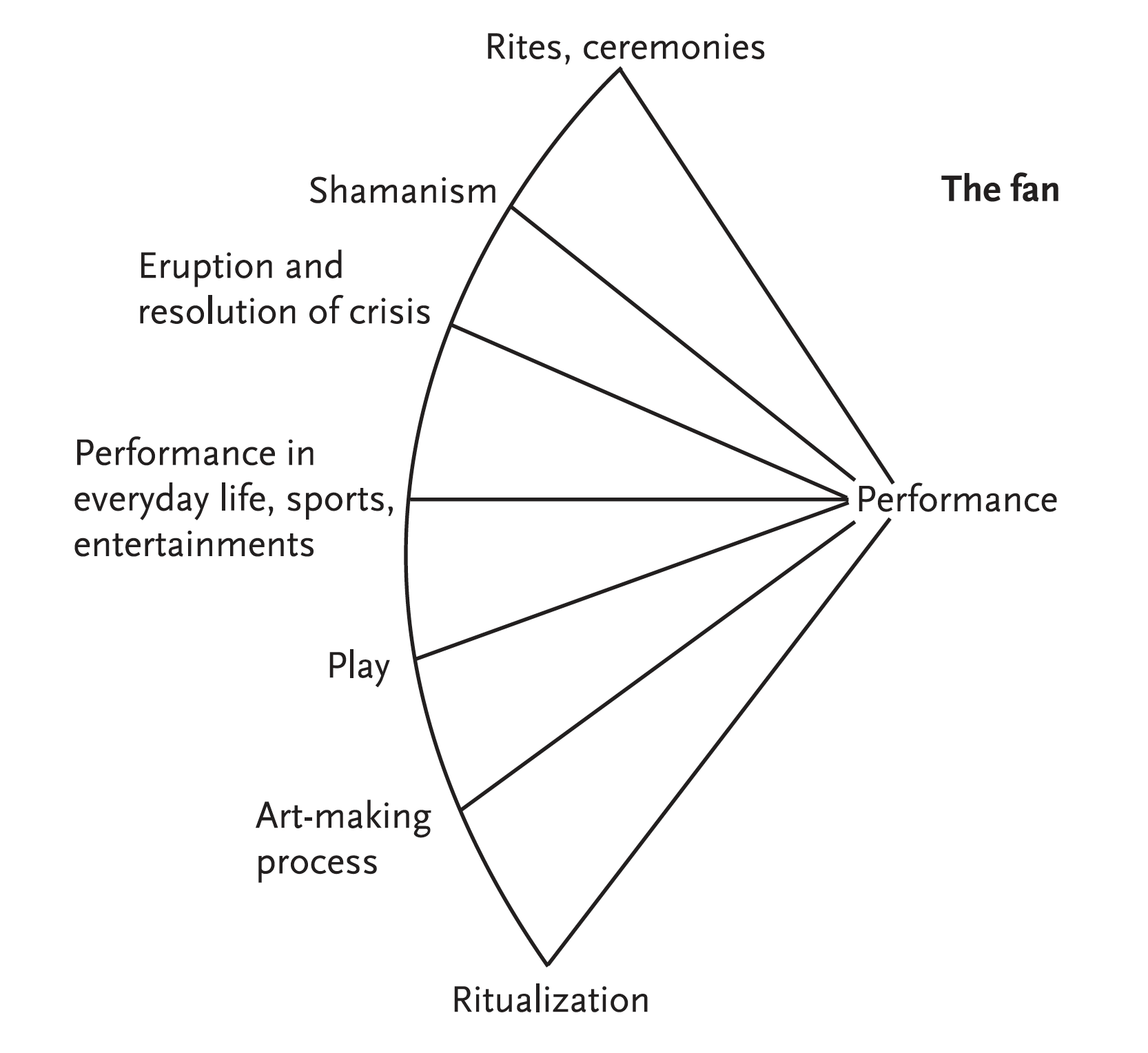
Richard Schechner conceives of the topics which relate to the term performance as a fan or as a web, as follows:

Performance1 Source: Richard Schechner, Performance Theory
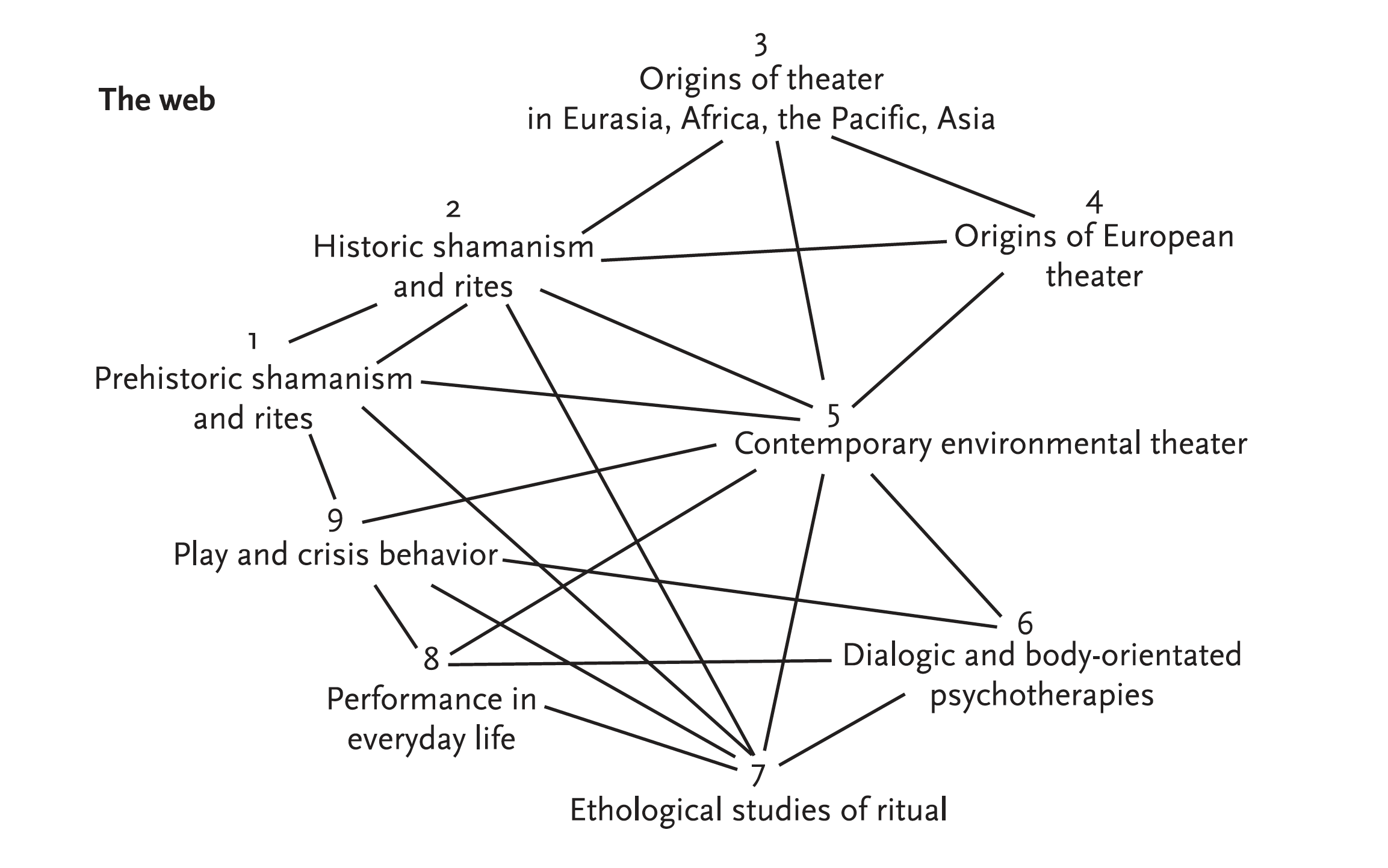
Performance2 Source: Richard Schechner, Performance Theory

References

Parker, A. and Sedgwick, E. K. (eds) (1995) Performativity and performance. New York, NY: Routledge.

Schechner, R. (2004) Performance theory. Rev & exp.ed. New York, NY: Routledge.

Passant

RELATED TERMS: Actant; Interpretant

The term passant is used to refer to a character in a narrative viewed from the perspective of the impressions registered on him or her, rather than from the perspective of the actions he or she performs. Rabinowitz (2005, 184) invented this term as a contrast to actant. Thus Rabinowitz states that his approach,

“makes us take the experiences of other characters more seriously on the level of the narrative audience. or, more accurately, it encourages us to take them seriously in a different way than the way promoted by classical narratology: specifically, if we take the notion of path (and experience) seriously, we might want to consider a narratology that included not only ‘actants’ but also ‘passants’ – those (especially including those beyond the narrator and his or her chosen focalizers) on whom impressions are registered.”

An analysis that takes ‘passants’ seriously may yield new perspectives from which to reflect on the story, Rabinowitz suggests.

Extended to the context of design practice, it refers to any entity upon which impressions are registered, leaving a trace that may itself subsequently have actantial potential. Actantiality would be rendered meaningless without passantiality, but they are not binary opposites. They weave round one another in an inter-actantial or inter-passantial cycle or as a kind of double helix of actantiality-passantiality, merging into one another responsively. Passantiality is, thus, a kind of potentiality. A passant is also a kind of interpretant, in the Peircean sense; or, perhaps, actantiality-passantiality defines the relationship named as interpretant.

Janet Rachel brings to attention a line of argument which suggests that, among the various ways of understanding actants and passants, there is a rather interesting connection with the body, and with gender, which tends to privilege acting over passing on phallocentric grounds. Thus she notes,

“Thomas Laqueur (1992) has reminded us that in the relatively recent past it was believed that women and men possessed essentially the same genitals. Where woman wore hers on the inside of her body, man had his on the outside. Ready to hand, as it were: the quintessential tool. And although modern anatomical thought maintains that the two kinds of genitals are now different, and not simply each other’s mirror image, we do still believe them to be respectively worn inside and outside the body. Freud (1925, 1937) has speculated on the potential significance of this anatomical difference for the human psyche, and in doing so, he has indicated the role of sight as arbiter: that which can be seen to move is treated as the superior and more prized variety.”

She proposes a passant-network theory as a means to comprehend the actantiality of the passant, rather than converting thr passant into an agent. We might suggest that actant and passant networks cannot exist one without the other.

References

Rabinowitz, Peter J (2005). They shoot tigers, don’t they?: path and counterpoint in The Long Goodbye In: A Companion to narrative theory, edited by J. Phelan and P. J. Rabinowitz. Oxford: Blackwell Publishing, 181-191.

Rachel, J. (1994) ‘Acting and passing, actants and passants, action and passion’, American Behavioral Scientist, 37(6), pp. 809–823. Available at: https://journals.sagepub.com/doi/abs/10.1177/0002764294037006007 (Accessed: 17 November 2018).

Participant

RELATED TERMS: Actant; Performance; Performativity

Participants are those taking an active part in a design interaction, understood as an event. The term participant is preferred to that of ‘user’ to avoid the more functionalist connotations of that term, and to suggest that a ‘visitor’ to an event is more engaged than a reader, spectator or audience member. They are more of a performer, partaking in a degree of scripted performance mixed with improvisation.

The notion of participation posits an active involvement of participants in the generation of the work, at a profound level, through interaction with, arrangement of, or even production of, its elements.

Theoretically, a participant is understood as an actant, one whose performativity contributes to the overall field of actantiality that as design, as event, constitutes.

Paradigm

RELATED TERMS: Performance and Performativity

Bowers (2014) considers that an onto-epistemological paradigm permits a unique world outlook which assumes distinctive approaches to shared universal concepts. Within a paradigm, points of view about the world’s constitution and its structure are compatible ontologically. Its values, concerns, conventions and assumptions, ‘truths’ and traditions of working in the world are also generally shared epistemologically.

The positivist, functionalist or structural-functionalist systems paradigm is the world of modern science and social science. It is a world of certainty, of logical proofs and deductions, reproducibly verifiable facts and hypotheses, exact measurements, objective observation, of unbiased and universal truths.

The interpretivist systems paradigm points out that each of us sees the world differently, subjectively, and each of us knows or understands it in their own way. This paradigm is concerned with and cares about reconciling issues of individuality and personal differences in a social world. It accepts that we disagree and are unpredictable. Reasoning is more often inductive and situated.

The postmodernist-poststructuralist systems paradigm acknowledges the limitations of human understanding. It appreciates a world of unfathomable depth and inter-active dimensionality; considers events which are sometimes fleetingly transient, spontaneous or non-rational; the true nature of the world thwarts our attempts to ‘know’ it. The world we do ‘know’ and the values we hold are socially constructed, it says, and they are relative. Reliant upon our constructions in human-language, ignorances and biases are unavoidable. We must, therefore, reflexively question the very bases of our assumptions. This paradigm exposes us to our limitations and can and should engender transparency, humility and open-mindedness.

The critical-emancipatory, or simply ‘critical’, systems paradigm can be characterized by its three commitments, or themes for debate: critical reflection; pluralism; and emancipation, or perhaps simply improvement. The critical systems thinking paradigm has liberated us from the one-size-fits-all, ‘hard’, positivist approach to everything for all occasions, or what from a larger perspective has been called imperialist or isolationist practices by Midgley (1992). The word ‘critical’ itself signifies an ethical commitment to critical reflexivity, that is, to self-critical, self-reflection and ideological critique (Gregory, 1992). To these ends, philosophy charges us with taking responsibility for our action or indeed inaction.

What is difficult to formulate is a logically coherent framework which can properly ground and inform multiparadigmatic, multimethodological approaches to practice. Design practices seek to be open to multiparadigmatic, multimethodological approaches to practice.

References

Bowers, T. D. (2014) ‘Developments in critical systems theory: on paradigms and incommensurability’, Proceedings of the 58th Meeting of ISSS, Washington DC, USA, July 2014. Available at: http://journals.isss.org/index.php/proceedings58th/article/viewFile/2251/754 (Accessed: 26 February 2016).

Gregory, Wendy J. (1992) Critical systems thinking and pluralism: a new constellation. [PhD thesis]. Systems Science department, City University, London.
Gregory,

Midgley, Gerald (1992) Pluralism and the legitimation of systems science. Systems Practice, 5(2), 147-172.

Ontology

RELATED TERMS: Computer Science; Epistemology; Information science; Methodology and Method; Ontological Designing; Ontological Metalepsis; Ontological Turn; Phenomenology; Philosophy; World-Building;


 “J. L. Austin once quipped that existence was ‘like breathing only quieter’.” (Garrett, 2006: xiv)

Ontology, Metaphysics, Philosophy … Design

Ontology is a much contested term. For example, it may be used to refer to an essential structure of reality. In that case, it is roughly a synonym for metaphysics, understood as the discourse that seeks to establish ultimate grounds and ends. It may also, however, refer to a particular form of analysis that affirms the idea that knowledge claims about the world are also interpretations of what sorts of entities there are to be known and, simultaneously, a certain ethical positioning of the subject of knowledge in relation to the world so interpreted (Nichols, 2014: 58).

Thus, ontology may refer to that which constitutes reality and/or the systematic study of that which constitutes reality. For Johanna Oksala (2012), it is politics that mediates between these two different senses of ontology. In this context, Oksala argues that the radicalness of Foucault’s method lies in showing how the ontological order of things is in itself the outcome of a political struggle. 

A similar point about the ambiguity inherent in the term ontology is made by Agamben (2016) when he states that it is well known that,

“in Indo-European languages the verb “to be” generally has a double meaning: the first meaning corresponds to a lexical function, which expresses the existence and reality of something (‘God is,’ that is, exists), while the second — the copula — has a purely logico-grammatical function and expresses the identity between two terms (‘God is good’).”

(Agamben, 2016: 117-118)

What is being argued here is that design practices, as material practices, mediate between these two different senses of ontology, just as much as do political practices, as highlighted by Oksala. One way of saying this might be to argue that
designs, of whatever level of complexity from artefacts to infrastructural and digital systems, are responses to ontological questions about what is the case in terms of how questions about what is known to be the case, what ought to be the case and what might be the case are articulated or entangled.

Ontological inquiry is, therefore, of crucial importance for design as professional practice, as academic discipline, as element of communal social practice and as material public discourse, whether as part of public pedagogy or public governance. In as far as designed outputs, in whatever form, take part in the constitution, the interpretation and the evaluation of reality, they are, at once, ontological, epistemological, axiological, historical and speculative in character: they assert their own existence as ‘what there is’; semiotically, they ‘speak’, ‘articulate’ or ‘argue’ for a particular understanding of the real.  ‘To design’, as material-semiotic construction, articulation and argument, may be understood as analogous to ‘to say’. Thus, in some way, designing, saying, becoming and being become indistinct. The basis for the analogy is to be found in Agamben who explains,

Legein, ‘to say,’ means in Greek ‘to gather and articulate beings by means of words’: onto-logy. But in this way, the distinction between saying and being remains uninterrogated, and it is the opacity of their relation that will be transmitted by Aristotle to Western philosophy …”

(Agamben, 2016: 117)

Thus, inheriting this ambiguity, designs may be said to gather together and articulate beings by means of ‘signs’, not necessarily but also including words. That is the character of their action, their actantiality: they have a lexical function (concerning existence and existents); they have a logico-grammatical function (establishing identities, equivalences); they have an axiological function (concerning what ought to be the case); and they have an epistemological function (reinforcing or questioning what is known to be the case). All of these are woven into their presupposed utilitarian function, their use-value.

If the end of metaphysics is understood as referring to the acceptance of the indeterminacy of reason and the fundamental contingency and singularity of the present, it must, as Derrida never tires of demonstrating, also involve a paradox. To argue for the contingency and indeterminacy of the present, Oksala points out, is precisely to make an ontological claim, which entails a metaphysical commitment and serves as an unquestioned starting point of philosophical inquiry. When we argue against one metaphysical schema, for example, the existence of absolute foundations and pure origins, we cannot help but adopt another. The idea that all ontological orders are nothing but contingent arrangements cannot be established by empirical sciences, but must be argued for philosophically. 

If modern thought has become irreversibly aware that all thinking necessarily relies on ontological commitments of some kind, and exposing them to a clear view has become one of the critical tasks of philosophy, including political philosophy, as Oksala maintains, then it is also a critical task of design, as mode of practice, discipline, pedagogy and governance, if it comes at the, ever paradoxical, end of metaphysics and philosophy.

Ontology, Metaphysics, Philosophy #2

In philosophy, ontology is the inquiry into, or theory of, being. It was coined in the early 17th century in order to avoid some of the ambiguities of the term ‘metaphysics’. It has come to mean the general theory of what there is, of what exists. As the study of being, ontology includes, at the very least, the study of what is, or what exists, including the study of the nature of specific existents; and the study of how existents exist.

In outlining his position on ontology, Levi Bryant (2012), for example, states that,

“As a discourse, ontology seeks to articulate the most general and fundamental nature of being or of what is and what is not.  Ontology and being are not the same.  Being consists of what is regardless of whether there is any discourse about it.  Ontology is a discourse about what is.  This distinction is important because ontologies, as discourses about the being of beings, can be mistaken.  There is no discourse that doesn’t presuppose an ontology or metaphysics (I use the two terms as synonyms).” 

Tony Lawson (2015) notes that the term ‘ontologia’ appears to have been coined in 1613 by two philosophers working independently of each other, Jacob Lorhard, in Theatrum Philosophicum and Rudolf Göckel in Lexicon Philosophicum. According to Øhrstrøm, Andersen and Schärfe (2005), this is incorrect. The term, they note, had already occurred in Jacob Lorhard’s book Ogdoas scholastica from 1606, where the word ‘ontologia’ appears on the frontispiece, used synonymously with “metaphysica”. In its English form, the first occurrence of ontology seems to be in Bailey’s 1721 Dictionary, where it is defined as ‘an account of being in the abstract’. Thus, ontology as the science or study of being should be distinguished from both epistemology, which is a concern with knowledge, and methodology proper, a concern with method.

Ontology in Philosophy and Computer Science

This usage of the term should not be confused with that in computer science and information science where an ontology is a representation of a set of concepts within a domain and the relationships between those concepts. It is used to reason about the properties of that domain and may be used to define the domain. As Øhrstrøm, Andersen and Schärfe (2005) state, “Where philosophical ontology has been concerned with the furniture and entities of reality, i.e., with the study of “being qua being”, computer scientists have been occupied with the development of formalized, semantic, and logic-based models, which can easily be implemented in computer systems.”

Discussion

Across a range of academic disciplines, researchers have made what is sometimes termed an ‘ontological turn’. This reflects a change of emphasis away from the epistemological and discursive (or, indeed, ‘representational’ or ‘mimetologogical’) approaches dominant in the 20th century towards a greater emphasis, emerging towards the end of the 20th century, upon the entanglement of epistemology and ontology in material social practices.

Examples include the work of Descola (2013, 2005) and Latour (1988), who have emerged as path-breakers in the ontological turn, having developed the two most formidable and productive approaches to an ontological anthropology (Kelly, 2014). A further example can be seen in the work of Dell’Alba in the field of education in which, in her conceptualisation of learning, there is a shift in focus from epistemology in itself to epistemology in the service of ontology (Dall’Alba and Barnacle, 2007).

Such a body of literature concerning the relationship between epistemology and ontology has considerable relevance to design practices. In the processes of designing, the designer will make various assumptions about what exists in the world and what can be considered to be real. In doing this, the designer is making certain ontological assumptions and perhaps challenging them by considering the conditions in which such entities, existents and realities emerge and are sustained.

As noted above, historically ontology is the branch of philosophy and of metaphysics that is concerned to establish the nature of the fundamental kinds of thing which exist in the world or the “nature of being”, what the world is and consists of. Examples of philosophical ontological theory include Plato’s theory of ‘forms’ and, more recently, scientific realism, which asks what kinds of thing are presupposed by scientific theories.

However, while philosophy can inform discussions in different disciplines, it is no longer regarded as the kind of final arbiter it was once assumed to be. Ontologies will change as knowledge and individual sciences and modes of study change. In sociological theory, for example, much of the debate since Comte has been broadly ontological in nature. This debate has done much to clarify the nature, while also underlining the very complexity, of social reality.

Furthermore, ontological arguments are an explicit or implicit feature of particular kinds of disciplinary theory, such as in sociological theory with Durkheim’s conception of ‘social acts’, the emphasis on individual actors in Weber and the symbolic interactionism and Marx’s emphasis on materialism and modes and relations of production.

Ontology has to do with the assumptions different social groups make about the kinds of entities taken to exist ‘in the real world.’ This definition does not entail a strong realist position, i.e. concerning a common or universal underlying reality. However, this does not mean the ‘the mind’ constructs the world. It is not a kind of subjectivism. What this definition seeks to bring to attention is the existence of multiple worlds without negating the real. Our ontological stances about what the world is, what we are, and how we come to know the world define our being, our doing, and our knowing, our historicity.

A complex definition of ontology that draws out these dimensions is provided by Blaser (2010), who proposes three-layers. The first layer concerns the assumptions about the kinds of beings that exist and their conditions of existence. The second layer refers to ways in which these ontologies give rise to particular socio-natural configurations, how they perform themselves, so to speak, into worlds. In other words, ontologies do not precede or exist independently of our everyday practices. The third layer occurs when ontologies manifest themselves as stories, which make the underlying assumptions easier to identify. This layer is amply corroborated by the ethnographic literature on myths and rituals, for example, creation myths. It also exists in the modern world, in the narratives that we, ‘moderns’, tell ourselves about ourselves, and which are repeated over and over by politicians in their speeches, or in the insistent news renditions of ‘what happens in the world.’

In an introduction to Heidegger’s The Basic Problems of Phenomenology, Albert Hofstadter (1988) argues that human behaviour is mediated by the understanding-of-being. If ontological means of or belonging to the understanding of being, then the human Dasein is, by its very constitution, an ontological being. This does not mean that the human being has an explicit concept of being, which s/he then applies in every encounter with beings. Rather, it means that before all ontology, as explicit discipline of thinking, the human Dasein always already encounters beings in terms of a pre-ontological, pre-conceptual, non-conceptual grasp of their being. Ontology as a scientific discipline is then the unfolding, in the light proper to thought and therefore in conceptual form, of this pre-conceptual understanding-of- being (Willis, 2006 96, n9).

The relevance of ontology, given this layered complexity, for design practices can be made very clear. Its relevance is strengthened by the fact that designers use material elements to articulate meaning, further complicating the relationships between the epistemological and ontological premises and presumptions embodied in and performed by such material entities. In this context, metalepsis may be understood as transgressions across different modes of existence conceived as a tangled hierarchy. This relevance is further established when one considers relational ontologies and ontological design.

Relational ontologies

A relational ontology proposes that nothing pre-exists the relations that constitute it. In such ontologies, life is inter-relation and inter-dependency through and through. Buddhism, through the principle of inter being, has one of the most succinct and powerful notions in this regard: nothing exists by itself, everything inter-exists, we inter-are with everything on the planet. A different perspective on this is provided by phenomenological biology through the notion that there is an “unbroken coincidence of our being, our doing, and our knowing” (Maturana and Varela, 1987: 35). Maturana and Varela (1987: 26) express this recognition aphoristically as follows: “All doing is knowing, and all knowing is doing”; and “every act of knowing brings forth a world”. The coincidence of saying and being, as noted by Agamben above, as well as the coincidence of doing and knowing, as noted by Maturana and Varela, implies that we are deeply interactively immersed in the world along with other sentient beings.

Relational ontologies are those which eschew the divisions between nature and culture, between individual and community and between us and them that are central to modern ontology. The emergence of relational ontologies challenges the epistemic foundation of modern politics. The political activation of relational ontologies enables a different way of imagining life and other modes of existence, pointing towards the pluriverse, which can be described as ‘a world where many worlds fit’ (Cadena and Blaser, eds, 2018). In many such mobilisations, for example, against mining in South America, the activation of relational ontologies politicise modern binaries by mobilising non-humans, for example, mountains and water, as sentient entities and as actors [actants] in the political arena. Struggles against the destruction of life are thus conjuring up the entire range of the living.

Ontological designing

A concept of ontological designing was Initially proposed by Winograd and Flores (1986) in the mid 1980s. The most important design, they suggest is ontological, as it constitutes an intervention into the ground of our heritage, growing from already-existent ways of being in the world, that into which we are ‘thrown’, and deeply affecting the kinds of beings that we are.

Ontologically-oriented designing, they continue, is therefore both reflective and political: it looks back to the traditions that have formed us; and forwards to the as-yet-uncreated transformations of our lives together. Through the emergence of new tools and environments, we come to a changing awareness of human nature and human action. In turn, this leads to new technological development. The design process is part of this movement through which the structure of possibilities for current and future worlds are generated. Thus, Winograd and Flores (1986: 179) argue,

“In ontological designing, we are doing more than asking what can be built. We are engaging in a philosophical discourse about the self – about what we can do and what can be. Tools are fundamental to action, and through our actions we generate the world. The transformation we are concerned with is not a technical one, but a continuing evolution of how we understand our surroundings and ourselves – of how we continue becoming the beings we are.”

However, Escobar suggests that ontological designing remains relatively undeveloped so far. Ontological designing, for Escobar, is one possibility for contributing to the transition from the hegemony of modernity’s One-World ontology to a pluriverse of socio-natural configurations. In this context, designs for the pluriverse become a tool for reimagining and reconstructing sustainable worlds.

Taken as the interaction between understanding and creation, designing is ontological in that it is a conversation about possibilities. It is about the making of worlds and knowledges otherwise, that is, worlds and knowledges constructed on the basis of different ontological commitments, likely to yield collective ways of living less marked by modernist forms of domination. This brings to attention more explicitly the politics of design.

References

Agamben, G. (2016) The Use of bodies. Translated by A. Kotsko. Stanford, CA: Stanford University Press.

Blaser, Mario. 2010. Storytelling: globalization from the Chaco and beyond. Durham: Duke University Press.

Bryant, Levi R (2012). On ontology. Larval Subjects. Available at https://larvalsubjects.wordpress.com/2012/09/15/on-ontology/ [accessed 18 August 2024]

Cadena, M. de la and Blaser, M. (eds) (2018) A World of many worlds. Durham, NC: Duke University Press.

Dall’Alba, G. and Barnacle, R. (2007). An ontological turn for higher education. Studies in Higher Education, 32 (6), 679–691. Available from http://www.tandfonline.com/doi/abs/10.1080/03075070701685130 [Accessed 25 November 2013].

Descola, P. (2013, 2005). Beyond nature and and culture, translated by Janet Lloyd. Chicago, IL: University of Chicago Press.

Escobar, A. (2013). Notes on the ontology of design [Draft paper]. Available from http://sawyerseminar.ucdavis.edu/files/2012/12/ESCOBAR_Notes-on-the-Ontology-of-Design-Parts-I-II-_-III.pdf [Accessed 4 September 2016].

Garrett, B. (2006) What is this thing called metaphysics? Abingdon, UK: Routledge.

Hofstadter, A. (1988) Translator’s introduction, in The Basic problems of phenomenology by Martin Heidegger. Rev. ed.. Bloomington, IN: Indiana University Press, pp. xv–xxxi.

Jary, D. and Jary, J. (2000). Collins dictionary [of] sociology, 3rd ed. Glasgow, Scotland: HarperCollins.

Kelly, J.D. (2014). Introduction: The ontological turn in French philosophical anthropology. HAU: Journal of Ethnographic Theory, 4 (1), 259–269. Available from http://haujournal.org/index.php/hau/article/view/hau4.1.011 [Accessed 23 April 2016].

Latour, B. (1988). The Pasteurization of France. Cambridge, MA: Harvard University Press.

Lawson, T. (2015) ‘A conception of social ontology’, in Pratten, S. (ed.) Social Ontology and Modern Economics. London, UK: Routledge, pp. 19–52.

Maturana, H.and Varela, F. (1987). The Tree of knowledge: the biological roots of human understanding. Berkeley: Shambhala.

Nichols, R. (2014) World of freedom: Heidegger, Foucault and the politics of historical ontology. Stanford, CA: Stanford University Press.

Øhrstrøm, P., Andersen, J. and Schärfe, H. (2005) What has happened to ontology, in Dau, F., Mugnier, M.-L., and Stumme, G. (eds) International Conference on Conceptual Structures 2005: Conceptual structures: Common Semantics for Sharing Knowledge, pp. 425–438. doi: 10.1007/11524564_29.

Oksala, J. (2012) Foucault, politics and violence. Evanston, IL: Northwestern University Press.

Willis, A.-M. (2006). Ontological designing – laying the ground. In: Willis, A.-M., ed. Design Philosophy Papers, Collection Three. Ravensbourne, Queensland: Team D/E/S Publications, 80–98. Available from https://www.academia.edu/888457/Ontological_designing [Accessed 14 September 2016].

Winograd, Terry, and Fernando Flores (1986). Understanding Computers and Cognition. Norwood, NJ: Ablex Publishing Corporation

Ontological Structure of Literary Fiction

RELATED TERMS: Actantiality; Affordances; Metalepsis;

As noted in the entry for Metalepsis, in the context of literary fiction, the simplest ontological structure has three levels:

  • the level of the story (the diegesis), at which the characters exist;
  • the level of the narration (the extradiegesis), at which the narrator exists, for example, through third-person narration; and
  • the level of the real, at which the reader and author exist.

In contrast to the reality of the world in which the book is authored and read, the diegesis and the extradiegesis are both fictional.

While constructed as a hierachy, even within literary narratives the relationships among these levels may be complicated. For example, in narrative autobiographies the author, the narrator and the main character coincide.

The ontological structure of designs is considerably more complicated than a simple hierarchy. The best image for the ontological structure of a design is that of a tangled hierarchy, with the participant entangled in its field of actantiality-affordances from which there is no simple ‘escape’.

References

Macrae, A. (2019) Discourse deixis in metafiction: the language of metanarration, metalepsis and disnarration. New York, NY: Routledge.

Monteagudo, J. G. (2011) Jerome Bruner and the challenges of the narrative turn. Narrative Inquiry, 21(2), pp. 295–302. doi: 10.1075/ni.21.2.07gon

Ontological Metalepsis

RELATED TERMS: Avant-garde movementsDeixis and Deictic Acts; Lifeworld – Lebenswelt – Umwelt; Metalepsis; Storyworld; Tangled Hierarchy and Strange Loop

The notion of ontological metalepsis is particularly important for design practices as it emphasises that meaning is generated through the engagement of the sensorimotor, experiential, existential, moving body with the designed objects, services and environments. Metalepsis, rather than being simply part of media theory concerning the transgression of levels of narration, i.e. intra-diegetic transfers across story levels and extra-diegetic incursions into the diegetic (where, for example, the narrator, as teller of the story, becomes a character in the world of the story), instead concerns the transgressions that occur across the diegetic and the real, i.e. the level of the author and the reader. The transgressions here generate confusions among what were held to be distinct levels: narratee (intra-diegetic); narrator (extra-diegetic); and author (real).

The former kind of transgression, concerning the intra- and the extra-diegetic and which relate to crossing from one narrative level to another, might be called ‘fictional metalepsis’, while the latter, concering transgressions from one ontological level to another, whether these be ‘fictional’ ontologies or ‘real’ ontologies, might be called ontological metalepsis.

Ontological metalepsis places the body within complex environments and brings to attention the various ways in which ontological metalepses can be achieved experientially and different worlds brought into play, conjunctively or disjunctively. In the design of narrative environments, the body is not considered ‘invisible’ or ‘irrelevant’ to the multisensory, aesthetic experience.

Taking into account ontological metalepsis therefore extends narrative beyond a transmedia context, i.e. narrative across print, electronic, cinematic, theatrical, art installation and other media of presentation, into an existential domain, not just narratological storyworlds but also lifeworlds, from whence an appreciation of the aleatory (chance), the ergodic (work, labour) and the rhizomatic (creative, inaugurative) elements of meaning-generation in lifeworlds come into play.

While narrative is an important part of lifeworlds, lifeworlds are not reducible to narrative structures, and ontological metalepsis concerns these always-shifting boundaries, as lifeworlds become narrativised, ritualised or conventionalised; and as narratives, rituals and conventions are critiqued. There is not, in other words, a single relationship between the diegetic storyworld and the lifeworld (‘actual’ world), but a continual interplay of borders and boundaries among storyworlds and lifeworlds.

In consequence, the immersion in narrative structures and processes in narrative environments involves a continual breaking of intra-diegetic and extra-diegetic borders and boundaries, to extend narrative into the lifeworld/’actual’ world; and to bring to awareness of the degree to which embodied experience is, has become or is becoming narrativised.

The concept of ontological metalepsis, as Ryan and Bell and Alber, indicate comes from a development of Gerard Genette’s narratological model.

For example, Bell and Alber propose a modification of Gerard Genette’s structuralist model to conceptualize ontological metaleptic jumps as:

(1) vertical interactions either between the actual world and a storyworld or between nested or hierarchised storyworlds; or as

(2) horizontal transmigrations between storyworlds.

They explain vertical and horizontal metalepses on the basis of interactions between ontologically distinct worlds rather than narrative levels; and suggest that the manoeuvres of ontological metalepses in particular suggest a breach of world boundaries.

Terminology that demarcates those domains of existence as ‘worlds’ rather than ‘levels’, Bell and Alber argue, more accurately reflects what we are led to believe happens in the course of ontological metalepses.

For discussion: Ontolepsis

The distinction that Raine Koskimaa (2000) makes between ‘narrative metalepsis’ and ‘ontolepsis’, of which the former is a special case of the latter, is of relevance here. Both concern transgressions or ‘leaking’ of ontological boundaries. However, they still only concern transgressions from one possible fictional world to another. They do not concern transgressions from the possible fictional worlds to actual experiential worlds.

Narrative metalepsis concerns transgressions of fictional ontological boundaries. The innovation central for the development of fictional ontology is the notion, grounded in possible worlds semantics, that a fictive text is not a “world”. Rather it is a fictional universe, a structure of multiple alternate worlds.

The conventions of realistic fiction define each fictional universe as having a centre, the textual actual world, around which a number of other worlds orbit, the textual alternative possible worlds, as well as the textual referential world, of which the textual actual world is a representation. The textual referential world, Koskimaa notes, can be more or less similar to our own actual world. However, for analytical reasons, they must always be separated

Three kinds of worlds together constitute a fictional universe, the domain of fictional ontology; the textual actual world; the textual alternative possible worlds; and the textual referential world. Crucially, Koskimaa clarifies that, “the levels of narrative embedding always constitute an ontological domain, but the border between fictional worlds does not necessarily imply a change of narrative level.” The complications hypertextual structure causes for ontology are more complex. The complications caused for ontology by the design of narrative environments are still more complex.

Koskimaa argues that,

“Ontolepsis in print fiction is a violation of narrative conventions. In postmodernist fiction it is used as a metafictional device to foreground ontological questions. In science fiction and fantasy it is presented as a feature of the foreign world. In hypertext fiction ontolepsis is an integral, unavoidable part of the representational logic.”

Equally, it could be argued, ontolepsis is an integral part of the representational logic of narrative environments. We may be dealing with metalepsis (transgressions across narrative levels), ontolepsis (transgressions across possible fictional worlds) and ontological metalepsis (transgressions across possible fictional worlds and actual experiential, social worlds).

References

Bell, A. and Alber, J. (2012). Ontological metalepsis and unnatural narratology. Journal of Narrative Theory, 42 (2), 166–192. Available from http://muse.jhu.edu/journals/jnt/summary/v042/42.2.bell.html [Accessed 18 March 2016].

Genette, G. (1980). Voice. Chapter 5 in: Narrative discourse: an essay in method. Ithaca, NY: Cornell University Press, pp.212-262. Available from https://ia801600.us.archive.org/12/items/NarrativeDiscourseAnEssayInMethod/NarrativeDiscourse-AnEssayInMethod.pdf [Accessed 27 November 2015].

Koskimaa, R. (2000) Ontolepsis – from violation to a central device. Digital literature: from text to hypertext and beyond. Available at: http://users.jyu.fi/~koskimaa/thesis/chapter4.htm#mark1 [Accessed: 17 March 2021]

Ryan, M.-L. (2006). Metaleptic machines. In: Avatars of story. Minneapolis, MN: University of Minnesota Press, 204–230.