Antonin Artaud, 1896-1948, wrote the extraordinary theoretical book, Le Théâtre et son double (The Theatre and Its Double) in 1938. Influenced by Balinese dancers he saw in Paris in the early 1930s, Artaud imagined a Western theatre that would neglect realism and narrative for kinetic images, rituals and even magic. The sheer physicality of Artaud’s theatre is exceptional. The mise-en-scene is not mere staging. It becomes an attack on the spectator’s senses: language is for screaming rather than for dialogue; traditional musical instruments are replaced by new alloys of metals to produce intolerable, ear-shattering sounds or noises. Such theatre surrounds the audience, enticing it to participate. It was a theatre not of estrangement but of derangement. His theatre of cruelty aims not to stage cultural masterpieces but to make the audience experience its flesh in the form of fear, delirium, and extremes of sensation.
The influence of Georges Bataille can be seen in Artaud when he writes in one of his manifestos:
“The theater cannot become itself again . . . until it provides the spectator with the truthful precipitates of dreams, in which his taste for crime, his erotic obsessions, his savagery, his fantasies, his Utopian sense of life and of things, even his cannibalism, pour out on a level that is not counterfeit and illusory but internal”
(Artaud, 1958: 92)
The theatre of cruelty anticipates in some ways the more radical performances of Peter Brook, the Living Theater, Happenings and performance art. Although Artaud aspired to create consequential avant-garde art, he was never able to put his theory of the theatre into practice and it is as a theorist that he is mostly remembered.
References
Artaud, A. (1958). The Theatre and Its Double, translated by M.C. Richards. NY: Grove.
Kostelanetz, R. (1993). A Dictionary of the avant-gardes. Pennington, NJ: a capella books.
Bruns, G.L. (2007). Becoming-animal (some simple ways). New Literary History, 38 (4), 703–720. Available from http://www.jstor.org/stable/20058035 [Accessed 18 July 2019].
“What is the real thing? The question is an ideal subject for the stage, where the actual and the illusory constantly shadowbox.” (Clapp, 2024)
The ‘as if’ and the ‘what if’ at the heart of theatre, drama and narrative are all important notions for design practices and the reception of designs as elements of everyday practices and material public discourse.
Keir Elam (1980) makes a distinction between ‘theatre’ and ‘drama’. He takes ‘theatre’ to refer here to the complex of phenomena associated with the performer-audience transaction, with the production and communication of meaning in the performance itself and with the systems underlying it. By ‘drama’, on the other hand, he means that mode of fiction designed for stage representation and constructed according to particular ‘dramatic’ conventions. The epithet ‘theatrical’, then, is limited to what takes place between and among performers and spectators, while the epithet ‘dramatic’ indicates the network of factors relating to the represented fiction.
Both ‘theatre’, in the context of environment-people interactions, and ‘drama’, in the context of narrative-people interactions, are relevant for design practices. The distinction between ‘theatre’ and ‘drama’ highlights the difference in levels of deictic act involved in theatre, and thus the different levels of deixis in the designed entity, Brandt (2016) frames the distinction between theatre and drama in terms of cascades of deixis.
The name of the architectural practice, Terreform, was derived from the combination of “terre”, meaning earth or soil, and “reform”, meaning to rebuild, reconstruct or recreate. The founders sought to differentiate their practice from that of “terraforming”. In planetary engineering, terraforming is a process of transforming an alien atmosphere to create a habitable living environment for humans. Instead of contriving to copy of the Earth’s atmosphere elsewhere, as the notion of “terraform” commonly implies, Terreform seeks to reform the planet Earth in place. Their intention is, “to repair the atmosphere of our world by fostering designs that reform the current pollution causing global trends.”
As their website explains, Terreform ONE [Open Network Ecology] is a nonprofit art, architecture and urban design research group who seek to combat the extinction of all planetary species through pioneering acts of design: design against extinction. It was co-founded in May 2006 by Mitchell Joachim, Maria Aiolova and others. Their projects aim to explore the environmental possibilities of habitats, cities and landscapes across the globe.
Similarly, Benjamin Bratton (2019) in The Terraforming, a short polemical book that serves as the basis for an urban design research programme at the Strelka Institute in Moscow, also notes that “terraforming” is usually taken to refer to the re-shaping of the ecosystems of other planets or moons in order to make them capable of supporting Earth-like life. However, he suggests, the ecological consequences of the Anthropocene mean that, in the coming decades, we will need to terraform the planet Earth itself, that is, if it is to remain a viable host for its own life.
Discussion
The planetary, the global and the world, particularly the concern for ‘our world’, may need to be distinguished from one another as terms that refer to some sort of autopoietic ‘whole’, one in which the governance of ‘our world’ is part and parcel. These distinctions, in turn, may need to be considered in relation to the discussion about the differences between (neoliberal) globalisation and alternative forms of ‘mondialisation’, to cite a term used by Jean-Luc Nancy and Jacques Derrida among others, or ‘new world order’, to cite a term from the early 1990s that has been reborn.
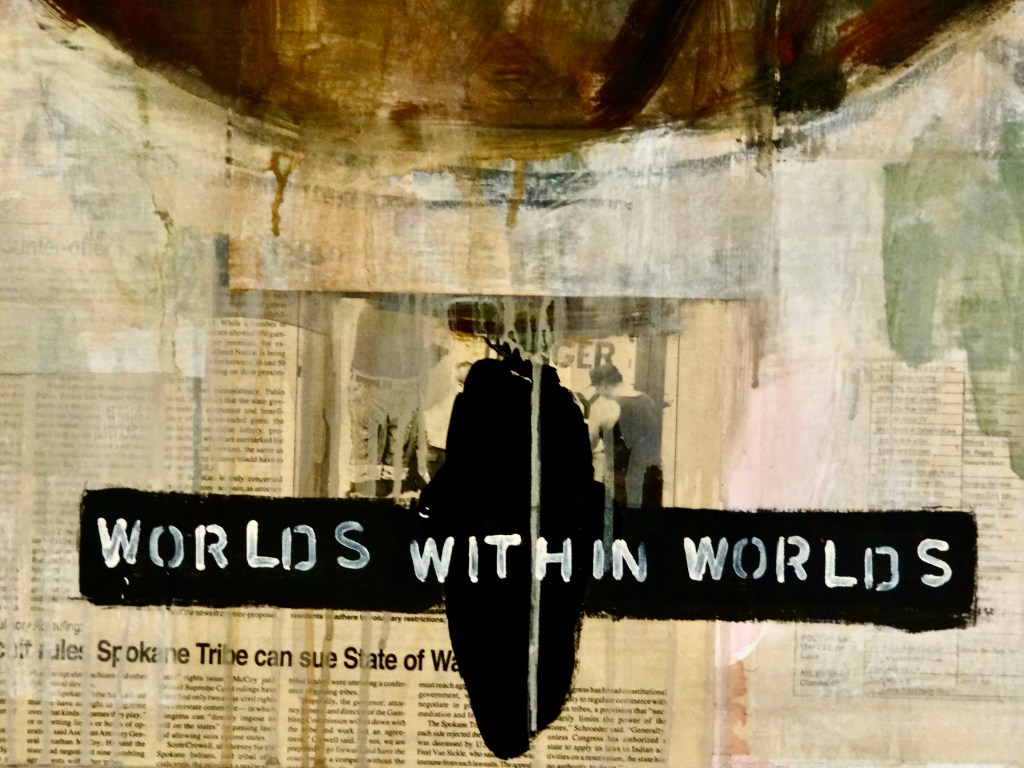
The ‘project’, if such it can be called, is ecological and political at once. This brings into play a consideration of what differences there are between an ‘order’, a ‘natural’ order or an ‘order of things’, both inadequate phrases, and a ‘mode of governance’, particularly whether an ‘order’ can be maintained or sustained through ‘governance’. Governance itself brings into play such notions as hierarchy, heterarchy, anarchy and hegemony; and especially the difficulty of understanding how all four exist at once in the contemporary ‘world’, or rather the contemporary worlds: world of worlds and worlds within worlds as pluriverse. The question of actual and possible worlds appears as a supplement.
References
Bratton, B. (2019) The Terraforming. Moscow, RU: Strelka Institute
“In short, the very manifesto of structuralism must be sought in the famous formula, eminently poetic and theatrical: to think is to cast a throw of the dice [penser, c’est e’mettre un coup de des].”
Deleuze, G. (2004) ‘How do we recognise structuralism?’, in McMahon, M. and Stivale, C. (trans.) Desert Islands and Other Texts 1953–74. Los Angeles, CA: Semiotexte, pp. 170–192.
It is important to grasp the importance of structuralism for design practices, not so much for what it is itself but for its relation to narratology and to other cultural practices, as well as for the thinking that developed, more or less simultaneously, under the heading of poststructuralism.
French structuralism was inaugurated in the 1950s by the cultural anthropologist Claude Lévi-Strauss, who analysed, using Saussure’s linguistic model, such cultural phenomena as mythology, kinship relations, and food preparation. In its early form, in the 1950s and 1960s, structuralism cut across the traditional disciplinary boundaries of the humanities and social sciences by claiming to provide an objective account of all social and cultural practices. It views cultural practices as combinations of signs that have a set significance, perhaps, more clearly, a dominant interpretation, for the members of a particular culture. It undertakes to make explicit the rules and procedures by which the practices have achieved their cultural significance. In addition, it seeks to specify what that significance is, by reference to an underlying system of the relationships among signifying elements and their rules of combination (Abrams, 1999: 300).
The structuralist impulse was little understood in Anglo-Saxon and Anglo-American academic cultures, where structure was considered as the complement to function within a structural-functionalist paradigm. Hence structure was seen as an element in the functionalism that dominated and continues to dominate those cultures. This is particularly the case in design practices because, as Burkhardt (1988: 146) notes, “The birth of design is bound up with the birth of functionalism.”
The importance of structuralism, however, is not as a form of reductionism, i.e. the notion that all appearances or surface structures can be reduced to a few structural elements, but rather as a form of relational thinking. As such, structuralism serves, on the one hand, as a critique of positivism i.e. a critique of the view that the world consists of fully-formed entities with predefined properties. On the other hand, it serves as a critique of functionalism, i.e. a critique of the view that an act is originary and is a simple cause which gives rise to a simple effect.
Structuralism opens up thought to the potential of network ontologies, that is, non-positivistic modes of existence, and network ‘causalities’, that is, forms of non-originary, co-implicated inter-action.
Structuralism, the Death of God and Post-Humanism
Deleuze (2004: 175) notes that one consequence of the structuralist emphasis on symbolic elements that primarily do not have extrinsic designation nor intrinsic signification but rather a positional, relational sense,
“is that structuralism is inseparable from a new materialism, a new atheism, a new anti-humanism. For if the place is primary in relation to whatever occupies it, it certainly will not do to replace God with man in order to change the structure. And if this place is the dummy-hand [la place du mort, i.e. the dead man’s place], the death of God surely means the death of man as well, in favor, we hope, of something yet to come, but which could only come within the structure and through its mutation.”
(Deleuze, 2004: 175)
Three types of relation can be distinguished, Deleuze (2004: 176) explains, real, imaginary and symbolic, of which it is the third which is of key significance for structuralism. The first type is established between elements which enjoy independence or autonomy. He gives the examples of 3 + 2 or 2/3. The elements are real and such relations must themselves be said to be real. The second type of relationship is established between terms for which the value is not specified but which, in each case, must have a determined value. He gives the example of x2 + y2 – R2 = 0. Such relations can be called imaginary. The third type is established between elements which have no determined value themselves, and which nevertheless determine each other reciprocally in the relation. His example is ydy + xdx = 0, or dy-/ dx = – x/y. Such relationships are symbolic, and the corresponding elements are held in a differential relationship: dy is totally undetermined in relation to y, and dx is totally undetermined in relation to x. Each one has neither existence, value, nor signification. Yet the relation dy/dx is totally determined. The two elements determine each other reciprocally in the relation. This process of a reciprocal determination is at the heart of a relationship that allows one to define the symbolic nature.
Deleuze (2004: 177) continues: Corresponding to the determination of differential relations are singularities. These are distributions of singular points which characterise curves or figures. For example, a triangle has three singular points. Thus, Deleuze argues, the notion of singularity becomes crucial. Taken literally, it seems to belong to all domains in which there is structure. The general formula which serves as a manifesto for structuralism, i.e. that “to think is to cast a throw of the dice,” itself refers to the singularities represented by the sharply outlined points on the dice. Every structure, then presents two aspects: a system of differential relations according to which the symbolic elements determine themselves reciprocally; and a system of singularities corresponding to these relations and tracing the space of the structure. Every structure, Deleuze concludes, is a multiplicity.
Significant for the understanding of the role of designed objects, artefacts and other design interventions, Deleuze explains that, “Symbolic elements are incarnated in the real beings and objects of the domain considered; the differential relations are actualized in real relations between these beings; the singularities are so many places in the structure, which distributes the imaginary attitudes or roles of the beings or objects that come to occupy them.”
In a certain sense, then, structures are not actual. What is actual is that in which the structure is incarnated or rather what the structure constitutes when it is incarnated. However, in itself, a structure is neither actual nor fictional, neither real nor possible (Deleuze, 2004: 178). Deleuze suggests that the word virtuality might designate the mode of the structure or the object of theory. However, he cautions that this would have to be on the condition that we eliminate any vagueness about virtuality. The virtual has a reality which is proper to it, but which does not merge with any actual reality, any present or past actuality. It could be said of structure that it is real without being actual, ideal without being abstract, a sort of ideal reservoir or repertoire, in which everything coexists virtually, but where the actualisation is necessarily carried out according to exclusive rules, always implicating partial combinations and unconscious choices.
Structuralism and narratology
The word ‘narratology’ was first used by the Franco-Bulgarian philosopher Tzvetan Todorov and has since made remarkable progress due to the works of such narratologists as Claude Bremond, A. J. Greimas, Roland Barthes, and Gerard Genette. It derived from Vladimir Propp’s study of Russian forktales and the structuralism of Claude Lévi-Strauss, who had re-evaluated the Russian formalism of the 1910s to the 1930s.
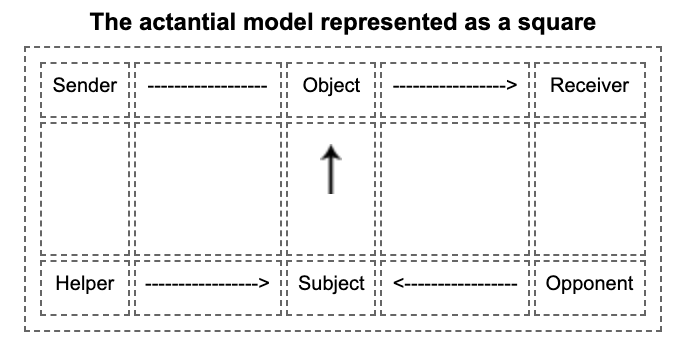
A. J. Greimas, a linguist and semiotician, considered Propp’s morphology in connection with Lévi-Strauss’s structural analysis of myth. Through a consideration of Propp’s thirty-one functions, Greimas defined an actant as a fundamental role at the level of narrative deep structure. Greimas’ actantial model schematically shows the functions and roles that characters perform in a narrative. Greimas replaced Propp’s syntagmatic structure of narrative with a paradigmatic one: the establishment of the actors by the description of the functions and the reduction of the classification of actors to actants of the genre (Susumu, 2010).
Greimas also employed Souriau’s catalogue of dramatic function. In so doing, Greimas found that the actantial interpretation could be applied to different kinds of narrative, not just folktale, and that Souriau’s results could be compared with those of Propp.
In this way, Greimas arrived at his first actantial model:
A good example of how structuralist thought, as relational thinking or the thinking of difference, is valuable outside of the domain of narratology can be found in Rosalind Krauss’ (1979) discussion of sculpture in what she calls the expanded field.
References
Abrams, M.H. (1999). A Glossary of Literary Terms, 7th ed. Boston, MA: Heinle & Heinle.
Burkhardt, F. (1988). Design and ‘avant-postmodernism’. In: Design after modernism, edited by J. Thakara. London, UK: Thames and Hudson, 145–151.
Deleuze, G. (2004) How do we recognise structuralism?, in McMahon, M. and Stivale, C. (trans.) Desert Islands and Other Texts 1953–74. Los Angeles, CA: Semiotexte, pp. 170–192.
Krauss, R. E. (1979) ‘Sculpture in the expanded field’, October, 8, pp. 30–44. Available at: http://www.jstor.org/stable/778224 (Accessed: 10 February 2016).
“The founding story of the academic world is Socrates being a gadfly.” (Jonathan Haight, quoted in an interview with David Shariatmadari, 2025)
Design practice involves the articulation of (interpreted) narrative world/worlds and (embodied) lifeworld/lifeworlds. This articulation gives rise to a storyworld. A storyworld is not a mere sequence of events to be followed, such as might be presented, for example, in a strict structuralist analysis, but is rather an emotionally engaging world in which the reader, viewer, audience or participant situates himself, herself or themselves, by means of which the associative field of a storyworld is created. In the words of Ryan and Thon (2014: 3), “while the author creates the storyworld through the production of signs, it is the reader, spectator, listener, or player [or participant, add AP] who uses … a finished text to construct a mental image of this world.”
Yael van der Wouden (2025) puts it in the following way:
“I recognised myself in [The Secret Garden] straight away. I think you feel so unacknowledged as a pre-teen and teen that to find a story mimicking your experience so exactly is magical. That really set me off as a reader.”
The notion of storyworld involves an extension of the thinking of the classical, structuralist narratologists, who relegated the referential or world-creating properties of narrative as a matter of little concern (Herman, 2009: 71). This was partly due to the exclusion of the referent in favour of the signifier and signified in the Saussurean language theory that informed the structuralists’ approach.
RELATED TERMS: In medias res; Genre; Tragic theatre – Aristotle; Defamiliarisation, Ostranenie or making strange; Narratology; Montage, Collage, Assemblage and Bricolage
Design practices, it is argued, would do well to consider the notions of story, plot, chronology, de-chronologisation and teleology (end, goal or purpose), in the contexts of the narrative unfolding (intelligibility) and environmental navigation (sensori-motor movement, perception, orientation and horizon) of design entities.
The term narrative covers both the act of telling or narrating of the tale and the tale itself as told, as a whole. Chronology is central both to the telling and the tale. Story, as the whole tale, is the sequence of event in chronological order, from beginning to end. Plot is the sequence of events as unfolded in the telling or narrating. The plot’s sequence of events may mirror the story’s chronological order. This is a simple plot, sometimes called a linear narrative. However, the plot may de-chronologise the story, presenting events out of chronological story-order. This is a complex plot, sometimes called a non-linear narrative. A plot may begin at any point in the story’s chronology.
Aristotle recommends complex plots because they heighten the poetic effect of the story. He suggests beginning in medias res (in the middle of things), setting up surprising sequences of events. Conversely, stories, as Sternberg notes, always begin at the (chronological) beginning and proceed through the (chronological) middle towards (chronological) ending. The effect upon the audience sought by Aristotle is primarily that of catharsis, i.e. the act of releasing a strong emotion, such as pity and fear. Aristotle’s approach to narrative, as story (whole) and as plot (sequence), is teleological: both story and plot are subordinate to poetic end or telos. Telos determines the choice of story (whole), with its particular chronology, and the organisation of plot (sequence), with its specific de-chronologisation.
A Greek tragedy, for example, usually starts with a flashback, or analepsis, a recapitulation of the incidents of the story which occurred prior to those which were selected for the plot. The reader is plunged in medias res (into the middle of things) and earlier incidents in the story are introduced artfully at various stages in the plot, often in the form of retrospective narration. (Selden, Widdowson and Brooker, 2005: 34)
The Aristotelian dichotomy of story (chronological whole) versus plot (chronological or de-chronologised sequence) has a strong affinity to such later pairings as the Renaissance opposition between the natural and the poetic (artificial) order; and the Russian Formalist distinction between fabula and sjuzhet as well as its assorted Structuralist offspring, such as Tzvetan Todorov’s histoire versus discours and Gerard Genette’s histoire versus recit.
Selden, Widdowson and Brooker (2005: 34-35) point out that for the Russian Formalists, only sjuzet (plot) is strictly literary, while fabula (story) is raw material to be organised by the writer. For the Formalists, story is the temporal-causal sequence of narrated events, whose formula, which is nevertheless capable of infinite extension, is always: because of A, then B (Lemon and Reis, 2012). Plot, in contrast, becomes the story as distorted or defamiliarised in the process of telling.
The Formalists’ concept of plot differs considerably from that of Aristotle, as can be illustrated through Shklovsky’s analysis of Laurence Sterne’s Tristram Shandy. Shklovsky argues that the plot is not solely the arrangement of story-incidents. It also includes all the devices and stratagems used to interrupt and delay the narration. Thus, Shklovsky contends, digressions, typographical games, displacement of parts of the book, for example, the preface and the dedication, and extended descriptions are all devices to make us attend to the novel’s form. Through such devices, our perceptions are sharpened
By frustrating familiar plot arrangement, Sterne draws attention to plotting itself, as literary invention. Shklovsky, in this sense, deviates from the Aristotelian model. A carefully ordered Aristotelian plot discloses to the audience the essential and familiar truths of human life. For Aristotle, the plot should be plausible and have a certain inevitability, its telos. The Formalists, on the contrary, often linked theory of plot with the act of defamiliarisation, a process in which the plot prevents us from regarding the incidents as typical and familiar (Selden, Widdowson and Brooker, 2005: 35).
Instead, the audience is repeatedly made aware of how artifice constructs or forges, i.e. both makes and counterfeits, the reality presented to the audience. The plot, therefore, is a display of poiesis, i.e. of making, rather than a display of mimesis, i.e. of imitating or representing in a ‘realist’ modality. These insights anticipate, as does Sterne himself, postmodernist self-reflexivity. (Selden, Widdowson and Brooker, 2005: 35)
For design practices, the insights of Aristotle and of the Russian Formalists concerning plot, both as arrangement of elements with a specific purpose and the disruption of those elements through various techniques to engage the participant reflexively, could be valuable in considering how to arrange the narrative elements and the environmental elements (sequentially and disruptively) to yield complex, engaging object-plots or system-plots.
In this sense, plot devices might be assimilated to the techniques of montage, collage, assemblage and bricolage as means for disrupting perceptions of ‘reality’ and ‘causality’ by playing with different presentations of chronologies and temporalities or spatio-temporalities.
References
Lemon, L. T. and Reis, M. J. (eds) (2012) Russian formalist criticism: four essays. 2nd edn. Lincoln, NE: University of Nebraska Press.
Selden, R., Widdowson, P. and Brooker, P. (2005). A Reader’s guide to contemporary literary theory, 5th ed. Harlow, UK: Pearson Longman.
Shklovsky, V. (2012) ‘Sterne’s Tristram Shandy: stylistic commentary’, in Russian formalist criticism: four essays. 2nd edn. Lincoln, NE: University of Nebraska Press. [no page numbers]
Sternberg, M. (1992). Telling in time (II): chronology, teleology, narrativity. Poetics Today, 13 (3), 463–541. Available from http://www.jstor.org/stable/1772872 [Accessed 24 June 2016].
The term speculative realism was coined by Graham Harman, Quentin Meillassoux, Ray Brassier and Iain Hamilton Grant as a title for a conference held at Goldsmiths, University of London in 2007.
According to Avanessian and Malik (2016) speculative realists positioned themselves in distinction to both poststructuralism and analytic philosophy, the two dominant critical and theoretical doctrines in the arts and humanities, in the case of the former, and in philosophy, in the case of the latter, in the early 2000s.
Both of these established paradigms, speculative realists argue, restrict what can be claimed philosophically and theoretically to the finitude of language, history, thought and subjectivity. In so doing, poststructuralism and ordinary language philosophy repudiate the claim that there can be knowledge of the real as such other than in terms of how it appears in cognition and how it is discussed and described in discourse.
Both poststructuralism and analytic philosophy, speculative realists suggest, practice social, cultural, psycho-symbolic or pragmatic variants of the anthropic principle, as it is called in physics, or remain within the strictures of Immanuel Kant’s noumenal-phenomenal distinction, which maintains that the world as humans know it is mediated by their intrinsic conditions of knowledge, with the consequence that what is outside of human knowledge cannot be known ‘in itself ’.
In contrast, speculative realists argue that philosophy can apprehend the real as such in its independence from the conditions of its being thought.
A critical, creative and reflexive design practice could benefit from an understanding of the issues raised by Guy Debord in his book, Society of the Spectacle, published in 1967. It is a manifesto of 221 theses on capitalist culture in France in the two decades between the end of World War Two in 1945 and the mid-1960s.
Developed from Marx’s theories of reification and alienation, Debord defines the spectacle as a passive, individualistic, quasi-visual (ocular-centric, perhaps) relation to the social world. The individual, divorced from the collective praxis that constructs the social world, is reduced to consuming corporate-supplied entrancing narratives.
Kaplan (2012) suggests that this critique, while valuable in offering a salient, potentially illuminating, description of people’s increasingly commodity-saturated, mass-mediated, image-dominated and corporate-constructed world, with all its conspicuous irrationalities, is nonetheless flawed. Its most serious defect, Kaplan argues, is Debord’s rejection of the necessary intermediation of social life by culture and communication. His analysis assumes a notion of mass society, in which people are culturally denuded, divorced from community and thereby subject to the imposition of false needs.
Against the profound alienation of post-World War Two capitalism, Debord opposes the utopian vision of a communist society of transparent, direct human action and community. One must choose either revolutionary socialism or prolong continued acquiesce to barbarism, Debord argues. Both the alienated masses and the revolutionary collective, however, Kaplan suggests, depend implicitly on the framework of liberal individualism, which abstracts individuals from the cultural traditions and social relations in which they are embedded.
References
Debord, G. (1983). Society of the spectacle. New York, NY: Zone Books.
Kaplan, R.L. (2012). Between mass society and revolutionary praxis: the contradictions of Guy Debord’s Society of the Spectacle. European Journal of Cultural Studies, 15 (4), 457–478. Available from http://ecs.sagepub.com/cgi/doi/10.1177/1367549412442208 [Accessed 10 August 2012].
Design practices would do well to be sociologically informed, particularly in relation to micro-sociological studies.
The decades from the 1960s to the 1980s saw an increase in micro-social studies and methodology. The 1980s saw an attempt to bridge the gap between the more recent micro- studies and the older macro-social studies and methodologies. Some authors began to reconstruct macrosociological phenomena based upon a micro-sociological foundation, while others developed new macro-social perspectives, such as neofunctionalism or neo-Marxism, that addressed and incorporated micro-level phenomena.
The challenge posed by micro-sociological approaches can be seen in two distinctive but interlocking developments: the move from a normative notion of social order to that of a cognitive order, and the rejection of both methodological collectivism and individualism in favour of methodological situationalism. Both developments call into question the dimensions in terms of which the micro-macro problem has traditionally been posed, such as the juxtaposition of individual and collectivity or of individual action and social structure. In the end, they point towards a reconstruction of macro-social theory and methodology based upon an integration of micro-sociological results.
One approach which emerged is actor-network theory, which highlights the actant as a phenomenon that exists at both the micro-social and the macro-social, forestalling the opposotion between the indvidual and the collective. Through networked, distributed agency, the collective runs through the individual and the individual runs through the collective and both run through the materiality of the worlds that they co-constitute.
Prior to the invervention of the micro-sociological studies, two conceptions of social order had dominated Western social philosophy since its beginnings: the integration theory of society, which conceives of social structure as a functionally integrated system regulated by normative consensus, as articulated by Durkheim and Parsons; and the coercion theory of society, which views social structure as a form of organization held together by force and constraint transcended in an unending process of change, as articulated by Marx.
References
Knorr-Cetina, K. and Cicourel, A. V. (eds) Advances in social theory and methodology: towards an integration of micro- and macro-sociology. London: Routledge & Kegan Paul.
RELATED TERMS: Modernism and avant-garde art practice
Vid Simoniti points out that the work of politically committed artists has radically shifted since the mid-1990s. A new generation of artists has sought not just to represent social reality, but to change it, by blending art with activism, through social regeneration projects, and even by oursuing violent political action. This form of contemporary art prompts a rethinking of theories of artistic value. These works, Simoniti contends, make a convincing case for a pragmatic view of artistic value, a view which is often dismissed. The pragmatic view, when properly applied, sets the bar very high indeed. Within this view, art that tries to change society should be considered ‘good’ art only when it succeeds in making tangible differences.
Thus, for socially engaged art, there is a critical difference between an art that engages in the politics of representation and the art institutions, and an art that engages in wider political practices. Socially engaged art has tended to follow particular patterns: it has focused on communities defined by place; artists have usually been in a strong position relative to the human community or environnment that forms the subject; and it has been assumed that there is a clear distinction between the work of artists, who are able to give voice to disadvantaged communities, and the actions of business which has tended to ignore these voices.
References
Simoniti, V. (2018) ‘Assessing socially engaged art’, Journal of Aesthetics and Art Criticism, 76(1), pp. 71–82. doi: 10.1111/jaac.12414.