RELATED TERMS: Design, Narratives, Futures; Design of Narrative Environments
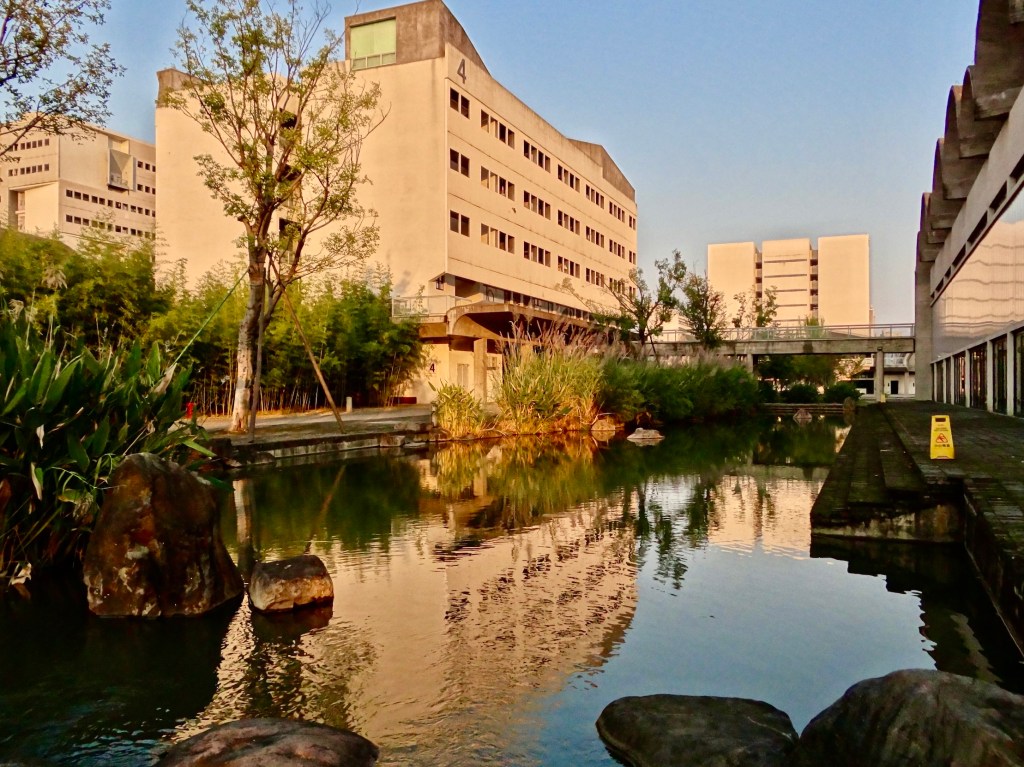
A two-day international conference was held at the Liangzhu campus of the China Academy of Art (CAA) in Hangzhou on 21-22 November 2026. The overall theme was the use of narrative as a method by means of which design practices could be shaped towards the goals of social innovation. The event was co-curated by professors Jiang Jun, Yao Zhijie and Liu Yihong from CAA and visiting professors Tricia Austin, from Central Saint Martins, University of the Arts London, and the independent scholar Allan Parsons. The event also marked the entry of CAA into the DESIS Network. The full programme and list of participants can be found on this website: Narrative Future.
The conference was entitled Narrative for the Site. The term ‘site’ in Chinese has several meanings, such as scene, place, situation, and may have connotations of ‘here and now’. The conference emphasised the relationship between living, moving bodies and the site, place or situation. One question which the conference addressed obliquely was that of establishing whether the third shifter that establishes the deictic centre for spatio-temporal orientation both in the site and in the narrative is ‘I’ or ‘we’: I-here-now or we-here-now? And if it is ‘we’, how inclusive or exclusive is that collectivity? Is it solely human or does it include both non-human objects, such as designed artefacts, and more-than human realities, such as weather events and climate patterns?
‘Here’, ‘now’, ‘I’ and ‘we’ are not specific places or times or people. They are deictic shifters. They depend on context for their meaning and scope. Stewart Brand (1999), founder of the Whole Earth Catalog, suggests one way to contextualise ‘now’ and ‘here’ when he writes that,
” ‘Now’ is the period in which people feel they live and act and have responsibility. For most of us, ‘now’ is about a week, sometimes a year. For some traditional tribes in the American northeast and Australia, ‘now’ is seven generations back and forward ([about – AP] 350 years). Just as the Earth photographs [from space from 1968 onwards – AP] gave us a sense of “the big here,” we need things which gives people a sense of “the long now.”
Given the considerations above, we also need things that give us a more comprehensive or inclusive ‘we’ with whom we feel we live and act and have responsibility.
This brings to attention some central issues with which the design of narrative environments is actively engaged, as a practice that takes seriously the notion of narrative as a design method.
In general, the advantage of using narratives in design is that they provide framing devices that allow designers to explore the ‘what if’ and the ‘as if’. This enables them to focus their attention on the possibilities of different scales of ‘here’, ‘now’, ‘we’ and possibly even ‘I’, when configured as a societal being.
For example, while language and representations of all kinds, such as images of the Earth from space, allow us to establish and stabilise a common world and a conventional social reality that orients us, they may not just stabilise that reality but fix it in place. In this case, narratives allow designers to explore a greater attentiveness to both:
- our experience of the shifts in reality that our conventional language and representations may fail to capture, i.e. new realities; and
- the undesirable features of our social reality that adherence to our representations cause us to repeat, despite our better selves, i.e. harmful habits.
Narratives achieve this by providing a frame in which to explore the implications of different deictic centres, for example, by seeking to displace the deictic centre of ego-centrism and nation-centrism (two variants of small ‘we’), near-sightedness (the small ‘here’) and short-termism (the short ‘now’) in the decision-making that guides action.
Narratives, particularly the design of narrative environments, also allow us to explore and develop our attention to the relationships between abstraction and materialisation. As the architect Juhani Pallasmaa (2000: 79) puts it,
“Abstraction and perfection transport us into the world of ideas, whereas matter, weathering and decay strengthen the experience of time, causality and reality.”
The limitation of narrative as method is that narratives are delivered through specific focalisations. They cannot speak for all, show all or include all. Narratives both reveal and conceal, include and exclude. Nevertheless, through this limitation, they may make us especially attentive to the difficulty of establishing collectivities that are not at the same time exclusivities.
As the American writer George Saunders (2021) points out, when discussing how Buddhism inflects his practice, reading, writing and interpreting narratives is a method for paying attention and for practicing radical empathy, to develop an attentiveness to the other, to alterity and to alternatives in a search for an ethics and a way of living, as Jacques Derrida (cited in Cunningham et al., 2005) describes the purpose of philosophy, which we could also apply to design.
The presentations given over the two days of the conference discussed and demonstrated how the methods of paying attention and practising radical empathy may be enacted and developed in a design context.
References
Brand, S. (1999) Reframing the problems, Long Now Foundation. Available at: https://longnow.org/ideas/reframing-the-problems/ (Accessed: 24 November 2026).
Cunningham, D. et al. (2005) Obituary symposium: Jacques Derrida, 1930–2004, Radical Philosophy, 129(January/February), pp. 11–32.
Pallasmaa, J. (2000) Hapticity and time, Architectural Review, 207(1239), pp. 78–84. Available at: papers2://publication/uuid/403F485D-3662-4AED-92B3-263CD3BDCBAA (Accessed: 6 December 2018).
Saunders, G. and Burke, D. (2021) George Saunders on What Buddhists can offer the world right now, Tricycle, (22 February). Available at: https://tricycle.org/article/george-saunders/ (Accessed: 24 November 2026).


2 thoughts on “Paying Attention and Practising Radical Empathy”