“A weird knowing. Weird, from the Old Norse, urth, meaning twisted, in a loop.”(Morton, 2017: 92)
Douglas Hofstadter (1979: 18) argues that a strange loop occurs whenever, by moving upwards or downwards through the levels of a hierarchical system, you unexpectedly find yourself right back where you started. He sometimes uses the expression tangled hierarchy to describe a system in which a strange loop occurs. They are thus paradoxical structures that nonetheless undeniably belong to the world in which we live (Hofstadter, 2007: 103).
He elaborates that a tangled hierarchy occurs when what are presumed to be clear hierarchical levels unexpectedly take a hierarchy-transgressing twisting- or folding-back. The surprise element is important and is the reason he calls such loops ‘strange’. He distinguishes them from simple tangles, such as feedback, which do not involve transgressions of presumed clear distinctions among levels (Hofstadter, 1979: 686; Hofstadter, 2007: 160). A loop’s strangeness comes solely from the way in which a system can seem to engulf itself through an unexpected twisting-around, violating what had been taken to be an inviolable hierarchical order (Hofstadter, 2007:159)
What he means by strange loop, he says, is an abstract loop in which, in the series of stages that constitute the cycling-around, there is a shift from one level of abstraction or structure to another, which feels like an upwards movement in a hierarchy, and yet somehow the successive upward shifts turn out to give rise to a closed cycle returning to the point of departure. That is, despite one’s sense of departing ever further from one’s origin, one winds up, to one’s great surprise, exactly where one had started out. In short, a strange loop is a paradoxical level-crossing feedback loop (Hofstadter, 2007: 101-102)
Such loops may take the form of one-step self-reference, such as the Epimenides paradox, in which Epimenides, a Cretan himself, made the statement: “All Cretans are liars”, a sharper version of which is simply “I am lying”, or, “This statement is false”. However, the loop can be made wider, by choosing to insert any number of intermediate levels, creating many-step strange loops,
Hofstadter (1979: 705) places strange loops at the crux of our understanding of ourselves, through which will come an understanding of the tangled hierarchy of levels inside our minds. His thesis in I am a Strange Loop (Hofstadter, 2007: 103) is that we ourselves, not as bodies but as selves, are strange loops.
Tangled hierarchies, Metalepsis and Design Practices
Hofstadter does not use the term metalepsis in his work, but his notions of strange loop and tangled hierarchy, as John Pier (2013) brings to attention, have great significance for narratology, a relevance which we extend here to design practices. Pier notes that for narrative metalepsis, understood ontologically, paradox is central, as it involves the logically inconsistent passage between two separate domains through suspension of the excluded middle.
Of central concern is the problem of maintaining distinct levels while seeking to avoid self-reference, a problem elaborated initially in logic and mathematics. Avoidance of self-reference is achieved by elaborating meta-levels, requiring the addition of recursive meta-levels ad infinitum. The eventual, inevitable paradox is captured by Gödel’s theorem. This paradox has long been discussed in scientific thought using the example of the Epimenides paradox, mentioned above. It is also conveyed visually by the Möbius strip, Klein’s bottle and Escher’s drawings.
Brian McHale (1987) takes these paradoxes into account in his discussion of postmodernist fiction which, he argues, brings to the fore the ontological status of text in relation to that of world. McHale recasts Gerard Genette’s narrative or diegetic levels in terms of ontological levels by adopting an ontology borrowed from possible worlds theory. Thus, a metalepsis produced by transgression of narrative levels has ontological implications, which arise from recursive embedding. McHale explicitly identifies metalepsis with the strange loop.
McHale also draws attention to the metaleptic function of the second-person pronoun, following Genette, although he does not distinguish between rhetorical and ontological metalepsis, a distinction proposed by Marie-Laure Ryan, who argues that metalepsis breaks down into a rhetorical (Genette) and an ontological variety (McHale).
Metalepsis, as Pier (2013) comments, is not a media-specific phenomenon. Transgressions of levels and boundaries are not limited to narrative. This means, Pier suggests, that metalepsis has a significant role to play in transmedial narratology and in intermediality. While rhetorical metalepsis is of interest, it is ontological metalepsis which is of central concern for design practices, given that its material and media elements stretch from the digital, through the printed, graphic textual, to the theatrical and the built and natural environments. Design practices take advantage of the symbol-object dualism by means of which the fictional, the real, the actual, the virtual and the possible are interwoven. Narrative discourse is taken into the world and the world is taken into narrative discourse, creating, through strange loops, virtual worlds and imaginary worlds, ‘real’ worlds shot through with narrative storyworlds.
The different ontological levels, traversing the fictional, the real, the actual, the virtual and the possible, are linked by the deictic acts that specify, first, the ontological level from which the design as event begins and which serve as its deictic centre and grounding, second, the transgressions that are occurring through the strange loops that are being enacted and, third, the tangled hierarchy of worlds that ensues: the imaginary-real world of the design.
Afterword: The Importance of Loops
Timothy Morton (2017: 93) argues that, “ecological awareness is in the form of a loop, because human interference has a loop form, because ecological and biological systems are in the form of a loop, because to exist at all is to assume the form of a loop.”
Allan Parsons, May 2021. Revised June 2025
References
Hofstadter, D. R. (1979) Godel, Escher, Bach: an eternal golden braid. New York: Basic Books.
Hofstadter, D. R. (2007) I am a strange loop. New York, NY: Basic Books.
McHale, B. (1987). Postmodernist Fiction. London: Methuen.
Morton, T. (2017) Why ecological awareness is loopy, in Nitzke, S. and Pethes, N. (eds) Imagining Earth: Concepts of wholeness in cultural constructions of our home planet. Bielefeld, DE: transcript Verlag, pp. 91–111.
The closure of an opening; the end is in the beginning
“To me, the facade of a building is like the first sentence of a novel – it sets the tone, the mood, and hints at what’s to come.” (Alexis Dornier quoted in Sharma, 2025)
The choice of what media and materials to use in the design of any specific narrative environment, as transmedial artefact, process or event, is led by the question posed by Ryan and Thon (2014: 3), who are parodying Seymour Chatman: ‘what can medium x do in terms of storyworld creation or representation that medium y cannot, and vice versa?’ The choice of medium concerns what stories can be told, how they are told and why they are told. Thus, by shaping narrative, according to Ryan (2014: 25), media shape human experience.
The term medium can be used in a semiotic sense, as the articulation of signs, or in a technological or cultural sense, such as film, theatre or art installations. One widespread trend in media studies is to associate media with specific technologies of communication, for example, writing, print, cinema, photography, television, radio and the telephone, with the uses of digital technology referred to as ‘new media’ (Ryan, 2014: 27).
Another approach is to list culturally recognised forms of communication, such as film, photography, literature, painting and music.
A yet further approach, such as that of Gunther Kress and Theo van Leeuwen is to focus on ‘modes’ and to study the multimodality of texts, that is, texts that use a variety of signs, such as image, language and sound (Ryan, 2014: 27).
In contrast to these approaches, Ryan (2014: 29) proposes a taxonomy that rests on three dimensions: semiotic, technical and cultural.
Thus, the semiotic dimension, as substance, includes such type of signs as image, sound, language and movement, which can be further analysed in terms of spatiotemporal extension, signifying dimensions, sensorial impact and mode of signification, for example, iconic, indexical or symbolic, to use the terms of C. S. Peirce.
Technical dimension includes not only media-defining technologies, such as film, television, photography and so on, but also any kind of mode of production and material support. Ryan notes that, In certain cases, the mode of production cannot be distinguished from the material support, such as in theatre or ballet, where the human body fulfils both of functions. In other cases, the mode of production is multilayered, such as in literature, which involves the technology of writing, with pen and paper, typewriter and paper or with the computer, and the technology of printing, the latter producing the material support of the book. In the case of multilayered modes of production, a distinction might be made between technologies that record and transmit other media, such as writing for language, books for writing and radio for speech and music, and technologies that capture life directly, such as photography, film and sound recording.
The cultural dimension addresses the public recognition of media as forms of communication and the institutions, behaviours, and practices that support them. In this category Ryan places those means of communication such as the press, the theatre or comics. She reasons that they are widely recognised as playing a significant cultural role but cannot be distinguished on purely semiotic or technological criteria.
On this basis, she defines three approaches to a media-conscious narratology:
a semiotic approach, which investigates the narrative power of language, image, sound, movement, face-to-face interaction, and the various combinations of these features;
a technical approach, which explores such issues as how technologies configure the relationship between sender and receiver, for example, one to one, few to many, many to many, and close or remote in either space or time, how they affect dissemination, storage, and cognition and what affordances certain types of material supports bring to storytelling; and
A cultural approach, which focuses on the behaviour of users and producers, as well as on the institutions that guarantee the existence of media. [1]
Space as a medium; Place as a medium; Time as a medium
In being defined as transmedial, the term ‘medium’ in the design of narrative environments is extended to include spatiality, placiality and temporality. That is, the notion of medium is taken deep into the territory that has been conventionally defined as ‘environment’. Thus, in the design of narrative environments, medium and environment are held in a chiasmic relation, such as discussed by Merleau-Ponty (2004).
The question of the relationship between medium and environment opens up the further question of whether it is more proper to describe narrative environments as trans-semiotic or inter-semiotic rather that transmedial or intermedial, since any specific narrative environment may involve a cascade of media and environments, drawing upon signs and semiosis from across a range of different materialities, from the more tangible to the less tangible.
Additional notes:
“Media can be defined here as ever-mutating alliances of technological settings and sociocultural uses, which have to be conceived not only as instruments of world transmission, as in top-down media channels, but also as tools that contribute to the active and participatory building of worlds.” (Boni, 2017: 12)
Reference
Boni, M. (2017) Introduction: Worlds, Today. In M. Boni (ed.) World Building: Transmedia, Fans, Industries. Amsterdam, NL: Amsterdam University Press, pp.9-27.
Notes
[1] Marie-Laure Ryan (2014: 44, n3) points out that Lars Ellestrom (2010) has developed a classification of media concepts that comes close to her own. Ellestrom proposes that there are ‘basic media’, which includes such semiotic categories as auditory text, still image and iconic body performance; ‘qualified media, such as film, dance and photography; and ‘technical media’, which realise or display basic and qualified media, for example a screen for television, a specific kind of paper for photography and the human body for dance.
Furthermore, Ellestrom contends that each medium has four modalities: material, such as the human body, paper and clay; sensorial, such as sight, hearing and taste; spatiotemporal, extending in time, space and/or both; and semiotic, such as convention, resemblance and contiguity.
Ryan suggests that each of these modalities could be subsumed under the semiotic category because they all concern the basic properties of signs, which could then be renamed ‘basic principle of signification’.
References
Ellerstrom, L. (2010) ‘The Modalities of media: a model for understanding intermedial relations’, in Ellestrom, L. (ed.) Media borders, multimodality and intermediality. Houndmills, Basingstoke, UK: Palgrave Macmillan.
Merleau-Ponty, M. (2004) ‘The Intertwining – the chiasm’, in Baldwin, T. (ed.) Maurice Merleau-Ponty: basic writings. London, UK: Routledge, pp. 247–257.
Ryan, M.-L. (2014) ‘Story/worlds/media: tuning the instruments of a media-conscious narratology’, in Ryan, M.-L. and Thon, J.-N. (eds) Storyworlds across Media. Toward a Media-Conscious Narratology. Lincoln, NE: University of Nebraska Press, pp. 25–49.
Ryan, M.-L. and Thon, J.-N. (eds) (2014) Storyworlds across media: toward a media- conscious narratology. Lincoln, NE: University of Nebraska Press.
Sharma, A. (2025). Not just a pretty facade. Financial Times, 21 June, House & Home, p. 10.
Use for: World-forming, World-making, Worlding, World-shaping, Welt-Bilden
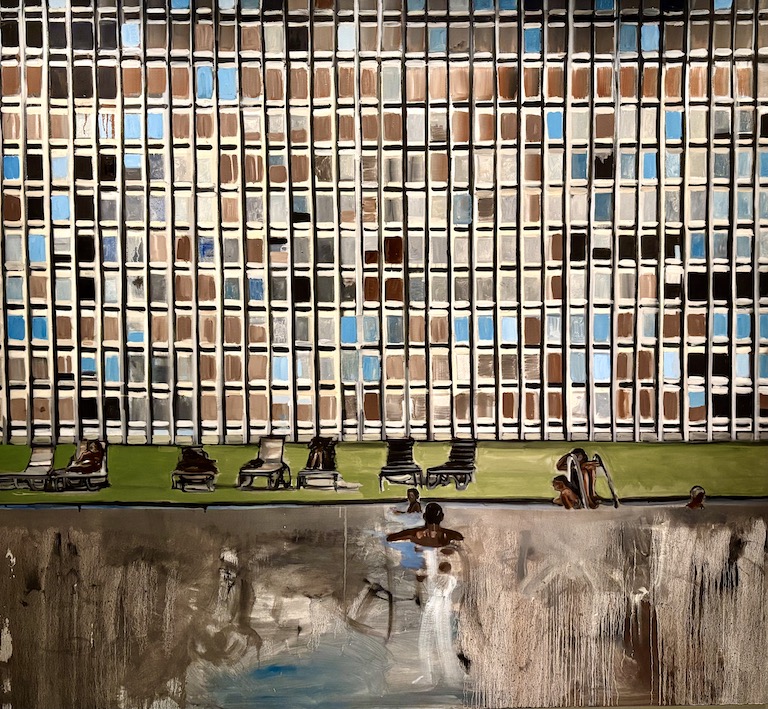
Noah Davis, The Missing Link 4, 2013 Davis sought to poise his work between the real and the otherworldly.
“the last man will save from the rubble a stool or a tree stump on which to rest from his labours …” (Cliff and De Chabaneix, 2003: 87)
World-building is a consequence of treating design practices as ontological in character. One line of thought for this kind of approach to design can be found in phenomenology, notably in the work of Heidegger, Arendt, Merleau-Ponty and Sloterdijk, as well as in anthropology. From the perspective of the design of narrative environments, as a transmedia practice, world-making, world-forming or world-building practices are design practices, albeit of differing degrees of complexity.
Thus, as Lemmens (2013) explains, like Heidegger, Sloterdijk conceives of humans as world-forming beings. For Sloterdijk, however, humans are never in the world nakedly or without protection, so to speak. They always reside in spheres. Another difference between them is that while Heidegger was principally engaged in the analysis of human being-in-the-world, Sloterdijk is more interested in the process of coming-into-the-world. Picking up on the theme of natality from Hannah Arendt, Sloterdijk emphasises that we all have to come to the world in order to be in it. We are born, but too soon (Elden and Mendieta, 2009: 5).
There are echoes here of Lacan’s conception of human being-in-the-world as shaped by a fundamental lack. Nick Mansfield (2000: 45-46) expresses Lacan’s view as follows:
“The subject’s entry into the symbolic order is at the expense of the magical feeling of oneness it had in the imaginary. At the heart of its very being is a sense of lack. It endlessly seeks to compensate for this lack, to fill the hole at its core. This longing for self-completion is Lacan’s definition of desire. The subject is propelled into and through the world, into its emotional and sexual relationships, its fraught group identities with nation, race and political party, its careerism and material acquisitiveness, all as a result of this insatiable need to fill up the lack at the centre of its being.”
In Arendt’s (1958: 96) view, ‘world’ emerges from the work of homo faber, which she distinguishes from the labour of the animal laborans, the latter leaving no persistent trace of its labour. Thus, Arendt argues,
“Human life, in so far as it is world-building, is engaged in a constant process of reification, and the degree of worldliness of produced things, which all together form the human artifice, depends upon their greater or lesser permanence in the world itself.”
In the context of the design practice, the product of ‘work’ is considered to be ‘designs’. Thus, the traces by means of which the world is constituted are designed phenomena.
For Sloterdijk, coming-into-the-world essentially consists in the process of sphero-poiesis, the creation of protective, immunising inner worlds or inner spaces. Sloterdijk’s Spheres trilogy presents a grand cultural-historical panorama of the process of the sphero-poietic “coming-into-the-world” and, thereby, the “coming-into-being”, of the human being as the ek-sisting and world-disclosing being Heidegger described in Being and Time.
Rauschenbach (2011) further explains that, from Sloterdijk’s point of view, the ontological starting point of human existence is the womb of the mother. Therefore, co-existence precedes existence. There is no being without being in‐something, initially in the uterus. Life is always life in between of life. From the beginning and at all times, the human being is surrounded by something that cannot appear as an object. It is the indiscernible complement of one’s own existence, with which one forms a pair.
To contain the infiniteness of space and to create spaces in which sharing can be experienced, Sloterdijk suggests speaking of human spheres, that is, contexts of and for understanding. The shared space is isolated from the rest of the infinite space. Within the sphere, the space can be manipulated. These manipulations can result in specific climates. Sloterdijk uses the term climate not only to denominate a meteorological state, but also to refer to nine dimensions, which altogether characterise the climate of human spheres.
Sloterdijk conceptualises the human sphere as a nine dimensional greenhouse (chirotope, phonotope, uterotope, thermotope, erotope, ergotope, alethotope, thanatotope, nomotope) in which human beings are able to survive and consequently can develop complexities beyond their animalistic heritage. Each of the nine dimensions can attain different degrees of implicitness and explicitness. An individual on its own is not able to survive. It depends on being part of a sphere, populated by others. Sloterdijk’s ontological starting point is therefore unthinkable without the other as it is the collaborative mode with the other that allows for positively influencing the climate within a sphere.
Such thinking can also be used to consider and gain a critical appreciation of the contemporary global conjuncture which, Escobar (2016) contends, can be best characterised by the fact that we are facing modern problems for which there are no longer modern solutions. Ontologically speaking, Escobar continues, one may say that the crisis is the crisis of a particular world or set of world-making practices, the world that we usually refer to as the dominant form of Euro-modernity, i.e. capitalist, rationalist, liberal, individualist, secular, patriarchal, white, and so on.
World-building in media and transmedia practices
In the context of transmedia practices, Jenkins (2016) notes, the concept of world-building emerged from fantasy and science fiction. Nevertheless, it has also been applied to fictions of a documentary or historical character. Thus, fictional texts imagine and design new worlds; documentaries investigate and map existing worlds. From the point of view of the design of narrative environments, both forms exist in a critical relation to existing worlds, drawing attention to specific features of the constitution of those worlds, and by exploring multiple points of view or competing realities.
As Jenkins explains,
“Worlds are systems with many moving parts (in terms of characters, institutions, locations) that can generate multiple stories with multiple protagonists that are connected to each other through their underlying structures. Part of what drives transmedia consumption is the desire to dig deeper into these worlds, to trace their backstories and understand their underlying systems.”
An example of the use of the term ‘world-building’ in the context of cinema can be found in Simran Hans’ (2021) review of the film Cruella (2021). Hans writes, “Set in 1970s London against the backdrop of the emerging punk scene, this playful prequel [to 101 Dalmations] by Craig Gillespie … is a fine feat of world-building”.
Reworldingand Remaking the World
Donna Haraway (2016) uses the term ‘reworlding’ to refer to the actions taken to address or mitigate the problems arising during the Anthropocene, a process she likens to ‘composting’.
For Nelson Goodman (1978, 6), cited by Boni (2017:17), “[w]orldmaking as we know it always starts from worlds already in hand; the making is remaking” .
World Destruction
In discussing the work of Bernard Stiegler, Daniel Ross (2018: 30) notes that, “Whereas animals adapt to their environment, noetic beings ‘are actively engaged in modifying their environment’ and, in the case of the kind of beings that we ourselves are, ‘this active attack on the environment is the most prominent fact in his existence’.”
De-Worlding
Designing and World-Building
A key figure in the explicit relationship between design practices and world-building is Alex McDowell. According to Noah Wardrip-Fruin, McDowell’s world building integrates interdisciplinary humanistic, scientific and design inquiry with emerging forms of computational media. In the context of film production process, McDowell achieves the blurring of boundaries between physical and virtual environments and the distinctions between film and other media forms.
Additional Notes
Jongen (2011) argues that, for Sloterdijk, the coming-into-the-world [Zurweltkommen] of the human being amounts to the same thing as the emergence of world [Welt].
Sloterdijk’s contention is a re-working of Heidegger’s basic tenet that the depiction of the world, or the emergence of the world as picture, is the converse face of the emergence of the human being as subject (Jongen, 2011).
References
Arendt, H. (1958). The Human condition. Chicago, IL: University of Chicago Press.
Boni, M. (2017) Introduction: Wolrds, today. In Boni, M. (ed.) World Building: Transmedia, Fans, Industries. Amsterdam, NL: Amsterdam University Press.
Cliff, S. and De Chabaneix, G. (2003) The Way we live: Making homes, creating lifestyles. London, UK: Thames & Hudson.
Elden, S. and Mendieta, E. (2009). Being-with as making worlds: the ‘second coming’ of Peter Sloterdijk. Environment and Planning D: Society and Space, 27 (1), 1–11. Available from http://dx.doi.org/0.1068/d2701em [Accessed 7 September 2016].
Escobar, A. (2016). Thinking-feeling with the Earth: territorial struggles and the ontological dimension of the Epistemologies of the South. AIBR, Revista de Antropología Iberoamericana, 11 (1), 11–32. Available from http://www.aibr.org/antropologia/netesp/numeros/1101/110102e.pdf [Accessed 5 September 2016].
Goodman, N. (1978) Ways of worldmaking. Hassocks, Sussex, UK: Harvester Press.
Hans, S. (2021). Cruella. Observer, New Review p.27.
Haraway, D. J. (2016) Staying with the trouble: making kin in the chthulucene. Durham, NC: Duke University Press.
Jongen, M. (2011) ‘On anthropospheres and aphrogrammes . Peter Sloterdijk’s thought images of the monstrous’, Humana. Mente Journal of Philosophical Studies, 18, pp. 199–219. Available at: http://www.humanamente.eu/PDF/Issue_18_Paper_Jongen.pdf (Accessed: 13 September 2014).
Mansfield, N. (2000) Subjectivity: theories of the self from Freud to Haraway. St Leonard’s, NSW: Allen & Unwin.
Rauschenbach, R. (2011) How to govern the universalizing community: Peter Sloterdijk’s concept of co-immunism. In: 6th ECPR General Conference, University of Iceland, 25th – 27th August 2011. Reykyavik: University of Iceland. Available from http://ecpr.eu/filestore/paperproposal/360087b2-c31f-413c-b33d-88b69534e9ab.pdf [Accessed 25 August 2014].
The notion of affordance is important for design practices as it emphasises the active nature of perception; the importance of the moving body in perception; the co-constitution of the human, the environmental, the ecological and the economic; and the interactive nature of perceptual, meaning-making and world-making actions and processes, that is, the active, collective, making of lifeworlds as shared worlds of meaningfulness and sustainable life-forms.
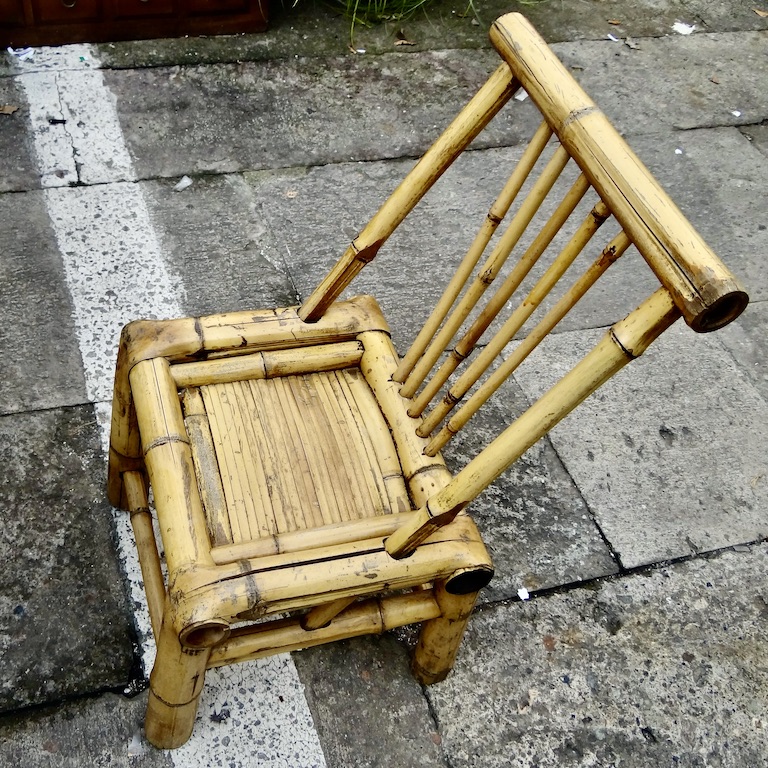
To ecological psychologist James Gibson (1979), affordances are opportunities for action that an object provides or affords a perceiver/agent. For example, a chair may ‘afford’, i.e. enable, sitting; or it may permit standing upon it, to reach something else (a double ‘affordance’, so to speak: standing and reaching); or, alternatively, it may, because of its age or delapidation, provide a resource for chopping up to use as firewood.
What does this chair ‘afford’?
In Gibson’s (1986, 1979) words, “an affordance is neither an objective property nor a subjective property; or it is both if you like. An affordance cuts across the dichotomy of subjective-objective and helps us to understand its inadequacy. It is equally a fact of the environment and a fact of behavior. It is both physical and psychical, yet neither. An affordance points both ways, to the environment and to the observer.”
Such affordances could be understood as ‘objective’, i.e. ‘reflective’ or ‘expressive’ of ‘properties’ that the chair ‘has’ or ‘possesses’, but this would be to adopt a reductive, essentialist approach. Affordances, more properly, are relations between perceivers/actors and objects. Any person may perceive/enact more than one affordance of the same ‘object’, depending on need or circumstance, thereby changing its ‘objecti-ive’ status. Persons from different cultural backgrounds may share perceptions of the same affordances; or they may see different ones.
Furthermore, such environmental or ecological perception is part of the ongoing situation(s) in which the perceiver, as actant, is actively partaking and constituting. It is through such situations that the environments or ecologies are in part, constituted as environmental and ecological realities. That is, perception itself is an active scanning of situations and environments, not simply a passive reception of stimuli from situations and environments. Perception, in other words, is multiply motivated and involves, as Merleau-Ponty affirms, the whole body in movement in domains constituted through intercorporeal interaction.
Affordance as Bewandtnis
Mark Wrathall (2021) notes that we do not typically describe things as offering themselves for use. J.J. Gibson, in struggling to come up with an English word to express the thought of the “offerings of nature, these possibilities or opportunities,” described them as “affordances,” as in the expression, “the door affords entry and egress” (Gibson 1986: 18). Context of use suggests that Heidegger is trying to express the same notion with his term Bewandtnis. This allows Heidegger to describe the lived world as Bewandtnisganzheit, a whole of affordances. The world thus appears as a shifting and richly interconnected context of opportunities and invitations to act. The available entities that we encounter are ontologically defined in terms of what they afford (Wrathall, 2021: 31).
The particular affordances that are disclosed in any given situation are a function of the equipment that is on hand; the kind of activities or practices in which agents are engaged; and the character of the particular agent themselves, including their skills and bodily constitution. Similarly as for Gibson, an affordance for Heidegger is defined simultaneously in terms of the way we are coping with things and the state of the environing world. Thus, in addition to being contextually determined, affordances, unlike objects, are inherently indexed to our skills and bodily capacities for action.
The entities that populate our everyday world, including or especially, the already-designed elements of our world, stand out as being available. Furthermore, they are structured by the place they hold in a network of reference relationships. That is, they ‘refer’ or point us, both explicitly-deictically and implicitly-inferentially, to the work or end product we are producing; the materials out of which they are constructed; the people who will put them to use; and the natural environment in which they are to operate or, in other words, provide further affordances.
Affordances and Design
The Interaction Design Foundation develops the discussion of the use of the notion of affordances in the context of design. The key figure in the introduction of affordances into design discourse and practice is Don Norman.
Norman, D. (2013) The Design of everyday things. Rev & Exp ed. New York, NY: Basic Books.
Rucińska, Z. (2020) Affordances in Dennett’s From Bacteria to Bach and Back, Avant, 11(2), pp. 1–11. doi: 10.26913/AVANT.2020.02.05.
Wrathall, M. A. (2021) Affordance (Bewandtnis), in Wrathall, M. A. (ed.) The Cambridge Heidegger lexicon. Cambridge, UK: Cambridge University Press, pp. 31–33.
According to Jary and Jary (2000), actor-network theory combines post-structuralist insights with detailed empirical studies of scientific practices and technologies, organisations and social processes. It builds on the work of Bruno Latour, John Law and Michel Callon. The focus of actor-network theory is on the reality and transformability of networks, as against such notions as institutions and society. Its conception of the social is as a circulatory field of forces beyond the agency-structure debate.
In a footnote in ‘Reassembling the Social’, Bruno Latour (2005, fn. 54, p. 54) writes that,
“It would be fairly accurate to describe ANT as being half Garfinkel and half Greimas: it has simply combined two of the most interesting intellectual movements on both sides of the Atlantic and has found ways to tap the inner reflexivity of both actor’s accounts and of texts.”
(Latour, 2005, fn. 54, p. 54)
The two intellectual movements referred to are North American ethnomethodology and French structuralism or semiotics (Beetz, 2013). The classic work in semiotics is best summarised in Algirdas Julien Greimas and Joseph Courte’s (1982), Semiotics and Language: an Analytical Dictionary. A more recent presentation of semiotics can be found in Jacques Fontanille (1998), Semiotique du discours.” (Latour, 2005: 54n-55n)
Relevance:
The relevance of actor network theory to design of practice is double:
1. It deals with the articulation of material, textural, architectural, technological, financial, environmental, textual, discursive and subjective phenomena as a system or network acting to create coherence and subject to change or modification. Designs, as network systems or network system elements can be conceived as having a similar range and to be similarly concerned with network effectiveness.
2. It deals with a number of themes that have to be addressed in design practices, such as for example,
• an emphasis on semiotic relationality, i.e. a network of elements which shape and define one another; • an emphasis on heterogeneity, in particular on the different types of actor and action, human and otherwise, that animates the network’s performativity; • an emphasis on materiality, i.e. the heterogeneous material forms through which the network is realised; • an insistence on processes and their precariousness, i.e. all elements need to continue to play their part or else it all falls apart; • paying attention to power, as a function of network configuration, as networked effect and effectiveness; and • paying attention to space and scale, e.g. how networks maintain their boundaries, extend themselves and translate distant actors.
Limitations
Actor network theory is not concerned primarily with the design or the creation of new systemic, networked environments but with the study of existing environments as actors-as-networks and networks-as-actors, even though it recognises its study as intervening in practice and that its descriptions, explanations and research actions extend the particular environment/network in question. Nor is actor network theory explicitly concerned with concepts of narrative, although Latour does use the phrase ‘narrative path’ when explaining actor network theory, e.g. in Latour (1996) below.
Jary, D. and Jary, J. (2000). Collins dictionary of sociology, 3rd ed. Glasgow: HarperCollins.
Latour, B. (1996). On actor-network theory. A few clarificaitons plus more than a few complications. Soziale Welt, 47, 369–381. Available from http://www.bruno-latour.fr/sites/default/files/P-67 ACTOR-NETWORK.pdf [Accessed 6 February 2016].
“Why should you always have live things in stories? said the Professor. “Why don’t you have events, or circumstances?”
“Oh, please invent a story like that!” cried Bruno.
The Professor began fluently enough. “Once a coincidence was taking a walk with a little accident, and they met an explanation — a very old explanation — so old that it was quite doubled up, and looked more like a conundrum —” he broke off suddenly.
“Please go on!” both children exclaimed.
The Professor made a candid confession. “It’s a very difficult sort to invent, I find … “
Lewis Carroll (1893) Sylvie and Bruno Concluded. London, UK: Macmillan and Co, p376
At the outset, it might be said that actantiality is a way of trying to understand acting amid complexity, acting in the middle of things, without a transcendent overview-horizon, an originating fundamental grounding or, indeed, an immanent purpose or drive: acting, we might say, in a heterarchy, in which there is more than one governing or determining principle. In addition, while such mediated and mediating action may be teleonomic, that is, purposeful or goal oriented, it is not necessarily teleological, that is, goal-determined.
Agency-Affordance Negotiation in the theory of actantiality
The argument presented here is that the term ‘design’ is preferable to the notions of ‘art’ and ‘technology’, that is, of ars and tekhne (techne), in order to discuss the matters which are of concern. Two Derridean terms are relevant here. First, design may be understood as an ‘original supplement’, in the sense that designs appear supplementary to what it means to be human but are simultaneously necessary to the definition of being human. Second, the meaning of any given ‘design’ is undecidable: in the form of a pharmakon, it can be a poison or a remedy-therapy, given the situation or the context. This brings to attention the importance of such notions as ‘value’, for example, inherent value, use value, exchange value, situational value and contextual value.
French paleoanthropologist André Leroi-Gourhan (1993) argues in a number of books, especially in Gesture and Speech, that human evolution, or socio-genesis, is technological through and through, that is, it implies a corresponding techno-genesis. Humanity and technology, or rather humanity and ‘design’, have co-evolved and are co-evolving (Lemmens, 2013). One way of expressing this is to say that Dasein is design, on which implies a phenomenology of worldliness or appearance.
Anthropogenesis, as socio-genesis, is a process, according to Stiegler (1998: 45) that must be understood in terms of a technogenesis, or, in other words, in terms of design as anthropo-socio-techno-genesis.
Humanity and design, which includes both ‘art’ and ‘technology’, are co-extensive in this view. The argument is that the human condition is, and has always been, a ‘design’ condition or a co-emergent conditionality. Human situatedness is, in some sense, a designing-designed condition. ‘Design’, here, takes on a much wider array of meanings than those conventionally ascribed to the term.
Actor-network theory and affordance
Bruno Latour (1999) discusses how actor-network theory addresses, but does not overcome, dissatisfactions arising in the context of the social sciences. These dissatisfactions concern, on the one hand, the micro level, focused on the actor or agency, which turns attention away from norms, values, culture and so on. On the other hand, they concern the macro level, focused on structure or system, whose abstractions gloss over incarnated, in the flesh practice. Latour proposes that perhaps the social is not made of agency and structure at all but is, rather, a circulating entity. If this is the case, he continues, then, “actantiality is not what the actor does … but what it provides actants, with their actions, with their subjectivity, with their intentionality, with their morality”.
In interpreting this passage, David Webster (2002) argues that ‘actantiality’ refers not to agency but to the facticity of agency through which results come to pass, that is, affordance. Webster models his conception of affordance upon Derridean differance, specifically, “the minimal event of the articulation [of] timed-space and spaced-time that takes the form of the generation of differences and the deferral of the meaning of those changes having taken place.” In so doing, he sets up an ontological framework of affordance as agency in medias res, a reformulation of distributed agency as agency-in-the-middle-of-things, as ergon (work) in the framework of parergon, that which is beside or in addition (supplementary) to the work, its ‘context’. For Derrida, the work (ergon) is not primary and the ‘outside work’ (parergon) secondary. Both are fundamental to one another: it is the parergon that renders the ergon self-same, a self-sameness arising through (Derridean) differance and supplementarity (adding to and displacing or replacing).
Webster continues,
“What a thing is (quidditas) is what it does (haecceitas), its agency. Agency, in its most general form, depends upon placement within the frame of a parergon, constituted by an “absent” centre as historicity, and an “absent” circumference as potentiality to be, the parergon supplements the thing to make up for what it will always lack to be what it would be, i.e., a framework of past facticity and future possibility.”
Furthermore, a thing’s self-identity, what it is, is what it can do, its agency, given what it is and what it can do. In this case, ‘is’ equates to structure while ‘does’ equates to agency. As a consequence, ‘is’ and ‘does’ cannot be stratified in either time or space. A thing is the summation of difference at that point, its historicity. What it does, is to endure through the ‘invariance’ of being the same but not identical, by deferring the meaning of that lack of self-identity.
Webster concludes, “Affordance does not happen to something, for the thing is co-terminus with affordance: Activity is built through the concatenation of affordance.”
Questions
The relationship between actantiality and affordance is central to what actually happens or transpires, between the ‘I can’ and the ‘I did’, between potentiality and actuality. Might Jerome Bruner’s conception of ‘agentivity’, as a focus on agent and action, and Husserl’s notion of ‘I cans’, as in I can throw, I can calculate, I can judge and so on, contribute to the development of this nexus?
Further notes on actantiality
Another term for actantiality might be ‘agentic in-between-ness’ (Kuby, 2017). In this understanding enacted agency is the relationship between human and nonhumans, which may reproduce existing conditions or may produce newness (Barad, 2007). In Derrida’s sense, this allows for ‘invention’ as the ‘incoming of the other’. Such agency does not lie within the human nor the nonhuman but rather in the in-between-ness of humans with the material world. Reality is, or realities are, about more than humanity.
References
Husserl, E. (1989) Ideas pertaining to a pure phenomenology and to a phenomenological philosophy. Second book: Studies in the phenomenology of constitution. Dordrecht: Kluwer Academic.
Knappett, C. and Malafouris, L. (eds) (2008) Material agency: towards a non-anthropocentric approach. New York, NY: Springer.
Kuby, C. R. (2017) ‘Why a paradigm shift of “more than human ontologies” is needed: putting to work poststructural and posthuman theories in writers’ studio’, International Journal of Qualitative Studies in Education, 30 (9), pp. 877–896. doi: 10.1080/09518398.2017.1336803.
Leroi-Gourhan, A. (1993) Gesture and speech. Cambridge: MIT Press.
Stiegler, B. (1998) Technics and Time 1. The Fault of Epimetheus. Stanford: Stanford: University Press.
Webster, D. S. (2002) Affording expertise: integrating the biological, cultural and social sites of disciplinary skills and knowledge. [PhD thesis] Durham University. Available at: http://etheses.dur.ac.uk/4096/ (Accessed: 8 April 2021).
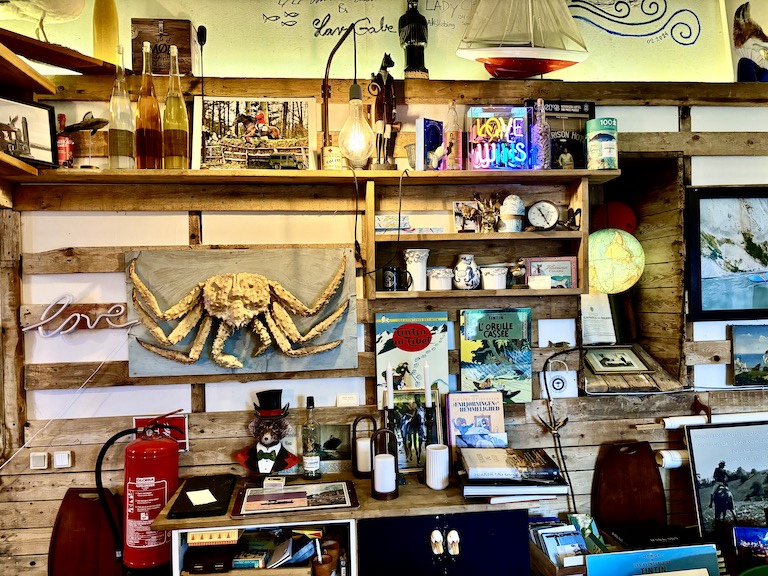
Klintholm Havn: A collection of environmental actants generating atmosphere
Why actant?
In order to develop a consistent approach in which the narrative, the environmental and the people dimensions of narrative environments are all understood to act, it is necessary to adopt a theory of action that is post-humanist in the sense that it does not put human agency first and foremost, but contextualises it within a field of more complex systemic, networked or rhizomic performance and performativity, while also acknowledging the possibility that such fields of action can generate new contexts.
One such theory is that which has developed around the term ‘actant’, as ‘material-semiotic’ entity or an operational or performative collective. As Lynnette Khong (2003: 698) explains,
“Instead of thinking of the world as made up of human subjects reflecting and acting upon passive objects, we should consider it as being made up entirely of actants. Latour portrays actants as teleological beings that come into existence only through their engagement with other actants (Sturdy, 1991, p. 164). In Pandora’s Hope, for example, Latour describes how, within the realm of scientific practice, actants interact with one another in order to become recognised entities, and to achieve a relatively stable position in a whole network of interactions.”
An actant is capable of exerting influence in a narrative setting (epistemologically, culturally, self-consciously), of effecting change in an environmental setting (ontological, ecological), and of altering perceptions, thoughts and emotions in a human intercorporeal and intersubjective, social setting (experience, consciousness, affiliation, empathy). In a narrative environment setting, an actant moves across these analytically-distinct fields, bringing them into relationship and effecting transformations across them, creating new ‘realities’.
In the words of Donna Haraway (1992),
“Non-humans are not necessarily “actors” in the human sense, but they are part of the functional collective that makes up an actant. Action is not so much an ontological as a semiotic problem. This is perhaps as true for humans as non-humans, a way of looking at things that may provide exits from the methodological individualism inherent in concentrating constantly on who the agents and actors are in the sense of liberal theories of agency.”
In the design of narrative environments, actantiality is an ontological, semiotic, epistemological and experiential issue at one and the same time.
A history of the term
The structuralist semiotician A.J. Greimas was the first to invoke the term actant in connection with narrative. However, he did not invent the word. In developing his actantial typology Greimas drew on the syntactic theories of Lucien Tesnière who, in Elements de syntaxe structurale (1959), translated as Elements of Structural Semantics (2015), likened a sentence to a little drama. Greimas drew on the syntactic theories of Tesnière in order to re-characterise Propp’s ‘spheres of action’ as actants (Herman, 2000).
For Tesnière, a sentence is like a drama. As a drama, it implies a process and, most often, actors and circumstances. The verb expresses the process. Actants are beings or things that participate in the process or that come into being through the process. Circumstants express the circumstances of the action (Melcuk, 2004). Tesnière acknowledged just three actantial grammatical functions: first actants (subjects), second actants (first objects), and third actants (second objects). Tesnière classified circumstants in the standard way, that is, according to the semantic content that they contribute to the clauses in which they appear, such as, temporal, locative, causal, final circumstances and those of manner, and so on.
When transposed from the plane of dramatic reality to that of structural syntax, the action, actors and circumstances become, respectively, the verb, the actants and the circumstants. The verb expresses the action. The actants are beings or things that participate in the action, in whatever capacity and whatever style this might entail, even if it is as mere walk-ons and in the most passive way imaginable. Actants are always nouns or the equivalents of nouns. Inversely, in a given phrase nouns always assume, at least in principle, the function of actants.
Tesnière’s actant vs. circumstant distinction is, for the most part, synonymous with the more modern terminology of argument versus adjunct . Actants (arguments) are necessary to complete the meaning of a given full verb, whereas circumstants (adjuncts) represent additional optional information, that is, information that is not essential to completing the meaning of the verb (Kahane, S. and Osborne, 2015).
Actant and narrative
As Timothy Lenoir (1994) explains, Greimas set out to produce a generative grammar of narrative in which a finite number of functional themes in binary oppositions juxtaposed with possible roles, such as subject-object, sender-receiver, helper-opponent, would generate the structures we call stories.
Greimas distinguishes between actants, which belong to narrative syntax, and actors, which are recognisable in the particular discourse in which they are manifested (Greimas 1987: 106). In simple terms, actors are the things in a narrative that have names, such as the King, Tom, Excalibur, while actants are the narrative units-functions they manifest. One actant can be manifested by several actors; and the converse is equally possible, just one actor being able to constitute a syncretism of several actants.
Beetz (2013) provides two examples of the use of these Greimasian actants:
“In a classical folklore tale, for example, the king (Sender) calls on his bravest knight (Subject) with his magical sword (Helper) to bring freedom (Object) to his daughter (Receiver), who is held captive by the evil sorcerer (Opponent); every actant is manifested by one actor. But in the comic series Batman, Subject and Sender are the same person in the narrative. Bruce Wayne (Sender), who gives himself the mission to bring justice to Gotham City (Object) is Batman (Subject), who fights The Joker, Poison Ivy and others (all Opponent) to secure the lives of the citizens of Gotham City (Receiver).”
These examples show that actants can be manifested by several actors and that one actor can manifest several actants. They also show that actants do not have to be manifested by human characters, as is the case in the freedom of the daughter, justice for Gotham City. Objects and abstract concepts can be actants just as much as humans, as long as they can be identified as ‘that which accomplishes or undergoes an act’. Furthermore, in a dynamic interpretation of Greimas’s semiotic square, one actor, over the course of a narrative unfolding, can pass through all modalities of actantiality (sender receiver, subject, object, helper, opponent)
Greimas’s actants, like Bruno Latour’s in his actor-network theory, therefore, are not solely human actors. Actants can also be non-human for Greimas as well as Latour. Actants are syntactically defined, and, for Greimas as for Latour, the performance of the actor presupposes competence. Subjects are defined not only as subjects but also by the position occupied in a narrative journey, a journey characterised by the acquisition of competences. Actors are constructed as the conjunction of actantial and thematic roles on this two-by-two grid (Lenoir, 1994).
An actant is a class of ‘characters’, in the broadest sense of this term, which have the same function in their different manifestations in a narrative. Actants appear as certain forces, powers or capabilities in a given text, situation or field. They are by no means equivalent to ‘actors, i.e. the concrete characters of a story or the dramatis personae of a play. (Rulewicz, 1997)
The reasons for requiring the concept of actant are as follows, as explained by Rulewicz:
Firstly, an actant may be abstraction, such as God, Freedom or Equality; a collective character, such as the chorus in ancient tragedy, a group of characters fulfilling the same tasks, like soldiers in an army; or an actant may be represented by different characters that all act in a definite way. It should be added that an actant may be an animal, organism, inanimate object or, indeed, an environment, so long as one understands the term ‘environment’ actively, as an ongoing process of contextualisation and environing.
Secondly, one character may simultaneously or successively assume different actantial functions.
Thirdly, an actant may or may not appear as a presence in the narrative, nor does it have to appear in the utterances of the characters. An actant may be the general abstract notion which is presented on the ideological level of the narrative.
Actant, actor-network theory [actant-rhizome ontologies]and new materialism
In the context of actor-network theory, Akrich and Latour (1992: 259) define the term actant as:
“Whatever acts or shifts actions, action itself being defined by a list of performances through trials; from these performances are deduced a set of competences with which the actant is endowed; the fusion point of a metal is a trial through which the strength of an alloy is defined; the bankruptcy of a company is a trial through which the faithfulness of an ally may be defined; an actor is an actant endowed with a character (usually anthropomorphic).”
Haraway (1992: 313) poses the question of actant and actantiality as one of ontology rather than representation:
“I have stressed actants as collective entities doing things in a structured and structuring field of action; I have framed the issue in terms of articulation rather than representation.”
Haraway (1992: 332) suggests that perhaps her approach comes down to,
“re-inventing an old option within a non-Eurocentric Western tradition indebted to Egyptian Hermeticism that insists on the active quality of the world and on “animate” matter.”
Latour emphasises the way that humans, as actants, both act and are acted upon by other entities (Khong, 2003: 698). While borrowing from Latour, Jane Bennett (2010: 21), similarly to Haraway, evokes the vitality or vibrancy of matter,
“While the smallest or simplest body or bit may indeed express a vital impetus, conatus* or clinamen**, an actant never really acts alone. Its efficacy or agency always depends on the collaboration, cooperation, or interactive interference of many bodies and forces. A lot happens to the concept of agency once nonhuman things are figured less as social constructions and more as actors, and once humans themselves are assessed not as autonoms but as vital materialities.”
* Conatus: In a general sense, conatus is an effort or an attempt. More specifically, it is a tendency simulating an effort on the part of a plant or an animal to supply a want. Conatus is a central theme in the philosophy of Benedict de Spinoza (1632–1677). It is derived from principles that developed by Hobbes and Descartes. In Spinoza’s philosophy, conatus is an innate inclination of a thing to continue to exist and enhance itself. The Spinozistic conception of conatus has been related to modern theories of autopoiesis in biological systems.
** Clinamen: Is defined variously as an inclination or tendency to turn aside; a bias; or an event without any cause, this last in reference to the Epicurean theory of the causeless swerving of atoms.
References
Akrich, M. and Latour, B. (1992). A Summary of a convenient vocabulary for the semiotics of human and nonhuman assemblies. In: Bijker, W.E., and Law, J., eds. Shaping technology/building society: studies in sociotechical change. Cambridge, MA: MIT Press, 259–264.
Bennett, J. (2010). Vibrant matter: a political ecology of things. Durham, NC: Duke University Press.
Greimas, A. J. (1987). On Meaning. Minneapolis: University of Minnesota Press.
Haraway, D.J. (1992). The Promises of monsters: a regenerative politics for inappropriate/d others. In: Grossberg, L., Nelson, C., and Treicher, P.A., eds. Cultural studies. New York, NY: Routledge, 295–337
Herman, D. (2000). Existentialist Roots of Narrative Actants. Studies in Twentieth Century Literature, 24 (2), 257–270. Available from https://newprairiepress.org/sttcl/vol24/iss2/5/ [Accessed 17 November 2018].
Kahane, S. and Osborne, T. (2015). Translators’ Introduction. In: Elements of structural syntax. Philadelphia, PA: John Benjamins.
Khong, L. (2003) Actants and enframing: Heidegger and Latour on technology, Studies in History and Philosophy of Science Part A, 34(4), pp. 693–704. doi: 10.1016/j.shpsa.2003.09.003.
“Abstract semiotic models like the very articulate and powerful one developed by Greimas and his school should, therefore, be conceived not as point of arrival but as point of departure of the comparative analysis [of cultures of meaning], offering a solid framework in relation to which contrasts could be observed and differences pinpointed.” (Leone, 2020: 193)
Joanna Kwiat (2008: 43) suggests that the actantial model of narrative structure proposed by Greimas (1983) drew on at least four theories: Levi-Strauss’ theory of opposition, which states that a given concept A is impossible to comprehend without the equal and opposite concept Not A, and how A necessarily entails Not A, and thereby every possibility between; the syntactical functioning of discourse; the inventory of actants proposed by Vladimir Propp, which he called “dramatis personae”; and the inventory of actants proposed by Etienne Souriau, which he referred to as “dramaturgic functions”.
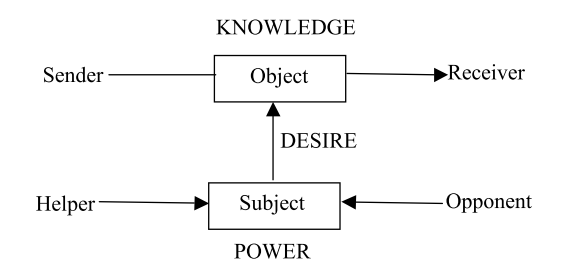
As Kwiat explains, in Greimas’ actantial model, there are six actants that form three pairs or oppositions: subject vs. object, sender vs. receiver and helper vs. opponent. These oppositions generate three types of relations: desire, which is felt by the subject for the object; knowledge, constituted by communication between sender and receiver; and power, realised through the agonistic struggle between helper and opponent (in relation to subject vs. object and sender vs. receiver).
These actants may combine. For example, there can be a duality of roles, in which one desires something in and receives something from the other who sends. Helper and Opponent may similarly combine with Subject, being at once the (conscious) will yet also the the (unconscious) resistance to act in fulfilling desire.
Conversely, a single actant may be instantiated with more than one actor, e.g. a multiplicity of helpers.
Propp had studied Russian folktales and described their constituent functions. After studying the relationships of these functions and the characters to which they were attributed, he defined certain spheres of action and seven characters to which these spheres corresponded. For Propp, the inventory of the functions could be reduced to 31 functions that had to be in a sequential order. Greimas saw that, with a structuralist approach, these functions and characters could be still much more reduced and freed from the sequential constraint. He accomplished this in his first book, Structural Semantics (Peisa, 2008).
Greimas first turned to the seven characters, which he reformulated as the three opposing actant-pairs: subject versus object; sender versus receiver; and, more hesitantly, helper versus opponent. The defining relation between subject and object was desire that could be manifested as the subject’s quest for the object. The sender’s and the receiver’s relation was that of communication. The helper and opponent again appeared to Greimas more as circumstants (circumstantial features of the action) that, as partial formulations of the subject, affect his abilities (Peisa, 2008)
A strategic consideration was that these actants were not necessarily tied to a single representative character in the narrative. Based on Propp’s material Greimas then constructed a model, depicted in the diagram below, where the object of the subject’s desire is also the object of communication, in a sender-receiver vocabulary, or the object of knowledge, in a knower-learner vocabulary. This is the form in which the actantial model has usually come to be known although, as Peisa (2008) notes, Greimas himself has rarely referred to it in this particular graphic form.
The actantial model first appeared in its canonical form in 1966 in A. J. Greimas’s Semantique structurale (Structural Semantics). It was later refined by Greimas in his 1973 essay on “Actants, Actors, and Figures”. The model was widely influential, adopted and adapted in much subsequent narratological work.
References
Greimas, A. J. (1983). Structural Semantics: An Attempt at a Method. Lincoln: University of Nebraska Press.
Herman, D. (2000). Existentialist Roots of Narrative Actants. Studies in Twentieth Century Literature, 24 (2), 257–270. Available from https://newprairiepress.org/sttcl/vol24/iss2/5/ [Accessed 17 November 2018].
Kwiat, J. (2008). From Aristotle to Gabriel: a summary of the narratology literature for story technologies. Technical Report, KMI-08-01. Milton Keynes: Knowledge Media Institute, Open University, Available from http://kmi.open.ac.uk/publications/pdf/kmi-08-01.pdf [Accessed 8 October 2015].
Leone, M. (2020) On insignificance: The Loss of meaning in the post-material age. London, UK: Routledge.
Peisa, J. (2008). The Unable individual. The actantial analyses of three Chinese films and discussion on their representations of the individual’s position in contemporary Chinese society [Master’s thesis]. University of Helsinki. Available from https://helda.helsinki.fi/handle/10138/19218 [Accessed 12 September 2015].
Further Reading
If you are interested in pursuing further research into A. J. Greimas and his work in semantics, semiotics and narratology, it is worth having a look at Sign Systems Studies, Vol 45, No 1/2 (2017): Special issue: A. J. Greimas – a life in semiotics. It can be found at http://www.sss.ut.ee/index.php/sss/
For a discussion of the limitations of Greimasian semiotics, See Leone, M. (2020) On insignificance: The Loss of meaning in the post-material age. London, UK: Routledge.
RELATED TERMS: Deictic Cascade; Diegetic Levels; Heterarchy; Metalepsis; Modes of Existence; Tangled Hierarchy and Strange Loop; Transgression
Designs enact deictic cascades that frame their actions, or their actantiality, their potential for action, in the theoretical language adopted here. In practice, such hierarchical cascades of deixis form strange loops and heterarchies, giving shape to the shared, common world as a social fiction or a social imaginary.
As ongoing constructions, social fictions and social imaginaries are not understood here as deficient or lacking in some sense. They are understood in a deconstructive sense as being both inventive and affirmative. In this context, designs are not simply objects (tautological things – ‘this is this’), statements (assertions or constatives – ‘this is a thing’), performatives, such as commanding or promising, although they could be taken as each or all of these kinds of example; they are also evocative. They evoke worlds as social imaginaries, both for participants in any given world-imaginary and observers of it.
Design practices, as cultural practices, involve cascades of deixis, similar to those found, for example, in drama. In drama, as Brandt (2016) explains, the first instance is the framing deixis of theatricality, or perhaps, more awkwardly, dramaticity or dramaturgicality: “I am now acting, and not behaving naturally”. The second instance is the narrative deixis: “I am now playing the role of a character in the story X”. The third instance is the aesthetic deixis: “I am shaping this role in a certain way and signing this version as ‘this way’ of playing it here now”.
The difficulty with design practices is that their cascade of deictic acts, as deictic framings, unlike, for example, those in drama, fine art or such performance media as dance, do not take place in a specific location or place, such as a theatre or gallery, to which one has to go in order to experience them. Since they take place in a range of situations, in the flow of ‘everyday life’, they may not be recognised as having a cascade of deictic acts by means of which their social and cultural meanings unfold. This may be because, unlike drama, fine art and dance, there is an expectation that designed phenomena have a staightforward instrumental function that exhausts their ‘meaning’. So, while designed phenomena may be recognised as what they ‘do’, their action is often understood solely as functional, instrumental, operational or ‘immediate’, that is, un-mediated.
The difficulty, in other words, is to open up the first instance of the framing deixis of the design, “I am now acting artificially or technically, not simply naturally, functionally, instrumentally or operationally”. This instance already assumes a theory of actantiality, wherein the design, in whatever form, whether symbol, object, technical artefact, service or environment, assumes a certain ‘agency’ in the networked or systemic situation being enacted. From there, one may begin to understand the further instances of deixis: “I am now playing the role of a character in the unfolding situation X in world Y”; and “I am shaping this role in a certain way and signing this version as ‘this way’ of playing it here and now”.
In understanding the instances of deixis, one may begin to grasp the modes of action in which the design is engaged, in addition to the assumed functional, instrumental or operational role. Furthermore, this opens up the notions of functionality, instrumentality and operationality to scrutiny, drawing out the cultural modes of action and the cultural assumptions on which they rely that are subsumed under those headings.
The discussion of deixis is valuable for design practices if it is tied into the discussion of levels of discursivity, especially in narrative discourse (diegetic levels), in relation to the implied modes of existence (or levels of existence), particularly if the focus is upon the potential transgressions, or metalepses, in the narratological sense, that may be effected through the designed instance: the appearance of a character or an entity from one level of discursivity or narration, and implied existence, in another level of discursivity or narration, and implied existence.
If the notion of levels is used, it should become clear fairly soon that any kind of hierarchy implied by the notion of level (higher or lower) will itself become problematic in design practices, as designs form strange loops or tangled hierarchies in which the top of the hierarchy becomes the bottom and vice versa, through the reflexive consciousness that the design provokes and engenders.
Such transgressions and strangenesses necessarily take place against a deictic centre, for example, a norm or an accepted reality, whose grounding, orientations and horizons and in whose person deixis ‘you’ are ‘now’ situated ‘here’, are overturned, so that ‘you’ are ‘now’ situated ‘there’, on other ‘grounds’. The participant in the design experiences both the deictic grounding and the transgressive overturning, as a passage and a disturbance which provokes learning, in the form of the questions raised for the participant, implied in the designed artefacts, by ‘now’ situating ‘you’ both ‘here’ and ‘there’ (or possibly situating ‘you’, ‘you’ and ‘you’, ‘here’, ‘here’ and ‘here’ and ‘there’, ‘there’ and ‘there’, and so on, indefinitely).
This highlights the complexity of the temporality, with (at least) three ‘nows’, and the spatiality, as a proliferation of ‘heres’ and ‘theres’, of the designed artefact achieved through the practices of deictic and indexical grounding and transgressing.
Allan Parsons, edited June 2025
References
Brandt, P. A. (2016) ‘Deixis – a semiotic mystery: Enunciation and reference’, Cognitive Semiotics, 9(1), 1–10. doi: 10.1515/cogsem-2016-0001



 Incomplete ...