RELATED TERMS: World; World-Building; Worldlessness #1; Worldlessness #2: Worldlessness and Design
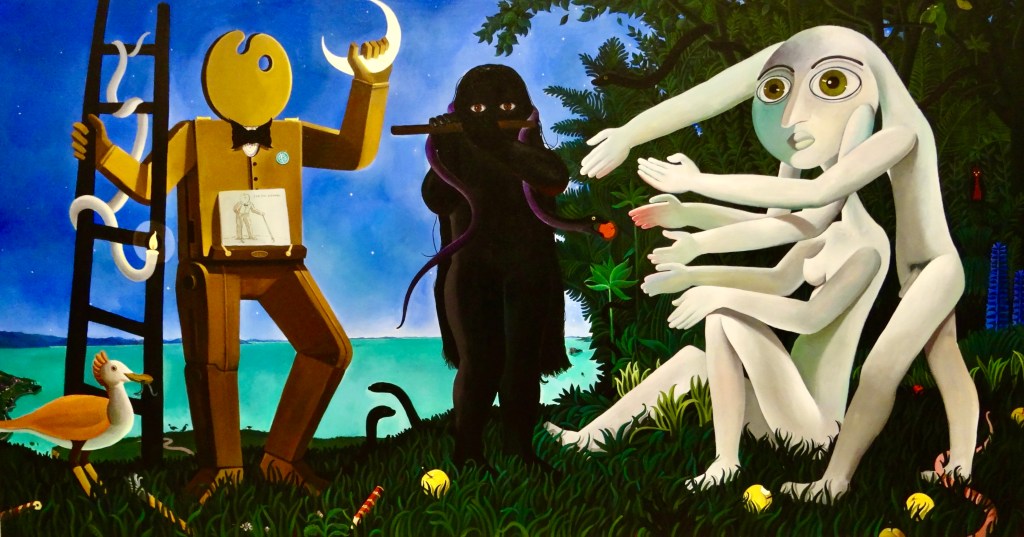
METAPHYSICS No need to know what it is. Laugh at it: this creates an impression of great intelligence. (Flaubert, The Dictionary of Received Ideas)
“Folks cried and laughed and hugged each other and called out loud for the end of the world. No one poured cold water on this by asking, What does that mean — the end of the world? How can you say that? Where’s that going to leave us? Or, How will we make sense of the end of the world when we go back to speak with our “allies”?” (Wilderson, 2020: 205-206)
In the Worldlessness #2 post, it was noted that Roland Vegso, in his book Worldlessness After Heidegger, could be interpreted as posing a challenge for designers, artists, activists and academics. This challenge is:
to imagine worldlessness without an apocalypse;
in non-eschatological terms, (without an ‘end of the world’);
in non-salvational terms (without ‘saving the world’, without redemption or liberation);
And without a sense of loss (because you cannot lose what you have never had and cannot have).
[We might add a further challenge here: to imagine worldlessness in non-utopian terms.]
Picking up initially on the threads of this secular eschatology and salvation[1], many media and academic discourses circle around the need to acknowledge the impending ‘end of the world’ or, more actively, to ‘end the world’ or to ‘end this world’; or, alternatively, the need to ‘save the world’.
Firstly, for example, Claire Colebrook (2017) comments that, “[t]he end of the world is a growth industry” while Marquis Bey (2022: 12), in Black Trans Feminism which explores the othernesses of blackness, transness and womanness, argues that,
“It is untenable to stick with what we have now, what exists now, if we heed that a radical end of the world requires a radical end of this world and its signatories.”
In another example, Andrew Culp (2016), in exploring the centrality and the limits of state-centric political order, states that,
“My ultimate purpose is to convince readers to completely abandon all the joyous paths for their dark alternatives. The best scenario would be that these contraries fade into irrelevance after Dark Deleuze achieves its ostensible goal: the end of this world, the final defeat of the state, and full communism.”
Secondly, in the context of saving the world, Claire Colebrook, for example, critiques such salvational attitudes. In Who would you kill to save the world?, she writes that,
“We have plundered the earth, laid waste to the planet by way of centuries of colonialism, slavery, genocide, holocaust, and other barbarisms … Yet in the face of the destruction of this all-too-fallen world, the response seems to be … that for all the ills of the past and all the horrors of the present, the world needs to be saved.” (Colebrook, 2023: 10)
Elsewhere, Claire Colebrook (2021) has expressed the paradox for contemporary theory in the following way: “it is certain that the world cannot be saved; even so, theory can have no other task but to save the world.”
Analogously, applying this insight to design theory and practice, it might be argued: it is certain that the world cannot be saved; even so, design can have no other task but to save the world.
For Colebrook, this historical sense of world-forming, and the salvational response with which it continues to be met, leads to a recognition of an, “ongoing drama of us and them, the world and the worldless”[2].
In the context of such discussions of worldliness, worldlessness, being-marginalised and being-erased, Tyrone Palmer, a practitioner of Black critical thought, notes that it is Calvin Warren who explicitly brings together worldlessness, blackness, antiblackness and, to bring us back to Vegso’s book, Heidegger. Thus, in a 2022 interview, Palmer comments that what he takes from Calvin Warren’s book, Ontological Terror, is that,
“the Negro is the figure par excellence of worldlessness — situated as without capacity for world or ‘world-forming’.” (Palmer and Sirvent, 2022)
Calvin Warren, in borrowing from Frank Wilderson, who asserts, in Red, White and Black (Wilderson, 2010: 38), that “Africans went into the ships and came out as Blacks”, theorises the ontological-historical emergence of black being in the following way:
“Something new emerges with the transport of the African. The African becomes black being and secures the boundaries of the European self — its existential and ontological constitution — by embodying utter alterity (metaphysical nothing). Metaphysics gives birth to black being through various forms of antiblack violence, and this birth is tantamount to death or worldlessness. (Warren, 2018: 38)
For Warren (2018: 82), “The Negro is a saturation of abject historicity and worldlessness.”[3]
Through a reading of Martin Heidegger’s Introduction to Metaphysics, Warren (2018: 179-180) argues that,
“black being lacks precisely this historical place (there-ness) that situates the human being in the world. Black being, then, lacks not only physical space in the world (i.e., a home) but also an existential place in an antiblack world. The black is worldless in this way, bordering on something between the worldlessness of the object and the world poorness of the animal.” [4]
Notes
[1] For Wagar (1982:6), cited by Lup (2013), eschatology is that which, “seeks and analyzes answers to the question of what will happen at the end — the end of time, the end of man, the end of civilization.” For Carl Mitcham (2000: 146), alternatively, in a view that is directly relevant to design practices, “Eschatology, the study of last things, has been displaced by the study of artifacts, technology.” That is, Mitcham suggests, the ‘things’ that environ us, and the (normative?) ‘pragmatism’ to which they adhere us, crowd out thought of other horizons, whether spatial, temporal, imaginative or affective.
The discourse on end times, and ambivalence towards it, is perhaps a perennial cultural or literary theme. For example, in a review of Elisabeth Roudinesco’s Philosophy in turbulent times, Elif Batuman (2008) points out that,
“On the one hand, Roudinesco rejects the ‘catastrophic outlook’ of those who announce ‘the end of history, the end of ideology, the end of towering individuals, the end of thought, the end of mankind, the end of everything’, and who claim ‘to bear witness to a new malaise of civilisation’. On the other hand, this seems to be just the kind of malaise she claims to be witnessing … “
Discourse on the end of the world has been given a contemporary twist, in the context of a history of modernity, by the debates on the Anthropocene. Kathryn Yusoff (2018) opines that,
“The Anthropocene might seem to offer a dystopic future that laments the end of the world, but imperialism and ongoing (settler) colonialisms have been ending worlds for as long as they have been in existence. The Anthropocene as a politically infused geology and scientific/popular discourse is just now noticing the extinction it has chosen to continually overlook in the making of its modernity and freedom.”
Geoff Mann (2026), however, seeks to historicise the emergence of such modern secular eschatology more precisely. He comments that,
“Contemporary fictions are preoccupied with apocalypse, human extinction and cataclysm, but as Dorian Lynskey makes clear in Everything Must Go: Why We Are Obsessed with the End of the World, this is nothing new. Secular eschatology is young compared to its millennial Christian variations, but it still has a history two centuries long, beginning, Lynskey says, when Byron ‘killed the whole world’ in his poem ‘Darkness’ “
Furthermore, by way of a partial explanation of this prevalence, Mann cites Frank Kermode who, in The Sense of an Ending (1967), argued that,
“one of the things eschatologies of all kinds do is to provide people with narrative closure. We are uncomfortable, he suggested, with the idea that we are all of us mere players in the middle of history. Apocalypses and other endings give us a sense that we can be there for the climax, to see how it all turns out.”
In this quote from Kermode, we might see the confluence of narrativity and historicity, the desire for historical events to be graspable by narrative, in this case understood as a linear progression of story from beginning to ending, and the desire to have an overview or transcendent grasp of this ‘whole’.
This quote also evokes the distinctions among teleology, eschatology and messianism as concepts that are concerned with ends, goals or purposes within human experience and within nature and which seek to define how a system, such as human history or the unfolding of the cosmos, can be understood. For example, teleology might be grasped as the purposeful design, eschatology as the final outcome of that design and messianism as the inaugural figure of the eschatological periodisation in question, a period with a specified beginning and a prefigured end, marking a new beginning.
As Lup (2013) explains it, eschatology was introduced to the West through the biblical texts, while teleology arrives through Greek philosophy. In Greek, telos had the primary meaning of ‘coming to pass,’ ‘completion’ or ‘attainment,’ applied either to time or space. Like eschatology, teleology is the study of ends or final causes particularly as it applies to design or purpose in nature – that is, not ‘design’ and ‘purpose’ as conceived in the modern industrialised-technologised-urbanised era.
According to Lup, understanding of telos was not unanimous among Greek philosophers. For example, the early Greek philosophers, such as Heraclitus, Anaxagoras and Diogenes of Apollonia, applied it to a general causal principle or arche, such as fire or nous (mind, intellect or reason), governing all the cosmos. In the Timaeus and the Laws, Plato distinguished between works produced by nous, the principle factor of design (techne), and those arising out of necessity (ananke), identified with chance-nature. For Plato nous was the dominating factor in the teleological scheme. However, for Aristotle, telos is essentially the Good and final cause of the cosmos, limiting nous to human techne (Peters 1967:191-192).
These refinements concerning telos and nous raise the issue of how thinking about design might incorporate, consciously or unconsciously, intentionally or unintentionally, teleological, eschatological, salvational and messianic elements through the figure of ‘the designer’, the outcome of design processes as form and event and the argument about the role of the designer in a period when everyone designs (Manzini, 2015).
The implications for design practices might include having to accept (always-already)-being-in-the-middle-of-things in two resonances: being-in-the-middle, a medium, being-in-between, being-with; and being-in-the-middle-of-things, immersion in non- and more-than-human material processes. In other words, can we accept that design and designing occurs in the midst of the designed undesign and the undesigned design of worldly worldlessness, the somewhat messy indeterminate intermediate, where particular design interventions have ill-defined repercussions at different spatio-temporalities and remain in-the-ongoing-middle-of-things as medium and mediator?
[2] In terms of Colebrook’s distinction, it might be preferable to propose that the difference concerns not ‘the world’ and ‘the worldless’ but ‘the worldly’ and ‘the worldless’, that is, a distinction between those included in the world, even if marginalised, and those eliminated or erased from the world.
As noted in Theory [Snippets 11], this particular concern for othering, the rendering of an us and a them, is highly relevant for those discourses which start out from an initial position of being them, of having been othered. This may be a position of marginalisation, which might be described as the ‘difficult’ challenge of ‘liminal existence’, given the constitution of the existing world. Alternatively and more radically, it may be a paradoxical starting point of non-being which might be characterised as an ‘impossible’ challenge of ‘non-existence’ or the challenge of living an existence in ‘objecthood’ or ’social death’, a life of persistent resistance as an ‘object’, or obstacle, given the constitution of the existing world – although it is Fred Moten (2003: 1) who makes it clear that such ‘objects’ are capable of resistance: “The history of blackness is testament to the fact that objects can and do resist.”
The question of whether and how this difference between two kinds of othering and two kinds of exclusion, that is, exclusion from the centre of power and exclusion from the being human, can be sustained is raised in a particularly acute form in discussions within the field of Black Studies in the USA where, as a matter of passing interest, Brar and Sharma (2019) suggest many of the issues raised in British cultural studies from the 1960s onwards migrated when the discipline was more or less obliterated in the UK during the 1980s. This distinction may be expressed as one between othering in the context of marginalisation and othering in the context of annihilation or extermination, perhaps as two forms of dehumanisation, one more acute and more lethal than the other.
On the one hand, the questions which open up here concern the relationships among existing debates about the different levels or kinds of processes of othering, pertaining to: otherness in general (generic others); particular others (categorically identified others); the unique or singular other (the named other); the other as unnameable (language limit); and the other as unrecognisable (perceptual limit). As suggested above, these processes bring to attention the limits of language, perception and sense-making, that is, they engage with the ‘ungraspable,’ as discussed by Alžbeta Kuchtová (2024); and, indeed, drawing in the broader context of the discussion here, the limits of world-making, world-ending, world-saving and worldlessness (‘worlding’ in all its forms).
On the other hand, these issues concern the cultural, intellectual and historical horizons opened by those discourses, such as those within the field of Black Studies, which posit the impossible possibility of operating from a position of non-being: the positing of an utter alterity which nevertheless serves as necessary for world-forming itself, the forming of an interiority (in this example, human being) through the consigning to an exteriority, as non-existence, of those deemed other (in this example, Black non-being).
A sub-question that arises here is what kind of process, a posited anti-Backness, is in play by means of which a ‘positivity’, that is, human being, is sustained or indeed brought into being by a ‘negative’, that is Black non-being; and indeed why is one characterised as ‘positive’ and the other ‘negative’ if they require one another to exist-non-exist. Is it a dialectic, a play of necessary contradictions forming a ‘whole’? It is not, in this case, a simple societal ‘oppression’ but an ontological dynamic.
This issue of different forms of othering is discussed by Chipato and Chandler (2023: 158) who argue that modernity has always contained two understandings of the limits of alterity, that is, the processes that define the othernesses of the worldly (liberal) human at the centre. They classify them as, firstly, the limits of difference, grasped in discourses of division-race, that is, the temporal and spatial limits of coloniality; and, secondly, the limits of otherness-ontology, that is, the limits of being and non-being. Often conflated in contemporary thought, Chipato and Chandler argue that it is important to grasp their difference.
They examine and discuss three key perspectives on these problems of alterity which they call the Planetary, including such theorists as Donna Haraway, Anna Tsing, Timothy Morton, Bruno Latour and William Connolly, loosely referred to as ‘new materialism’; the Pluriversal, including the work of Deborah Bird Rose, Deborah Danowski, Eduardo Viveiros de Castro, Arturo Escobar and Walter Mignolo, loosely referred as decoloniality; and the Black Horizon, including the work of Nelson Maldonado-Torres, Saidiya Hartman, Christina Sharpe, Fred Moten and Edouard Glissant.
The discussion here focuses on differences within the Black Horizon itself which may be characterised as a division between the non-ontological, as in Afropessimism, and the para-ontological, as in the work of Fred Moten among others. This issue is explored in the following paragraphs. This raises the possibility that othering may be considered as a logic of difference, marked by hierarchisation (power struggle, hegemonic struggle); a logic of elimination, marked by violence (life and death struggle); and othering as the pre-condition for the proliferation of living alternatives, the generation of other forms of subjectivity and sociality, that ‘avoid’ elimination (survive) and ‘ignore’ (power or political or hegemonic) hierarchisation.
One aspect of this overall discussion is that of incomparability. For example, in the context of Afropessimism within Black Studies, Frank Wilderson argues that there is no analogy between the position of ‘Blacks’, who are socially dead ‘objects’ without agency and without capacity, and other oppressed, displaced or dispossessed groupings, who are marginalised but do have limited agency and capacity. In short, the (structural, ontological, necessary) position of Blacks is incomparable to the positions of others (peripheral, phenomenological, contingent). For Wilderson (2010: 37), “The ruse of analogy erroneously locates Blacks in the world – a place where they have not been since the dawn of Blackness.” On his website, Wilderson (no date) writes:
“Rather than celebrate Blackness as a cultural identity, Afro-Pessimism theorizes it as a position of accumulation and fungibility; that is, as condition — or relation — of ontological death”
Thus, for this Afropessimist line of thought, other marginalised, oppressed, displaced or dispossessed groups are not in a position that is analogous to Blacks. Anna E. Stoutenburg (2022) points out that while Lee Edelman, in his work on queer negativity, seeks to utilise the framework of Afropessimism, it is that very framework that explicitly argues that there is no way to analogise antiblackness with any other form of oppression, including queerness and anti-queerness. Wilderson’s point, according to Stoutenburg, is that, even though there are different methods of oppression, such as classism, patriarchy, homophobia, transphobia and so on, antiblackness is premised on the need for the Black subject to be the (ontologically generative) foil to the modern ‘human’ whom it sustains. Stoutenburg cites Wilderson (2020) as saying, “The antagonist of the worker is the capitalist. The antagonist of the Native is the settler. But the antagonist of the Black is the Human being.”
Calvin Warren makes the non-analogous relationship between blackness and, in this example, queerness, explicit when he argues that,
“The “Black Queer” does not and cannot exist. This is an ethical statement about the tension between what Frank Wilderson would call “an experience of unfreedom” (Queerness) and a structural position of non-ontology (Blackness).”
Stoutenburg glosses Warren’s argument, rather problematically, as follows:
“Warren correctly identifies the fact that the Black queer subject will always be treated Black first, as queerness is simply another axis of oppression that is on top of that ontological foundation.”
This way of expressing the matter is problematic in as far as it is decontextualised. Rather than saying, for example, that in the history of the USA the black queer subject will be treated as black first, she suggests, following Warren, that all situations conform to a ‘universal’ situation in which this essential hierarchisation of subject qualities always holds.
Stoutenburg (2022) brings to attention one contributing factor to the Afropessimistic characterisation of the incommensurability of the Black-American experience to other forms of oppression by noting Wilderson’s (2022: 33′:00”-35′:40”) response in an interview to the question of what he means by his borrowing of Gramsci’s dictum, ‘pessismism of the intellect, optimism of the will’.
Wilderson begins by explaining that, in the setting of multi-racial activist coalitions, in his experience and that of fellow graduate school black activists the expression of the specificity of black oppression was being marginalised and closed down. Similarly, in the academic context, the resources provided by such critical discourses as Marxism and psychoanalysis, in their descriptions of what it means to be oppressed, flattened out the differences among different forms of oppression. The limitations of these Western discourses became palpable in attempting to use them to think through blackness.
In these activist and academic contexts, Wilderson became pessimistic about the potential of the intellectual production that is possible through, for example, Marxism, psychoanalysis and other Western critical discourses, in their attempts to universalise suffering. Nevertheless, he remains optimistic about the intellectual and emotional capacity of black people on the ground to respond creatively to their specific situation of oppression.
It is in this light that the elevation of (anti-)blackness over all other forms of oppression can be understood, as a counteraction to undo the practices of being subsumed by non-black perspectives expressing the ways that they had been mistreated through, for example, misogyny, homophobia, xenophobia and so on. In other words, it is not an aggressive dismissal of other forms of oppression but an affirmative assertion of the importance of the black experience which was being undervalued.
Thus, it might be argued, as does Stoutenburg (2022), that Afropessimism is not overly concerned with the lived realities of other groups, just as other frameworks which analyse oppression are not overly concerned with the specificity of Black experience.
Seeking to separate in this way the experiential-phenomenological, for example, queerness and anti-queeerness, from the ontological-real, for example, blackness and antiblackness, makes it difficult to understand what the relationships might be among the notions of the Black, Blackness, Blacks, Black people, Black Americans, the Black American experience or the experience of Black people in the USA as socio-epistemological categories and as socio-historical phenomena in changing circumstances. How are ‘axes of oppression’ to be defined and understood if a universal, unchanging, static, ‘grammatical’, ‘structural’, ‘sedimentary’, ‘foundational’, ‘ontological’ framing is assumed. The specific, parochial, historical situation seems here to be merged with general, universal, unchanging situatedness.
In other words, this founding of the black and the human (as essences?, as substances?) through (the processes of, the violence of?) anti-blackness might seem to suggest that both the human and the black are ‘fully there’, even if in (a dialectical?) negation of one another, which undermines the recognition articulated by Athanasiou (2003) that, “In the clefts of history and at the limits of representation, the cut body of humanity tells the story of the indeterminability that haunts the dreams and nightmares of the ‘fully there’.”
The initial scenario presented above seems to suggest two separate and distinct kinds of othering and/or two kinds of ‘negating’: the semantic-symbolic, on the one hand, a logic of sameness-difference, combined with hierarchisation, the one over the other, which can be reversed or inverted; and the ontological-real, on the other hand, a logic of erasure, elimination or annihilation, the one eliminating the other, which is an irreversible part of an ongoing dialectical generation – antiblackness ‘creates’ the human.
Indeed, Wilderson (2020: 205) argues as much in Afropessimism when he writes that, “what the [conference] organizers had unleashed was a realization that oppression has two, not one, regimes of violence: the violence that subjugates the subaltern and the violence that subjugates the Slave, or the Black.”
However, singer, songwriter and visual artist Anohni, in an interview in The Guardian (Jonze, Basinski and Anohni, 2026), comes close to proposing that these two registers of othering are not easily separable but are interwoven systemically when she says, speaking from a position aligned to queerness in one of its senses, that,
“we came from an era of Aids. We came from a community that was viscerally and intimately experienced in the feeling of annihilation. So when we watched 9/11 I remember being scared, but also feeling that this kind of trauma was familiar to me. … Young people in our community had experienced an apocalyptic event that took their best friends, their family members and mentors. My sense of things was that Aids, 9/11, and the emergence of global ecocide were all aspects of a system that was deeply unwell.”
Anohni continues,
“The feeling that most people around the world carry with them now [in the 2020s], that sense of unease about the present and dread of the future, is something that some of us were already sitting with back then, maybe with slightly different imagery populating it, but with the same sense of the stakes and the scale. It was made obvious to us much earlier, as queer people, than it was to heterosexuals in the west.”
Anohni, in a sense, is tracing a reverse passage of knowledge from the margins (peripheries) to the ‘centre’ or from the ‘tributaries’ to the ‘mainstream’. That such a passage is possible is questioned by Afropessimism. A similar anachronism to that brought to attention by Anohni in terms of moments of realisation is highlighted by Yusoff (2018) in respect the Anthropcene:
“If the Anthropocene proclaims a sudden concern with the exposures of environmental harm to white liberal communities, it does so in the wake of histories in which these harms have been knowingly exported to black and brown communities under the rubric of civilization, progress, modernization, and capitalism.”
One path out of this aporia of incomparability and comparability, the possibility or impossibility of analogisation, is suggested by David Lloyd (2020) through an examination of Fred Moten’s trilogy consent not to be a single being.
Fred Moten emphasises the anarchic performance of blackness as aesthetic sociality, in contrast to Afropessimists’ insistence that black people can have no access to civil society. In so doing, Moten critiques the overvaluation of the political and of freedom based on political subjecthood, citizenship and sovereignty. Nevertheless, Lloyd points out that when Moten (2018: 159) says that,
“Ultimately, the paraontological force that is transmitted in the long chain of life-and- death performances with which black studies is concerned is horribly misunderstood if it is understood as exclusive. Everyone whom blackness claims, which is to say everyone, can claim blackness.”
this detachment of ‘blackness’ from ‘bodies that are black’ may perform its own kind of erasure by displacing the historical labour of black social movements and the transformations they have effected with a preference for “black refusal of political subjectivity” (Moten, 2018: 101) .
Although Lloyd is sympathetic to Moten’s critique of the super-ordination of the political, he nevertheless remains perplexed by the extent and limits of a dissociation of blackness from black people. Thus he poses the question of, insofar as blackness is performative rather than being an attribute of a subject, how far ‘blackness’ risks becoming a portable term, like the postcolonial ‘subaltern’ or the race critical ‘intersectionality’, whose use is detached from any relation to the social histories these terms were intended to designate? The danger of this happening is significant because Moten’s work persistently pursues and performs a “disseminative dissolution of conceptual propriety” Lloyd, 2020: 90).
Even so, Lloyd wonders whether blackness can be thought outside the historical formation of the social and political life of black people because it is from their survival and improvisational creativity, under conditions of dispossession, captivity, enslavement, Jim Crow segregation laws and contemporary re-inscriptions of state-sanctioned anti-blackness, that Moten derives the ethical and aesthetic practices of blackness?
[Aside: In contrast to such improvisational creativity, Afropessimism limits ‘performance’ to a series of sequential socio-economic situational contexts, as if these constituted the ‘surface phenomena’ of an unchanging noumena:
“Afro-pessimism posits that the modern world is fundamentally a product of Black slavery and its afterglow. “The imaginary of the state and civil society is parasitic on the Middle Passage,” writes Wilderson (2010), such that the genocidal violence foundational to the invention of “Black” “remains constant, paradigmatically, despite changes in its ‘performance’ over time — slave ship, Middle Passage, Slave estate, Jim Crow, the ghetto, and the prison-industrial complex (p. 75).” ” (Craig and Rahko, 2025: 63)
Alternatively, Lloyd conjectures, is there any way in which blackness can become a path towards thinking the ensemble of practices forged in other subaltern spaces in other ways and with other relations to one another? For example, can fugitive forms of subaltern organising be rendered otherwise in light of the improvisatory flights of blackness?
Such historical and geographical examples when identified can be thought not as blackness but in relation to it. This is not on account of the abstraction of the concept into unlimited transferability. It is, rather, and perhaps paradoxically, “an index of the specificity of Moten’s deduction of the performative lexicon of blackness from the particular conditions of black social history” (Lloyd, 2020: 91).
In this light, as Moten insists, blackness is not an ontological essence. Blackness is an effect produced in, and productive of the trajectory of modernity and its aesthetico-political regimes and, as such, emerges in difference. It must therefore be thought in differential relation to other systems of racial formation. However, that thinking partake in a similar degree of specificity to that of Moten,
“such that any invocation of blackness as analogue or as a means to the theoretical displacement of normative conceptual or representational frames can only do justice to that term through a painstaking attention to social formations that have emerged precisely in difference from it.” (Lloyd, 2020: 91)
All of this raises, for design practices, questions of ‘knowing’, for example, knowing from whence (by whom and by what, by what mode of intelligence) and knowing when, (within what moment of what history and its historiography); aligned to the recognition that historiography itself is ‘designed’, for example by event selection and by story framing through focalisation and plotting. Within what historiography is design theory and practice articulated with what performative capabilities?
[3] In emphasising that “the Negro is the figure par excellence of worldlessness” (Palmer) and that “Something new emerges with the transport of the African. The African becomes black being and secures the boundaries of the European self — its existential and ontological constitution” (Warren), in addition to the question of the incomparability or otherwise of the black, blackness and antiblackness, as discussed in note 2 above, three other aspects of this overall discussion hove into view: the notions of the exemplary; the exceptional; and the causal (or deterministically generative). In passing, in relation to the discourse on design, much of this type of debate occurs in relation to ‘the iconic’: iconic designs and iconic designers, although they are not incomparable in as far as they are being compared favourably to other designs and designers, nevertheless are considered to be exceptional, exemplary and can serves as a ‘model’ for design practice and design products.
The incomparable, exceptional, exemplary and deterministic status of anti-blackness for Afropessimism can be understood as a rhetorical argument, a rejoinder and, indeed, rebuke, to post-World War Two philosophical discourses and to Western historiographical discourses that take the Holocaust (Auschwitz, the Shoah) as a foundational critical resource. Because it serves as an extreme ‘limit’ and a ‘model’ for Western philosophical and historiographical discourse, Afropessimists argue that the status of the Holocaust takes place at the expense of recognition of the Middle Passage and transatlantic slavery.
For Afropessimism, the Middle Passage, the forced voyage of enslaved Africans across the Atlantic Ocean to the Caribbean and the Americas, is modernity’s singular event, an event whose repercussions persist. This event invented, or allowed to come into existence, anti-blackness as the world’s constitutive antagonism, at the same time constituting the black as negation (Kaplan, 2019). Thus, Wilderson (2010) asserts, “the structure of the entire world’s semantic field – regardless of cultural and national discrepancies – is sutured by anti-black solidarity” (Wilderson, 2010: 58). The black is a, “sentient being for whom recognition and incorporation is impossible” (Wilderson, 2010: 55), a being that can never reach the Human because it is constituted only in antagonism to it.
In this conceptual horizon, antiblackness is more than oppression. Its emergence in the Middle Passage is an event as ereignis, a determining or ‘appropriating’ moment in history, a ‘founding’ moment of the history of the modern world, different (ontologically) from the (ontic) events within that history which the ereignis enframes, appropriates or with which they fall into line. This argument, it may be recognised, is a reconfiguration of the later Heidegger. Ereignis, Heidegger’s name for the event, is understood as the emergence of a new world within which all entities appear, a non-ontic and epochal disclosure of a new configuration of Being (Baki, 2015: 4). In short, in this historiography, the Middle Passage and the consequent practices of transatlantic slavery (the slave plantation) are not just without analogue (incomparable) and unusual (exceptional), they serve as a model (exemplary) that determines other events that follow (deterministic): they are, in short, incommensurable.
Parisa Vaziri (2022) cites Marc Nichanian’s (2009: 48–51) book, The Historiographic Perversion, which argues that it is Hannah Arendt’s articulation in Eichmann in Jerusalem of a new legal distinction between ‘inhuman acts’ and ‘crimes against humanity’ that set the stage for subsequent reflections on the incommensurability of the Holocaust with any other human event, including other historical genocides, while inscribing this difference in an international penal code. Afropessimism seeks to shift the debate on incommensurability to the Middle Passage and the consequent practices of transatlantic slavery, displacing the emblem of Auschwitz, the concentration camp, with the emblem of the slave plantation.
In one crucial sense, then, Afropessimism seeks to define the originary and orienting event of the modern world, the model that, through its exceptional character, establishes the limits of ‘normal’ (moral) and ‘rational’ (human) being. In so doing, Afropessimism seeks to displace the Holocaust as a key critical resource for postwar philosophy and historiography, re-framing those discourses in the aftermath or wake of the Middle Passage and Transatlantic slavery.
As Vaziri (2022) notes, black theorists’ interrogation of Holocaust exemplarity has a long, although not always recognised, genealogy. Following Aimé Césaire, Frantz Fanon saw the Holocaust as the manifestation of an immemorial violence against colonised peoples, one which was, in this instance, unleashed internally against the European body politic. It was only after racism had emerged as an internal European threat that it became possible to recognise that a certain violence had been present all along, but exerted outward against the non-European world.
At the time when Césaire and Fanon were writing, Black Studies did not yet exist as an institutionalised discipline; nor was the history of slavery, unlike Nazi genocide, considered an object worthy of European philosophical reflection, even if historically, slavery could be said to constitute the unconscious of Western philosophical discourse, for example, through its supply of metaphors for the articulation of philosophical concepts, sociality, and subjectivity and through its constitution of a frequently wild, ahistorical terrain for abstract speculations on human essence.
More recently, with the benefit of reflection and hindsight, Alexander Weheliye’s (2014) Habeas Viscus: Racializing Assemblages wonders concretely about the recourse to the Holocaust through an examination of one particular contemporary philosopher’s work: Giorgio Agamben. Agamben’s Homo Sacer trilogy develops his conception of ‘bare life’, which itself relies on Foucault’s notion of ‘biopolitics’. The texts which constitute Homo Sacer, argues Weheliye, elevate a historical condition of biological precarity in Nazi concentration camps to the generalised status of political theology, the title of a book by Carl Schmitt (Vaziri, 2022).
Anna Stoutenburg (2022) points out that Weheliye has an issue with Foucault’s labelling of the Third Reich as the ultimate example of biopolitics in action. Given Foucault’s principal point about the overall pervasiveness of biopolitics in Europe, Weheliye (2014, 59) questions why its most severe incarnation should bear the heavy burden of paradigmatic exemplariness, as it does also in Agamben. There is no reason, Weheliye argues, that this form of racism should necessarily figure as the apex in the telos of modern racialising assemblages, as Weheliye calls them. Weheliye asks: can the biopolitics of Nazi racism not simply be examined as Nazi racism?
This critique of Foucauldian biopolitics equally pertains to Agamben’s notion of ‘bare life’. For Agamben, bare life means those who are on the outermost margins of society and are struggling to survive (Stoutenburg, 2022), without political, social and legal rights, they are exposed to violence. For Agamben (1998: 4), “the entry of zoe into the sphere of the polis – the politicization of bare life as such – constitutes the decisive event of modernity.”
For Weheliye, this elevation to the status of universality is untenable because Agamben explicitly positions his theory of biopolitics as a substitute and replacement for theories of racial violence. Thus, Agamben ignores earlier accounts of biological precarity, for example, in the work of Black feminist scholarship that reflects on human abjection in the context of the slave plantation. Such work, because these women, “articulate their critiques as a result of and in relation to their identities, the knowledge they produce is often relegated to ethnographic locality within mainstream discourses.” (Weheliye, 2014: 7)
Vaziri notes that if Auschwitz wreaks havoc on the comprehension of other genocides, as Marc Nichanian (2009) contends, and also on the comprehension of history as such, then transatlantic slavery, too, occupies a similar position in relation to the study of slavery more generally. As a model, some historians argue, it prevents the autonomy of a truly objective historical account of other slaveries. In this way, the complaint against the Holocaust’s emblematic status in postwar philosophy shares a parallel with the complaint against the Middle Passage’s emblematic status in comparative slavery and, at times, in Black Studies.
However, Vaziri suggests, Weheliye’s engagement with Agamben is a partial one because Agamben’s own reckoning with the Holocaust, especially in Remnants of Auschwitz, resonates with Lyotard’s reflections on the differend, seen as a problem of testimony and historiographical truth. By reading Lyotard’s differend as a critique of the modern genre-supremacy of historiography, Vaziri argues that the very ground of historical examples, that is, the demand that there be evidentiary proof, demonstrates the regressive character of exemplarity itself.
For Vaziri, complaints against archival selection do not go far enough because they do not address the problem of the kind of event, the fugitive and the ephemeral, for example, whose very nature is to erase its own archive, an archive appearing only though its disappearance.
For Weheliye, racializing assemblages means drawing back into cognition and relation histories of annihilation, such as indigenous and African genocides, Atlantic slavery and the Holocaust. However, Vaziri notes, such assemblages, predicated on history, remain beholden to the project of historiography.
Although it is an optimistic rewriting of ‘bare life’, Vaziri concludes, Weheliye’s racializing assemblages cannot address the fundamental annihilation of heterogeneity that the historiographic enterprise effects, as it conceals, perverts and leaves for dead the many absent, destroyed or impossible archives – so many non-existent traces or traces unrecognisable as re-memorialisations.
[4] Mark Thompson (2022) discusses the shift from earlier sociological definitions of “blackness” to later philosophical investigations into the “ontology of Black being”, a position which is taken up by a later generation still to those discussed by Thompson. According to William Paris (2022), one valuable aspect of Thomson’s book is that,
“his intellectual history makes it possible for us to better understand contemporary trends in Black philosophy and aesthetics. Scholars such as Hortense Spillers, Fred Moten, Saidiya Hartman, Christina Sharpe, Frank Wilderson, and Jared Sexton seem to be inheritors and innovators of the tradition set forth by the African-American thinkers Thompson discusses.”
References
Agamben, G. (1998) Homo sacer: Sovereign power and bare life. Translated by D. Heller-Roazen. Stanford, CA: Stanford University Press.
Athanasiou, A. (2003) Technologies of humanness, aporias of biopolitics, and the cut body of humanity, Differences, 14(1), pp. 125–162. doi: 10.1215/10407391-14-1-125.
Baki, B. (2015) Badiou’s Being and Event and the Mathematics of Set Theory. London, UK: Bloomsbury Academic.
Bey, M. (2022) Black trans feminism. Durham, NC: Duke University Press.
Chipato, F. and Chandler, D. (2023) The Black horizon: Alterity and ontology in the Anthropocene, Global Society, 37(2), pp. 157–175. doi: 10.1080/13600826.2022.2110041.
Colebrook, C. (2017) End-times for humanity, Aeon, (June). Available at: https://aeon.co/essays/the-human-world-is-not-more-fragile-now-it-always-has-been (Accessed: 27 October 2025).
Colebrook, C. (2021) Can theory end the world?, Symploke, 29(1–2), pp. 521–534. doi: 10.1353/sym.2021.0026.
Craig, B. B. and Rahko, S. E. (2025) Remembering redlining: Trauma, anti-blackness, and Afro-Pessimistic affect in Them, Howard Journal of Communications, 36(1), pp. 59–76. doi: 10.1080/10646175.2024.2326214.
Culp, A. (2016) Dark Deleuze. Minneapolis, MN: University of Minnesota Press.
Flaubert, G. (1994) The Dictionary of received ideas. London, UK: Syrens.
Jonze, T., Basinski, W. and Anohni (2026) “We watched 9/11 from the rooftop, blasting the music out”: how The Disintegration Loops became a requiem for the attacks [Interview with Anohni and William Basinski], Guardian, 24 February. Available at: https://www.theguardian.com/music/2026/feb/22/911-the-disintegration-loops-anohni-william-basinski (Accessed: 24 February 2026).
Kaplan, A. S. (2019) Notes Toward (Inhabiting) the Black Messianic in Afro-Pessimism’s Apocalyptic Thought, Comparatist, 43(October), pp. 68–89. Available at: https://www.jstor.org/stable/10.2307/26824948 (Accessed: 9 December 2022).
Kuchtová, A. (2024) The Ungraspable as a philosophical problem: The Stubborn persistence of humanism in contemporary phenomenology. Leiden, NL: Brill.
Lloyd, D. (2020) The social life of black things: Fred Moten’s consent not to be a single being, Radical Philosophy, (207), pp. 79–92.
Lup, J. R. (2013) Eschatology in a secular age: An Examination of the use of eschatology in the philosophies of Heidegger, Berdyaev and Blumenberg [PhD thesis]. University of South Florida. Available at: https://digitalcommons.usf.edu/etd/4532/d=9645.
Mann, G. (2026) Good failures, London Review of Books, 48(1). Available at: https://www.lrb.co.uk/the-paper/v48/n01/geoff-mann/good-failures (Accessed: 22 January 2026).
Manzini, E. (2015) Design, when everybody designs: An introduction to design for social innovation. Translated by R. Coad. Cambridge, MA: MIT Press.
Mitcham, C. (2000) Character and technology, in Higgs, E., Light, A., and Strong, D. (eds) Technology and the good life? Chicago, IL: University of Chicago Press, pp. 126–148.
Moten, F. (2003) In the break: The Aesthetics of the black radical tradition. Minneapolis, MN: University of Minnesota Press.
Moten, F. (2018) The universal machine. Durham, NC: Duke University Press.
Nichanian, M. (2009) The historiographic perversion. Translated by G. Anidjar. New York, NY: Columbia University Press.
Olaloku-Teriba, A. (2018) Afro-pessimism and the (un) logic of anti-blackness, Historical Materialism, 26(2). Available at: https://www.historicalmaterialism.org/articles/afro-pessimism-and-unlogic-anti-blackness (Accessed: 6 October 2022).
Palmer, T. S. and Sirvent, R. (2022) BAR Book Forum: Interview with Tyrone S. Palmer, Black Agenda Report. Available at: https://www.blackagendareport.com/bar-book-forum-interview-tyrone-s-palmer (Accessed: 14 January 2026).
Paris, W. (2022) Phenomenal Blackness: Black Power, Philosophy and Theory [Review], Notre Dame Philosophical Reviews. Available at: https://ndpr.nd.edu/reviews/phenomenal-blackness-black-power-philosophy-and-theory/ (Accessed: 3 February 2026).
Peters, F. E. (1967) Greek philosophical terms: An Historical lexicon. New York, NY: New York University Press.
Stoutenburg, A. E. (2022) White histories of antiblack violence: An Investigation between black studies and critical theory [MA thesis]. University of Western Ontario. Available at: https://ir.lib.uwo.ca/etd/8906 (Accessed: 1 February 2026).
Thompson, M. C. (2022) Phenomenal blackness: Black power, philosophy, and theory. Chicago, IL: University of Chicago Press.
Vaziri, P. (2022) False differends: Racial slavery and the genocidal example’, Philosophy Today, 66(2), pp. 237–259. doi: 10.5840/philtoday2022120437.
Vegso, R. (2020) Worldlessness after Heidegger: Phenomenology, psychoanalysis, deconstruction. Edinburgh, UK: Edinburgh University Press.
Wagar, W. W. (1982) Terminal things: The Literature of last things. Bloomington, IN: Indiana Univerity Press.
Weheliye, A. G. (2014) Habeas viscus: racializing assemblages, biopolitics, and black feminist theories of the human. Durham, NC: Duke University Press.
Wilderson, F. B. (no date) Afropessimism, Frank B Wilderson III [Website]. Available at: https://www.frankbwildersoniii.com/afropessimism/ (Accessed: 25 February 2026).
Wilderson, F. B. (2020) Afropessimism. New York, NY: Liveright Publishing.
Yusoff, K. (2018) A Billion Black Anthropocenes or none. Minneapolis, MN: University of Minnesota Press.
 Incomplete ...