RELATED TERMS: World; World-as-Milieu; World-Building; Worldlessness #2: Worldlessness and Design; Worldlessness #3: Saving the world / at the end of / the world / is not enough
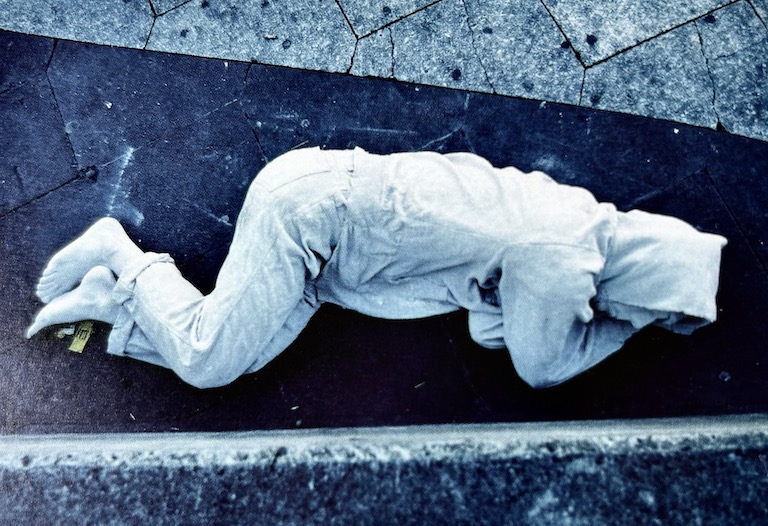
A Possible Phenomenology of the Anonymous, the Invisible, the Im-material and the Im-mediate
It was noted in The Paradox of the Anonymous that Dan Hancox (2025) projectively and retrojectively ascribes to Walter Benjamin a wish or a command for us, “to sift through the rubble, bring up the dead, to reassemble history from below.”
The question that this potential (re-)writing of history from below raises is that of methodology: what are the methods of remembering, recovering or, indeed, ‘creating’ the evidence from which such a history can be assembled or re-assembled? It is a question of figuring, configuring and re-configuring. What the notions of the anonymous, those without name, and the invisible, those without image or (phenomenal) appearance, brings to attention, it might be argued, is the (nominalist) logocentrism and the (anthropic) ocularcentrism of world-making and therefore of world-history making. World history consists of (named, located, traceable) events in which the actions of named (individuals and peoples) become visible phenomena (appearances) and the consequences of those actions tracked temporally through a narrative of these worldly events.
Yet history from below, while pointing to the margins of the historiography of the named, the visible and the event, that is, those upon whom the named and the visible depend for their evental and eventual consequentiality, must also include evocation of the existence of that which cannot be named and that which cannot be imaged or imagined, that from which the historiographical world itself emerges: the worldless, the unnameable, the invisible, the non-existent, the im-material and the im-mediate.
It may be that historiography itself is trapped in this aporia as articulated by Jane Ridley (2019). She cites Thomas Carlyle in whose opinion, ‘The history of the world is but the biography of great men.’ However, Ridley points out, Carlyle’s great man theory is now often seen as, “a piece of romantic claptrap”, not a working theory of history. In part, this is because digitised sources allow historians to excavate, or “sift through the rubble’ and “bring up the dead”, in Hancox’ terms, the lives of ordinary men and women in ways hitherto impossible. Such history from below is booming. Even so, biographies of great men continue to proliferate. What does this mean for historiographic practices, on the one hand, and the philosophy of history, on the other hand?
In part, it is about audiences, Ridley suggests. Not all audiences are interested in academic monographs seeking a high degree of explanatory objectivity, the reasons within the reasons. They enjoy biographical details. However, Ridley argues, while telling us how the great man achieved things remains an acceptable historical project, the biography of a great man does not pretend to answer ‘why’ questions, questions which raise issues about the forms of ‘worldlessness’, the phenomena that become accessible ‘between the lines’ of the historiographic recounting of historical events, as that which ‘exceeds’ or ‘subceeds’ the narration.
References
Hancox, D. (2025) Final days, Financial Times Magazine, 11 January, pp. 16–19.
Ridley, J. (2019) Biographies of great men continue to pour from the press, History Today, 69(9).
 Incomplete ...
2 thoughts on “Worldlessness #1”