RELATED TERMS: World; World-Building; Design, the Buddhisms, Geo-Politics and Geo-Economics
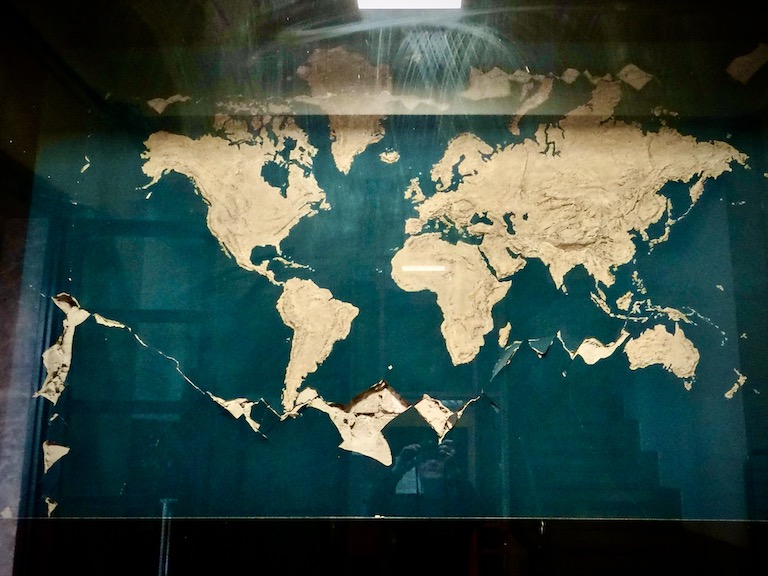
The context for design practices in the 2020s, the macro framing ‘world’ or the macro framing narrative environment in which they operate, might be described as a period in which the existing world order is in transition. Many of the practices and verities of neoliberal globalisation are being rejected or are falling apart. As a Guardian (2025) editorial puts it, “The postwar order stood on three pillars: US dominance, hydrocarbons and open trade. Today, all three are cracking…”
This current situation can be seen in the light of an economic-financial history of the 20th century, such as the one outlined by Gillian Tett (2025). The narrative path begins in the late 19th century with imperialist globalisation; it passes through the protectionist, nationalist populism of the 1918-1939 period; on to the welfarism and international co-operation of the post-1945 period; and through to the neoliberal globalisation of the 1980s to 2008. The narrative then moves back towards protectionist, state-interventionist, nationalist populism, beginning in the post-2008 financial crisis and intensifying in the Covid-19 period and its aftermath.
Where do design objects, services and strategies, as, in effect, our media-material perceptual ecosystem that enables us to ‘see’ and to ‘feel’ this enframing world, stand in this shifting terrain, a question that cleaves most closely to that of what are their (assumed) political-ideological stances in relation to their (actual) performativities or actantialities: what designs do, how they do what they are doing and whether they are capable of acting otherwise? Taking note of the discussion in Design, the Buddhisms, Geo-Politics and Geo-Economics do design practices find themselves in the 2020s in an analogous position to the liberal activists in the USA in the 1980s in that they are playing a role in a morality play designed to help solidify the USA’s global political and economic domination, even while they may be critical of that aspiration. A major difference, however, is that the drama has in the meantime dropped any illusion of there being the possibility of occupying a moral high ground, opting instead for a narrower geo-psycho-drama in which domination is assured solely through force.
Since the 2008 financial crisis, a shift has occurred in how global economic forecasts are shaped. Rather than money mattering most, and the emphasis placed upon economic and financial cycles, domestic political and geopolitical factors now assume greater importance. This has led, Tett (2025) points out, to a revival of the term ‘geoeconomics’. Its renewed prominence is often explained with reference to China and its rivalry with the USA: China has been employing geoeconomic and mercantilist policies for a number of years. Tett outlines how mainstream views on the global political economy have changed since the beginning of the 20th century, leading up to the current inter-relationship between the geoeconomic and the geopolitical.
The first change occurred in 1914, she states, after decades of imperialist globalisation, alongside increasing market competition and technological progress. In the high imperialist age of 1870-1914, economic logic overpowered political factors. After the outcome of the First World War, however, trade protectionism, populist politics and nationalism were in the ascendent, while globalist and free-market ideas, along with those of imperialism, were in retreat. In the years between the First and Second World Wars, therefore, the quest for greater national power pervaded international trade policies and practices.
The second change occurred in the aftermath of the Second World War. In this period, Western governments embraced Keynesian thought which recommended that the state use public finances to manage domestic demand cycles. At the international level, institutions such as the World Bank and the International Monetary Fund were set up to promote global trade and financial relationships. The interwar years had been dominated by a zero-sum view of trade and finance, emphasising winners and losers. This was displaced after 1945 by a focus on a generalised or collective welfare rather than on a concern for which nations are deemed winners relative to others-as-losers.
The third change came about in the 1980s when the focus on the domestic agenda advocated by Keynes was dismissed in favour of an embrace of the free-market as envisioned by economists such as Jack Kemp, Eugene Fama and Milton Friedman. The assumption in this approach was that markets and money supply were determined by the law-like patterns of supply and demand. Being consistent and universal, it was held, such regularities could be modelled using methods borrowed from mathematics and physics. This perspective favoured the financial industry whose models, using complex mathematics, proliferated. Financiers and economists began to think of the economy as an independent sphere, separated from cultural and political issues and susceptible to quasi-scientific analysis and prediction.
In the 2020s, there has been a consolidation of the backlash against both neoliberal economics and cooperative internationalism. The notion that global markets were ‘free’ in any meaningful sense after the neoliberal revolution has been shown to be illusory; while the USA has been drifting away from globalisation and free markets long before the arrival of Donald Trump on the scene[1]. The sentiments expressed in 1999 in Seattle against the World Trade Organisation have spread more widely across both the left and right of the political spectrum, as the combined influence of trade patterns and technological developments displaced workplace jobs. Furthermore, state interventions into the economy increased in response to the 2008 financial crisis, intensified during the period of the Covid-19 pandemic and were consolidated during the energy crisis spurred by the Russian invasion of Ukraine.
The specific Trumpian intervention into this backlash at the global scale is twofold[2]. First, it adopts an extreme zero-sum approach in which the USA must win, or rather be seen to win or to seem to win, whether this is actually the case or not, at the expense of all others (America First). Second, it places a renewed emphasis on power politics. The Trumpian approach, based on a kind of material ‘instinct’ rather than a plan, is a mixture of, on the one hand, chaotic tactics, for example, in the use of threats, bullying, uncertainty and ‘flooding the zone’ with soundbite messages, such as in the case of tariffs; and, on the other hand, a wider strategic agenda: to remake the world order so as to strengthen the power of the USA.
Simon Kuper (2025) also makes a contribution to our endeavour to understand the distinction between the chaotic tactics and the strategic agenda of the current US government. He refers to Fernand Braudel’s contention that history operates on three levels of time: geographical time, referring to the relationship of humans with their environment(s); social time, referring to economic, demographic and cultural cycles; and individual time, referring to short-term events. Kuper suggests, however, that Trump operates on a fourth plane of time: the daily news cycle.
Trump, for Kuper, has an ‘intuitive’ grasp of two of the most recent innovations in entertainment: reality television and social media[3]. His administration, Kuper contends, is not metaphorically structured like a reality television series but literally structured as one. Like all reality television, the series oscillates between fiction and nonfiction. It is built around a central protagonist who is in a perpetual state of conflict with a shifting array of ‘enemy’ antagonists. Episodes are played out daily in order to keep the attention of the viewer, who might otherwise switch off. While we continue to watch this series, Kuper cautions, we remain under its illusion. Given the daily turnaround, it is difficult to judge which of the multiple unfolding storylines, if any, are consequential. In this context, without time to think or reflect, we are faced with the unenviable task of distinguishing which of the ostensibly meaningless episodes, characterised by chaotic, attention-seeking, tactical outbursts, might convey a consequential truth, one that takes a concrete step towards the goals of the strategic agenda.
Tett suggest that there are two frameworks that can assist in making sense of this ‘instinctual’ approach to remaking the world order.
The first framework is derived from Albert Hirschman’s work on hegemonic power. Hirschman argued that countries which control key nodes in certain sectors can achieve real dominance. Following Hirschman, the Global Capital Allocation Project argues that China has hegemonic control of manufacturing, through its dominance in key supply chain nodes such as rare earth minerals, while the USA has hegemonic control of finance because of the role of the dollar as the world’s reserve currency. From this perspective, what the USA is seeking to achieve is an undermining of China’s industrial hegemony while protecting its own financial dominance. Technology dominance remains contested between them, in Tett’s view. The implication of this situation is that there is now a return to strategic statecraft.
The second framework is built around the notion of stakeholders, a concept that arose to counter Friedman’s assertion that companies should only serve shareholders. It was initially associated with the environmental, social and governance movement, a movement that has now come under attack from right-wing politicians. However, this attack does not advocate a return to a focus solely on shareholders. Rather, these politicians want companies to pay attention to different stakeholder interests, notably those of national security, energy sufficiency and patriotism as a predominant cultural value. In this frame, understanding the rise of geoeconomics and geofinance arises from thinking through how government and business work together; or in asking which stakeholders matter and how change might be effected. In media-material design-perceptual terms, this is a question of who is named and who remains anonymous and who has an appearance and who remains invisible; in short, a division between who is part of the world-picture and is consequential in its unfolding history and who is seemingly worldless and inconsequential, out of the picture.
In terms of design practices, including those of world-building and world-modelling, this is a question of whether they pay attention only to the already recognised or whether they pay attention to the anonymous and the invisible: are the latter left to fend for themselves outside the ongoing ‘world-modelling’? Do design practices leave the world intact as a game of dominant perception through word, image and model, in the particular logical media-materiality of a certain mathematical abstraction; or do they attempt to intervene to change the entirety of the ‘modelling’, breaking apart the model, its methodologies and its assumptions; but, crucially, not by developing a politics of despair and resentment.
In terms of macro ‘world order’, this leaves many questions open, such as whether other countries will follow the USA down the path towards mercantilism and isolationism. Many countries do not accept that globalisation is dead and some countries, such as those in Europe, continue to pursue liberal (and indeed neoliberal) ideas.
Taking into account the strategic global and domestic agendas in the USA, which is in turn putting pressure on other countries to follow suit, the question for design practices is the extent to which they address working people, the comfortable middle class, the rich or the ultra-rich, that is, the spectrum running from the socially dis-valued to the socially over-valued. More generally, the question for design practices is how they address the issues that concern the different categories of the ‘worldless’, those without world or history, from the socially anonymous and invisible (as the dis-valued and discarded) to the anonymous and invisible actants in the biosphere and the Earth systems (the other-than-human and the more-than-human).
Notes
[1] John Ganz (2024, 2025), for example, traces the discontent upon which Donald Trump capitalised in his 2016 and 2024 presidential campaigns back to the early 1990s. At that time, writers such as newspaper editor Samuel T. Francis saw the likes of the Neo-Nazi and former Klansman David Duke as auguries of a time when there would be a middle American revolution in which the dispossessed would throw off the rule of the globalist elite in order to establish a new assertive American nationalism behind a populist, Caesarist presidency.
In his introduction to When the Clock Broke, Ganz writes that the early 1990s was a period when some argued that, after the fall of the Soviet Union, ideological struggle was irrelevant and, according to Francis Fukuyama, that history itself had ended. In this situation, some in the USA began to look for inspiration among the ideological remnants of earlier times, which led them towards nationalism, populism, racism, antisemitism and fascism. They wanted to “break the clock” of progress, to return the USA to a previous dispensation while, at the same time, creating a new country of their own devising. They lost in the short term. However, they brought to the surface an intense anguish in American life, articulated as a politics of national despair, an anguish that has returned in the 2010s and 2020s more acutely and with greater vigour.
[2] At the domestic scale, Trumpian rhetoric plays into the resentments aligned around anti-elitism in the USA, as discussed by Rana Faroohar (2025). For Faroohar, in agreement with the position developed by Joan C. Williams (2025) in her book Outclassed, progressives in the USA have focused too much on issues of race rather than issues of class. It is this emphasis that has led to ‘middle-status’ voters to Trump. So, while some of Trump’s base are indeed racist, or at least xenophobic, Williams cites research which suggests that almost a fifth of that base are simply anti-elitist.
This group of anti-elitists hold moderate views on immigration, gay marriage and environmental issues (Faroohar, 2025, citing Williams). They are mostly white, non-university graduates who see their future economic prospects as being less prosperous than their past. Sitting outside the white-collar meritocracy, they are more interested in community and traditional institutions, such as the church, trade unions and the military, than in individualism and achievement.
Thus, while the liberal elites congratulate themselves on their ‘enlightened’ political views and hyper-individualism, in other words in their occupation of the moral high ground in a domestic morality play, working people typically see them as selfish, entitled and over-protective of their children (Faroohar, 2025).
This debate, about the de- or dis-valuation of the ‘working class’ in elite liberal discourse, is one dimension of the category of the ‘anonymous’ and the ‘invisible’ or, in other words, the ‘world-poor, if not ‘worldless’. Eliciting the voice and appearance of this group is part of the difficulty of writing ‘histories from below’, a topic raised in the Paradox of the Anonymous: When We Wake [Snippets 9].
It will remain an open question for some time to come as to whether the strategic international agenda of restoring US power does, or does not address the domestic agenda of responding to the demands of anti-elite sentiment by improving the economic prospects of working people. Is the anti-elite rhetoric of the Trump administration simply ‘playing to the gallery’?
[3] Chris Bruni-Lowe (2025) points out the impacts of media evolution on political language, particularly in the context of campaign slogans, trends which the Trumpian team has put to effective use in “the age of mass outrage”. Bruni-Lowe writes, “Each evolution of mass media … reduced the length of slogans. Radio rewarded catchy snippets, television demanded soundbites and social media expects hashtags.”
References
Bruni-Lowe, C. (2025) The history of campaign slogans reveals words are not enough. Financial Times, 12 July, pp.12.
Faroohar, R. (2025) The Very rich are very different. Financial Times, 7 June, Life & Arts, p.8
Ganz, J. (2024) When the clock broke: Con men, conspiracists, and how America cracked up in the early 1990s. New York, NY: Farrar, Strauss and Giroux.
Ganz, J. (2025) The Decade that made Donald Trump. Financial Times, 7 July. Weekend magazine pp.14-16
Guardian (2025). The Guardian view on Brics growing up: A new bloc seeks autonomy – and eyes a post-western order. Guardian, 13 July. Available at https://www.theguardian.com/commentisfree/2025/jul/13/the-guardian-view-on-brics-growing-up-a-new-bloc-seeks-autonomy-and-eyes-a-post-western-order [Accessed 14 July 2025]
Kuper, S. (2025) Switching off the Trump show. Financial Times, 21 June, Weekend Magazine p. 12.
Tett, G. (2025) The New age of geoeconomics, Financial Times, 12 July, Life & Arts pp. 1-2.
Williams, J. C. (2025) Outclassed: How the Left lost the working class and how to win them back. New York, NY: St Martins Press
Resources
 Incomplete ...