RELATED TERMS: Iconic Designs and Iconic Designers; Imaginary

The Iconic
As acknowledged in Iconic Designs and Iconic Designers, the iconic approach to design is not wholly without merit. For example, it recognises that designs have cultural meanings and other-than-utilitarian uses, such as in the construction, maintenance and performance of self-hood and social standing. In other words, the notion of iconicity draws attention to designs as important socio-cultural phenomena or actants in everyday social practices and material public discourses.
The reservation expressed about the iconic approach to design was that, in as far as it seems to depend on a prior approach to art which emphasises titled ‘works’ and named ‘artists’, it might place design practice in a secondary or derivative position to art practice. ‘Iconic’ designs, considered as ‘works’, may be thought of as approaching, but never quite reaching, the value of an ‘art-work’. Iconic designers, equally, may be thought to approach the status of artists but never quite achieving it.
Design-Art-Works
However, as Francesca Perry (2024) discusses [1], this seemingly unbridgeable hierarchical gap between the higher status of art and the lower status of design has been broached and breached, as has the difference between the artist and the designer. This signals the emergence of designer-artists who create ‘design-art-works’ largely for themselves rather than for commercial manufacturers. This art-design transgression or crossing, as noted by Jensen (2015: 2), may pass in either direction. Moving from design towards or into art leads to hybrid objects that mix the functionality of a design with the meaning or content in art. An example of this is ‘Dust Furniture’ by the designer Jurgen Bey, which turns dust into something of value. Conversely, crossings from art into design lead to outcomes which combine meanings as articulated in art with elements of utility and social relevance borrowed from design. An example of this is ‘PARAsite’ by the artist Michael Rakowitz.
Other examples include the work of Swedish artist Anna Uddenberg, who exhibits sculptures that are in some respects like furniture designs, as discussed by Kristina Foster (2024). They become neither art nor design and both art and design. In recent years, she has shifted the focus of her work to scrutinise the unspoken social codes of everyday spaces that are embedded in their design. She evokes the sterile settings of airports, hotels and medical centres in order to highlight the markers in a social setting that provide a script for people’s behaviour. This is why she describes them as ‘sculptural scripts’ that give direction to the body similarly to the way we must navigate social norms. They can be described, in other words, as narrative environments.
Uddenberg’s works exhibit a utilitarian aesthetic, calling us to recognise them as functional objects. However, it is unclear what exactly their function might be. Her sculptural installations, such as ‘Premium Economy’ at the 2014 Art Basel fair, weave together threads of power, artifice and social etiquette. In doing so, they enact a kind of ensnarement which invites us to reflect upon the control that we relinquish to products and in public spaces. This is an issue that may be exacerbated with the increasing deployment of AI programs and ‘user-friendly’ technologies which create automated surroundings.
While Uddenberg’s work represents a move from an art form that incorporates elements of what looks like furniture design, from the other direction furniture designer Anna Karlin, quoted by Jessica Salter (2024), says that she sees a piece of furniture, “as a piece of sculpture in a room yet full of purpose”. The collection of artefacts that she designs, which include steel Chess stools, a landscape-embroidered headboard, a chaise longue made from maple burl and bouclé and a cylindrical drinks cabinet, are all intended to work with each other. The contrasting shapes, patterns and edges work in dialogue, she argues, responding to one other to create a world around the pieces.
Uddenberg creates installations, as fictional worlds, for gallery spaces. Karlin makes furniture-sculptures, as everyday worlds, for domestic interiors. Interior designer Veere Grenney uses contrasts between, for example, humble and grand, refined and tactile, in order to introduce what he calls ‘friction’ and, like art, to spark conversation (Fokschaner, 2024).
Design-sculpture hybridity operates not only in relation to furniture design but also fashion design. Fashion designer Craig Green, for example, combines conceptual, sculptural fashion with functional, purposeful design (Chilvers, 2024). His past collections, which have included hand-dipped latex inflatables, purposefully packable garments, wearable wooden sculptures, digital prints and the use of medical tubing, seek to balance the avant-garde (art) and the wearable (functional design). He rationalises these two contrasting directions by recognising two different contexts: that of wearing clothes fit for everyday purposes; and that of models wearing designed artefacts in a fashion show for the purposes of spectacle and theatre. Green sees them as two aspects of more comprehensive a story that includes the designing of fashion items, on the one hand, and the designing of wearable clothes, on the other hand. Both are appropriate for their respective contexts.
In these convergences between art and design and artists and designers, elements which are usually considered specific to art are extended to design. They include such factors as collectibility, contemplation, creativity, expression and experimentation (Perry, 2024). Designs, as physical artefacts, may move from being objects for use to objects for contemplation. In so doing, they may become suitable to be collected and exhibited. Even so, the Mexico City-based designer Maika Palazuelos, who founded the practice Panorammma that does produce such experimental works, does not wish, “to create objects that exist apart from everyday experience as museum pieces, but objects to be lived and used.” [2]
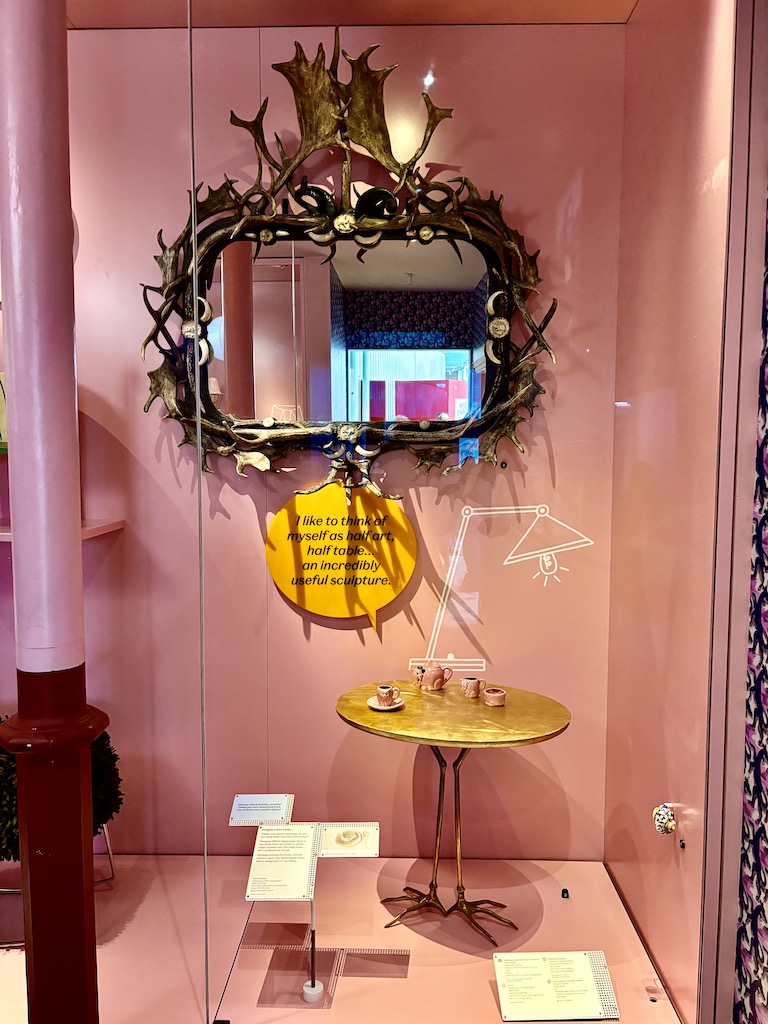
Design-art-works may become experimental interrogations of technique and process, extended meditations on materiality and making, presenting openings for further interpretations and reflections. Rather than a sequence that runs directly from designer-to-design-to-user, which opens up a cycle of incremental improvements that responds to questions about affordances and usability (how inviting is the design?; how easy is it to interact with it to fulfil a practical goal?) and user satisfaction (how efficient is the design in arriving at a practical goal?; how valuable in relation to other means of reaching that goal?), we have a recursive path that opens to other kinds of questions that have in the past been considered relevant only to art-works and art-making.
Design Cycles and Interaction Cycles
In these recursive cycles, design-art-works become interventions in social practices and associated material public discourses. Questions of an epistemological, axiological and ontological nature may arise, troubling what we seem to know, what we value (as ‘good’, as ‘better’) and what we take reality to be.
Such ‘design-art-works’ may, for example, take the values expected of a particular design form and invert them or critique them. In the examples discussed by Perry (2024), chairs, one of whose expected values is comfort, are rendered uncomfortable for sitting. However, even the invitation or affordance to sit may be absent. Perry quotes the designer Matan Fadida as saying of her design-art-work, “the chair doesn’t invite you in”. The interaction, rather than functional, becomes dialogical as the would-have-been sitter has to adopt a different disposition toward the no-longer-chair. The chair refuses the predicated qualities that conventionally define what a chair is and does.
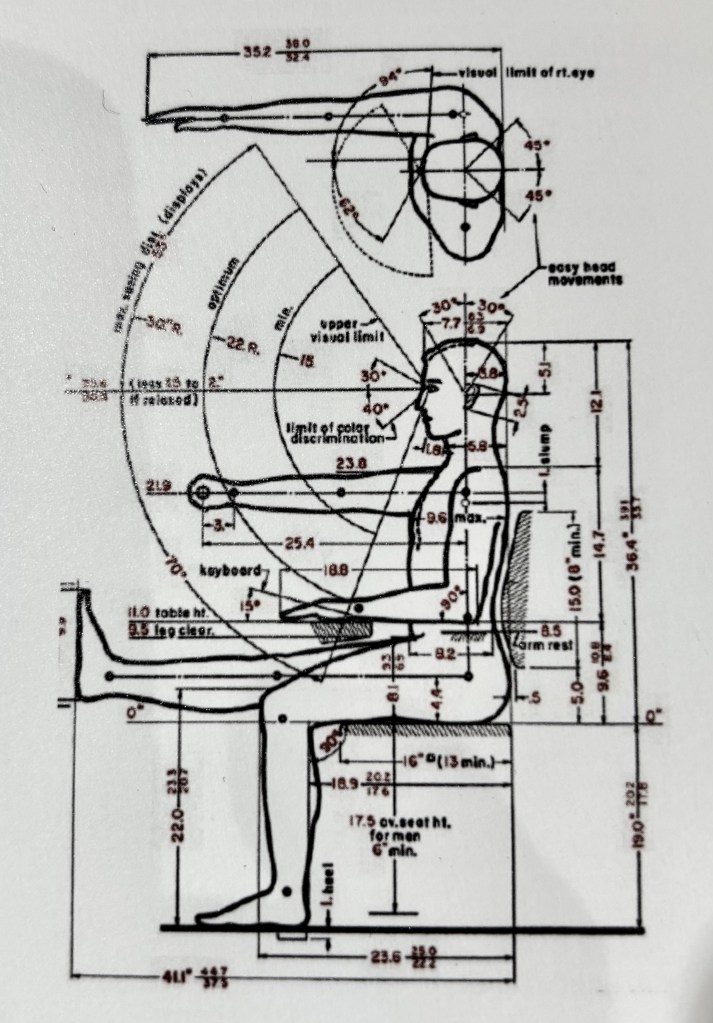
The no-longer-sitter becomes instead an ‘aesthete’ who seeks other predicated qualities and meanings for the no-longer-chair. The physical sense of being uncomfortable is displaced to another register to become aesthetic, intellectual or cultural unease. The inter-action moves in the direction of questioning assumptions about ‘what is’: not only about what is a comfortable chair but also about what is a ‘comfortable’ life. What is it, in particular and in general, that makes them feel comfortable or uncomfortable. In addition, questions concerning who does and does not have a comfortable life arise. For whom is the ‘uncomfortable chair’, the chair that is a ‘sculpture’, designed? For those who are comfortable enough, wealthy enough, to have the time to contemplate what it means for a chair not to function as a ‘chair’; a chair that they can collect and ‘exhibit’ to their friends and acquaintances?
Material comfort and psychodynamic comfort become explicit issues, as purposes, goals, ends or telos and as states of being, dispositions. Designed entities, in this example chairs, are no longer simply for comfort. They are neither comfortable nor comforting. In becoming ‘functional sculptures’, as described by Nic Sanderson and Inga Tilda, quoted by Perry (2024), they are conceived for interaction rather than as furniture. They open a dialogue about purposiveness, and about the kind of social practices in which one is engaged, from the functional to the meditative, and the techniques they imply. They open up to what George Saunders (2022: 3) calls the aim of art, that is, to ask the ‘big questions’:
“How are we supposed to be living down here? What were we put here to accomplish? What should we value? What is truth, anyway, and how might we recognize it? How can we feel any peace when some people have everything and others have nothing? How are we supposed to live with joy in a world that seems to want us to love other people but then roughly separates us from them in the end, no matter what?”
The assertion here is that design, too, is capable of asking the ‘big questions’ without having to be removed from the everyday, without having, in other words, to become institutionalised as ‘art’. This is because designs are constituted through interaction and it is in the context of everyday interactions that these ‘big questions’ have the most relevance in terms of how they are ‘answered’ in the ‘habitus’ of behaviour and practice. How things are done ordinarily are already responses to the ‘big questions’. The further question is how adequate these ordinary responses are and how far and in what directions designs guide those responses. There are more dimensions to design, in terms of the ‘big questions’, than there are to art because we are starting with ‘answers’ that seem to ‘work’. Why would you question what appears to work? That is the first question, that may never arise, that may always be foreclosed.
Discomfiture, Disquiet, Shock and the Ethics of Defamiliarisation
While aiming to discomfit, such design-art-works are not necessarily aiming to disturb. For example, staying with the theme of chairs, Andy Warhol’s screen prints of the electric chair are designed to have a doubly disquieting, chilling effect: unfeelingness, or indifference, unfeelingly, or indifferently, represented, an impassive, yet positively murderous, violence. The images are not simply a reminder of death, a memento mori. They constitute a more potent threat of death. Capers (2003: 252) notes that the Electric Chair canvases have an ‘iconic’ status in US culture. They prompt reflection on Americans’ fascination with death, particularly with state-administered death, and with capital punishment as spectacle. They also evoke the history of obtaining pleasure by gazing upon death.

They also evoke a socio-political, legal history. The label on the photograph that Warhol used, now held in the archives of the Warhol Museum, dated 13 January 1953, identifies the scene as “Sing Sing’s Death Chamber” (Capers, 2003: 249). The label also identifies the chair as the one in which Julius and Ethel Rosenberg were scheduled to be electrocuted on 19 June 1953. While potentially bringing to attention the three purported goals of criminal justice, that is, retribution, incapacitation and deterrence, the image nevertheless also incorporates, or is haunted by, the controversy surrounding that particular execution (Capers, 2003: 249).
The trial of the Rosenbergs, who were accused of conspiring to commit espionage by passing information to the Soviet Union, was infused by anti-Semitism and McCarthy-era anti-communist hysteria. The sole evidence against Ethel Rosenberg came from a cooperating witness and her prosecution was largely a ploy to induce her husband to plead guilty and name Communist sympathisers. Warhol may be said to use this particular execution as an indirect referent in his Electric Chair screen-prints, asking the viewer to contemplate who is sentenced to death in the USA and how this process is achieved (Capers, 2003: 249).
Warhol leaves the chair empty, a threat of death. In that sense, Warhol might be said to hold back in this Electric Chair series from depicting actual killing, although in other images in the Death and Disaster series, such as Ambulance Disaster, dead bodies are presented. In the Electric Chair series, Warhol foregrounds the space the viewer occupies as spectator, witness or potential executionee.
Warhol does not go as far, for example, as reproducing Tom Howard’s 1928 photograph of the execution of Ruth Snyder by electric chair, also in Sing Sing. This image is chilling in a different way. Although it equally may provoke reflection on questions of life and death and the ethics of the state administered killing, it is designed – intended – specifically to shock, passing beyond spectacle and into sensational ghastly horror. The issue here, in becoming a voyeur in this scene, is whether such sensational shock provokes or arrests reflection. Published by the New York Daily News, Robert Klara (2023) points out that although tabloid newspapers had run photographs of dead bodies before, few were as gruesome as this. The photograph is part of the move towards sensationalism in the medium of newspapers from the late 19th century throughout the 20th century, a move that has migrated into the realm of online media. For social and cultural theorist Susie Linfield, this raises ethical questions for the viewer in terms of their responsibility: each has seriously to consider what they choose to look at and why.
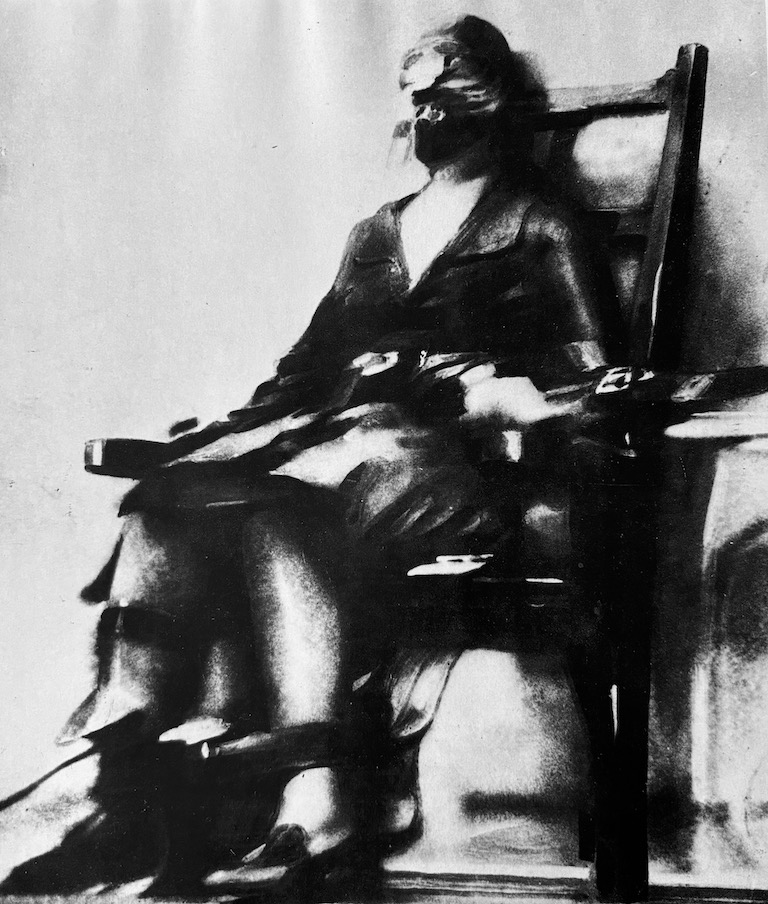
Both Warhol’s screen-prints of the electric chair and the Daily News’ photograph of Ruth Snyder’s electrocution can be considered from the point of view of design. Both images are the result of intention. Both involve a selection of topic and medium. Both images are framed institutionally, Warhol by the gallery-museum context, the Daily News by that of industrial newspaper production and sales. How far, and in what directions, for example, towards reflection, aesthetic shock or sensationalism, do particular defamiliarising designs push or guide the questioning that they provoke? For instance, the Panorammma design practice seek to insert their defamiliarising designs into everyday narratives in order to compete with them and extend them. Such designs enable artistic discourses that disrupt and reframe the mundane to be incorporated into everyday situations, to incite a refusal to live ordinarily, to live in a constrained manner. [3]
Physical discomfort in the design of chair-sculptures, for example, is provoked formally by using steel, aluminium, hard plastic, resined pulped cardboard and other hard or sharp materials. Such defamiliarising design practices question everyday practices by dislodging the expectations around everyday artefacts, such as the chair, by altering their material qualities The examples discussed by Perry (2024) aim to push the questioning towards aesthetic contemplation of a collectible item.
Alternatively, design-art-works might be raising issues relating to well-being, beyond aesthetic questions. For example, Annabel Bourne reports that prolonged sitting is a form of sedentary behaviour and such behaviours, which include television-watching, gaming, driving, desk-bound work and so on, which occupy much of our everyday lives, are associated with a higher risk of cardiovascular disease, type 2 diabetes and premature mortality. The World Health Organization has recommended measures to reduce sedentary behaviour. The ‘uncomfortable chair’ could be pointing in the direction of discouraging sedentary behaviour.
Equally, beyond questions of aesthetics or health, such design-art-works might raise questions of a broadly anthropological nature concerning our constitution as human beings formed within particular cultural patterns. Marcel Mauss (2006: 88), for example, contends that, “The way of sitting down is fundamental. You can distinguish squatting mankind and sitting mankind.” Mauss also points out that the design of one artefact, such as the chair, implies the design of accompanying artefacts, such as the table. Other cultures, who squat rather than sit, have carpets or mats rather than tables. Designed entities, it becomes apparent, do not exist in isolation from the cultural economy and cultural ecology in which they operate. As Taylor (2013: 360) points out, “the useful things we encounter in the process of living our daily lives are part of an economy of design, a whole structure of value and exchange”. A design-art-work, then, as well as posing the big questions of art, may pose questions for particular aspects of a specific cultural economy-ecology.
Critique
An example discussed by Damon Taylor (2013) takes a different tack on the design-art-work nexus. In this example, Jurgen Bey appropriates a stacking chair, a functional everyday designed item, and renders it dysfunctional by shortening one of its four legs. This is a different kind of intervention from those discussed above. Made in 2000, the Do Add chair was part of the Do Create collection for the Dutch collective Droog Design.
Taylor poses the question of how what Bey has made is to be understood. It could be taken as a joke or, as Perry (2024) has indicated of her examples, as a form of contemporary art. A third suggestion Taylor makes is that the altered object may have a more political dimension, operating as a form of critique of the object that is altered or rendered other.
Since the late 1990s, Taylor argues, two approaches have emerged that seek to explain works like this: design-art; and critical design. Both combine a concern for material and formal inventiveness, while granting a certain conceptual weight to the work.4
The first approach conceptualises such pieces as limited edition design-art-works, as in the examples presented by Sophie Lovell (2009) and Karolien Van Cauwelaert (2009), which are similar to those examples discussed above cited by Perry (2024). Lovell states that the examples she showcases are made by independent creators who both design and produce their own work in small quantities. They have not completely abandoned the design system, whose main goal is to design products for a ‘mass’ audience. Instead, Lovell suggests, they are practising what might be seen as a reinstatement of the pre-industrial mindset that does not divide the fine arts from the applied arts.5
Design-art artefacts, in this view, are examined from the position of the connoisseur and the aesthete, on the one hand, and the collector and the market, on the other hand. They are, Taylor (2013: 359) summarises, “to be enjoyed for their formal qualities and contemplated as to their deeper meaning, just as they are sold and consumed in the manner traditionally attributed to fine art.”
The second approach argues that works such as Bey’s exhibit the characteristics of critique. It is therefore an example of critical design, as elaborated by Anthony Dunne (1999) and Anthony Dunne and Fiona Raby (2001, 2013). Such artifacts are said to “ask carefully crafted questions” (Dunne and Raby 2001: 58) that make people think, perhaps then causing them to consider their relationship to such objects (Niedderer 2007).
Both perspectives, Taylor argues, tend to emphasise the communicative function of such works, the way they operate as bearers of meaning. For Taylor, this concentration on meaning seems to neglect a defining quality that distinguishes design from art: to some degree a design must ‘function’. To get critical traction from Bey’s dysfunctional chair, Taylor argues, it is necessary first to think of it as a use object, as a part of a system of designed objects that are to be used in the performance of the practices of everyday life. Taylor implies that even if a work such as Bey’s does deliberately open a space for contemplation, begin a dialogue or present a proposition, it is important that this contemplation, dialogue and proposition are returned to the context of everyday practices in order to evaluate what they mean for those practices. The contemplation, dialogue and proposal are not ends in themselves for Taylor.
Interaction and Participation
As noted previously, Taylor considers that the useful things we encounter in our daily lives are part of an economy of design or, rather, as will be discussed below, a political economy. By taking something designated as useful in such an economy, in this example a chair, and destabilising it, Jurgen Bey has not only altered what the object means to anyone but also the way anybody might be able to live with such a thing, affecting the conditions of being and becoming made available by it.
As already noted, Bey’s Do Add chair was made in the context of the Do Create project initiated in 1996 by KesselsKramer, a self-described communications agency. The project encouraged a series of experimental prototypes for functional things that involved the active participation of the consumer in the completion of the object. This approach contrasts to the dominant culture in which mass-produced objects come into our lives as as fully ready-made things.This is a political economy of design whereby the user is conceptualised as a perfect consumer of the ‘completed’ product.
Bey’s intervention, by negating the finished nature of the object to be used, opens a new space of possibility in the interaction between the subject and the object. What Bey may be said to bring to light is the ‘script’ that such ‘finished’ products embody that guides interaction with them. The notion that designed entities have ‘scripts’ encoded into them is taken from Madeleine Akrich (1992), whodeveloped the idea from the field of actor-network theory. The designed entity, in other words, instructs or commands; it ‘gives orders’, and in doing so orders or organises the field of interaction. It is in that sense that the designed entity has ‘power’ and the field of interaction is ‘political’.
Fallan further elaborates on Akrich’s insight by arguing that the physical scripts of the object are related to the broader socio-technical script, the wider cultural narrative, in which it is inscribed. Taylor suggests that the socio-technical script might be better grasped as a Gramscian ‘complex of social relations’ (Gramsci 2000: 304), defined as the continually shifting interaction of the contingent relationships in which any actant is enmeshed, the pattern of which is determined by the power relations running through the field. It should be noted that the notion of a ‘broader socio-technical script’, a ‘wider cultural narrative’ or a ‘complex of social relations’ brings to attention Alexandra Daisy Ginsberg’s notion of a social imaginary, as discussed in the post Imaginary
There is no guarantee that the script encoded into a design will wholly determine the role that any given user will adopt in response, since users may choose to misuse or subvert the script, displacing the design into a setting that was never envisaged for it. Nevertheless, the manner in which users interact with the design as they make sense of it will occur in relation to those encoded scripts and the power relations that accompany those inscriptions. In other words, users may ‘disobey’ the instructions, commands or orders, by intention or otherwise.
What is being encountered in the example of Bey’s Do Add chair is the field of habitual cultural techniques and taken for granted power relations that are so familiar that they have become ‘invisible’ in daily practices. Through another technique, that of making strange, in Shklovsky’s sense (Shklovsky, 1990), by altering the materiality and the accompanying script of the design artefact, those invisible parameters of action, those ‘forces’ of habit, are rendered explicit. The aim of ‘enstrangement’, as Benjamin Sher translates Shklovsky’s term ostranenie, is to de-immerse ‘users’ from their ‘dream state’ of habituation to consumption.
What Bey’s Do Add chair also brings to attention is the performative character of designed entities. The notion of the performative has been translated from the domain of linguistics, as defined by Austin (1976), to that of social action by Judith Butler, by way of Althusser, Foucault and Derrida. The performative, as extended to design, concerns the ways, by means of their physical qualities, designed entities call us or address us, that is, to recognise their vocative character. Furthermore, in our recognition of their call, they ‘command’ us and constitute us for particular subject and actantial roles. As material scripted ‘performative statements’, designed entities enact and set the frame for interaction, whether this is refused, disobeyed or not.
With the Do Add chair, Bey intervenes in these processes by materially altering the object’s script. He does so not to cause the user to reflect and decode the meaning of the piece as such. Rather, he aims to alter the affective potentiality of its functioning through the creation of an everyday use object that is persistently incomplete. In its conspicuous incompleteness, as a chair that presents an obvious ‘lack’, it is asking you to participate, to partake in ‘completing’ the design, while acknowledging that any proposed ‘solution’ may itself have its own ‘unsatisfactoriness’. In one sense, as a design, it remains perpetually in a state of incompletion.
In a culture that presents things to us as ‘complete’, with well-defined physical affordances and a clear, commanding script, an entity that is ready-to-hand and ready-to-use, the creation of an incomplete design is a refusal of the socio-technical script of instrumentality and efficiency, of the perfectly behaved consumer and of the social relation that this nexus constitutes.
We are asked to act differently, perhaps to respond creatively, imaginatively, mindfully …
This leaves open the field for forms of pedagogy and performativity, academic, public and governmental, other than the one that instructs us, perhaps rather dogmatically, to be perfectly behaved consumers and prosumers of complete designs, which nevertheless leave us still incomplete; and pedagogy and performativity are matters of technique: new techniques grafted onto existing techniques; techniques to undo techniques.
Notes
1: Perry reviews some art-design works presented at the 2024 Milan Design Week and other design exhibitions, including that of Max Lamb, Matin Fadida, Niceworkshop, Tomasso Le Rose, Touch With Eyes, Togigi (founded by Thomas Van Noten), Nic Sanderson and Inga Tilda, Panorammma (founded by Maika Palazuelos) and Carsten in der Elst.
2: Quote from the Panorammma website.
3: Quote from the Panorammma website.
4: By way of supplementing Taylor’s history, Dautrey et al. (2016) explore the emergence in the world of design in recent years of strange objects, which are ambiguous, dysfunctional, enigmatic and complicated. These objects are based on an approach that has been called anti-design, radical design, conceptual design or critical design. These are forms of speculative design that raise questions rather than offer solutions. Dautrey et al. trace a history of critical design that passes through four episodes: the Italian radical design of the late 1970s; the Dutch conceptual design of the 1990s; the English critical design of the 2000s; and contemporary period (to 2016).
5: This last point brings to attention the socio-historical emergence and conditionality of the hierarchy by means of which the fine arts are seen axiologically as of higher value, a conditional characteristic that would now seem to be being challenged. However, as Darras (2006), for example, notes, the ‘design-art’ niche continues to be situated hierarchically below the (‘pure’) artwork. Such design-art works may be considered hybrids, mixtures and transgressions of art and design, and/or regressions to a prior, pre-industrial relationship.
References
Ackrich, M. (1992) ‘The De-scription of technological objects’, in Bijker, W. E. and Law, J. (eds) Shaping Technology- Building Society: Studies in Sociotechnological Change. Cambridge, MA: MIT Press, pp. 205–224.
Auge, M. (1995) Non-places: introduction to an anthropology of supermodernity. Translated by J. Howe. London, UK: Verso.
Bourne, A. (2024) Why you are probably sitting down for too long, BBC. Available at: https://www.bbc.com/future/article/20240722-why-you-are-probably-sitting-down-for-too-long (Accessed: 27 July 2024).
Capers, B. (2003) On Andy Warhol’s Electric Chair, California Law Review, 94, pp. 243–260.
Chilvers, S. (2024) Craig Green: “I encourage my students to create fearless work”, Financial Times, 10 April. Available at: https://www.ft.com/content/2d2960a7-36c9-4eab-b64a-f5e860c54a08 (Accessed: 18 July 2024).
Darras, B. (2006) Artists and designers – can the divide be overcome?, in 7o Congresso Brasileiro de Pesquisa & Desenvolvimento em Design, Curitiba – 9 – 11 août 2006. Available at: https://www.academia.edu/2425338/Darras_B_2006_Artists_and_Designers_Can_the_divide_be_overcome (Accessed: 27 March 2024).
Dautrey, J. et al. (2016) Strange Design : From Objects to Behaviours. Forcalqueiret,France: it: editions.
Dunne, A. 1999. Herzian Tales: Electronic Products, Aesthetic Experience and Critical Design. London: RCA Computer-related Design research.
Dunne, A. and F. Raby. 2001. Design Noir: The Secret Life of Electronic Objects. London: Birkhauser
Dunne, A. and Raby, F. (2013) Speculative everything: design, fiction and social dreaming. Cambridge, MA: MIT Press.
Fallan, K. (2008) De-scribing design: Appropriating script analysis to design history, Design Issues, 24(4), pp. 61–75. doi: 10.1162/desi.2008.24.4.61.
Fokschaner, S. (2024) Veere Grenney, the designer’s designer: “I can’t decorate without friction”, Financial Times, 10 May. Available at: https://www.ft.com/content/e87fdbbb-3d40-4662-b9e2-8019b55366e3 (Accessed: 18 July 2024).
Foster, K. (2024) Anna Uddenberg’s sculptures of seduction, submission and control, Financial Times, 8 June. Available at: https://www.ft.com/content/b5fa0e93-e7df-45f3-ab0a-0483d7b7791a (Accessed: 17 July 2024).
Gramsci, A. (2000) The Gramsci Reader: Selected Writings 1916-1935. Edited by D. Forgacs. New York, NY: New York University Press.
Klara, R. (2023) How the New York “Daily News” photographed Ruth Snyder’s execution by the electric chair, Smithsonian Magazine, (12 January). Available at: smithsonianmag.com/history/how-a-new-york-tabloid-captured-the-first-photograph-of-an-execution-by-the- electric-chair-180981432/ (Accessed: 22 August 2024).
Lovell, S. (2009) Limited edition: prototypes, one-offs and design art furniture. Basel, CH: Birkhauser.
Mauss, M. (2006) Techniques, technology and civilisation. Edited by N. Schlanger. New York, NY: Berghan Books.
Perry, F. (2024) The provocative designers asking “Are you sitting uncomfortably?” Financial Times, House and Home supplement, 11 May, pp. 12–13.
Salter, J. (2024) Furniture designer Anna Karlin: “I see furniture as sculpture full of purpose”, Financial Times, 14 June. Available at: https://www.ft.com/content/3f97672d-7443-43e4-a4b3-7dca184c8ebb (Accessed: 18 July 2024).
Saunders, G. (2022) A Swim in the pond in the rain. London, UK: Bloomsbury Publishing.
Shklovsky, V. (1990) Art as device, in Theory of Prose. Elmwood Park, IL: Dalkey Archive Press, pp. 1–14.
Taylor, D. (2013) After a broken leg: Jurgen Bey’s Do Add chair and the everyday life of performative things, Design and Culture, 5(3), pp. 357–374. doi: 10.2752/175470813X13705953612246.
Van Cauwelaert, K. (ed.). 2009. Design/Art: Limited Editions. Frankfurt: stichting Kunstboek BVBA.
 Incomplete ...
One thought on “Iconic Designs, Critical Designs”