RELATED TERMS: Sabi and Wabi Sabi
The human-environmental interactive dimensions of the design of narrative environments may be enhanced by a consideration of Japanese aesthetics expressed through design principles. Beginning in the Heian era (794-1185), the Japanese developed a distinct sense of aesthetic perception, including such experiences as mono no aware, ma and wabi sabi. Each of these notions carries a sense of understated aesthetic experience which guide perceptions and feelings toward the natural and the cultural environment or, dare we say, the ‘technological’ environment, as that which supplements the natural – both takes the place of (supplants) and adds to (augments). Furthermore, each of these aesthetics relies upon the participants’ keen sense of their surroundings, their mindful perception of their (own and shared) experience and the dynamic relationships between them.
Mono no aware
Mono no aware conveys a sense of fleeting beauty, creating a powerful experience for the observer as it must be fully enjoyed in a specific period of time.
As an experience, it unfolds through the harmony of feeling and reason in which the emotional attitude (aware) of the subject fuses with the object (mono) being contemplated. In this way, the inanimate object articulates an emotional quality which must be grasped and appreciated. The emotion associated with the object, however, changes as the situation varies. As a consequence, one must constantly adapt to the changing feeling in the object, heightening the participant’s sensitivity for finding the beauty in mono no aware.
Prusinski (2012) provides the example of the feeling of joy at the sight of a beautiful, full blossom of sakura which, in a few hours or days, may have already wilted or fallen to the ground. Each component of this process must be recalled in order fully to grasp the meaning of mono no aware, which requires a close view of the characters and surrounding context. In the Heian period, mono no aware came to be closely associated with melancholy moods. This was because the aroused, yet changing, emotion was often fleeting, leaving nothing behind but a trace, memory or hint of what might have been there.
The beauty, Prusinski concludes, lies not in object itself, but rather in the whole experience, transformation and passage of time in which the object shows itself, passes through changes and passes away.
Wabi Sabi
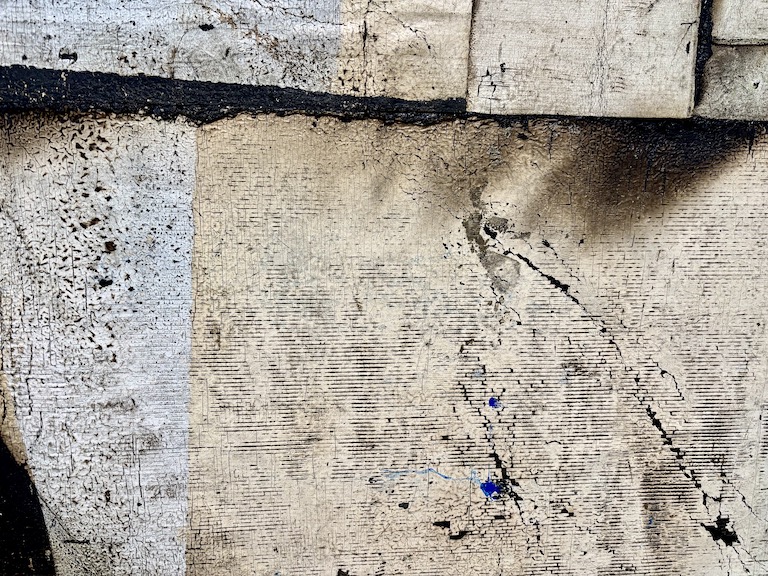
Wabi sabi, as noted elsewhere, refers to a raw and often faded beauty correlated to a dark, desolate sublimity. Prusinski suggests, for example, that a dilapidated wooden house with the sun shining through bamboo reeds that create shadows on the wall would demonstrate wabi sabi. Applying wabi sabi synthetically, as a design principle, for example, in the design of narrative environments, requires a scene that appears flawed and random, as if untouched by human hands, yet, paradoxically, designed.
Ma
Ma, again through paradox, brings to attention a beauty in emptiness, formlessness and intangibility. Ma cannot be represented overtly. Just as mono no aware cannot be captured in a single moment but must be pursued through a passage of time, so ma creates a boundless feeling that must be traced in relation to the environment in which it lies.
An observer cannot simply see a presence and call it ma. Rather, the observer must observe all aspects of the surroundings and feel the beauty that lies in the spaces that are unoccupied by material objects or living things. It cannot be captured and identified by a stationary moment. This may be valuable in seeking to articulate the experience and interaction that takes place over time in a narrative environment.
Henk Oosterling (2000: 77) brings to attention an exhibition on ma held at the Museum of Decorative Arts in Paris in 1979. The exhibition brought into experience different dimensions of ma through nine spatial, visual and sculptural installations. The exhibition catalogue sought to evoke ma by describing it as:
- the place in which a life is lived;
- organising the process of movement from one place to another – the breathing and movement of people divide the space in which people live;
- maintained by absolute darkness;
- the sign of the ephemeral;
- the alignment of signs, an empty place where all kinds of phenomena appear, pass and disappear;
- the way to sense the moment of movement.
Of particular interest from a design perspective is Oosterling’s endeavour to connect the materialistic interpretation of sensus communis by Western thinkers of difference to Kitaro Nishida’s basho, or logic of place, and to the notion of ma as a dynamic spatio-temporal interval that is used in architecture and the philosophy of martial art. The corporeal, yet immaterial, quality of these phenomena allows Oosterling to compare them with different configurations within philosophies of differences, notably Derrida’s différance, Lyotard’s passibility and Deleuze and Guattari’s plan of immannence.
What is at issue here for design practices is the relationship between this Japanese, more gentle, it would seem, conception of ageing as passing and correlated experiences and the, more violent, motif of destruction that marks the dawn of modernity. As noted by Nancy (2013), this motif can be traced in the poetics of Baudelaire, for whom destruction overwhelms, through Mallarmé, for whom destruction was a muse, to Rimbaud, who poses the question of whether it is possible “to become ecstatic amid destruction, rejuvenate oneself through cruelty!”
Before the dawn of modernity, Nancy suggests, the motif of ruin occupied an ambivalent place that exhibited, echoing Japanese aesthetics, the melancholic charm of broken-down constructions, which served as monuments to their own ruin.
In some ways what is at stake for design is whether it pursues, intentionally or unintentionally, destruction, which annihilates, or deconstruction, which destroys while tracing and retaining; a choice, deliberate or not, between violent erasure and differential re-marking and re-making. Another way of trying to understand what is at stake for design is whether grasping the ‘ruined’ or the ‘(de)-spoiled’ in aesthetic pleasure can open up to a history, one that poses challenges for the participant-observer as active respondent and as potential collaborator. In this case, aesthetic pleasure ceases to be an end and becomes a means, another beginning. In other words, there may be a tendency to dwell on what has been called ‘ruin porn’ as gratifying end in itself rather than to perceive the questions and challenges that the ‘ruined’, as ‘trace’, articulates and the responses for which it calls (Doucet and Philp, 2016).
References
Doucet, B. and Philp, D. (2016) In Detroit ‘ruin porn’ ignores the voices of those who still call the city home, Guardian, 15 February. Available at: https://www.theguardian.com/housing-network/2016/feb/15/ruin-porn-detroit-photography-city-homes (Accessed: 7 August 2024).
Nancy, J.-L. (2013) Of Struction, Parrhesia. Translated by T. Holloway and F. Méchain, (17), pp. 1–10.
Oosterling, H. (2000) A Culture of the ‘inter’: Japanese notions of ma and basho, in Kimmerle, H. and Oosterling, H. (eds) Sensus communis in Multi- and Intercultural perspective: On the Possibility of Common Judgements in Arts and Politics. Wurzburg: Konigshausen & Neumann, pp. 62–92.
Prusinski, L. (2012) Wabi-sabi, mono no aware, and ma: tracing traditional Japanese aesthetics through Japanese history, Studies on Asia, Series IV, 2(1), pp. 25–49.
 Incomplete ...