RELATED TERMS: Afrofuturism; Black Studies; Critical Race Theory; Intersectionality; Identity Politics;
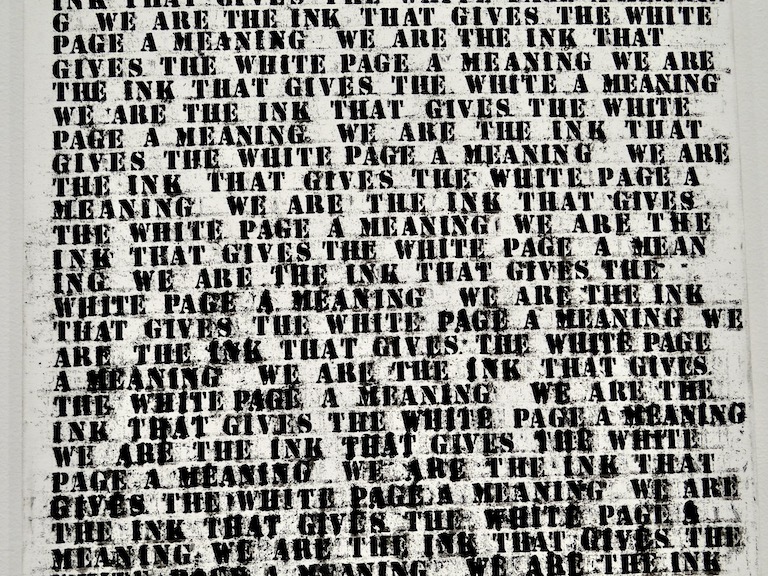
David Marriott (2021: viii) proposes that the work of Afro-pessimism has an extreme, audacious place in the history of Black Studies. The value for Marriott is that Afro-pessimism allowed him to rediscover what is for him the most exacting question: what is blackness? Furthermore, Annie Olaloku-Teriba (2018) suggests that it is crucial to engage with Afro-pessimist literature because it has both shaped and been shaped by the organisational impulses of Afro-American and Black British activists in particular.
What accounts, then, for the particular critical purchase and affective resonance of what Jarod Sexton (2016) at one time called, “a highly technical dispute in a small corner of the American academy”?
Rather than a fixed ideology, Afro-pessimism may be better thought of as a theoretical lens for situating relations of power at the level both of the political economy and the libidinal economy (Wilderson et al 2017: 7, n.1). Libidinal economy is defined as the distribution and arrangement, the condensation and displacement of desire and identification, of energies, concerns, foci of attention, anxieties, pleasures, appetites, revulsions, and phobias. In short, the libidinal economy affects the whole structure of psychic and emotional life, including the complex relationship between sexuality and the unconscious. Although unconscious and invisible, such processes have a palpable effect on the world, including the monetary, political economy.
Afro-Pessimism, Critical Race Theory and Racial Realism
Afro-pessimism, in many ways, picks up the critiques started by Black revolutionaries in the 1960s and 1970s. In this sense, it may be seen to have a relationship to critical race theory and the legacy of the civil rights movement of the 1950s and 1960s. For example, Derrick Bell, whose ideas proved foundational to critical race theory, came to recognise over time that decisions in landmark civil-rights cases were of limited practical impact in the longer term. He drew the unsettling conclusion that racism is so deeply rooted in the makeup of American society that it has been able to reassert itself after each successive wave of reform aimed at eliminating it.
This developed and strengthened a theme in Bell’s earlier work, that black rights have been held hostage to white self-interest. He began to argue that racism is permanent. Blacks can no longer afford to educate themselves and live their lives on the proleptic delusion of an integrated and non-racist white America, when they know that their reality is fundamentally determined by white racism (Cobb, 2021). Hopes of the gradual elimination of racism can no longer serve as the base from which Blacks are taught to interact with the world.
However, this position has its critics. Stanley Crouch (1995), for example, wrote that Bell’s theory of interest convergence undermined the importance of Black achievements in transforming American society. Crouch regarded Bell’s view as pessimism. To Bell, it was hard-won realism (Cobb, 2021). By overstating the case, Crouch argued, “the issue is smudged beyond recognition”. Crouch perceived Bell as fundamentally defeatist, someone who accepted high positions of success then told others below him that they don’t have a chance. Crouch (1995: 76), in addition, suggests that it is possible for black females, for example, to identify with achievements across colour lines. They do not necessarily need to see someone who looks like them to believe it is possible to succeed in the world. If that were the case, Crouch argues, no black achievement of any kind would have taken place unless it was based on replicating some practice held over from Africa.
In as far as Afro-pessimism holds that Black Americans are still viewed as they were viewed in days of the slavery, that is, as different, inferior, and as outsiders, as does Orlando Patterson (1982), there are clear parallels between the thought of Bell and Afro-pessimism. Patterson theorises slavery as a relational dynamic between “social death”, the slave, and “social life”, the human.
A central argument of Afro-pessimists is that Black people are constitutively excluded from the category of the self-possessing, rights-bearing human being of modernity. Afro-pessimism is marked by its ontological nihilism and its attempt to think blackness in terms other than property, alienation, and re-appropriation (Marriott, 2021). Violence, as structure or paradigm, and sexual violence, as an ensemble of practices within that paradigm, is at the heart of Afro-pessimist meditations (Wilderson, 2020: 167).
Jared Sexton (2016) suggests that, “if Afro-Pessimism is defined by anything … then it may be the motive force of a singular wish inherited in no small part from black women’s traditions of analysis, interpretation, invention, and survival”. That ‘wish factor’ is born of a confrontational style that assumes a general antagonism. This style contrasts sharply with what might be called the ‘hope creed’ that characterises those engaging in the politics of everyday life through the assumption of a general consensus disrupted by conflict.
Afro-pessimism and Identity Politics
Afro-pessimism is often misunderstood as a discourse about identity politics. When Afro-pessimists talk about blackness, Wilderson insists, they are talking about a kind of vector of violence and rituals. They are talking about blackness as a position. When others talk about blackness and identity, they are talking about it as a culture. The first step for those trying to understand Afro-pessimism is that one has to think about blackness as a kind of site (Wilderson and Park, 2020).
In an issue of the journal Historical Materialism whose theme is identity politics, Annie Olaloku-Teriba (2018) discusses the value and limitations of Afro-pessimism, focussing on the conceptual confusions around the notion of blackness and the implications this has for theories of anti-blackness.
Design and Afro-pessimism
In as far as design practices work across material, political, libidinal and symbolic economies, understanding their deployment is crucial for recognising how flows of energies are articulated through the materiality of design interventions, which partake in the societal processes of sexuation and racialisation and the constructs which emerge from them. In particular, design practices operate between the political economy and the libidinal economy: by shaping material practices, including processes of commodification they, in turn, shape desire. Design practices thus serve as part of the formation as well as deformation of desire, which is, as argued by Stiegler (2013: 123), technologically conditioned through and through. In short, a libidinal economy is crucially sustained by a mnemotechnical milieu, that is, a technical ‘milieu of the mind’ (Lemmens, 2017). This takes into account Stiegler’s (2013: 123) argument that, “what is generally ignored by the theory of the libidinal economy, including by Freudians, is the role of technics, which also means, in our epoch, the role of industry – which Valery was almost alone, in his time, in trying to think.”
In terms of the design of the theoretical discourse around blackness and anti-blackness, William Hart (2018) outlines what he calls a ‘genealogy’, but which might easily be characterised as a ‘montage’ or ‘bricolage’, of concepts derived from debates about slavery and capitalism with which both Afro-pessimists and black optimists might find some agreement. Hart cites:
- Frantz Fanon’s (1988, 1952) phenomenology of blackness, particularly his concept of ‘negro phobogenesis’ or the “lived experience of the black person”;
- Orlando Patterson’s (1982) notion of slavery as social death;
- Cedric Robinson’s (2020, 1983) concept of ‘racial capitalism’;
- Hortense Spillers’s (1987) ontological distinction between ‘body’ and ‘flesh’, rooted in the experience of the Middle Passage and slavery;
- Saidiya Hartman’s (1997; 2007) meditations on ‘world’ destruction within the hold of the slave ship, the afterlife of slavery and naïve celebrations of agency; and
- Nahum Chandler’s (2008) concept of blackness as a ‘double movement,’ both ontic and ontological, that is, blackness as ‘paraontological’.
Afro-Pessimism, African Americans, Afropessimism and Africa
William Hart (2018: 19) suggests that Frank Wilderson appropriated the term Afro-pessimism from development theory, while Aaron Robertson (Wilderson and Robertson, 2020) points out that a conversation in 2003 between Saidiya Hartman and Frank Wilderson (Hartman and Wilderson, 2003) is generally cited as the start of a second wave of Afro-pessimist thought.1
During the 1980s, the term Afropessimism expressed the view of many Africanists in economics, area studies and elsewhere concerning the prospects for the African continent. Black Africa was seen as politically corrupt and poorly equipped for economic development. This was because black Africa, in contrast to their more prosperous Asian counterparts, had failed to adopt the political reforms and follow the market-centric strategies promoted by the World Bank, the International Monetary Fund and other institutions of global capitalist management. Under Wilderson’s re-signification, Afro-pessimism becomes an ontological account of white supremacy and the tenacity, perdurance and radicality of anti-blackness.
Ochieng Okoth (2020) avers that, for decades, Afropessimism had referred to the unrelentingly negative coverage of Africa in Western news media. Such Afropessimist discourses imposed a Eurocentric developmental model on the continent, assessing its progress in relation to a set of arbitrary criteria that takes Western liberal democracies to be the final stage in the progress of world history. Greg Thomas (2018), Ochieng Okoth notes, has given the name Afro-pessimism 2.0 to Wilderson’s, Sexton’s and others’ appropriation of the term.
Afro-pessimism – added notes from Wilderson et al. 2017
In the ‘Introduction’ to Afro-Pessimism: an introduction, the editors point out that one of the central tenets of Afro-pessimism, developed from the work of Orlando Patterson, is a re-definition of slavery: rather than being a relation of forced labor, it is more accurately a relation of property. The slave is objectified and legally made a commodity to be used and exchanged. It is not just the slave’s labour-power that is commodified, as is the case with the worker, but their whole being. For this reason, they are precluded from the category of the ‘human’: inclusion in humanity is predicated on social recognition, volition, subjecthood and the valuation of life, but slaves are not recognised as social subjects.
Furthermore, Afro-pessimism argues that the slave, because a commodity, is socially dead. This means that slaves are open to gratuitous violence, as opposed to violence contingent upon some transgression or crime; natally alienated, their ties of birth not recognised and familial structures intentionally broken apart; and generally dishonoured, or disgraced prior to any thought or action is considered.
This social death means, according to Afro-pessimism, that slaves experience their ‘slaveness’ ontologically: being-a-slave means ‘being for the captor’. Slaves, therefore, are not oppressed subjects, who experience exploitation and alienation, but are objects of accumulation and fungibility or exchangeability.
This distinction problematises any positive affirmation of identity: non-Black categories are defined against the Blackness they are not, a relation of race that directly and indirectly sustains anti-Blackness by producing and sustaining racialised categories.
From this understanding Afro-pessimism defines what it sees as the limits and failures of the Civil Rights and Black Power movements, including their reformist ideologies of progress and their integration with bureaucratic machinery, which is seen as disastrous from an Afro-pessimistic perspective. Afro-pessimism argues that it is not possible to affirm Blackness itself without at the same time affirming anti-Black violence. As a result, attempts at recognition and inclusion in society will only ever result in further social and real death. Because Blackness is negated by the relations and structures of society, Afro-pessimism posits that the only way out is to negate that negation.
The challenges Afro-pessimism poses to the affirmation of Blackness extend to other identities, in the process problematising identity-based politics.
Afro-pessimism is critical of the rhetoric often used that takes an assumed, historically oppressed subject at its centre, for example, workers or women, arguing that this rhetoric conflates experience with existence while failing to acknowledge the incommensurate ontologies between, for example, white women and Black women.
To speak in generalities, of workers or women, for example, is to speak from a position of anti-Blackness. This is because the non-racialised subject is the white, or at least non-Black, subject.
This means that the movements against capitalism, patriarchy or gender mean little if, firstly, they do not elucidate ontological disparities within a given site of oppression; and, secondly, they do not seek to abolish the totality of race and anti-Blackness in an unqualified way. This is not to privilege anti-Black racism in a hierarchy of oppression, but to insist upon the un-livability of life for Blacks over centuries of social death and physical murder, perpetuated, at different times, by all non-Black subjects in society.
Notes
1. The phrase ‘Afro-pessimists’ appears in the conversation between Hartman and Wilderson (2003) in the context of a discussion of the supposed differences in dispositions between Africans and African-Americans. Hartman states,
“In In My Father’s House, Anthony Appiah says that African-Americans are angrier at white people than Africans because colonialism didn’t exact the same psychic damage. I don’t believe that, I think that’s an untrue statement. I think that there’s definitely a difference between we who are of the West and people elsewhere, but I really challenge that supposition because the psychic damage of apartheid is tremendous. When you look at certain African writers, say Achille Mbembe and the other so-called “Afro-Pessimists” who are diagnosticians of their society, you see the consequences of the colonial project. The trauma may not be as extreme or radical as in our case because we’re literally living inside this order, but I would still greatly qualify these positive assessments of African subjectivity.”
(Hartman and Wilderson, 2003: 197)
Podcasts
Always Already Podcast- Interview: Frank B. Wilderson III on Afropessimism – Epistemic Unruliness 28
A transcript of this interview can be found at https://alwaysalreadypodcast.files.wordpress.com/2021/01/wilderson-interfere.pdf
Video Resources
For a critical discussion of Afro-pessimism from a Lacanian perspective, listen to Sheldon George’s talk at https://www.youtube.com/watch?v=j1W5cFmT2C0
Websites
Frank B Wilderson’s website: https://www.frankbwildersoniii.com/
References
Chandler, N. D. (2008) Of exorbitance: the problem of the negro as a problem for thought, Criticism, 50(3), pp. 345–410. Available at: http://www.jstor.org/stable/23130886 (Accessed: 7 February 2023).
Crouch, S. (1995) ‘Dumb Bell blues’, in The All-American Skin Game or, The Decoy of Race. The Long and the Short of it, 1990-1994. New York, NY: Pantheon Books, pp. 75–76.
Fanon, F. (1988, 1952) Black skin, white masks. London, UK: Pluto Press.
Grant, C. A., Woodson, A. N. and Dumas, M. J. (eds) (2021) The Future is black: Afropessimism, fugitivity, and radical hope in education. New York, NY: Routledge.
Hart, W. D. (2018) Constellations: Capitalism, Antiblackness, Afro-Pessimism, and Black Optimism, American Journal of Theology and Philosophy, 39(1), pp. 5–33. Available at: https://www.jstor.org/stable/10.5406/amerjtheophil.39.1.0005 (Accessed: 2 September 2022).
Hartman, S. V (1997) Scenes of subjection: terror, slavery and self-making in nineteenth-century America. New York, NY: Oxford University Press.
Hartman, S. V (2007) Lose your mother: a journey along the Atlantic slave route. New York, NY: Farrar, Strauss and Giroux.
Hartman, S. V. and Wilderson, F. B. (2003) The Position of the unthought, Qui Parle, 13(2), pp. 183–201. Available at: https://www.jstor.org/stable/20686156 (Accessed: 1 December 2022).
Lemmens, P. (2017) The conditions of the common: a Stieglerian critique of Hardt and Negri’s thesis on cognitive capitalism as a prefiguration of communism, in Ruivenkamp, G. and Hilton, A. (eds) Perspectives on Commoning. London, UK: Zed, pp. 169–212.
Marriott, D. S. (2021) Lacan Noir: Lacan and Afro-Pessimism. Cham, CH: Palgrave Macmillan.
Ochieng Okoth, K. (2020) The Flatness of Blackness: Afro-Pessimism and the erasure of anti-colonial thought, Salvage. Available at: https://salvage.zone/issue-seven/the-flatness-of-blackness-afro-pessimism-and-the-erasure-of-anti-colonial-thought/ (Accessed: 12 November 2022).
Olaloku-Teriba, A. (2018) ‘Afro-pessimism and the (un) logic of anti- blackness’, Historical Materialism. Available at: https://www.historicalmaterialism.org/articles/afro-pessimism-and-unlogic-anti-blackness (Accessed: 6 October 2022).
Patterson, O. (1982) Slavery and social death: a comparative study. Cambridge, MA: Harvard University Press.
Robinson, C. J. (2020, 1983) Black Marxism, 3rd edn. Chapel Hill, NC: University of North Carolina Press.
Sexton, J. (2016) ‘Afro-pessimism: the unclear world’, Rhizomes, 29. doi: 10.20415/rhiz/029.e02.
Spillers, H. J. (1987) Mama’s baby, Papa’s maybe: An American grammar book, Diacritics, 17(2), pp. 64–81.
Stiegler, B. (2013). Uncontrollable Societies of Disaffected Individuals: Disbelief and Discredit. Volume 2. London-New York: Polity.
Thomas, G. (2018) Afro-Blue Notes: the death of Afro-pessimism (2 . 0)?, Theory and Event, 21(1), pp. 282–317. Available at: https://muse.jhu.edu/article/685979 (Accessed: 12 November 2022).
Wilderson, F. B. (2010) Red, White and Black: Cinema and the structure of U.S. antagonisms. Durham, NC: Duke University Press.
Wilderson, F. B. et al. (2017) Afro-Pessimism: an introduction. Minneapolis, MN: Racked & Dispatched.
Wilderson, F. B. (2020) Afropessimism. New York, NY: Liveright Publishing.
Wilderson, F. B. and Park, L. (2020) ‘Afropessimism and Futures of … : A Conversation with Frank Wilderson’, Black Scholar, 50(3), pp. 29–41. doi: 10.1080/00064246.2020.1780863.
Wilderson, F. B. and Robertson, A. (2020) The Year Afropessimism hit the streets?: A Conversation at the edge of the world, Literary Hub, (27 August). Available at: https://lithub.com/the-year-afropessimism-hit-the-streets-a-conversation-at-the-edge-of-the-world/ (Accessed: 1 December 2022).
Winters, J. (2019) Afro-pessimism, in Paul, H. (ed.) Critical terms in futures studies. Cham, CH: Palgrave Macmillan, pp. 5–12.
 Incomplete ...