RELATED TERMS: Actant; Actantiality; Performance and Performativity;
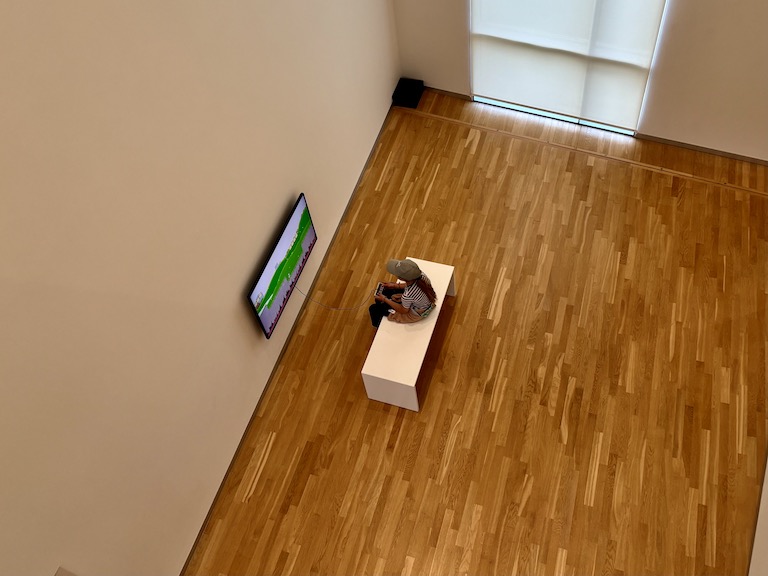
“If it is understood that all use is interaction, then all design is inter-active design”. (Taylor, 2013: 370)
Interaction, a mutual and progressive exchange between two or more entities, human or otherwise, is a key feature of designed environments. The overall pattern of this interaction may be called a field of actantiality or performativity, indicating its dynamic, networked or systemic character.
In interaction design, which arose in the context of human-computer, human-machine or human-technology interaction, the interaction is a two-way exchange which may be person-to-person, person-to-machine, machine-to-machine or machine-to-environment. It is typified by responsiveness and also by being characterisable as a sequence of exchanges.
Nathan Shedroff (2000) contends that interaction design is essentially story-creating and story-telling. It is, therefore, both an ancient art and a new technology. This is because, while media have always effected the telling of stories and the creation of experiences, new media currently offer capabilities and opportunities not yet addressed in the history of interaction and performance. Shedroff notes that, “the emphasis in interaction design is on the creation of compelling experiences.”
It is the character of the interaction which determines the kind of agency an inter-actant can have within the framed experience. In the design of narrative environments the term actant is used for the participant, while the overall interaction creates a field of actantiality or potential agency, but agency which is of a networked, distributed or systemic kind. The participant-actant has limited capacity to control, shape or direct the interaction.
Participant, or participant-actant, is a term which extends beyond the usual understanding of the ‘user’ of a design. It posits an active involvement of participants in the generation of the work, at a profound level, through interaction with, arrangement of, or even production of, its elements.
For examples of such participation, see the work of Usman Haque, particularly Open Source Architecture and Reconfigurable House
In interaction design in the context of human-computer, human-machine or human-technology interaction, the interaction is a two-way exchange which may be person-to-person, machine-to-machine or person-to-machine. It is typified by this mutual responsivity but also by being characterisable as a sequence of discrete exchanges.
Interactive Storytelling
Traditionally, Celia Pearce (1997) argues, interactive narrative has been synonymous with non-linear storytelling, or branching, video-based genres. Virtual reality, she suggests, offers a more interactive alternative, that of ‘omnidirectional storytelling.’ However, she points out, therein lies the challenge: the more interactivity, the more challenging it becomes to facilitate the story. How can the seeming contradiction between ‘interactive’ and ‘narrative’ be resolved?
References
Pearce, C. et al. (1997) Narrative environments: virtual reality as a storytelling medium (Panel moderated by Celia Pearce). SIGGRAPH 1997. Available at https://history.siggraph.org/learning/narrative-environments-virtual-reality-as-a-storytelling-medium-moderated-by-celia-pearce/ [Accessed 2 November 2022]
Shedroff, N. (2000) ‘Information interaction design: a unified field theory of design’, in Jacobson, B. (ed.) Interaction design. Cambridge, MA: MIT Press, pp. 267–292.
Taylor, D. (2013) After a broken leg: Jurgen Bey’s Do Add chair and the everyday life of performative things, Design and Culture, 5(3), pp. 357–374. doi: 10.2752/175470813X13705953612246.
Other Resources
Dag Svanaes, Philosophy of Interaction. In The Encyclopedia of Human-Computer Interaction, 2nd Ed. Available at https://www.interaction-design.org/literature/book/the-encyclopedia-of-human-computer-interaction-2nd-ed/philosophy-of-interaction
 Incomplete ...