RELATED TERMS: Environments – Art; Happenings; Immersion; Ocular-Centrism; Sculpture
The term installation is usually applied to arrangements of materials and/or media in interior spaces, whereas exterior interventions are often called land art. However, the boundaries between these categories are fluid, as Rosalind Krauss (1979) discusses.
Installation artworks have been constructed in exhibition spaces such as museums and galleries, as well as public and private spaces. The genre incorporates a very broad range of everyday and natural materials, which are often chosen for their evocative qualities, as well as media such as video, sound, performance, interactive media, virtual reality and the internet.
Many installations are site-specific in that they are designed to only exist in the location for which they were created, taking into account such things as the nature, attributes, purpose and prior use of that space.
Installation art, according to Harriet Hawkins (2010) in discussing an installation work by Tomoko Takahashi, intertwines spatial politics with embodied visual politics through its configuration of bodies, spaces and objects. The history of installation art, particularly since the 1960s, demonstrates a critique of ocular-centric understandings of art and representation while witnessing the emerging dialogue among artist, viewer and artwork.
installation practice is often referred to as immersive. Installations create spaces into which you take your whole body.
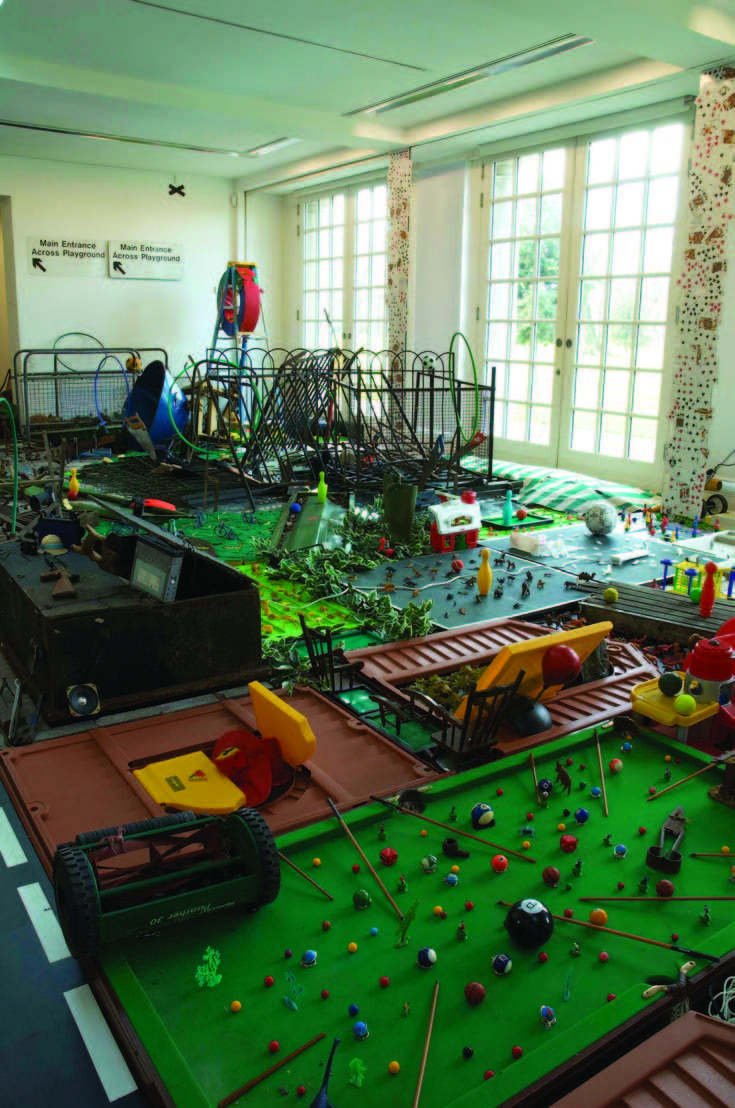
Tomoko Takahashi, my play-station at serpentine 2005 – garden, Installation at Serpentine Gallery, London
References
Hawkins, H. (2010) The argument of the eye? The cultural geographies of installation art, Cultural Geographies, 17 (3), pp. 321–340. doi: 10.1177/1474474010368605.
Krauss, R. E. (1979) Sculpture in the expanded field, October, 8, pp. 30–44. Available at: http://www.jstor.org/stable/778224 (Accessed: 10 February 2016).
 Incomplete ...