RELATED TERMS: Agonism and avant-gardism; Agonistic Politics – Mouffe; Apparatus – Dispositif; Arendt; Avant-garde movements; Dissensus – Ranciere; Politics and the Political
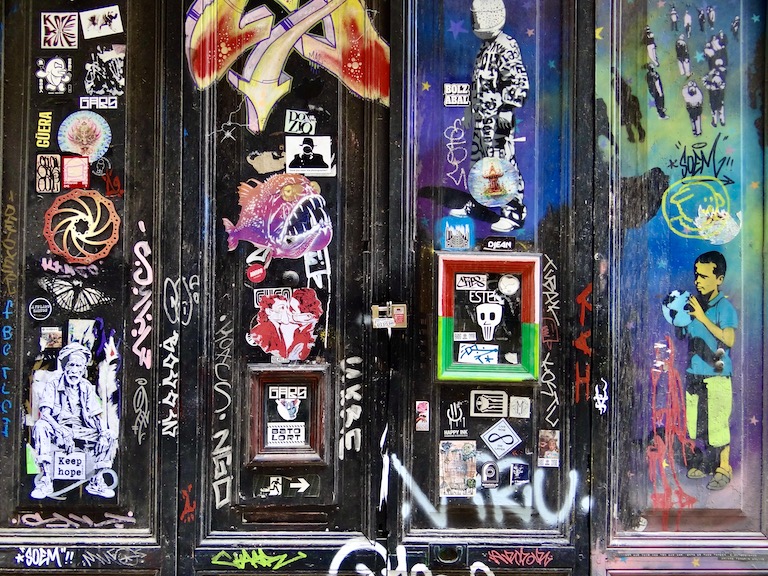
A narrative environment could be conceived of as a ‘distribution of the sensible’; or, if it is a political act, a disruption of a ‘distribution of the sensible’. Ranciere’s phrase, partage du sensible, is sometime translated as ‘partition of the sensible’.
Jacques Ranciere (2004: 12) defines the distribution of the sensible as, “the system of self-evident facts of sense perception that simultaneously discloses the existence of something in common and the delimitations that define the respective parts and positions within it.”
Such a system, Ranciere continues, as distribution or partition of the sensible, establishes, at one and the same time, something common that is shared (inclusively) as well as parts that are exclusive.
From the perspective of the design of narrative environments, it is important to note that such an apportionment of parts and positions is based on a distribution of spaces, times, and forms of activity that determines the way in which something in common lends itself to participation and in what way various individuals have a part, or do not, in the enactment of this distribution.
In this way, Ranciere notes, the distribution of the sensible reveals who can have a share in what is common to the community based, firstly, on what they do and, secondly, on the time and space in which this activity is performed. Thereby, having a particular ‘occupation’, as a commitment to be at a particular place or places for specified periods of time, determines an actant’s ability or inability to take charge of what is common to the community. In addition, it defines what is visible or not in a common space, endowed with a common language, and so on.
There is thus an ‘aesthetics’ at the core of politics, Ranciere argues, not to be understood as the perverse commandeering of politics by a will to art or by a consideration of ‘the people’ as work of art but rather as the system of a priori forms determining what presents itself to sense experience. This ‘aesthetics’ might be characterised as a set of practices of perception, perception understood environmentally as an active scanning of possibilities for action and intervention.
Ranciere uses this approach to propose his theory of the inter-relationship between aesthetics, as the distribution of the sensible, and politics, as specific arrangements of participation and exclusion.
Thus, for Ranciere (2004: 13):
“Politics revolves around what is seen and what can be said about it, around who has the ability to see and the talent to speak, around the properties of spaces and the possibilities of time.”
For Rancière, the ‘distribution of the sensible’ is tied to the concept of democracy (Birrell, 2008), by means of a potential ‘redistribution of the sensible’, both as a perceptual alteration of the visible/invisible and as a political rearrangement of the inclusive/exclusive, to form a new apparatus, regime or dispositif; or, indeed, narrative environment.
Ranciere’s thinking about the ‘distribution of the sensible’ is an important factor in Ales Erjavec’s (2015) definition of aesthetic avant-gardes, which seek to reach beyond art into ‘life’, and which aim to transform not just artistic styles and techniques but also the world. The artistic elements of such works are set within an experience-transforming orientation.
However, as Rok Bencin (2024) notes, politics in Rancière conception is constituted by a conflict among a plurality of worlds. For Rancière, according to Bencin, worlds are shared structures determining the coordinates of perception and intelligibility that define a common reality and the way various subjects can, or cannot, take part therein. Political subjectivation thus becomes primarily a dissensual evocation of another world, that of equality, within a given one, that of inequality.
For Rancière, worlds are irreconcilable framings of the common. They therefore constitute an agonistic multiplicity rather than a common horizon of politics. This complicates the endeavour of any avant-garde work that would seek to integrate ‘art’ into ‘life’. Rather, such work would initially have to prescribe which world or worlds into which it was seeking to intervene from which other world or worlds, in other words, allowing us to recognise, “the ways in which artworks enable us to trace another world within a given one” (Bencin, 2024: 6).
In this Rancierian view, emancipatory politics, in so far as it is possible, opens up singular worlds that reframe dissensually what is perceived as common.
References
Bencin, R. (2024). Rethinking the Concept of World: Towards Transcendental Multiplicity. Edinburgh, UK: Edinburgh University Press.
Birrell, R. (2008). Jacques Ranciere and the (re) distribution of the sensible: five lessons in artistic research. Art & Research, 2 (1), . Available from http://www.artandresearch.org.uk/v2n1/pdfs/v2n1editorial.pdf [Accessed 23 December 2015]. Alternative source: https://videomole.tv/wp-content/uploads/2023/RB2008.pdf
Erjavec, A. (2015). Introduction. In: Erjavec, A., ed. Aesthetic revolutions and twentieth-century avant-garde movements. Durham, NC: Duke University Press, 1–18.
Grabar, N. (2021) Architecture and the distribution of the sensible, Filozofski vestnik, 42(2), pp. 259–280. doi: 10.3986/fv.42.2.12.
Ranciere, J. (2004). The Politics of aesthetics: the distribution of the sensible. London, UK: Continuum.
 Incomplete ...