RELATED TERMS: Affordances; Apparatus – Dispositif; Biopolitics and Biopower; Body; Burnout Society; Fordism and Post-Fordism; Libidinal Economy
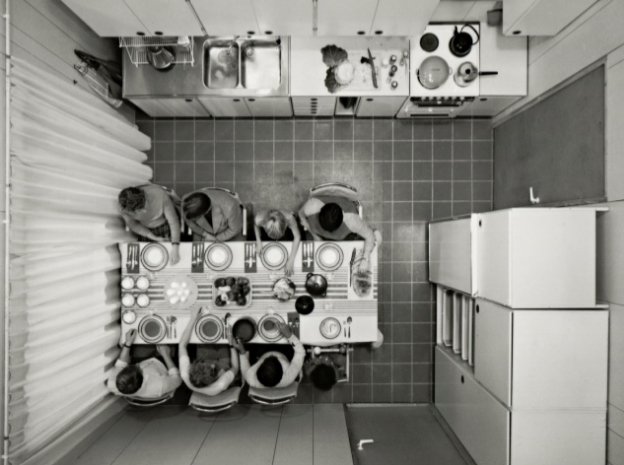
Environmental design outputs, such as narrative environments, could be said to form domains or territories with their own characteristic habits, rules, regulations and laws, a kind of ‘world’ or ‘universe’. In order to develop a sense of how such immersive enclosures might operate, how power is realised and distributed within them and how they, in turn, relate to their environments, i.e. the context of other narrative environments, it is worth considering the thoughts of Michel Foucault on disciplinary societies, Gilles Deleuze on societies of control and Byung-Chul Han’s on the ‘burnout society’.
Disciplinary societies, as defined by Foucault, are in the process of becoming societies of control, as defined by Deleuze, Chantal Mouffe (2012: 23) contends. This transition, which does not necessarily imply a complete replacement or displacement, is marked by the emergence of a new paradigm of power. In the disciplinary societies, command is exercised through the articulation of a network of apparatuses (dispositifs) that produce and regulate customs, habits and practices of production, the major disciplinary institutions being the family, school, factories, asylums and hospitals. In societies of control, however, command is immanent to the social field, distributed to the minds and bodies of the citizens.
The means of social integration and exclusion are no longer primarily realised primarily as enclosures that are spatialised, territorialised and exteriorised, as they used to be in disciplinary societies. In societies of control, integration and exclusion are now more often realised through perceptions that are interiorised and cognitive, woven into and guiding embodied inter-action. The environment is scoured for opportunities and affordances, for permissions and interdictions. This new paradigm of power Foucault calls ‘biopolitical’. Looking at this transition from the perspective of spatial practices, however, it might be seen as a re-articulation of enclosure and perception, with people ‘enclosing’ themselves through their own perceptual and behavioural habits in a terrain that appears more ‘open’, ‘public’ or ‘common’ but nevertheless remains ‘enclosed’.
As outlined by Deleuze (1992: 3), Foucault defined disciplinary societies as those which arose during the 18th and 19th centuries in Europe and reached their peak at the outset of the 20th century. Such societies inaugurate and develop the organization of vast spaces of enclosure, in which the individual passes sequentially from one closed environment to another, each having its own laws. The first (narrative) environment is that of the family. From there, the individual passes on to the school and after that, if a man at that time, to the barracks. The passage continues to the factory and, on occasion, the hospital, and possibly the prison, this last place being the pre-eminent instance of the enclosed (narrative) environment. For Foucault, the prison serves as the central analogical model.
The ideal project of these environmental enclosures, as analysed by Foucault, is particularly visible within the factory. It seeks to concentrate in place; to distribute in space; to order in time; and to compose a productive force within the dimension of space-time whose effect will be greater than the sum of its component forces. Foucault also recognised the transience of this model, as itself a successor to the societies of sovereignty. The goal and functions of societies of sovereignty were to tax rather than to organise production and to rule on death rather than to administer life. This prior transition took place over time, with Napoleon seeming to effect the large-scale conversion from one kind of society to the other. However, in their turn, the disciplines underwent a crisis to the benefit of new forces that were gradually instituted and which accelerated after World War II: a disciplinary society had ceased to be dominant.
In Foucault’s (1980: 58) words,
“From the eighteenth to the early twentieth century I think it was believed that the investment of the body by power had to be heavy, ponderous, meticulous and constant. Hence those formidable disciplinary regimes in the schools, hospitals, barracks, factories, cities, lodgings, families. And then, starting in the 1960s, it began to be realised that such a cumbersome form of power was no longer as indispensable as had been thought and that industrial societies could content themselves with a much looser form of power over the body.”
Deleuze (1992: 4) summarises the difference between enclosures and controls in the following terms: “Enclosures are molds, distinct castings, but controls are a modulation, like a self-deforming cast that will continuously change from one moment to the other … “
Footnote
Mark Fisher (2012) argues that part of the reason why the work of Deleuze and Guattari continues to be relevant is that the question they raised, concerning the relation of desire to politics in a post-Fordist context, remains a crucial one. Deleuze and Guattari’s work specifically engages with the problem of how to construct an effective anti-authoritarian leftist movement, a goal which was promised but never actually delivered by the various cultural revolutions of the 1960s.
The lessening of the dominance of of the Fordist economy [Note 1], with its concomitant disciplinary structures means that, as Eric Alliez (2010) comments, we cannot, “just carry on with the same old forms of political institution, the same modes of working class social organisation, because they no longer correspond to the actual and contemporary form of capitalism and the rising subjectivities that accompany and/or contest it.”
There is little doubt that the language of ‘flows’ and ‘creativity’ used by Deleuze and Guattari has an exhausted quality because of its appropriation by capitalism’s creative industries, including design practices. Nevertheless, rather than seeing the proximity of some of Deleuze and Guattari’s concepts to the rhetoric of late capitalism as a mark of their failure, Fisher suggests they should be seen as a mark their success in gaining some purchase on the problems of political organisation under post-Fordist conditions.
The shift from Fordism to post-Fordism as the dominant political economic form, or in Foucault-Deleuze’s terms from disciplinary societies to societies of control, involves a change in the libidinal economy, notably an intensification of desire for consumer goods, funded by credit. These shifts cannot easily be combated by an assertion of working-class discipline because post-Fordism has seen the decomposition of the old working class. In the global North, the working class is no longer concentrated in manufacturing spaces. Its forms of industrial action, consequently, are no longer as effective as they once were. At the same time, the libidinal attractions of consumer capitalism needed to be met with an active counter-libido, not simply an anti-libidinal dampening.
This means that politics has to come to terms with the essentially inorganic nature of libido, as characterised by Freud, the Surrealists, Lacan, Althusser and Haraway, Deleuze and Guattari and others.
Inorganic libido is what Lacan and Land call the death drive: not a desire for death, for the extinction of desire in what Freud called the Nirvana principle, but an active force of death, defined by the tendency to deviate from any homeostatic regulation.
As desiring creatures, we ourselves are that which disrupts organic equilibrium. The novelty of Deleuze and Guattari’s Anti-Oedipus account of history is the way that it combines an account of inorganic libido with the Hegelian-Marxist notion that history has a direction. One implication of this is that it is very difficult to put this historically machined inorganic libido back in its box: if desire is a historical-machinic force, its emergence alters ‘reality’ itself; to suppress it would therefore involve either a massive reversal of history, or collective amnesia on a grand scale, or both. [In other words, it would require the end of the world which, by all accounts, is easier to imagine than the end of capitalism]
Notes
1. Bob Jessop (1992) notes that the language of Fordism and post-Fordism has entered everyday discussion. In doing so, it has been vulgarised, reducing its utility for theoretical understanding and empirical analysis. Jessop distinguishes four levels in which Fordism and post-Fordism can be analysed: the labor process; the regime of accumulation; the mode of regulation; and the mode of societalisation. Jessop concludes that there is a fundamental analytical asymmetry between the two terms and advocates a more cautious and critical use of the notion of post-Fordism.
References
Deleuze, G. (1992). Postscript on the societies of control. October, 59 (1), 3–7. Available from http://www.jstor.org/stable/778828 [Accessed 21 March 2016].
Deleuze, G. and Guattari, F. (1983) Anti-Oedipus: capitalism and schizophrenia. Minneapolis, MN: University of Minnesota Press.
Fisher, M. (2012) Post-capitalist desire, in Campagna, F. and Campiglio, E. (eds) What we are fighting for: A radical collective manifesto. London, UK: Pluto Press, pp. 131–138.
Foucault, M. (1980). Body/Power. In: Power/Knowledge: selected interviews and other writings 1972-1977, edited by C. Gordon. New York, NY: Pantheon Books, 55-62.
Han, B.-C. (2015) The Burnout society. Translated by E. Butler. Stanford, CA: Stanford Briefs.
Jessop, B. (1992) Fordism and post-fordism: A critical reformulation, in Scott, A. J. and Storper, M. (eds) Pathways to industrialization and regional development. London, UK: Routledge, pp. 42–62. doi: 10.4324/9780203995549.
Mouffe, C. (2012). Space, hegemony and radical critique. In: Featherstone, D., and Painter, J., eds. Spatial Politics: Essays for Doreen Massey. Chichester, West Sussex, UK: Wiley-Blackwell, 19–31.
 Incomplete ...
One thought on “Disciplinary Societies and Societies of Control”