RELATED TERMS: Biopolitics and Biopower; Disciplinary Societies and Societies of Control; Place, Space, Placiality, Spatiality; Sensorimotor System; Somatosensory System
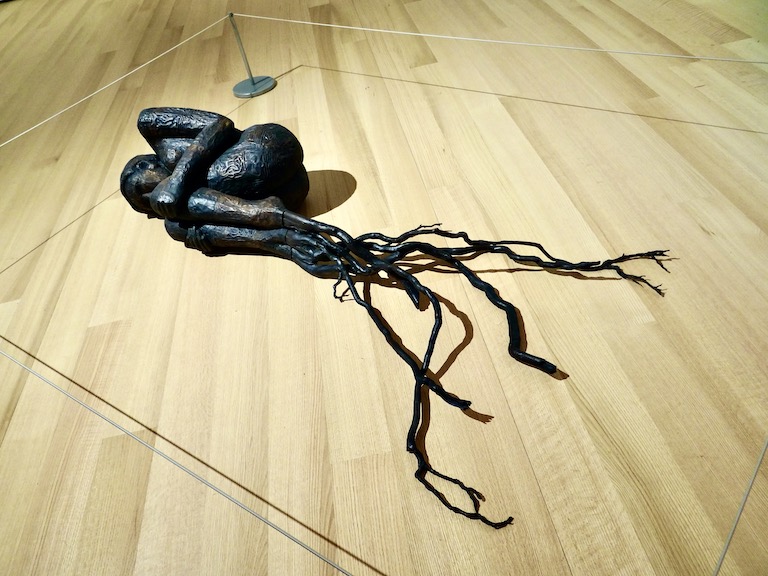
“Simone de Beauvoir argues that the body is a situation — a set of material givens whose value shifts depending on context … [For Donna Haraway,] the body is the vantage point from which one makes sense of the world … [while for Sara Ahmed,] bodies take shape through tending toward objects that are reachable, that are available within the bodily horizon … forms of extension, aversion, and movement are … how we reside in space.” (Musser, 2024)
Aside from narratology, for example, the approaches of Greimas and Genette, and environmental theories of various kinds, for example, those of Peter Sloterdijk or Henri Lefebvre, the human body is a key area of research for design practice. This is particularly the case if the body is understood through phenomenology and neuroscience, while being inflected by a feminist epistemological, ontological, axiological and political stance. In the mutual contextualisation of narrative, discursive progression and processional environmental immersion, the human body can be grasped as an integrative actantiality and potentiality. The body’s being and becoming mediate and intervene, draw together and pull apart. They organise the levels of deixis whereby a here-and-now and a there-and-then are constructed, intertwined and altered. All this happens through an ongoing you-and-I dialogue of call and response wherein the real is constituted, de-constituted and re-constituted.
Human social subjectivity, consciousness and self-consciousness, imagined and realised through the body, are embedded in the world, the world being understood as an enfolded set of cultural, often narrative, worlds, or interwoven fictional and factual storyworlds and world stories. They may be lived as narratives, ideologies or belief systems; or as culture. The body mediates among these ontologically-distinct worlds. By multifarious assimilations, sensorimotor interactions and their further processing, the body becomes transparent to the world in which we are living, allowing us to act in it, seemingly seamlessly. At crucial moments, however, bodily non-transparency, where body does not disappear into environment but becomes obstacle, raises other issues that may be addressed by particular design configurations.
Embodied consciousness may be characterised as mediated immediacy (Plessner, 1981). The tacit knowledge or knowing-how of the body implies all the taken for granted that has become part of our bodily repertoires, habits, and dispositions. We use the operative intentionality of our body as an instrument for understanding the other’s intentions. The body works as a tacitly felt mirror of the other. It elicits a non-inferential process of empathic perception that Merleau-Ponty called transfer of the corporeal schema and which he attributed to a primordial sphere of “intercorporeality”.
As Merleau-Ponty expresses it, the communication or comprehension of gestures comes about through the reciprocity of my intentions and the gestures of others, of my gestures and the intentions discernible in the conduct of other people. It is as if the other person’s intentions inhabited my body and mine theirs (Merleau-Ponty, 2002). In intercorporeity, the “as-if” structure of the body becomes the very medium of understanding.
From a neuroscience perspective, the distinction between mind and body, as if they were two different kinds of substance, a thinking and a non-thinking thing (res cogitans and res extensa), has become untenable. Mind-brain and body are intimately intertwined. The way we perceive our body is crucial for the way we perceive our self.
As research into the phenomenon of so-called body integrity identity disorder (BIID), in which phantom sensations occur, seems to suggest, brain-mind-body interactions enable the creation of a dynamic model of the body by integrating tactile and visual information with limb position signals from the muscles and tendons (Costandi, 2022).
‘Mind’, in this perspective, considers the brain as part of systems that include the body and its environment.
Body as place; place as battleground
The body, which should serve as a reliable place from which to live, is under challenge, Susie Orbach (2019) suggests. The potentially commercial aspects of our bodies are being commandeered by a range of industries, including the cosmetic, fashion, style, food, diet, health, anti-ageing, wellness, surgical, pharmaceutical and fitness industries, all of which can be understood as practices of design and re-design. Under these circumstances, body anxiety has become as fundamental as emotional anxiety, Orbach comments.
In discussing this interwoven social and financial anxiety, she argues that the terrain of the body is changing due to such developments as the #MeToo movement, artificial intelligence, epigenetics, egg freezing, selfies, Snapchat dysmorphia, the Kardashians, gut politics, womb rentals, implants and sex dolls, amongst other things. She suggests we are living in a post-industrial moment that lies between the difficulty of living in the bodies we currently inhabit, with their predicaments; and the promise of a trouble-free, near body-free, existence, in futures constituted by the algorithms of artificial intelligence (AI) and synthetic biology.
The current bodily predicaments that Orbach mentions are anorexia, self-harm, the desire to do away with a body part, eczema, sexual identity confusions, fear of ageing and compulsive exercising.
References
Costandi, M. (2022). Is the body key to understanding consciousness? The Observer, 2 October 2022. Available at https://www.theguardian.com/science/2022/oct/02/is-the-body-key-to-understanding-consciousness [Accessed 3 October 2022].
Fuchs, T. (2005). Corporealized and disembodied minds: a phenomenological view of the body in melancholia and schizophrenia. Philosophy, Psychiatry, & Psychology, 12 (2), 95–107. Available from http://muse.jhu.edu/journals/philosophy_psychiatry_and_psychology/v012/12.2fuchs01.html [Accessed 25 October 2010].
Merleau-Ponty, M. (2002). Phenomenology of perception, translated by C. Smith. London: Routledge Classics.
Musser, A. J. (2024) Between shadows and noise: Sensation, situatedness, and the undisciplined. Durham, NC: Duke University Press.
Orbach, S. (2019). Will this be the last generation to have bodies that are familiar to us? Guardian Review, 24 August, 32–34. Available from https://www.theguardian.com/books/2019/aug/23/susie-orbach-that-will-bodies-be-like-in-the-future [Accessed 1 September 2019].
Plessner, H. 1981. Die Stufen des Organischen und der Mensch. Gesammelte Schriften IV. Frankfurt am Main: Suhrkamp.
 Incomplete ...
One thought on “Body”