RELATED TERMS: Distribution of the Sensible – Ranciere; Interaction Design; Narratology; Sculpture; Urban design;
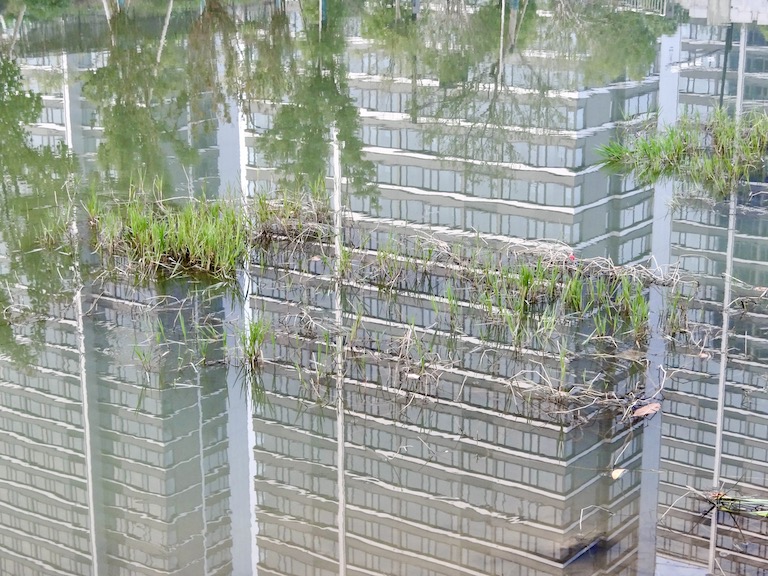
“the sense of architectural space is … related to the political distribution of the sensible and the way it frames reality through fiction.” (Grabar, 2021: 279)
Rowan Moore (2014) argues that it is a terrible misconception to think that architecture is a visual art. To the extent that you do indeed see architecture, it is still not a purely visual experience. When you look at something, you interpret it, you make associations, find memories evoked, gain a greater or lesser sense of the physical efforts and skill that went into making a structure. Architecture does not work with one sense alone, but with synaesthetic hybrids. Synaesthetic hybrids is one way of understanding designed environments and indeed, narrative environments.
Philip Johnson thinks that it is the modern perversion of photography that freezes architecture to three dimensions or, in some buildings, to two dimensions. However, Johnson argues, architecture is surely not the design of space, certainly not the massing or organizing of volumes. These are auxiliary to the main point which is the organization of procession. Architecture exists only in time.
At the dawn of the 21st century, Charles Jencks (2003) perceived the beginnings of a new paradigm emerging in architecture. It related, Jencks thought, to a deep transformation going on in the sciences, which, in time, will permeate all other areas of life. The new sciences of complexity, which concern such notions as fractals, nonlinear dynamics, the new cosmology and self-organising systems, have brought about this change in perspective. We have moved from a mechanistic view of the universe to one that is self-organising at all levels, from the atom to the galaxy. Illuminated by the computer, this new worldview is paralleled by changes now occurring in architecture.
Sam Jacobs (2012) argues that, “Through re-enactment, architecture rewrites itself, making fictions a part of the real landscape that surrounds us.” Understanding architecture in this way opens up the path to the ways in which the materialities of designed environments operate as real-fictions and fictional-realities at once, but with a critical element that draws attention to the constitution of the real, not to any simple acceptance of it ‘being-there’.
Nika Grabar (2021: 267-268) similarly points to the importance of the interweaving of fiction and reality. Grabar cites Ranciere (2022), who argues that fiction is, “the construction of a framework within which subjects, things and situations are seen as belonging to a common world, while events can be identified and linked in terms of coexistence, succession and causal linkage. Fiction is required whenever a certain sense of reality needs to be produced.”
Alessandro Calvi Rollino (2019) notes that formal innovation in architecture provides a means of access to new modes of understanding space and place. This is because, Rollino argues, architecture is one of the most conspicuous media through which a society materialises and reifies the core concepts around which are shaped its values and beliefs. Thus, architecture embodies,
“the way society understands the fundamentals of reality, that is ‘the where’ of entities and their relations” (Rollino, 2019).
References
Derrida, J. (1986). Point de Folie – maintenant l’architecture. Available from http://isites.harvard.edu/fs/docs/icb.topic1412058.files/Week 8/DerridaPointdeFolie.pdf [Accessed 1 June 2017].
Grabar, N. (2021) Architecture and the distribution of the sensible, Filozofski vestnik, 42(2), pp. 259–280. doi: 10.3986/fv.42.2.12.
Jacob, S. (2012) Make it real: architecture as enactment. Moscow, RU: Strelka Press.
Jencks, C. (2003). The New paradigm in architecture. Hunch. Available from http://www.charlesjencks.com/articles.html [Accessed 8 October 2011].
Johnson, P. (1965). Whence & whither: the processional element in architecture. Perspectiva, 9/10 167–178. Available from http://www.jstor.or/stable/1566915 [Accessed 8 June 2011].
Moore, R. (2014). A masterclass in spatial awareness. [Sensing Spaces : Architecture Reimagined – review]. Observer, 26 January, 33. Available from http://www.theguardian.com/artanddesign/2014/jan/26/sensing-spaces-royal-academy-review [Accessed 30 January 2014].
Ranciere, J. (2022) Modern times: Temporality in art and politics. Translated by G. Elliott. London, UK: Verso.
Rollino, A. C. (2019) Place and space: a philosophical history, Rethinking Space and Place {Blog]. Available at: https://rethinkingspaceandplace.com/2019/09/12/place-and-space-a-philosophical-history/ (Accessed: 21 August 2024).
Resources
 Incomplete ...