RELATED TERMS: Arendt; Design of Narrative Environments; Global Challenges; Heidegger; Lifeworld – Lebenswelt – Umwelt; Ontology; Sloterdijk; Terraforming; Theoretical Practice; World; World-as-Milieu
Use for: World-forming, World-making, Worlding, World-shaping, Welt-Bilden
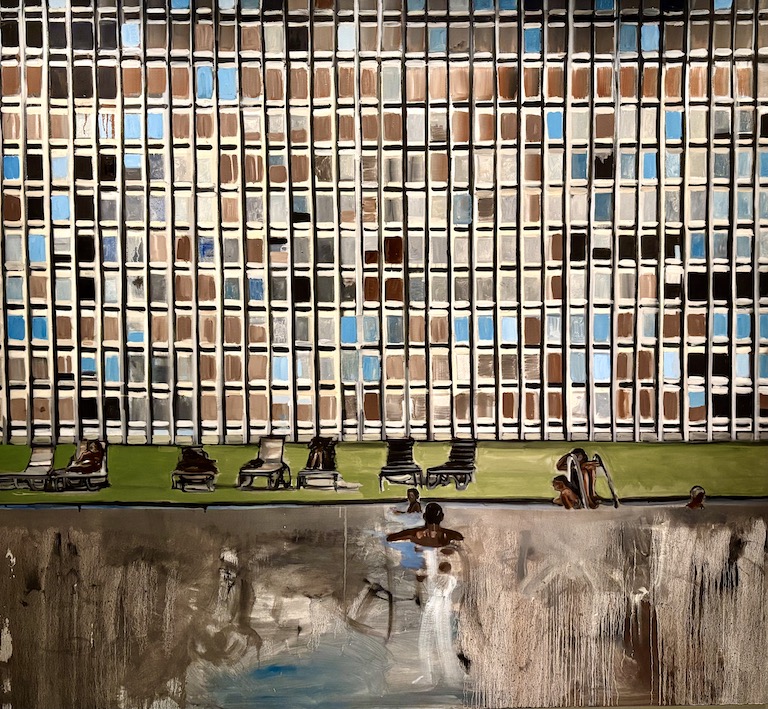
Davis sought to poise
his work between the real and the otherworldly.
“the last man will save from the rubble a stool or a tree stump on which to rest from his labours …” (Cliff and De Chabaneix, 2003: 87)
World-building is a consequence of treating design practices as ontological in character. One line of thought for this kind of approach to design can be found in phenomenology, notably in the work of Heidegger, Arendt, Merleau-Ponty and Sloterdijk, as well as in anthropology. From the perspective of the design of narrative environments, as a transmedia practice, world-making, world-forming or world-building practices are design practices, albeit of differing degrees of complexity.
Thus, as Lemmens (2013) explains, like Heidegger, Sloterdijk conceives of humans as world-forming beings. For Sloterdijk, however, humans are never in the world nakedly or without protection, so to speak. They always reside in spheres. Another difference between them is that while Heidegger was principally engaged in the analysis of human being-in-the-world, Sloterdijk is more interested in the process of coming-into-the-world. Picking up on the theme of natality from Hannah Arendt, Sloterdijk emphasises that we all have to come to the world in order to be in it. We are born, but too soon (Elden and Mendieta, 2009: 5).
There are echoes here of Lacan’s conception of human being-in-the-world as shaped by a fundamental lack. Nick Mansfield (2000: 45-46) expresses Lacan’s view as follows:
“The subject’s entry into the symbolic order is at the expense of the magical feeling of oneness it had in the imaginary. At the heart of its very being is a sense of lack. It endlessly seeks to compensate for this lack, to fill the hole at its core. This longing for self-completion is Lacan’s definition of desire. The subject is propelled into and through the world, into its emotional and sexual relationships, its fraught group identities with nation, race and political party, its careerism and material acquisitiveness, all as a result of this insatiable need to fill up the lack at the centre of its being.”
In Arendt’s (1958: 96) view, ‘world’ emerges from the work of homo faber, which she distinguishes from the labour of the animal laborans, the latter leaving no persistent trace of its labour. Thus, Arendt argues,
“Human life, in so far as it is world-building, is engaged in a constant process of reification, and the degree of worldliness of produced things, which all together form the human artifice, depends upon their greater or lesser permanence in the world itself.”
In the context of the design practice, the product of ‘work’ is considered to be ‘designs’. Thus, the traces by means of which the world is constituted are designed phenomena.
For Sloterdijk, coming-into-the-world essentially consists in the process of sphero-poiesis, the creation of protective, immunising inner worlds or inner spaces. Sloterdijk’s Spheres trilogy presents a grand cultural-historical panorama of the process of the sphero-poietic “coming-into-the-world” and, thereby, the “coming-into-being”, of the human being as the ek-sisting and world-disclosing being Heidegger described in Being and Time.
Rauschenbach (2011) further explains that, from Sloterdijk’s point of view, the ontological starting point of human existence is the womb of the mother. Therefore, co-existence precedes existence. There is no being without being in‐something, initially in the uterus. Life is always life in between of life. From the beginning and at all times, the human being is surrounded by something that cannot appear as an object. It is the indiscernible complement of one’s own existence, with which one forms a pair.
To contain the infiniteness of space and to create spaces in which sharing can be experienced, Sloterdijk suggests speaking of human spheres, that is, contexts of and for understanding. The shared space is isolated from the rest of the infinite space. Within the sphere, the space can be manipulated. These manipulations can result in specific climates. Sloterdijk uses the term climate not only to denominate a meteorological state, but also to refer to nine dimensions, which altogether characterise the climate of human spheres.
Sloterdijk conceptualises the human sphere as a nine dimensional greenhouse (chirotope, phonotope, uterotope, thermotope, erotope, ergotope, alethotope, thanatotope, nomotope) in which human beings are able to survive and consequently can develop complexities beyond their animalistic heritage. Each of the nine dimensions can attain different degrees of implicitness and explicitness. An individual on its own is not able to survive. It depends on being part of a sphere, populated by others. Sloterdijk’s ontological starting point is therefore unthinkable without the other as it is the collaborative mode with the other that allows for positively influencing the climate within a sphere.
Such thinking can also be used to consider and gain a critical appreciation of the contemporary global conjuncture which, Escobar (2016) contends, can be best characterised by the fact that we are facing modern problems for which there are no longer modern solutions. Ontologically speaking, Escobar continues, one may say that the crisis is the crisis of a particular world or set of world-making practices, the world that we usually refer to as the dominant form of Euro-modernity, i.e. capitalist, rationalist, liberal, individualist, secular, patriarchal, white, and so on.
World-building in media and transmedia practices
In the context of transmedia practices, Jenkins (2016) notes, the concept of world-building emerged from fantasy and science fiction. Nevertheless, it has also been applied to fictions of a documentary or historical character. Thus, fictional texts imagine and design new worlds; documentaries investigate and map existing worlds. From the point of view of the design of narrative environments, both forms exist in a critical relation to existing worlds, drawing attention to specific features of the constitution of those worlds, and by exploring multiple points of view or competing realities.
As Jenkins explains,
“Worlds are systems with many moving parts (in terms of characters, institutions, locations) that can generate multiple stories with multiple protagonists that are connected to each other through their underlying structures. Part of what drives transmedia consumption is the desire to dig deeper into these worlds, to trace their backstories and understand their underlying systems.”
An example of the use of the term ‘world-building’ in the context of cinema can be found in Simran Hans’ (2021) review of the film Cruella (2021). Hans writes, “Set in 1970s London against the backdrop of the emerging punk scene, this playful prequel [to 101 Dalmations] by Craig Gillespie … is a fine feat of world-building”.
Reworlding and Remaking the World
Donna Haraway (2016) uses the term ‘reworlding’ to refer to the actions taken to address or mitigate the problems arising during the Anthropocene, a process she likens to ‘composting’.
For Nelson Goodman (1978, 6), cited by Boni (2017:17), “[w]orldmaking as we know it always starts from worlds already in hand; the making is remaking” .
World Destruction
In discussing the work of Bernard Stiegler, Daniel Ross (2018: 30) notes that, “Whereas animals adapt to their environment, noetic beings ‘are actively engaged in modifying their environment’ and, in the case of the kind of beings that we ourselves are, ‘this active attack on the environment is the most prominent fact in his existence’.”
De-Worlding
Designing and World-Building
A key figure in the explicit relationship between design practices and world-building is Alex McDowell. According to Noah Wardrip-Fruin, McDowell’s world building integrates interdisciplinary humanistic, scientific and design inquiry with emerging forms of computational media. In the context of film production process, McDowell achieves the blurring of boundaries between physical and virtual environments and the distinctions between film and other media forms.
Additional Notes
Jongen (2011) argues that, for Sloterdijk, the coming-into-the-world [Zurweltkommen] of the human being amounts to the same thing as the emergence of world [Welt].
Sloterdijk’s contention is a re-working of Heidegger’s basic tenet that the depiction of the world, or the emergence of the world as picture, is the converse face of the emergence of the human being as subject (Jongen, 2011).
References
Arendt, H. (1958). The Human condition. Chicago, IL: University of Chicago Press.
Boni, M. (2017) Introduction: Wolrds, today. In Boni, M. (ed.) World Building: Transmedia, Fans, Industries. Amsterdam, NL: Amsterdam University Press.
Cliff, S. and De Chabaneix, G. (2003) The Way we live: Making homes, creating lifestyles. London, UK: Thames & Hudson.
Elden, S. and Mendieta, E. (2009). Being-with as making worlds: the ‘second coming’ of Peter Sloterdijk. Environment and Planning D: Society and Space, 27 (1), 1–11. Available from http://dx.doi.org/0.1068/d2701em [Accessed 7 September 2016].
Escobar, A. (2016). Thinking-feeling with the Earth: territorial struggles and the ontological dimension of the Epistemologies of the South. AIBR, Revista de Antropología Iberoamericana, 11 (1), 11–32. Available from http://www.aibr.org/antropologia/netesp/numeros/1101/110102e.pdf [Accessed 5 September 2016].
Goodman, N. (1978) Ways of worldmaking. Hassocks, Sussex, UK: Harvester Press.
Hans, S. (2021). Cruella. Observer, New Review p.27.
Haraway, D. J. (2016) Staying with the trouble: making kin in the chthulucene. Durham, NC: Duke University Press.
Jenkins, H. (2016) Transmedia what?, Immerse. Available at: https://immerse.news/transmedia-what-15edf6b61daa (Accessed: 8 April 2021).
Jongen, M. (2011) ‘On anthropospheres and aphrogrammes . Peter Sloterdijk’s thought images of the monstrous’, Humana. Mente Journal of Philosophical Studies, 18, pp. 199–219. Available at: http://www.humanamente.eu/PDF/Issue_18_Paper_Jongen.pdf (Accessed: 13 September 2014).
Lemmens, P. (2013). Review essay: Sloterdijk. ID: International Dialogue, a Multidisciplinary Journal of World Affairs, 3 101–114. Available from https://www.academia.edu/15683426/Peter_Sloterdijk_You_Must_Change_Your_Life._On_Anthropotechnics_Peter_Sloterdijk_In_the_World_Interior_of_Capital._For_a_Philosophical_Theory_of_Globalization_Peter_Sloterdijk_Globes._Spheres_II [Accessed 9 January 2016].
Mansfield, N. (2000) Subjectivity: theories of the self from Freud to Haraway. St Leonard’s, NSW: Allen & Unwin.
Rauschenbach, R. (2011) How to govern the universalizing community: Peter Sloterdijk’s concept of co-immunism. In: 6th ECPR General Conference, University of Iceland, 25th – 27th August 2011. Reykyavik: University of Iceland. Available from http://ecpr.eu/filestore/paperproposal/360087b2-c31f-413c-b33d-88b69534e9ab.pdf [Accessed 25 August 2014].
Wardrip-Fruin, N. (2014) An Introduction to Alex McDowell’s “World Building”. Journal of Digital Humanities, 3 (1). Available at: https://journalofdigitalhumanities.org/3-1/an-introduction-to-alex-mcdowells-world-building-by-noah-wardrip-fruin/ [Accessed 15 January 2026]
 Incomplete ...
3 thoughts on “World-Building”